1) according to the purchasing-power-parity theory, the u.s. dollar maintains its
purchasing-power parity if it depreciates by an amount equal to the excess of:
a.u.s. interest rates over foreign interest rates
b.foreign interest rates over u.s. interest rates
c.u.s. inflation over foreign inflation
d.foreign inflation over u.s. inflation
2) the monetary approach contends that, under a fixed exchange rate system, an excess
demand for money leads to a trade deficit.
a.true
b.false
3) the european union is primarily intended to permit:
a.countries to adopt scientific tariffs on imports
b.an agricultural commodity cartel within the group
c.the adoption of export tariffs for revenue purposes
d.free movement of resources and products among member nations
4) the macdougall study of comparative advantage hypothesized that in those industries
in which u.s. labor productivity was relatively high, u.s. exports to the world should be
lower than u.k. exports to the world, after adjusting for wage differentials.
a.true
b.false
5) assume the united states is a large consumer of steel that is able to influence the
world price. its demand and supply schedules are respectively denoted by du.s. and su.s.
in figure 4.2. the overall (united states plus world) supply schedule of steel is denoted
by su.s.+w.
figure 4.2. import tariff levied by a “large” country
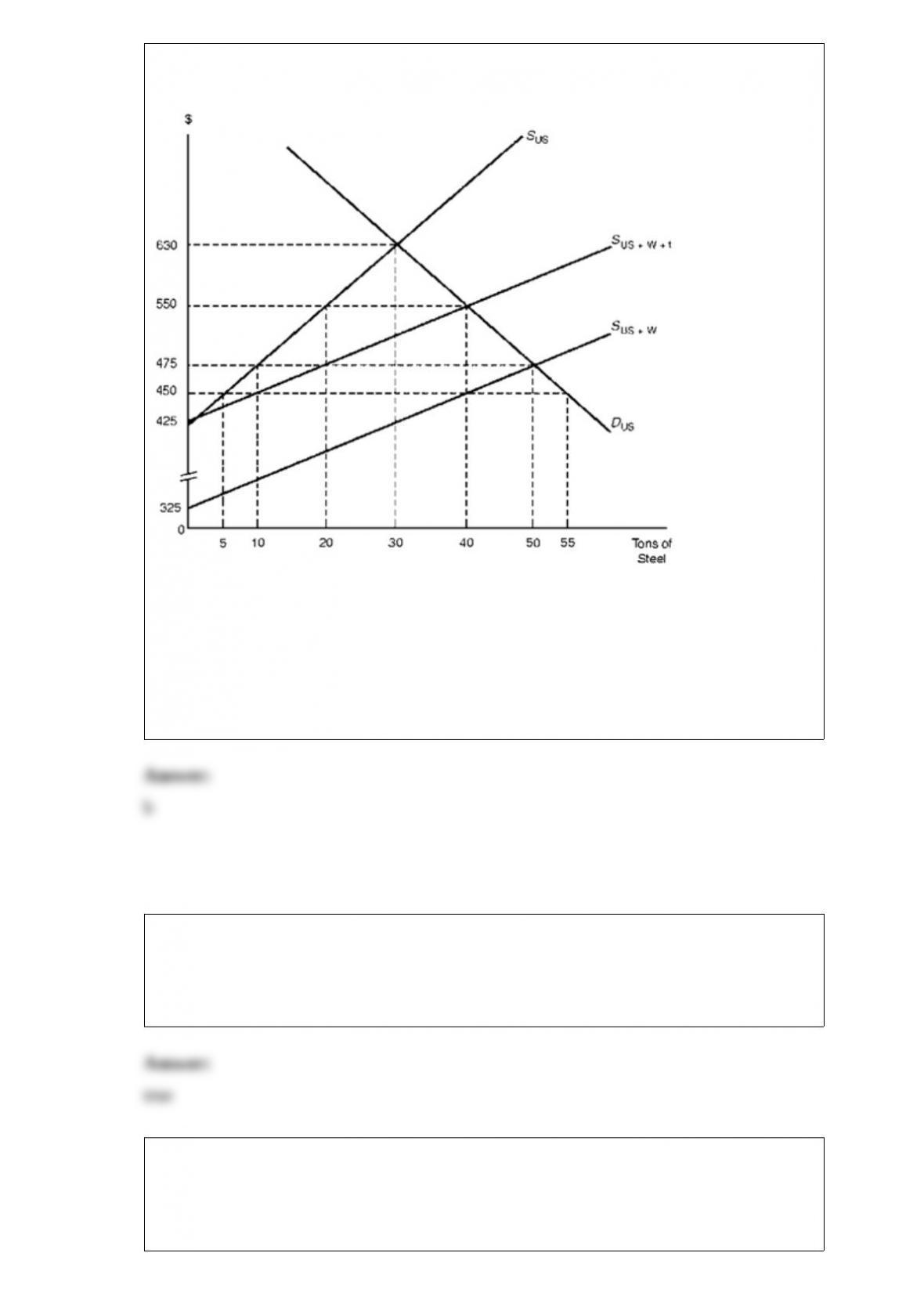
consider figure 4.2. with free trade, the united states achieves market equilibrium at a
price of $____. at this price, ____ tons of steel are produced by u.s. firms, ____ tons are
bought by u.s. buyers, and ____ tons are imported.
a.$450, 5 tons, 60 tons, 55 tons
b.$475, 10 tons, 50 tons, 40 tons
c.$525, 5 tons, 60 tons, 55 tons
d.$630, 30 tons, 30 tons, 0 tons
6) on the u.s. balance-of-payments statement, a capital inflow would occur if a swiss
resident purchases the securities of the u.s. government.
a.true
b.false
7) under the common agricultural policy, exports of any surplus quantities of eu
produce are encouraged through the usage of:
a.variable levies
b.export subsidies
c.import quotas
d.countertrade
8) assume the canadian demand elasticity for imports equals 1.2, while the foreign
demand elasticity for canadian exports equals 1.8. responding to a trade deficit, suppose
the canadian dollar depreciates by 10 percent. for canada, the depreciation would lead
to a(n):
a.worsening trade balance–a larger deficit
b.improving trade balance–a smaller deficit
c.unchanged trade balance
d.none of the above
9) the fast-track provision of u.s. trade law has the affect of speeding up the timetable
during which the president negotiates trade agreements with foreign governments.
a.true
b.false
10) the diagram below represents the exchange market position of the united states in
trade with the united kingdom. starting at the equilibrium exchange rate of $3 per
pound, suppose the demand for pounds rises from d0 to d1.
figure 17.1 foreign exchange market
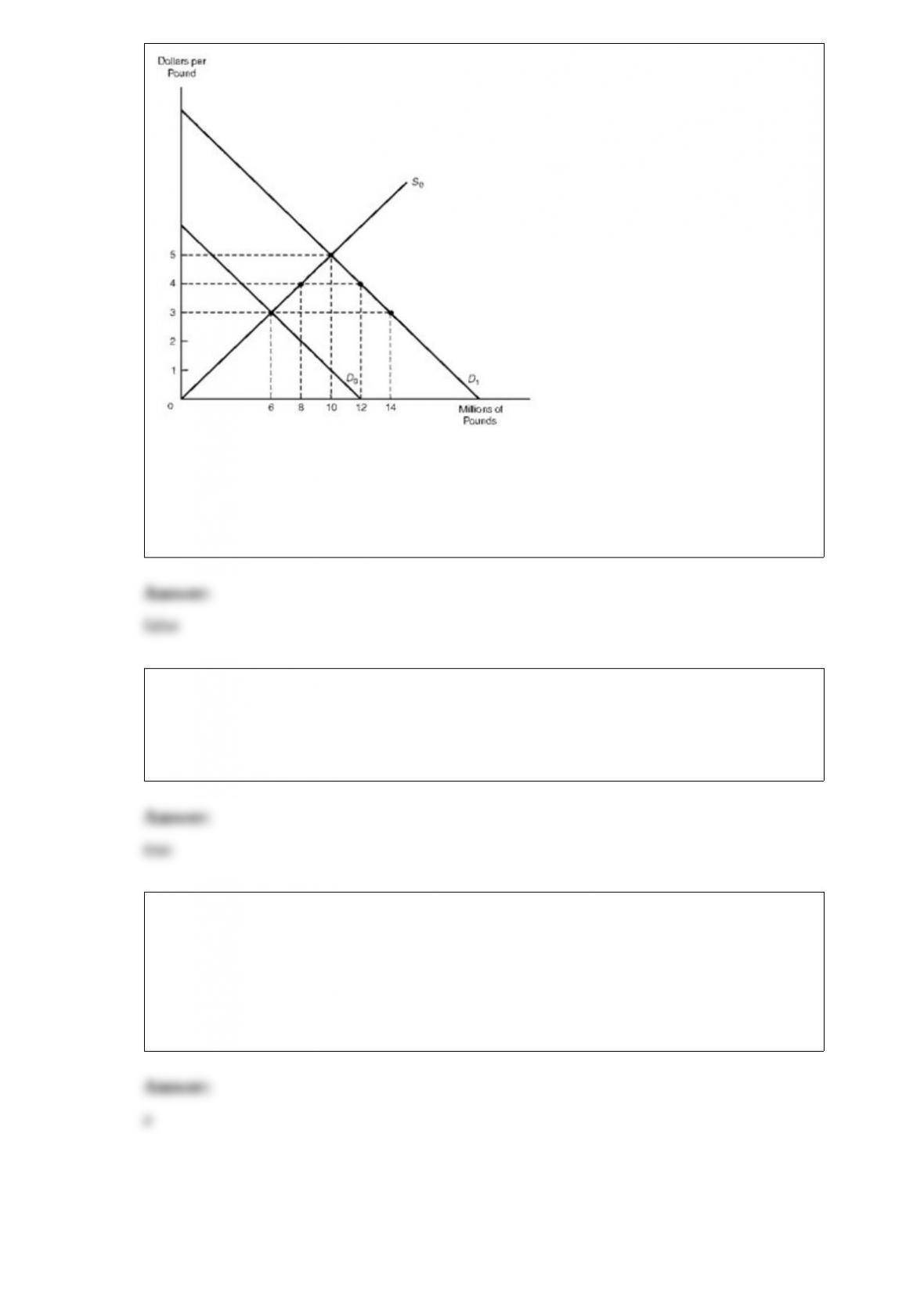
refer to figure 17.1. under a floating exchange rate system, the exchange rate would rise
to $4 and u.s. monetary authorities would have to supply 4 million pounds to the
foreign exchange market in exchange for dollars to maintain this rate.
a.true
b.false
11) the bonn summit of 1978 and plaza accord of 1985 are examples of international
policy coordination.
a.true
b.false
12) a key factor underlying the instability of primary product prices and export receipts
of developing nations is the
a.low price elasticity of the demand of primary products
b.high price elasticity of supply of primary products
c.high price elasticity of demand of primary products
d.none of the above
13) a main advantage of specialization results from:
a.economies of large-scale production
b.the specializing country behaving as a monopoly
c.smaller production runs resulting in lower unit costs
d.high wages paid to foreign workers
14) the foreign-trade multiplier equals the sum of the marginal propensity to import and
the marginal propensity to save.
a.true
b.false