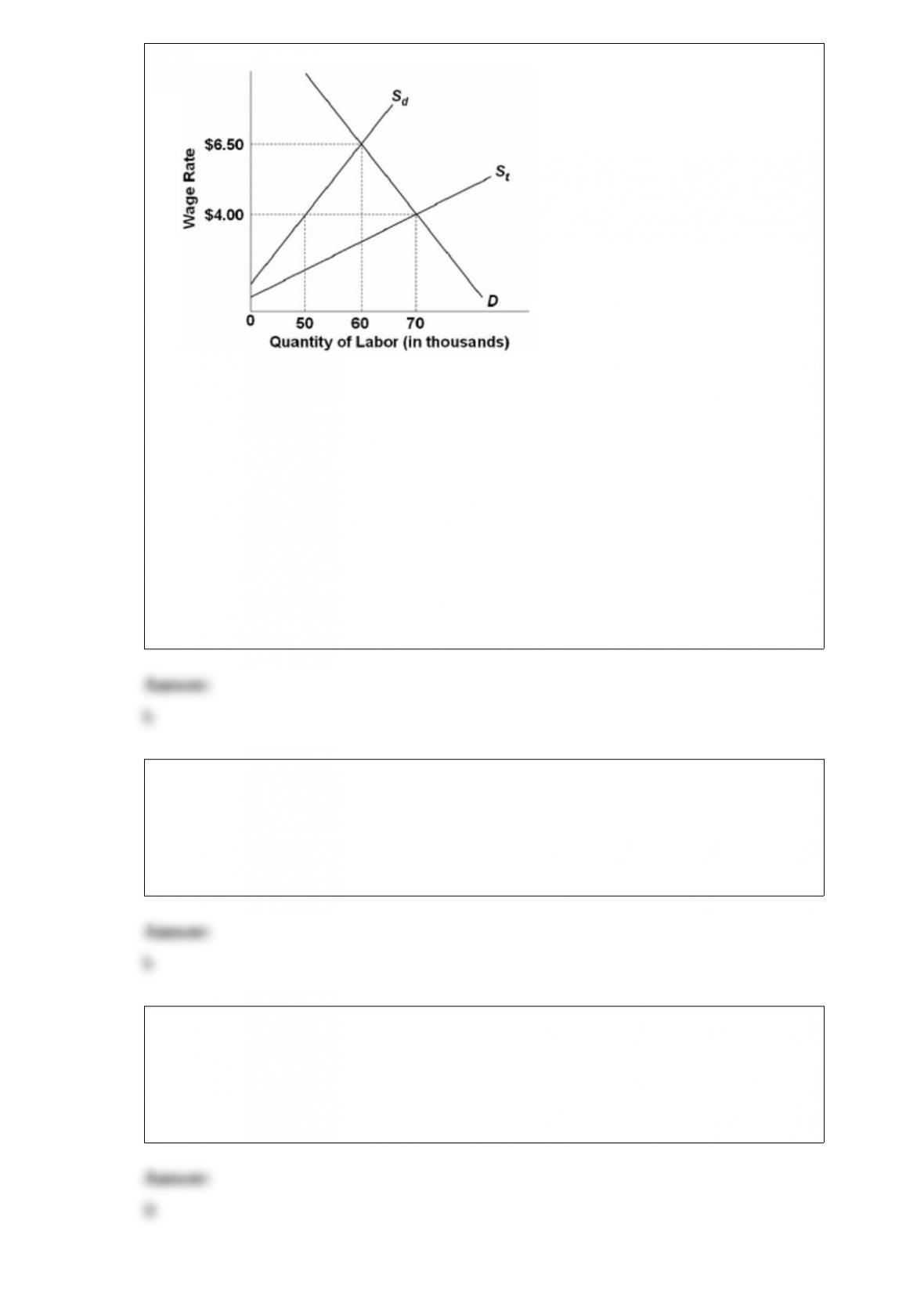
1)
assumptions: 1) employers in this market are willing and able to ignore minimum wage
laws; 2) sd represents the supply of domestically-born (and legal immigrant) workers;
3) st represents the total supply of workers in this labor market (sd plus illegal
immigrants); and 4) unless otherwise stated, illegal immigration is not effectively
blocked by the government.
refer to the above figure. how many domestically-born (and legal immigrant) workers
will be hired at equilibrium?
a.20,000
b.50,000
c.60,000
d.70,000
2) in which of the following cases would real income rise?
a.nominal income rises by 8 percent, and the price level rises by 10 percent.
b.nominal income rises by 2 percent, and the price level remains unchanged.
c.nominal income falls by 4 percent, and the price level fall by 4 percent.
d.real income will rise in all of the above cases.
3) Which of the following involves the creation of human capital?
A.the XYZ Corporation upgrades the machinery on its assembly line
B.Jones receives apprenticeship training as a carpenter
C.Smith buys 30 shares of common stock
D.a retired person decides to reenter the labor force
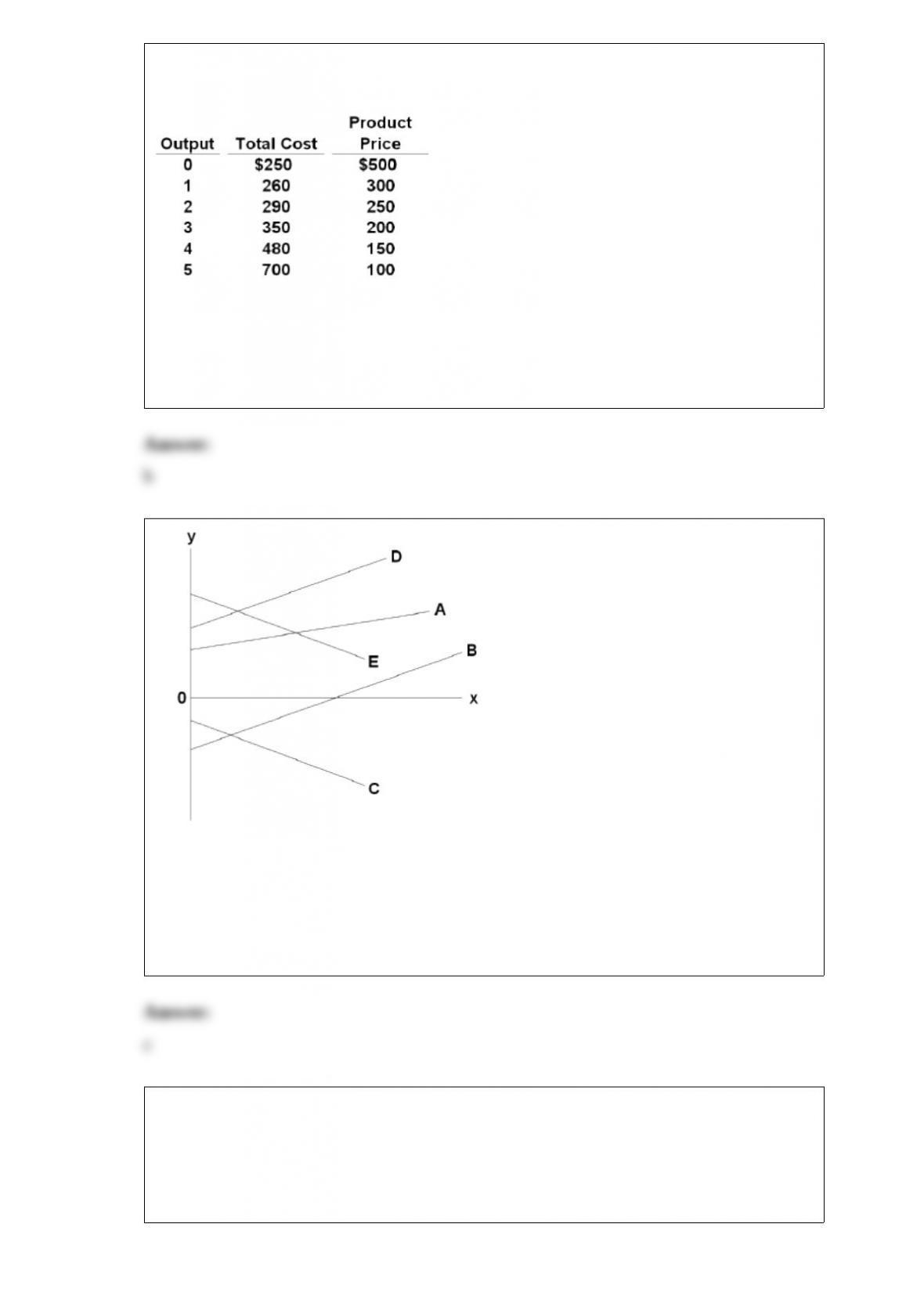
4) the following information for a pure monopolist:
at its profit-maximizing output, the above nondiscriminating monopolist:
a.incurs a loss.
b.earns an economic profit of $250.
c.earns a normal profit of $250.
d.earns an economic profit of $150.
5)
refer to the above diagram. which line(s) show(s) a positive relationship between x and
y?
a.a only.
b.a and d only.
c.a, b, and d.
d.both c and e.
6) Which of the following bargaining tactics is illegal?
A.a lockout
B.a strike
C.refusal to meet with union representatives
D.hiring strikebreakers

7) The conjecture that R&D expenditures as a percentage of firms’ sales first rise, reach
a peak, and then fall as industry concentration rises is known as the:
A.inverted-U theory of R&D.
B.average product of R&D theory.
C.bell-shaped curve.
D.theory of increasing and diminishing returns.
8) the u.s. census bureau estimates that the net inflow of unauthorized immigrants is
now about:
a.100,000 annually.
b.200,000 annually.
c.350,000 annually.
d.700,000 annually.
9) the h1-b provision of immigration law:
a.allows 65,000 high-skilled workers in specialty occupations to enter and work in the
united states for six years.
b.raised u.s. annual immigration quotas from 500,000 to 700,000.
c.established a lottery for the admission of diversity immigrants into the united states.
d.provided amnesty to over one million illegal immigrants in 1989-1991, allowing them
to become legal citizens of the united states.
10) Assuming no other changes, if checkable deposits increase by $40 billion and
currency in circulation decreases by $40 billion, the:
A.M1 money supply will decline.
B.M1 money supply will not change.
C.M2 money supply will decline.
D.M2 money supply will increase.

11) between 1980 and 2000 the price level approximately doubled. the average annual
rate of inflation over this 20-year period was about:
a.5.5 percent.
b.4.7 percent.
c.3.5 percent.
d.2.8 percent.
12) The four main tools of monetary policy are:
A.tax rate changes, the discount rate, open-market operations, and the Federal funds
rate.
B.tax rate changes, changes in government expenditures, open-market operations, and
the term auction facility.
C.the discount rate, the reserve ratio, the term auction facility, and open-market
operations.
D.changes in government expenditures, the reserve ratio, the Federal funds rate, and the
discount rate.
13) Which country has the largest share of total world exports?
A.Japan
B.Germany
C.United States
D.China
14) The velocity of money is the:
A.relationship between the money supply and the price level.
B.number of times per year the average dollar is spent on final goods and services.
C.relationship between asset and transactions demands for money.
D.price level divided by aggregate supply.
15) which form of business enterprise accounts for the largest proportion of total
output?
a.corporations
b.proprietorships

c.partnerships
d.cooperatives
16) In a full-employment economy a rise in M will cause inflation unless:
A.V rises in proportion to the increase in M.
B.the quantity of goods produced declines proportionately.
C.tax reductions accompany the increase in the money supply.
D.the velocity of money diminishes.