1) which of the following will not hold true for a competitive firm in long-run
equilibrium?
a.p equals afc
b.p equals minimum atc
c.mc equals minimum atc
d.p equals mc
2)
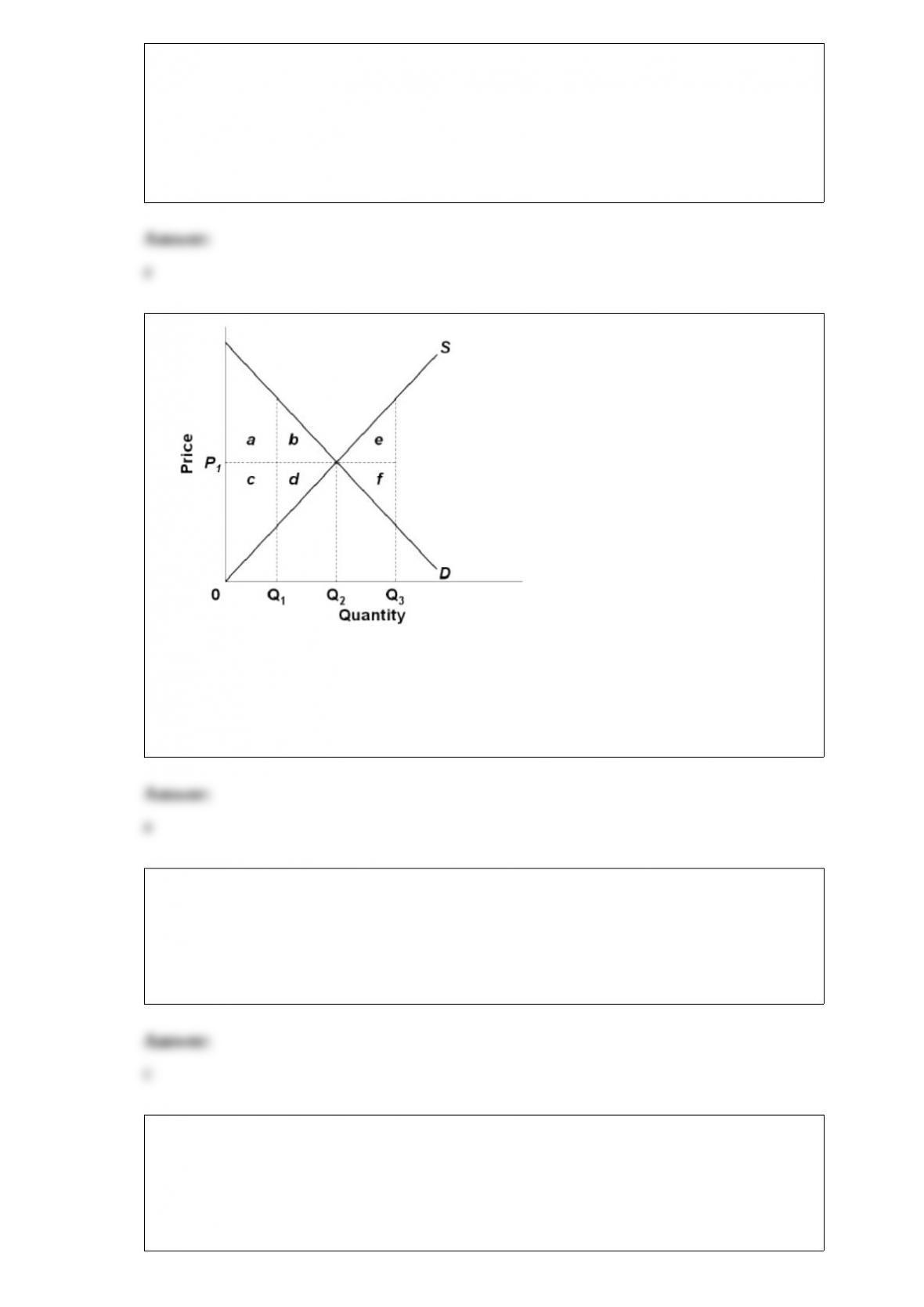
refer to the above diagram. if actual production and consumption occur at q2:
a.efficiency is achieved.
b.an efficiency loss (or deadweight loss) of a + b + c + d occurs.
c.an efficiency loss (or deadweight loss) of a + c occurs.
d.an efficiency loss (or deadweight loss) of e + f occurs.
3) most remittances flow toward:
a.european nations.
b.advanced industrial nations.
c.developing nations.
d.north america.
4) The pushing-on-a-string analogy makes the point that, monetary policy may be better
at:
A.controlling demand-pull inflation than cost-push inflation.
B.pulling the aggregate demand curve leftward than pushing it rightward.
C.pulling the unemployment rate downward than pushing the economic growth rate

upward.
D. keeping rapid inflation from occurring than reducing it once it has begun.
5) the gdp tends to:
a.overstate economic welfare because it does not include certain nonmarket activities
such as the productive work of housewives.
b.understate economic welfare because it includes expenditures undertaken to offset or
correct pollution.
c.understate economic welfare because it does not take into account increases in leisure.
d.overstate economic welfare because it does not reflect improvements in product
quality.
6) If the economy is in equilibrium at $400 billion of GDP and the full-employment
GDP is $500 billion:
A.real and nominal GDP will both increase.
B.GDP will remain at $400 billion unless aggregate expenditures change.
C.real GDP will increase, but nominal GDP will decrease.
D.the price level will increase.
7) Which of the following demographic groups does not bear a disproportionate burden
of poverty?
A.households headed by women
B.persons 65 or over
C.Hispanics
D.African-Americans
8) if a product is in surplus supply, its price:
a.is below the equilibrium level.
b.is above the equilibrium level.
c.will rise in the near future.
d.is in equilibrium.

9) Paying an above-equilibrium wage rate might reduce unit labor costs by:
A.permitting the firm to attract lower-quality labor.
B.increasing the cost to workers of being fired for shirking.
C.increasing voluntary worker turnover.
D.increasing the supply of labor.
10) For an employer biased against African-Americans, the discrimination coefficient d:
A.will decrease if the employer becomes more prejudiced against African-Americans.
B.must equal the actual ratio of African-American to white wage rates.
C.measures the amount an employer is willing to pay to hire a white rather than a
African-American worker.
D.varies inversely with the actual African-American-white wage ratio.
11) Taxes represent:
A.a leakage of purchasing power, like saving.
B.an injection of purchasing power, like investment.
C.an injection of purchasing power, like government spending.
D.a leakage of purchasing power, like government spending.
12) the introduction and use of the euro is expected to:
a.increase the rate of inflation slightly in the euro zone nations.
b.increase poverty substantially in euro zone nations.
c.increase international trade among the euro zone nations.
d.increase income inequality within the euro zone nations.
13) the basic difference between consumer goods and capital goods is that
a.consumer goods are produced in the private sector and capital goods are produced in
the public sector.
b.an economy that commits a relatively large proportion of its resources to capital
goods must accept a lower growth rate.
c.the production of capital goods is not subject to the law of increasing opportunity
costs.
d.consumer goods satisfy wants directly while capital goods satisfy wants indirectly.
14) “because the outputs of many industries are the inputs to other industries, the failure
of any single industry to fulfill the output quantities specified in the central plan caused
a chain-reaction of adverse repercussions on production.” this quotation best identifies
the:
a.incentive problem under central planning.
b.self-sufficiency dilemma under communism.
c.resource overcommitment problem under communism.
d.coordination problem under central planning.
15)
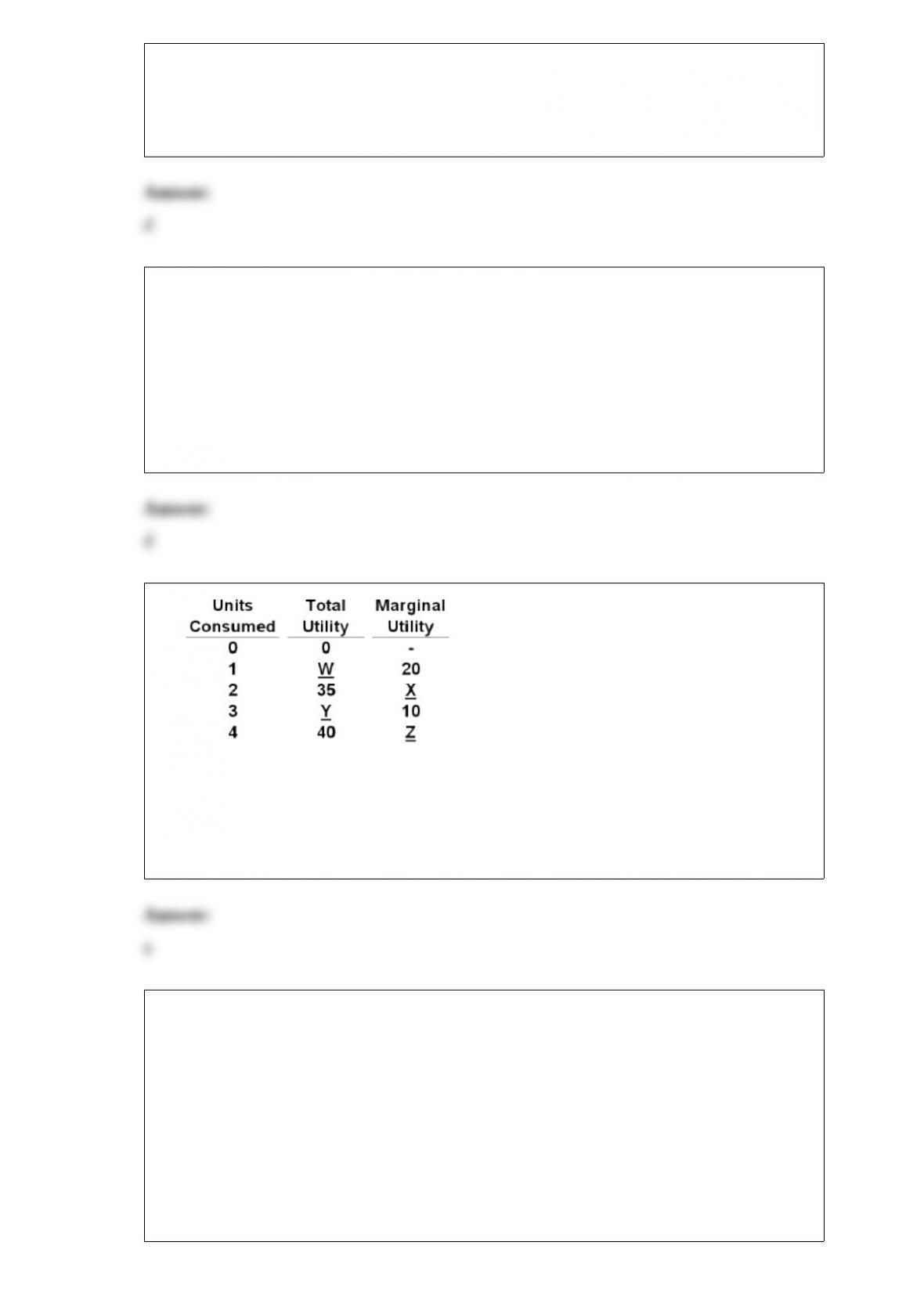
refer to the above data. the value for x is:
a.15.
b.5.
c.55.
d.10.
16) assuming migration is unimpeded and costless, which of the following statements is
most accurate about the effect of immigration on wages in both the origin and
destination nations?
a.wages will rise in the origin nation, fall in the destination nation, and overall wage
income must rise.
b.wages will rise in both nations, and overall wage income must rise.
c.wages will rise in the origin nation and fall in the destination nation, and the wage
changes must cancel each other, resulting in no net change in overall wage income.
d.wages will rise in the origin nation and fall in the destination nation, but the effect on
overall wage income depends on the elasticities of labor demand.

17) the measured slope of a line:
a.is independent of how the two variables are denominated.
b.will be affected by how the two variables are denominated.
c.necessarily diminishes as one moves rightward on the line.
d.necessarily increases as one moves rightward on the line.
18) Other things equal, patents:
A.decrease the expected rate of return on a R&D expenditure.
B.increase the expected rate of return on a R&D expenditure.
C.increase the interest-rate cost of funds used to finance a R&D expenditure.
D.decrease the interest-rate cost of funds used to finance a R&D expenditure.
19) the market system’s answer to the fundamental question “how will the system
accommodate change?” is essentially:
a.”through government leadership and direction.”
b.”through the guiding function of prices and the incentive function of profits.”
c.”through training and retraining programs.”
d.”through random trial and error.”
20) A rightward shift of the traditional Phillips Curve would suggest that:
A.the productivity of labor increased.
B.the rate of inflation is now higher at each rate of unemployment.
C.cost-push inflation decreased.
D.the rate of inflation is now lower at each rate of unemployment.