
Economic analysis indicates that the monetary policy of the 1930s, which shifted back
and forth between restrictive monetary policy and expansionary monetary policy, would
likely result in
a. economic stability and growth in real levels of output.
b. keeping the general level of prices relatively stable because the periods of restrictive
policy would just offset the periods of expansion.
c. an environment of uncertainty, which would lead to economic instability.
d. economic stability, because changes in monetary policy can be counted on to exert a
predictable impact on the economy quickly.
In 2010 the federal government reduced the Social Security tax withholding rate from
12.4 percent (6.2 percent on both the employer and employee) to 8.4 percent (4.2
percent on both the employer and employee) on the wages of all workers. If the supply
of labor is relatively inelastic when compared to the elasticity of the demand for labor,
the burden of this tax will
a. continue to fall primarily on employees.
b. continue to fall primarily on employers.
c. be divided equally between employees and employers.
d. change from primarily falling on employees to employers.

The difference between the money rate of interest and the real rate of interest is often
called the
a. real balance effect.
b. prime interest rate.
c. inflationary premium.
d. discount rate.
According to data on GDP growth between 1980 and 2010,
a. poor nations stagnated, while the rich nations continued to grow.
b. poor nations grew rapidly, while the rich nations stagnated.
c. most of the world’s rapidly growing countries were located in Africa.
d. many poor nations grew more rapidly than wealthy nations, while others continued to
stagnate.
Which of the following is a unique characteristic of the oligopolistic market structure?
a. low barriers to entry
b. a large number of firms producing highly differentiated products that are
complements to each other
c. product differentiation among the products produced by individual firms
d. mutual interdependence among firms in demand, and thus, in price decisions

The marginal value of a commodity to a consumer
a. increases as more of the good is consumed.
b. is exactly equal to price for all units purchased by the consumer.
c. is measured by the height of the individual consumer’s demand curve.
d. is equal to the area above the price and below the individual consumer’s demand
curve.
If a family earned an additional $6,000 and, as a consequence, sustained a reduction of
$3,600 in government benefits, the implicit marginal tax rate for this family would be
a. zero.
b. 45 percent.
c. 60 percent.
d. 75 percent.
When a profit-maximizing firm in a competitive price-searcher market is in long-run
equilibrium, price equals
a. marginal cost, and profits are positive.
b. average total cost, and profits are zero.
c. marginal cost, and profits are zero.
d. average total cost, and profits are positive.
Answer the following questions:
Suppose sharply higher coffee prices lead to an increase in demand for tea. As tea prices
increase, tea producers experience short-run economic profits. If the tea industry is a
price-taker industry and if sufficient time is allowed for the market to adjust fully to the
increase in demand for tea, one would expect the tea industry’s output to
a. increase, and economic profits to increase as well.
b. increase, and economic profits to disappear.
c. decline, and economic profits to increase.
d. decline, and economic profits to disappear.
Based on the idea of opportunity cost, which of the following students would be most
likely to drop out of college before completing their degree?
a. a senior mathematics major with a solid B average
b. a junior physical therapy student who has just read about the fantastic job offers
available to students with degrees in her area
c. a star college football player in his junior year that just received a $5 million offer
from a professional team

d. a junior economics major who wants to attend graduate school
Which of the following is true?
a. The stock market provides investors with an opportunity to own a fractional share of
the firm’s future profits.
b. A new stock issue is often an excellent way for a firm to raise funds for future
expansion.
c. Changes in stock prices provide information about what investors think of various
business decisions.
d. All of the above are true.
A law establishing a maximum legal price for a good or service is known as
a. an equilibrium price.
b. a price floor.
c. a price ceiling.
d. a price wall.

Researchers have found that countries that were settled by Europeans who planned on
staying permanently were
a. more likely to protect private ownership rights and limit the power of the
government.
b. less likely to protect private ownership rights and limit the power of the government.
c. more likely to protect private ownership, but less likely to limit the power of the
government.
d. less likely to protect private ownership, but more likely to limit the power of the
government.
If the Fed raises the discount rate, what happens to reserves and the money supply?
a. Reserves increase and the money supply decreases.
b. Both increase.
c. Reserves decrease and the money supply increases.
d. Both decrease.

When an economy dips into recession, automatic stabilizers will tend to
a. enlarge the budget deficit (or reduce the surplus).
b. reduce the budget deficit (or increase the surplus).
c. ensure that the budget remains in balance.
d. expand the supply of money and, thereby, stimulate aggregate demand.
The law of comparative advantage implies that a nation, individual, or region should
produce those economic goods for which it
a. has an absolute advantage.
b. is a low opportunity cost producer.
c. is a high opportunity cost producer.
d. pays the highest wage rate.

Assuming that firms maximize profits, how will the price and output policy of an
unregulated monopolist compare with ideal market efficiency?
a. The output of the monopolist will be too large and the price too high.
b. The output of the monopolist will be too small and the price too low.
c. The output of the monopolist will be too small and the price too high.
d. The price will be too high, but the impact of monopoly on the output is
indeterminate.
A contestable market is a market
a. that is highly contested by two, and only two, rival firms.
b. in which the costs of entry and exit are low.
c. characterized by high profitability and government regulation.
d. characterized by a large number of firms; in essence, the term means the same thing
as pure competition.
Which of the following is true concerning the growth record of less developed countries
(LDCs) during the last several decades?
a. The per capita GDP of several poverty stricken African countries was lower in 2009
than in 1980.
b. None of the LDCs have been able to match the per capita income growth rate of the
United States.

c. During the last two decades, the fastest growing countries in the world (those with
annual real growth rates of 3.5 percent or more) have been LDCs.
d. Both a and c are correct.
e. All of the above are correct.
The multiplier principle is important because it
a. was central to economic theory before Keynes.
b. implies that investment will help stabilize the economy.
c. shows why small shifts in investment have a powerful influence on national income.
d. illustrates why a small change in income causes a large change in saving.
Figure 17-4
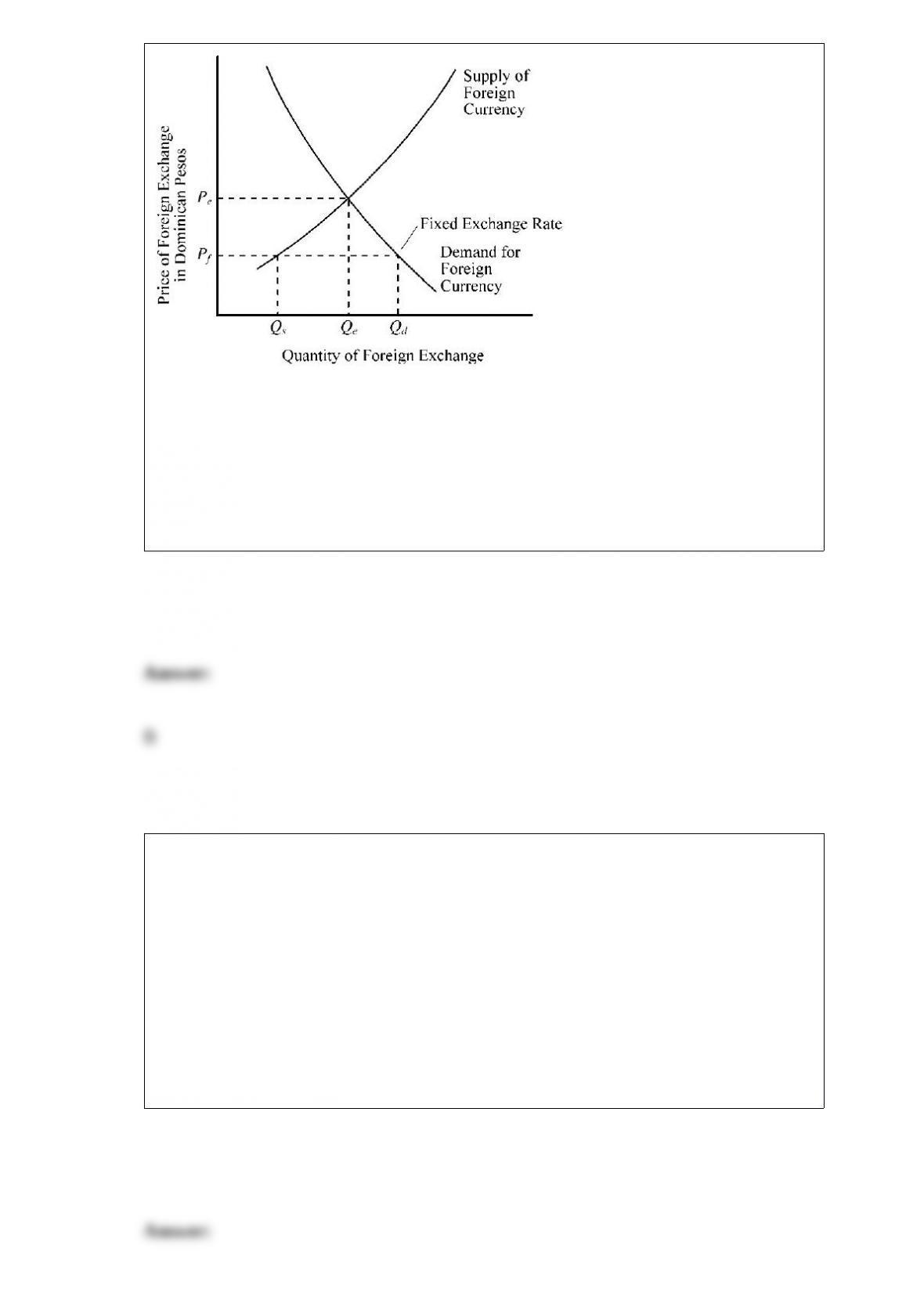
In Figure 17-4, the equilibrium price of Dominican pesos is Pe. If the Dominican
Republic government fixes the price of foreign currency in terms of domestic currency
at Pf(below equilibrium), what does the quantity Qdthrough Qsrepresent?
a. the quantity of Dominican exports
b. a shortage of foreign exchange
c. the quantity of Dominican imports
d. a surplus of foreign exchange
If a restaurant in a summer tourist area is highly profitable during the summer months
but unable to cover even its variable costs during the winter months, the restaurant
should
a. go out of business immediately, because no firm should continue to operate if it is
losing money; doing so is contrary to the idea of profit maximization.
b. go out of business as soon as the summer is over; losses should never be tolerated.
c. operate during all months of the year as long as its profits during the summer exceed
its losses during the winter.
d. shut down during the winter, but continue operating during the summer as long as the
summer profits exceed the losses (fixed costs) during the winter shutdown period.

Which of the following is an example of how incentive structures contributed to the
collapse of investment banks?
a. The bonus structures of most executives were tied to short-term profitability.
b. The rating agencies acted independently in assigning ratings to mortgage-backed
securities and had no incentive to understate the risks.
c. Mortgage-backed securities were closely scrutinized in order to minimize risk and
obtain higher ratings.
d. Despite SEC regulations, investment banks kept leverage ratios low in order to
increase profits.
Technological progress generally has the effect of
a. creating permanently higher levels of unemployment.
b. freeing resources that can now go to other uses.
c. lowering the national standard of living.
d. doing all of the above.

The traditional view of competitive price-searcher markets holds that this type of
market structure is inefficient because
a. there are too few firms to reach an efficient level of competition.
b. barriers to entry are high.
c. excessive advertising is encouraged.
d. consumers are not allowed a sufficient amount of choice in which to express their
individual preferences.
During the last two decades, most of the surplus generated by the Social Security
system was
a. used to finance current government expenditures.
b. invested in government bonds that will make it possible for the federal government to
pay future retirement benefits without an increase in federal taxes.
c. used to pay down the national debt.
d. invested in bonds offered by foreign governments and businesses that will provide a
stream of future income for the finance of retirement benefits.

Economic profit that stems from entrepreneurship reflects
a. market power achieved through the use of public policy that restricts entry into a
market.
b. the ability of some individuals to recognize and undertake economically beneficial
projects that have gone unnoticed by others.
c. windfall gains due to unanticipated changes in weather.
d. the influence of special interest groups on the market process.
Stable money and prices are a key source of economic growth because
a. they allow activist policymakers to fine tune the economy.
b. uncertainty and instability in prices will attract investors and business decision
makers.
c. price instability increases capital formation.
d. price stability reduces the risks that accompany investment and other long-term
commitments.
In a competitive price-searcher market, the marginal revenue of the firm will always be
a. a horizontal line.

b. greater than price.
c. less than price.
d. equal to price.
Gabriela, a brilliant new Ph.D. in economics, has turned down many job offers because
she hopes eventually to teach at one of the top ten universities in her field. The type of
unemployment she is experiencing is
a. frictional
b. structural
c. seasonal
d. cyclical
e. underemployment
The term marketalways refers to
a. an arrangement in which buyers and sellers meet at a specific time and place.
b. an arrangement in which an auctioneer plays at least a limited role in setting prices.
c. a group of buyers and sellers of a particular good or service.
d. a single buyer and seller of a particular good or service.

In the United States, between 2007 and 2012, carbon dioxide emissions fell by 12
percent, primarily because of
a. fewer highway miles driven by cars and trucks.
b. expanded use of ethanol as the result of regulations imposed by the Environmental
Protection Agency.
c. an increase in the supply and lower prices of natural gas, leading to substitution of
this cleaner fuel for coal in the generation of electricity.
d. milder weather in the nation during the period, which reduced the energy demanded,
and fuel used for heating and cooling.
When a law is passed that requires businesses to obtain permission from government
officials in order to enter a market, this is an example of
a. price-control legislation.
b. a barrier to entry
c. antitrust legislation.
d. the invisible hand principle.

Ten cases of spring water are sold for $6 each, and the marginal product of the last unit
of labor is 5. If the price of a case increases from $6 to $8, then the marginal revenue
product of the last unit of labor would
a. decrease by $10.
b. increase by $40.
c. decrease by $30.
d. increase by $10.
e. not change.