
If the demand for a particular farm product is inelastic between price P1 and P2 (where
P2 > P1), farmers as a group would want to sell their product at the
a. higher price, but an individual farmer would rather sell his product at the lower price.
b. higher price, and an individual farmer would rather sell his product at the higher
price, too.
c. lower price, but an individual farmer would rather sell his product at the higher price.
d. lower price, and an individual farmer would rather sell his product at the lower price,
too.
Which of the following statements is false?
a. For the monopsonist, marginal factor cost decreases as it buys additional units of a
factor.
b. For the monopsonist, the supply curve of the factor it buys is different from the
marginal factor cost curve.
c. The monopsonist buys that quantity of a factor at which marginal revenue product
equals marginal factor cost.
d. The monopsonist pays its factors a dollar amount less than its marginal factor cost.
If the four-firm concentration ratio is 0.45, and the top four firms account for $10
million in sales, it follows that total industry sales equal

a. $28.57 million.
b. $12.00 million.
c. $35.00 million.
d. $15.00 million.
e. $22.22 million.
The practice of companies promoting from within is on the decline, possibly because of
less regulated, increasingly competitive product markets.
a. True
b. False
Normative economics is concerned with
a. value judgments.
b. opinions.
c. cause-effect relationships.
d. observations that can be proved.

e. both a and b
Which of the following will not shift a supply curve?
a. a change in the price of relevant resources
b. a change in the good’s own price
c. a change in the number of sellers
d. a change in per-unit costs brought about by a change in taxes
The demand curve facing a perfectly competitive firm
a. is downward sloping.
b. is upward sloping.
c. is perfectly horizontal.
d. is perfectly vertical.
e. may be downward or upward sloping, depending upon the type of product offered for
sale.

Which of the following can change the supply of labor in labor market A?
a. a change in the wage rate in labor market A.
b. a change in the wage rate in related labor markets B or C.
c. a positive change in the overall pleasantness of working in labor market A.
d. a negative change in the working conditions in labor market A.
e. b, c, and d
Refer to Exhibit 3-5.In the market shown, if equilibrium was originally at point V and is
now at point Z, the new equilibrium price is __________ it was originally and the new
equilibrium quantity is ____________ it was originally.
Exhibit 3-5
a. greater than; greater than
b. less than; greater than
c. greater than; less than

d. less than; less than
Which of the following is an example of a trade restriction?
a. quotas
b. tariffs
c. dumping
d. a and b
e. a, b, and c
If a person’s income falls, his or her budget constraint moves
a. inward toward the origin, and its slope changes.
b. outward away from the origin, and its slope remains the same.
c. inward toward the origin, and its slope remains the same.
d. outward away from the origin, and its slope changes.
e. none of the above
The major components of a bond include all of the following except its
a. maturity date.
b. face value.
c. price.
d. coupon rate.
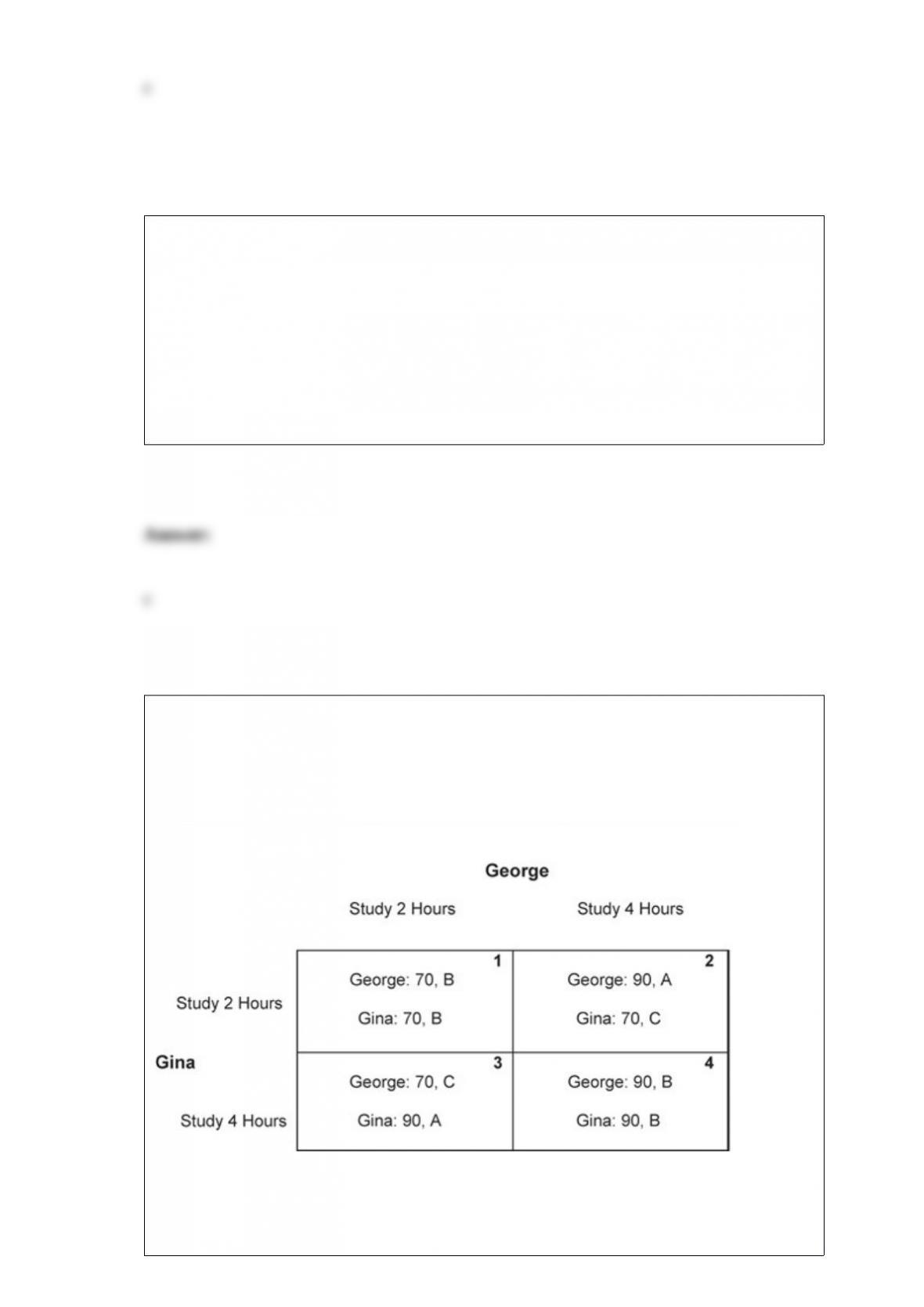
Refer to Exhibit 25-10.If Gina studies for two hours and George studies for four hours,
George’s letter grade on the test will be a ___________ and Gina’s letter grade on the
test will be a __________________.
Exhibit 25-10
Suppose that the letter grade earned on a test for each student in a class depends upon
how well he/she does relative to other students in the class. This exhibit shows a
prisoner’s dilemma setting for two representative students in the class, George and
Gina. a. C; A

b. C; C
c. B; B
d. A; C
If a supply curve shifts rightward, this means
a. suppliers are willing and able to offer less of the good for sale at every price.
b. suppliers are willing and able to offer more of the good for sale at every price.
c. quantity supplied is greater at every price.
d. suppliers are willing and able to offer more of the good for sale only at a particular
price.
e. b and c
In perfect competition, the firm’s marginal revenue curve is
a. perfectly elastic.
b. the same as the firm’s demand curve.
c. the same as the firm’s total revenue curve.
d. a and b
e. a and c
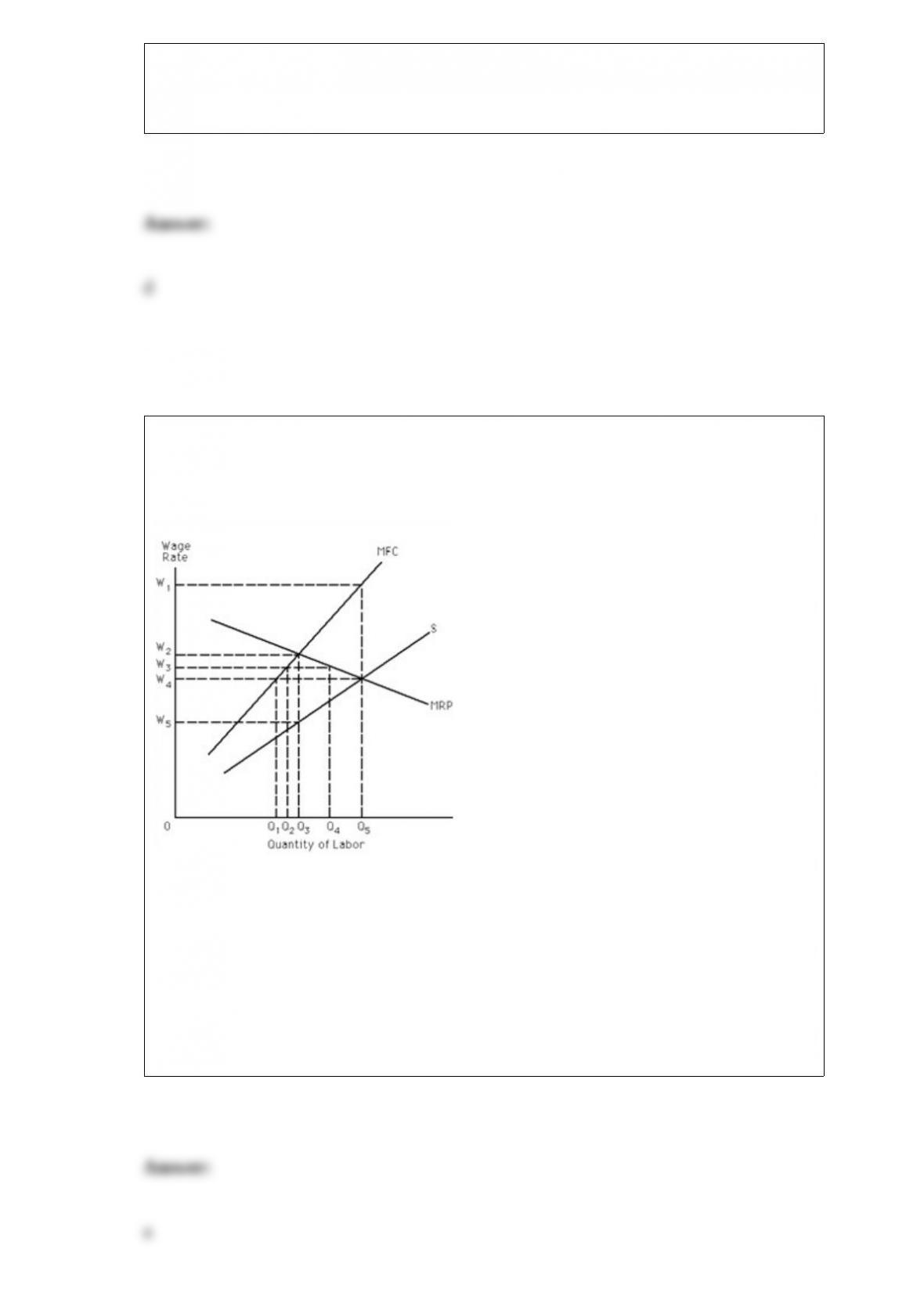
Refer to Exhibit 28-8. What is the total wage bill of the profit- maximizing
monoposonist?
Exhibit 28-8
a. W5 x Q3
b. W4 x Q5
c. W3 x Q2
d. W2 x Q3

When negative externalities are involved, the market is said to
a. fail, because it underproduces the good connected with the negative externality.
b. fail, because it overproduces the good connected with the negative externality.
c. succeed, because it produces the socially optimal quantity of the good connected with
the negative externality.
d. be “in optimum,” because the equilibrium fully adjusts for the negative externality.
A price ceiling set below the equilibrium price will
a. clear the market for the good.
b. result in a shortage of the good.
c. result in a surplus of the good.
d. induce new firms to enter the industry.
Interdependence implies that each firm in an industry
a. is independent of one another and are essentially price takers.
b. is aware that its actions influence the others and that the actions of the other firms
affect it.
c. is so large and powerful that they do not need to consider how their actions will affect
their rivals.
d. must depend on the other firms to maintain consumers’ interest in their “mutual”
product.
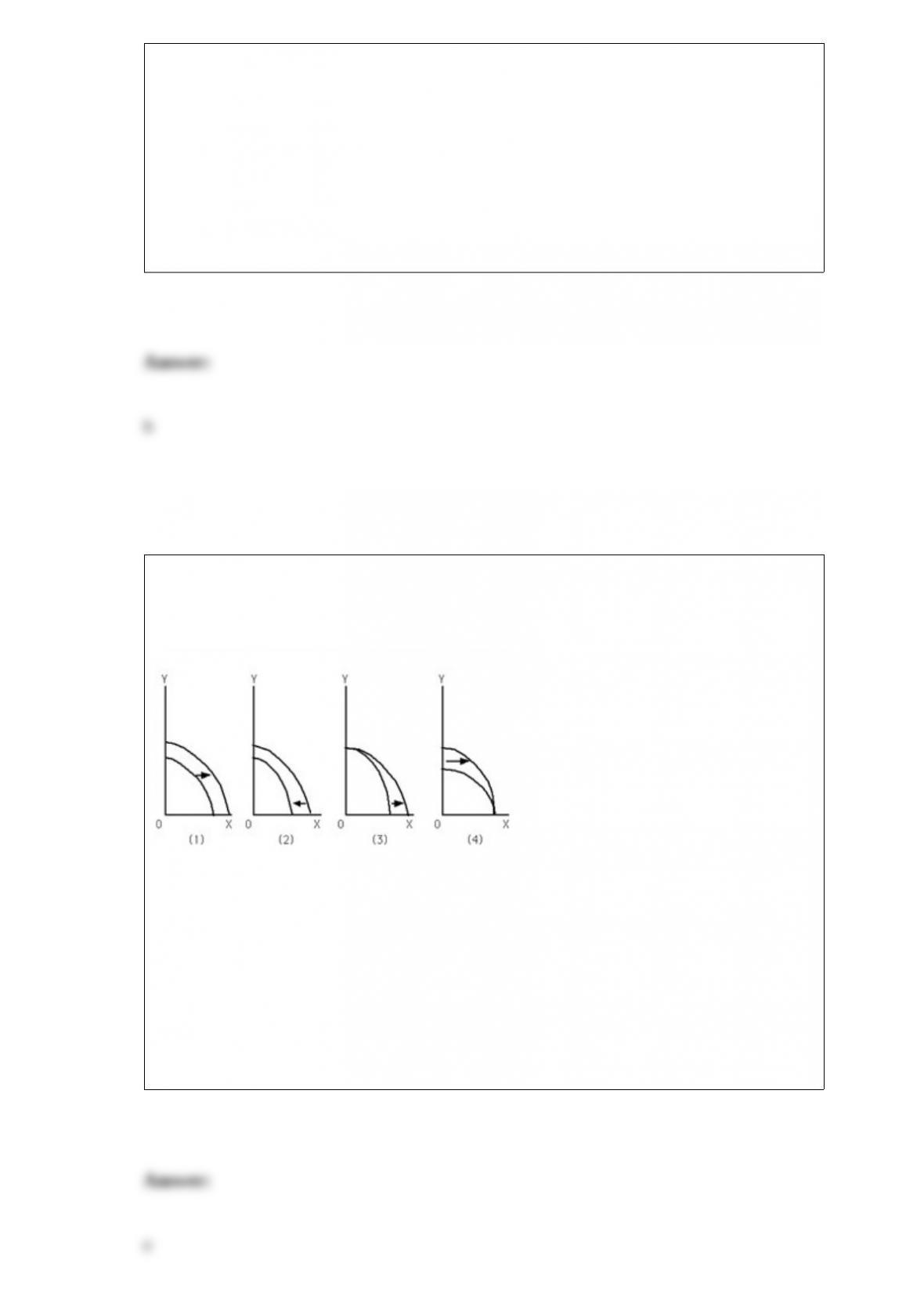
Refer to Exhibit 2-6.Which graph depicts the result of an increase in the unemployment
rate?
Exhibit 2-6
a. (1)
b. (2)
c. (3)
d. (4)
e. none of the above
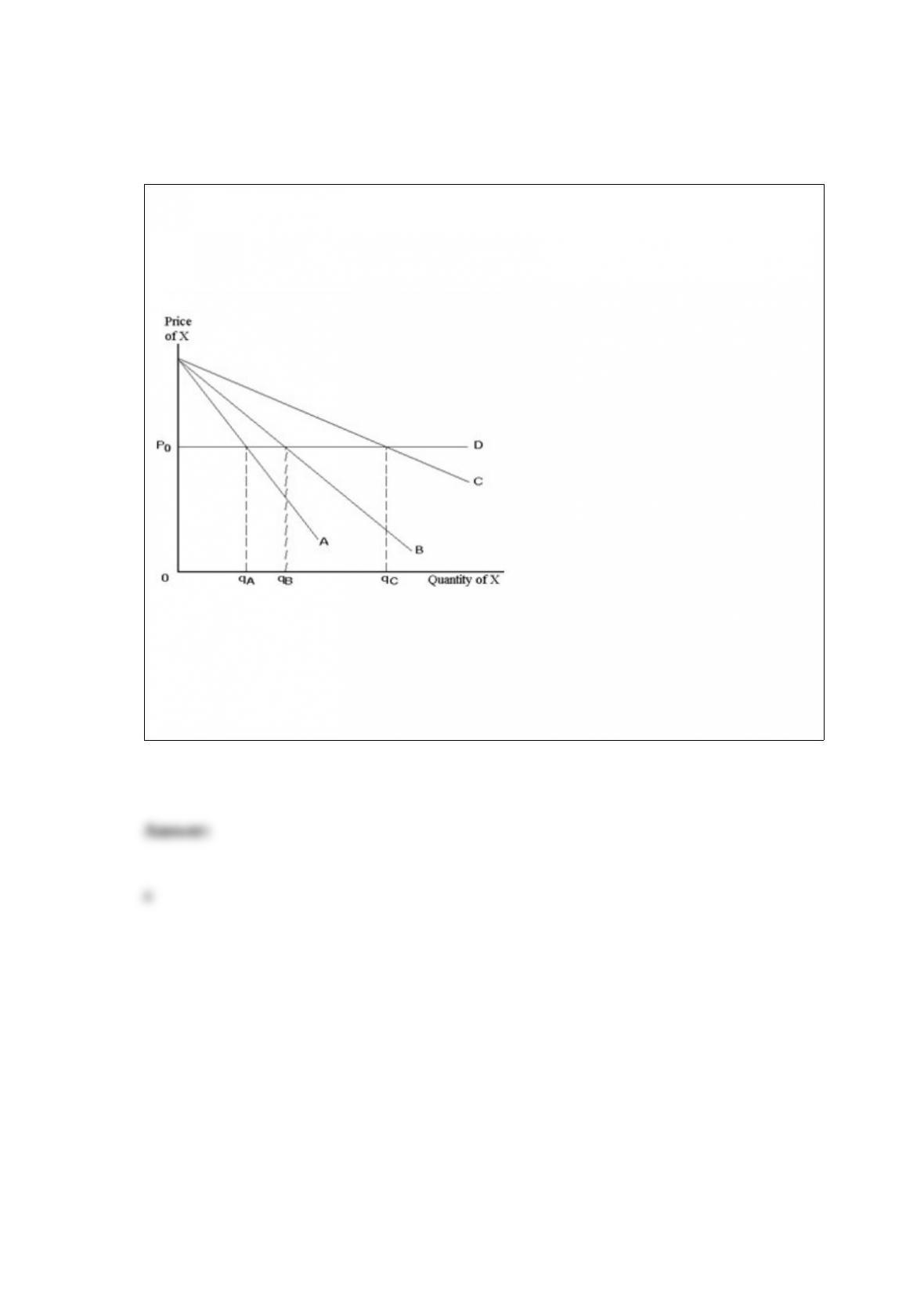
Refer to Exhibit 24-6. The price and quantity of a single-price monopolist producing
good X are P0 and qB, respectively. The marginal revenue curve is represented by
Exhibit 24-6
a. A.
b. B.
c. C.
d. D.