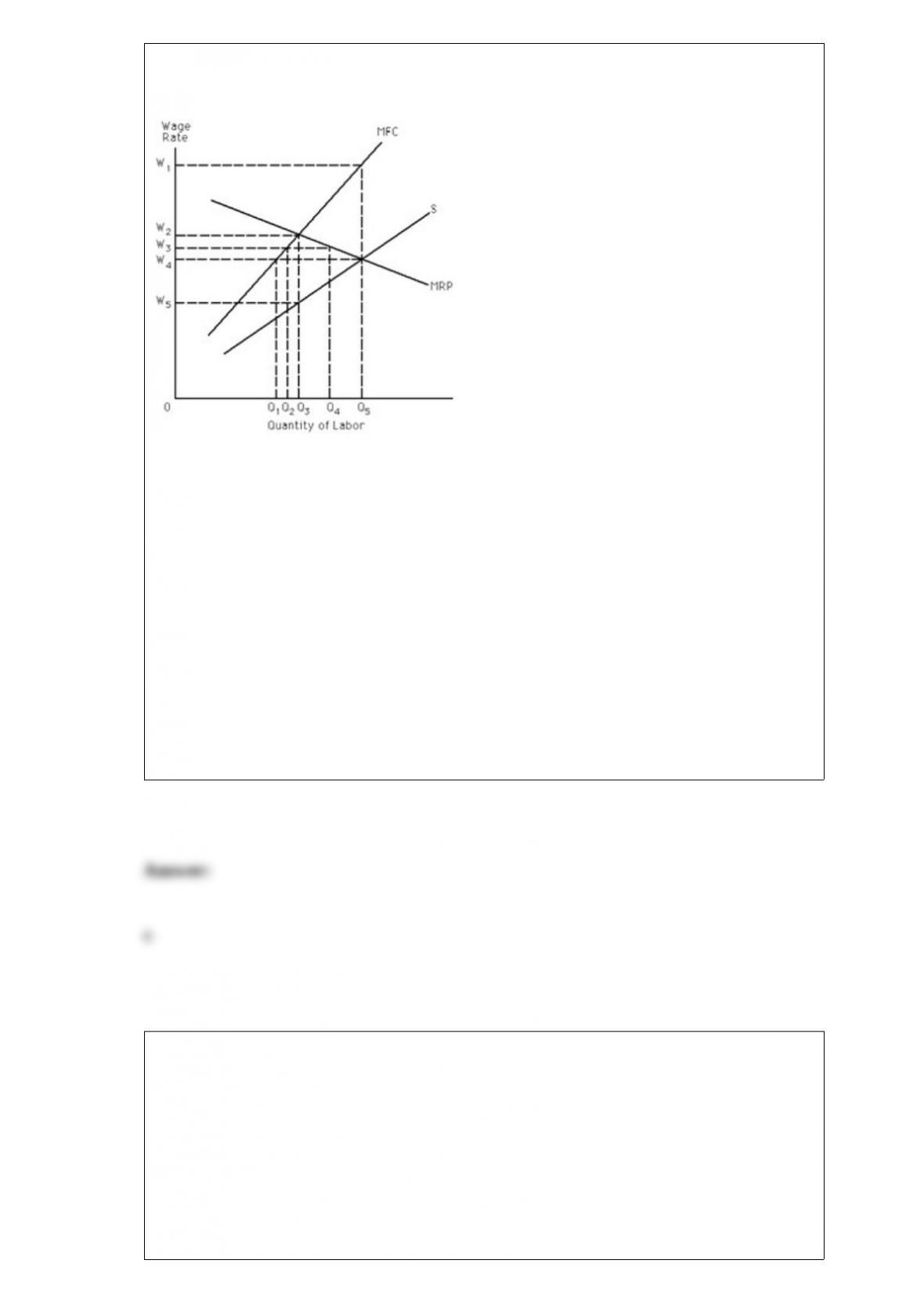
Exhibit 28-8
If the monopsonist could perfectly discriminate by paying each worker a different wage
rate, the number of workers employed would be
a. Q1.
b. Q2.
c. Q3.
d. Q4.
e. Q5.
If the price elasticity of demand for a given product is 7, this means that
a. the percentage change in quantity demanded is 7 times the percentage change in
price.
b. if quantity demanded fell by 1 percent, price would fall by 7 percent.
c. if price was raised 7 percent, quantity demanded would fall by 7 percent.
d. if price was raised 7 percent, quantity demanded would rise 7 percent.
e. none of the above
Resource X is necessary to the production of good Y. If the price of resource X falls,
a. the supply curve of Y shifts leftward.
b. the supply curve of Y shifts rightward.
c. the supply curve of Y is unaffected.
d. there is a movement down the supply curve of Y.
e. there is a movement up the supply curve of Y.
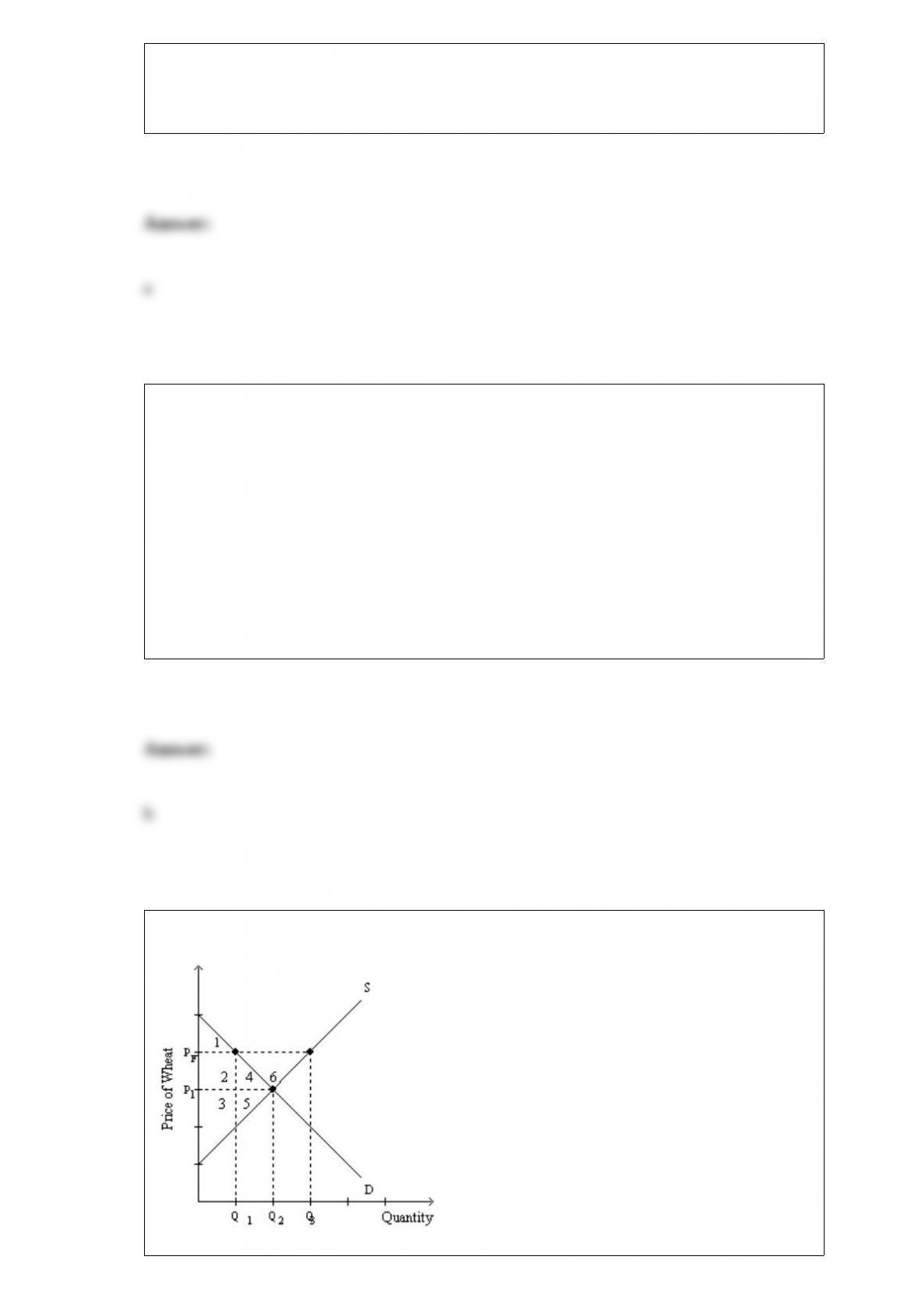
Exhibit 4-8

Suppose that wheat producerslobby the government for a price floor and receive
one.This price floor is set at PF.What is the size of the total surplus at PF?
a. area 1 + 2 + 3
b. area 1 + 2 + 3 + 4
c. area 1 + 2 + 3 + 4 + 5
d. area 1 + 2 + 3 + 4 + 5 + 6
The Federal Trade Commission Act of 1914 declared illegal
a. interlocking directorates.
b. anticompetitive mergers that occurred as a result of one company acquiring the
physical assets of another company.
c. unfair or overly aggressive methods of competition.
d. price discounting of goods supplied to large sellers.
Opportunity cost is the __________ alternative forfeited when a choice is made.
a. least-valued
b. most highly-valued
c. most convenient

d. most recently considered
A mandatory seatbelt law ends up raising the number of traffic fatalities if it lowers
fatalities per accident from 0.12 to 0.08 while raising the number of accidents per
period from 400,000 to any more than
a. 480,000.
b. 600,000.
c. 660,000.
d. 770,000.
A person buys a newly issued bond that matures in 6 years with a face value of $1,000
and a coupon rate of 5%. How much money will the bondholder receive in the sixth
year?
a. $1,050.
b. $1,500.
c. $1,000.
d. $50.
e. $500
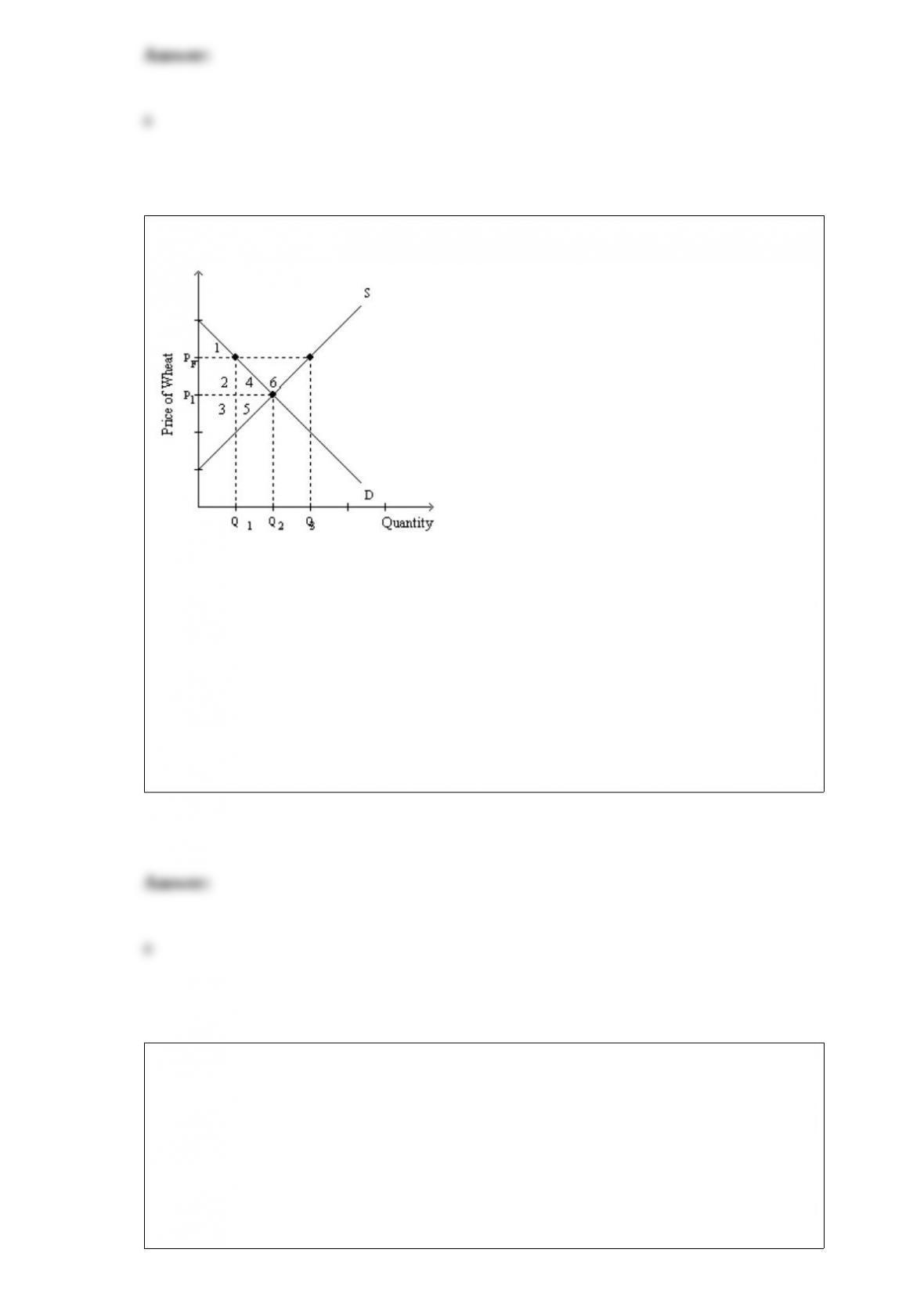
Exhibit 4-8
If the wheat market is in competitive equilibrium the total surplus will equal
a. area 1 + 2 + 3 + 4 + 5
b. area 1 + 2 + 3
c. area 2 + 3 + 4 + 5
d. area 4 + 5
Differences in income result from differences in
a. innate abilities and attributes.
b. education and other training.
c. attitudes toward risk.

d. a and b
e. a, b, and c
When deciding whether a person is “worth” a certain salary, economists will want to
compare a person’s __________ with his or her wage or salary.
a. marginal physical product
b. marginal revenue product
c. marginal factor cost
d. derived demand
e. none of the above
The monopolist’s demand curve is
a. upward sloping.
b. perfectly elastic.
c. perfectly inelastic.
d. downward sloping.

If there are six firms in an industry and the market shares of the firms are 30 percent, 25
percent, 20 percent, 11 percent, 10 percent and 4 percent, the Herfindahl index is
a. 2,162.
b. 2,046.
c. 8,600.
d. 10,000.
e. 86.
If real interest rates in Japan fall relative to real interest rates in the United States, the
yen will likely __________ in terms of the dollar and the dollar will likely __________
in terms of the yen.
a. appreciate; depreciate
b. depreciate; appreciate
c. remain unaffected; remain unaffected
d. remain unaffected; appreciate
e. remain unaffected; depreciate
As the marginal physical product of a variable input increases, the marginal cost
decreases.
a. True
b. False
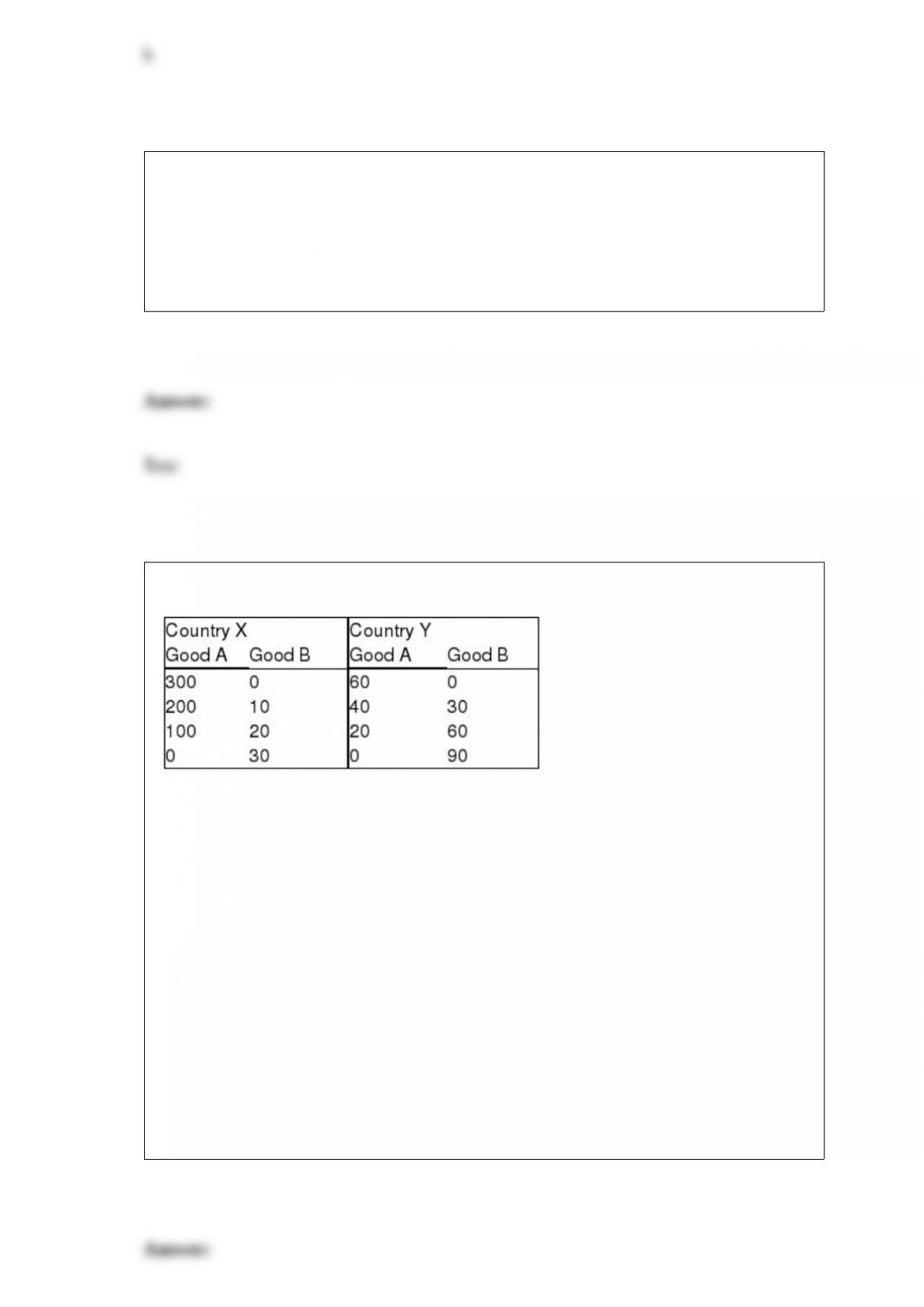
Exhibit 34-9
In the no specialization-no trade case, suppose country X produces and consumes 100
units of good A and 20 units of good B. Country Y produces and consumes 20 units of
good A and 60 units of good B. If the two countries specialize and trade, and the actual
amounts traded are 125 units of good A for 25 units of good B, how many more units of
good A will country X consume by specializing and trading?
a. 75
b. 25
c. 15
d. 105
e. 50

The term “roundabout methods of production” refers to
a. Firm A purchasing a product from Firm B and reselling it to consumers.
b. firms first producing capital goods and then using those capital goods to produce
consumer goods.
c. firms selling unassembled products so that the consumer completes the production
process.
d. banks and other financial institutions making loans available to producers so that the
producers can make goods available to consumers; thus in a roundabout way the banks
are making the goods available to consumers.
Public choice deals with
a. negative and positive externalities.
b. public-sector decision making.
c. how people choose between several mutually exclusive options.
d. bond, stock, and money markets.
e. none of the above