
The ________ curve is vertical.
A) short-run aggregate supply
B) short-run aggregate demand
C) long-run aggregate supply
D) long-run aggregate demand
What is the principal-agent problem?
A) It is a problem caused by a person (principal) who hires an agent to act on his behalf
but is unwilling to delegate authority to the agent to carry out the task in the best
possible way.
B) It is a problem caused by agents pursuing their own interests rather than the interests
of the principals who hired them.
C) It is a problem of the power system of boss and subordinate where the boss
(principal) exerts influence over his subordinates (agents) using punishment or threat.
D) It is a problem that exists when a person (principal) has more information about the
task than the agent he hires to perform the task.
Implicit costs can be defined as
A) accounting profit minus explicit cost.
B) the non-monetary opportunity cost of using the firm’s own resources.

C) the deferred cost of production.
D) total cost minus fixed costs.
An increase in aggregate expenditure has what result on equilibrium GDP?
A) Equilibrium GDP rises.
B) Equilibrium GDP is not affected by a decrease in aggregate expenditure.
C) Equilibrium GDP falls.
D) Equilibrium GDP may rise or fall depending on the size of the decrease in aggregate
expenditure relative to the initial level of GDP.
All else equal, the desired increase in the supply of smart phones for Google would
cause the equilibrium price of the smart phones to ________ and the equilibrium
quantity of the smart phones to ________.
A) increase; increase
B) increase; decrease
C) decrease; increase
D) decrease; decrease

The midpoint formula is used to measure the elasticity of demand between two points
on a demand curve
A) when demand is elastic.
B) in special cases when the percentage change in the quantity demanded is equal to the
percentage change in price.
C) to ensure that the elasticity has a negative value.
D) to ensure that we have only one value of the price elasticity of demand between two
points on a demand curve.
The money demand curve, against possible levels of interest rates, has a
A) positive slope.
B) negative slope.
C) zero slope.
D) positive slope for low levels of money demand, a negative slope for high levels of
money demand.

The price level in the economy between 2012 and 2013 rose from 100 to 105. Between
2013 and 2014, the price level rose from 105 to 110.25. How does the short-run Phillips
curve predict the unemployment rate will change as a result?
A) The unemployment rate will decrease since inflation decreased.
B) The unemployment rate will decrease since inflation increased.
C) The unemployment rate will increase since inflation increased.
D) The unemployment rate would not change since there is no change in the rate of
inflation.
If the average productivity of Indian firms is rising more quickly than the average
productivity of American firms, which of the following would you expect to see?
(India’s currency is the rupee.)
A) a decrease in the value of the rupee relative to the dollar
B) an increase in the prices of Indian products
C) an increase in the quantity demanded of Indian products relative to American
products
D) All of the above are correct.
Factory incentives on cell phones have encouraged consumers to upgrade their phones.
How does this affect the market for bluetooth headsets?
A) The quantity of bluetooth headsets demanded increases.

B) The quantity of bluetooth headsets demanded decreases.
C) The demand for bluetooth headsets increases.
D) The demand for bluetooth headsets decreases.
Many people assume that if child workers in developing countries weren’t working in
factories, they would be in school. In fact, children in developing countries
A) split their time evenly between work and school.
B) usually have few good alternatives to work.
C) are only allowed to work if they have attended school up to age 15.
D) who work are relatively rare, as most do attend school full time.
Parents who do not have their children immunized and attempt to benefit from other
parents who did have their own children immunized are exhibiting an economic
behavior known as
A) excludability.
B) public rivalry.
C) free riding.
D) internalizing an external cost.
Typically, the higher the level of income per person in a country, the higher the level of
spending per person on health care. This relationship between income and spending
indicates that health care is
A) a normal good.
B) an inferior good.
C) a luxury.
D) a necessity.
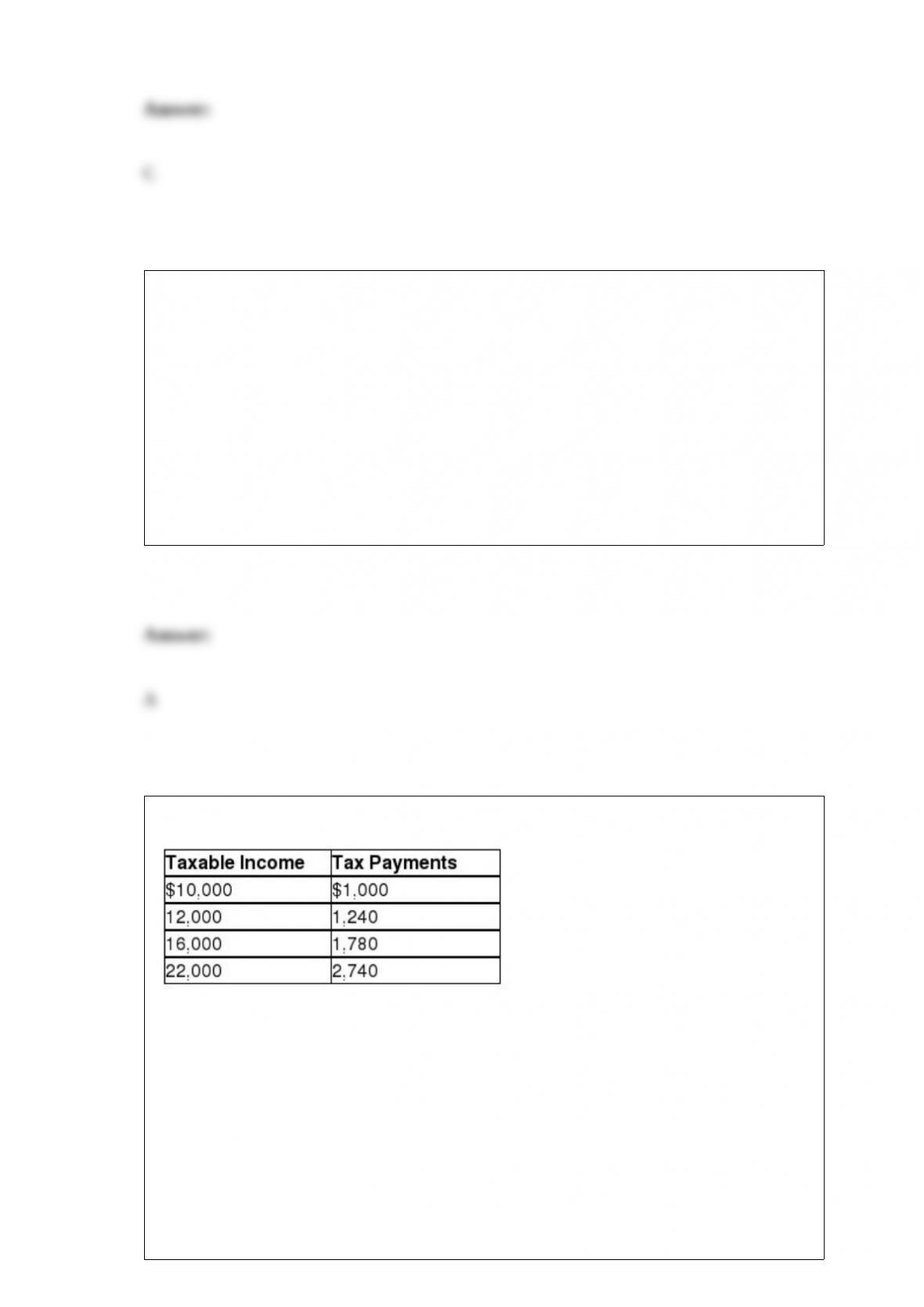
Table 18-7
Table 18-7 shows the amount of taxes paid on various levels of income.
The tax system is
A) progressive throughout all levels of income.
B) proportional throughout all levels of income.
C) regressive throughout all levels of income.
D) progressive between $10,000 and $12,000 of income and regressive between

$16,000 and $22,000.
Which of the following does not explain why consumers buy products that many other
consumers are already buying?
A) technology
B) the satisfaction people derive by being viewed as “fashionable”
C) cost-effective way to gather information about a product
D) differences in tastes and preferences
In a small economy in 2013, aggregate expenditure was $850 million while GDP that
year was $800 million. Which of the following can explain the difference between
aggregate expenditure and GDP that year?
A) Aggregate expenditure is always less than GDP in developed countries.
B) Firm investment in inventories was less than anticipated in 2013.
C) Firm investment in inventories was greater than anticipated in 2013.
D) Aggregate expenditure is always less than GDP in developing countries.

Economists caution that conventional statistics used to estimate the extent of poverty in
the United States fail to account for benefits people receive that, if considered, would
reduce the amount of poverty. Which of the following is an example of these benefits?
A) Individuals can use tax credits and the personal exemption to reduce their taxable
incomes. This reduces what they owe the government and increases their disposable
incomes.
B) The federal income tax system is progressive. As a result, the poor have higher
after-tax incomes than they would have if the income tax system was proportional or
progressive.
C) Individuals with low incomes receive non-cash benefits such as free school lunches
and food stamps.
D) The federal minimum wage forces employers to pay workers with low skills an
efficiency wage.
Scenario 19-1 CANOES-R-US makes canoes. It buys the shell of the canoe from
another firm for $300 and uses its labor and intermediate goods to make the canoe. It
sells the finished canoe to a retail canoe store for $800. The retail canoe store then sells
the canoe to a consumer for $1,200.
The value of each canoe in gross domestic product equals
A) $1,200.
B) $800.
C) $500.
D) $400.

Suppose you pre-ordered a non-refundable movie ticket to X-Men: Days of Future Past.
On the day of the movie you decide that you would rather not go to the movie.
According to economists, what is the rational thing to do?
A) Since the cost of the movie ticket is a sunk cost, it should not influence your
decision. Your decision should be based solely on whether you want to see the movie or
not.
B) You should not waste resources. Since you have paid for the ticket you should watch
the movie.
C) Your should go to the movie to minimize your losses.
D) You should go to the movie to maximize your utility.
Which is the smallest component of aggregate expenditure?
A) planned investment expenditures
B) consumption expenditures
C) government expenditures
D) net export expenditures