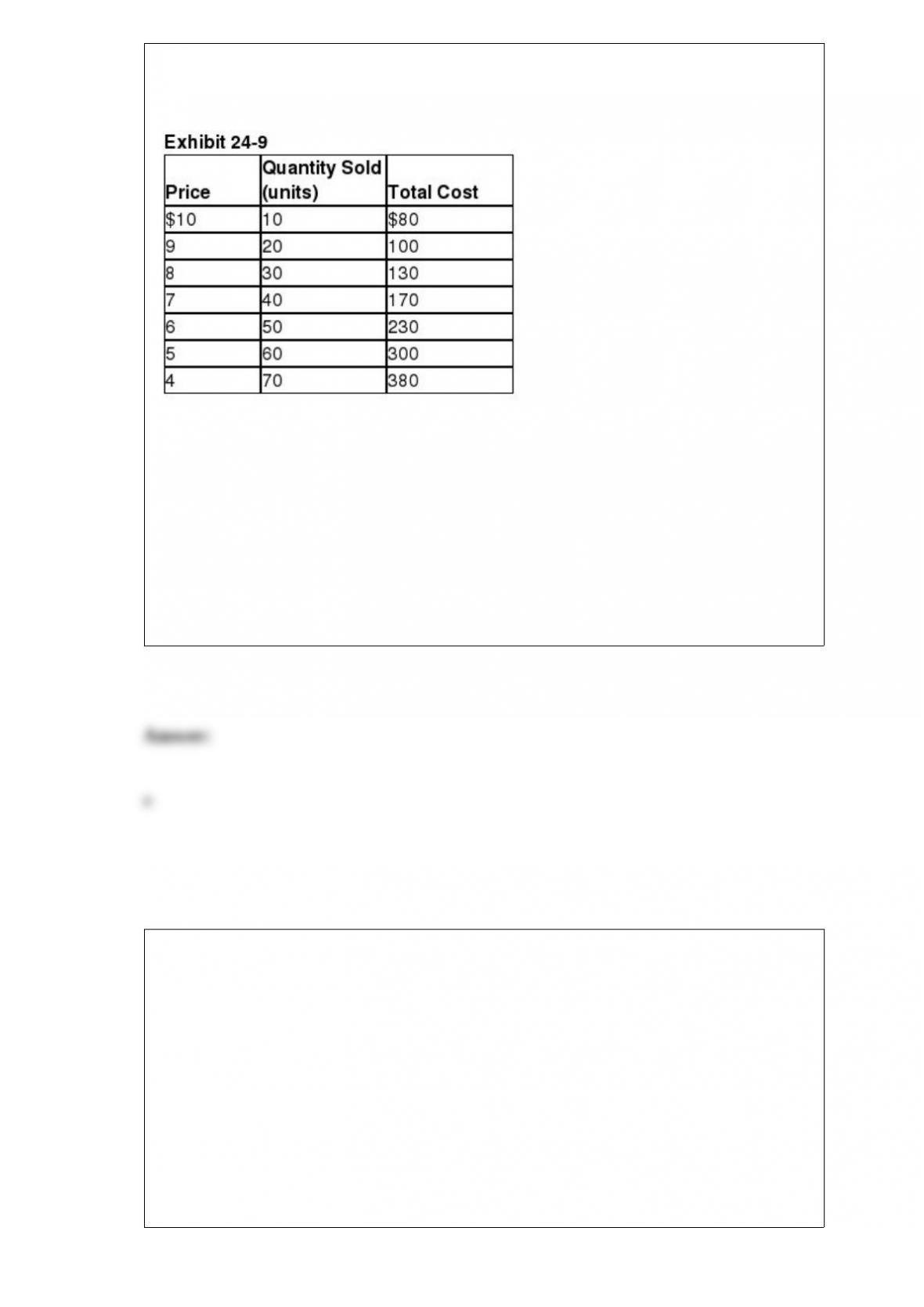
Refer to Exhibit 24-9. Total fixed costs are equal to.
a. $0.
b. $10.
c. $25.
d. $59.
e. There is not enough information to answer the question.
Suppose the demand curve for corn is inelastic between the current price and price that
exists after the supply of corn falls. It follows that
a. fewer farmers are producing corn at the new price than at the old price.
b. the total revenue for corn is lower at the new price than at the old price.
c. the total revenue for corn is higher at the new price than at the old price.
d. more farmers are producing corn at the new price than at the old price.
e. a and c

When a negative externality exists,
a. external costs are necessarily greater than private costs.
b. social costs equal private costs.
c. social costs are less than private costs.
d. social costs are greater than private costs.
e. none of the above
The capture theory of regulation holds that
a. regardless of the motive for the initial regulation and the establishment of the
regulatory agency, eventually the special interests of the industry that is being regulated
will be “captured” (controlled) by the regulatory agency.
b. regardless of the motive for the initial regulation and the establishment of the
regulatory agency, eventually the regulatory agency will be “captured” (controlled) by
the special interests of the industry that is being regulated.
c. whether or not the special interests of the industry that is being regulated will be
“captured” (controlled) by the regulatory agency depends on the motive for the initial
regulation and the establishment of the regulatory agency.
d. whether or not the regulatory agency will be “captured” (controlled) by the special
interests of the industry depends on the motive for the initial regulation and the
establishment of the regulatory agency.
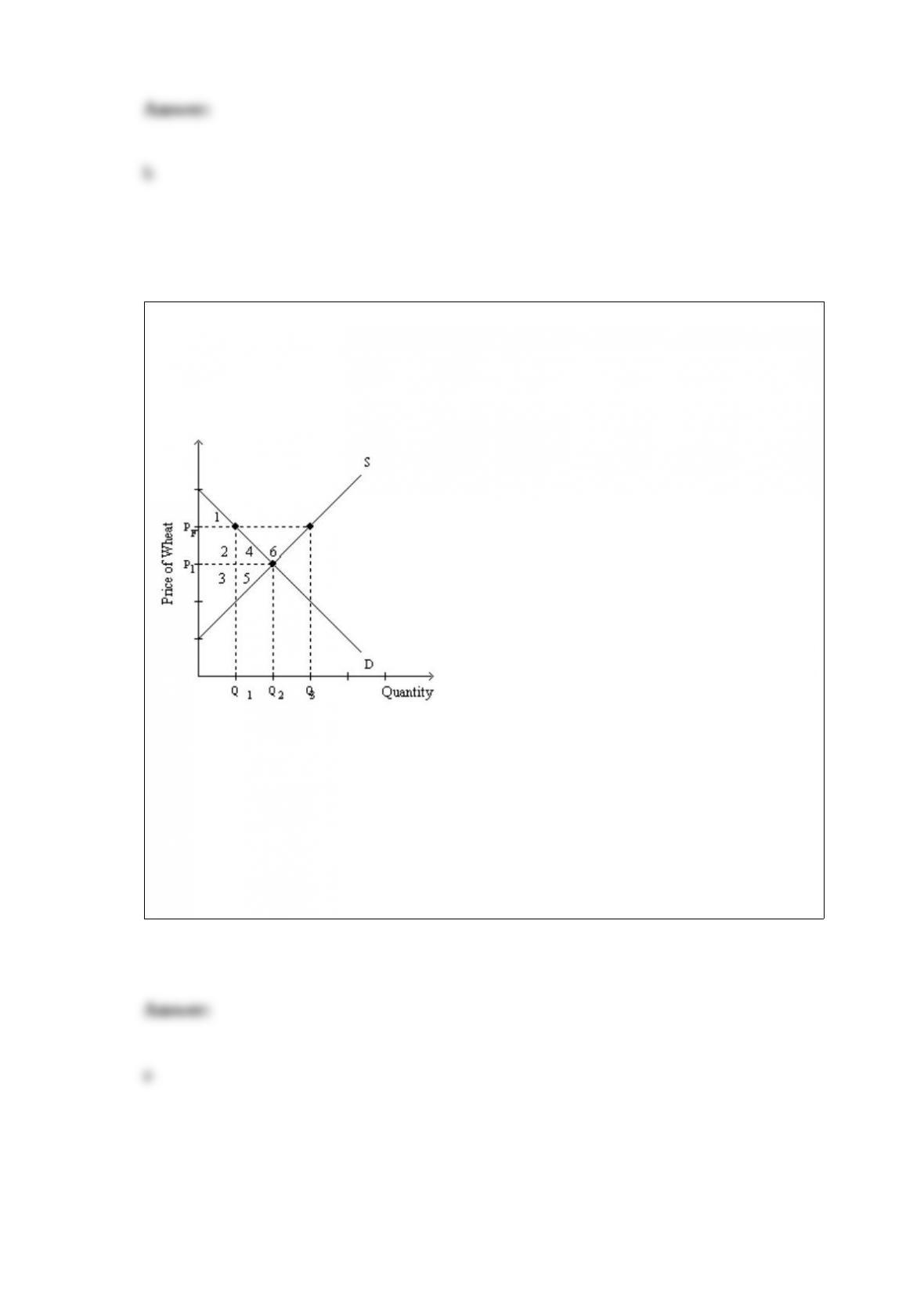
Refer to Exhibit 4-8.Suppose that wheat producerslobby the government for a price
floor and receive one.This price floor is set at PF.What is the quantity of wheat
purchased at PF?
Exhibit 4-8
a. Q1
b. Q2
c. Q3
d. Q2 – Q1
If the Gini coefficient is zero, there is
a. relative income equality.
b. complete income inequality.
c. complete income equality.
d. relative income inequality.
e. none of the above
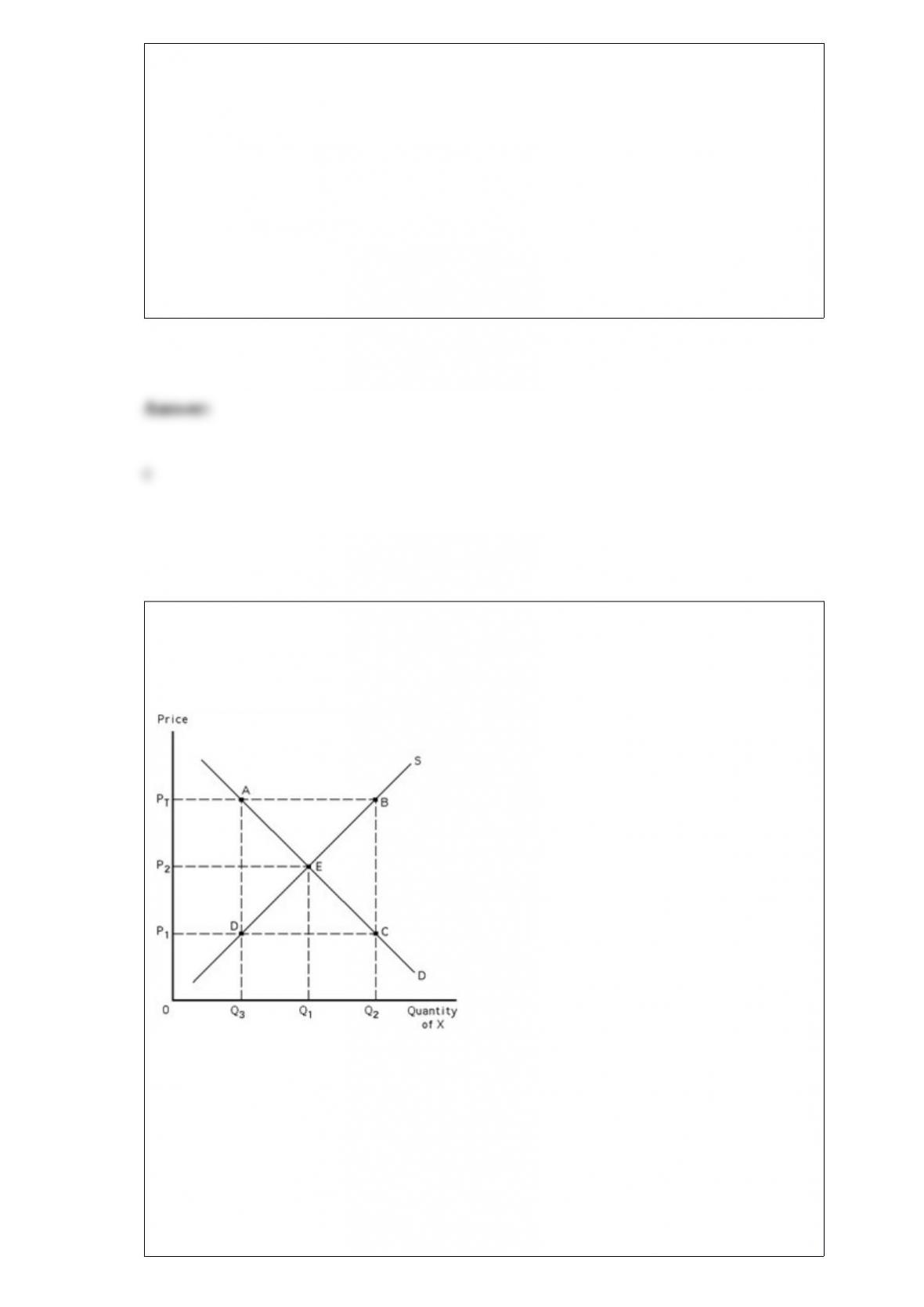
Refer to Exhibit 39-1. Given the target price PT, the total deficiency payment made by
the government is the area of
Exhibit 39-1
a. 0P1CQ2.
b. 0PTBQ2.
c. PTBCP1.
d. PTBEP2.

In long-run competitive equilibrium, no firm has an incentive to change its plant size.
a. True
b. False
Which combination of factors would lead to large price and total revenue changes?
a. inelastic demand for a product and large swings in supply
b. elastic demand for a product and small swings in supply
c. inelastic demand for a product and constant supply
d. a and c
e. none of the above
Consider two labor markets, C and D. Wages in labor market D fall. This could be due

to
a. the marginal revenue curve in the product market (that employees in labor market D
supply with goods) shifts to the left.
b. an increase in the marginal physical product of the employees in labor market D.
c. an increase in the price and marginal revenue of the product that employees in labor
market D produce.
d. b and c
e. a, b, and c
Which of the following can cause an increase in real wages?
a. a technological advance that increases the quality of the capital goods used by labor.
b. higher demand for labor.
c. an increase in the price level.
d. a and b
e. all of the above
A PPF is more likely to be a downward-sloping curve that is bowed outward than a

downward-sloping straight line because most resources are
a. better suited for the production of some goods than others.
b. used efficiently.
c. relatively cheap at low levels of output.
d. used to produce consumption goods.
Ceteris paribus, economics predicts that voter turnout will be higher
a. the smaller the number of eligible voters.
b. the larger the number of eligible voters.
c. the easier it is to get to the polls on election day.
d. a and c
e. b and c
The MPP/Price ratio for labor is 25/$5 and the MPP/Price ratio for capital is 30/$6. A
firm that employs both labor and capital will likely
a. buy more labor and less capital because labor is cheaper.
b. buy more capital and less labor because capital is more productive.
c. maintain the current combination of capital and labor.

d. buy more capital and less labor because capital is cheaper.
e. There is not enough information to answer the question.
A “price taker” is a firm that
a. does not have the ability to control the price of the product it sells.
b. does have the ability, although limited, to control the price of the product it sells.
c. can raise the price of the product (above the market price) and still sell some units of
its product.
d. sells a differentiated product.
e. none of the above
The Townsend Acts, passed by the British Parliament in 1767, imposed taxes on various
products imported into the American colonies.
a. True
b. False

Which of the following statements is false?
a. A millionaire definitely receives less utility from an additional dollar than a poor
person.
b. A poor person definitely receives less utility from an additional dollar than a rich
person.
c. A millionaire definitely receives the same utility from an additional dollar as a poor
person.
d. A millionaire generally receives less utility from an additional dollar than a poor
person.
e. We do not know if any of the statements are true or false, because we do not know
how much utility one person receives relative to another.
The law of increasing opportunity costs states that as
a. less of a good is produced, the higher the opportunity costs of producing that good.
b. more of a good is produced, the lower the opportunity costs of producing that good.
c. more of a good is produced, the higher the opportunity costs of producing that good.
d. more of a good is produced, the opportunity cost of producing the good remains the
same.
e. a and b

If natural monopolies are regulated to produce where there is resource-allocative
efficiency, they produce where
a. price equals average total cost.
b. marginal revenue equals marginal cost.
c. price equals marginal cost.
d. marginal revenue equals average total cost.
There is no toll charge to drive on freeway A. If there is freeway congestion at 9 a.m.,
there will be greater freeway congestion at 11 a.m. if
a. the demand to drive on the freeway is the same at both times.
b. the demand to drive on the freeway at 11 a.m. is greater than the demand to drive on
the freeway at 9 a.m.
c. the demand to drive on the freeway at 9 a.m. is greater than the demand to drive on
the freeway at 11 a.m.
d. more people carpool at 11 a.m. than at 9 a.m.
e. none of the above.

Suppose that the annual dividend per share of stock is $5.40 and the closing price of the
stock is $72.50, the yield of the stock would be
a. 13.43%
b. 7.45%
c. 23.62%
d. 8.38%
In recent years, which of the following industries has had high four- and eight-firm
concentration ratios?
a. tires
b. soap
c. retail clothing
d. a and b
e. all of the above
Which of the following statements is true?
a. A tax applied to an activity that generates a negative externality always brings about
the socially optimal level of output.
b. A subsidy applied to an activity that generates a positive externality always brings
about the socially optimal level of output.
c. a and b
d. none of the above