
A negative demand shock decreases the price level in the short run.
Approximately how often is the Consumer Price Index (CPI) market basket updated?
a. Every 10 years
b. Every 25 years
c. Every year
d. Every 2 years
e. Every 5 years
If the Fed increases the money supply in response to positive demand shocks, it
a. lowers the interest rate
b. reduces each type of unemployment
c. adds its own positive demand shock
d. creates financial stability
e. crowds out private investment
Figure 12-9 shows the number of baseballs a manufacturer can produce per day with
different quantities of labor. Each baseball sells for $5. If the wage rate is $380 per day,
the firm

If the monopolistically competitive firm in Figure 11-8 is typical of its competitors, the
industry will likely experience
Diminishing returns to labor occur for two primary reasons: 1) as we keep adding new
workers, it becomes increasingly difficult to obtain productivity gains through
additional specialization; and 2) each additional worker we add has less land and capital
to work with.

If the price level increases, the money demand curve will
a. shift leftward
b. become steeper
c. remain in the same position; however, there will be movement upward along the
curve
d. shift rightward
e. remain in the same position; however, there will be movement downward along the
curve
In the short-run macro model, which of the following is the cause of cyclical
unemployment?
a. It takes time for people to move to new jobs.
b. Insufficient aggregate spending.
c. It takes time for firms to find new employees.
d. It takes time for people to retrain.
e. Fewer people want to work than before.
Why is a rightward shift of the labor supply curve difficult to rationalize in the classical
model?
a. The labor supply curve is based on firms’ preferences.
b. Labor supply is very difficult to measure.
c. The labor supply curve is almost never a known entity.
d. Workers’ preferences and therefore labor supply tend to change very slowly.
e. Workers’ preferences and therefore labor supply tend to change very quickly.
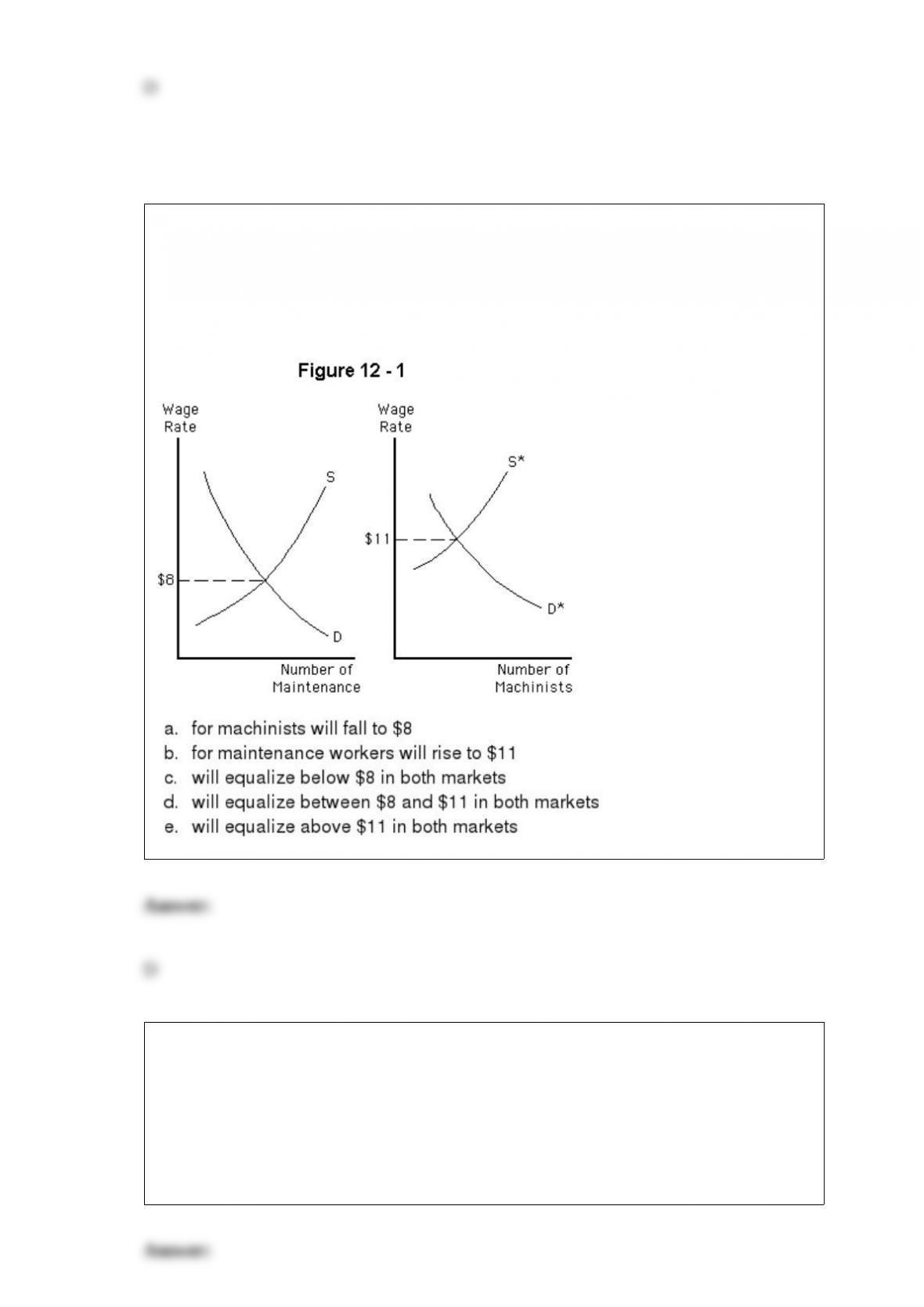
Consider an economy in which all labor markets are perfectly competitive, all workers
are equally able to do any job, and the nonwage attributes of all jobs are equally
attractive to all workers. Figure 12-1 shows supply and demand curves in the labor
markets for maintenance workers and machinists. In the long run, the hourly wage
rate(s)
Which of the following people would be considered employed in the Census Bureau’s
Household Survey?
a. A homemaker working 20 hours cleaning her house
b. A person paid to work 2 hours per week cleaning houses
c. A child shoveling neighbors’ driveways for money
d. A person volunteering full-time at a local hospital
e. A laid-off carpenter looking for a job

If net taxes increase by $100 billion and the marginal propensity to consume is 0.6, by
how much will GDP change?
a. -$250 billion
b. $150 billion
c. $250 billion
d. -$100 billion
e. -$150 billion
The principle of comparative advantage says that
Microeconomics is the study of

The money demand curve is
a. downward sloping
b. upward sloping
c. horizontal
d. vertical
e. has an inverted V-shape.
The more available substitutes there are for a good, the