
You have just opened a new Italian restaurant in your hometown where there are three
other Italian restaurants. Your restaurant is doing a brisk business and you attribute your
success to your distinctive northern Italian cuisine using locally grown organic produce.
What is likely to happen to your business in the long run?
A) Your competitors are likely to change their menus to make their products more
similar to yours.
B) Your success will invite others to open competing restaurants and ultimately your
profits will be driven to zero.
C) If your success continues, you will be likely to establish a franchise and expand your
market size.
D) If you continue to maintain consistent quality, you will be able to earn profits
indefinitely.
Borrowing to pay for long-lived capital expenditures makes sense as
A) the benefits are received in the current year so the burden of paying for them should
be spread over many years.
B) the benefits are received over many years so the burden of paying for them should
be spread over many years.
C) the benefits are received in the current year so the burden of paying for them should
be paid in the current year.
D) the benefits are received over many years so the burden of paying for them should
be paid in the current year.
Based on the current rate of growth, health care spending as a percentage of GDP
through Medicare, Medicaid, and other U.S. government programs is expected to
A) stabilize within the next 20 years.
B) account for a majority of spending as a percentage of GDP within 5 years.
C) slow down during this decade.
D) more than double over the next 40 years.
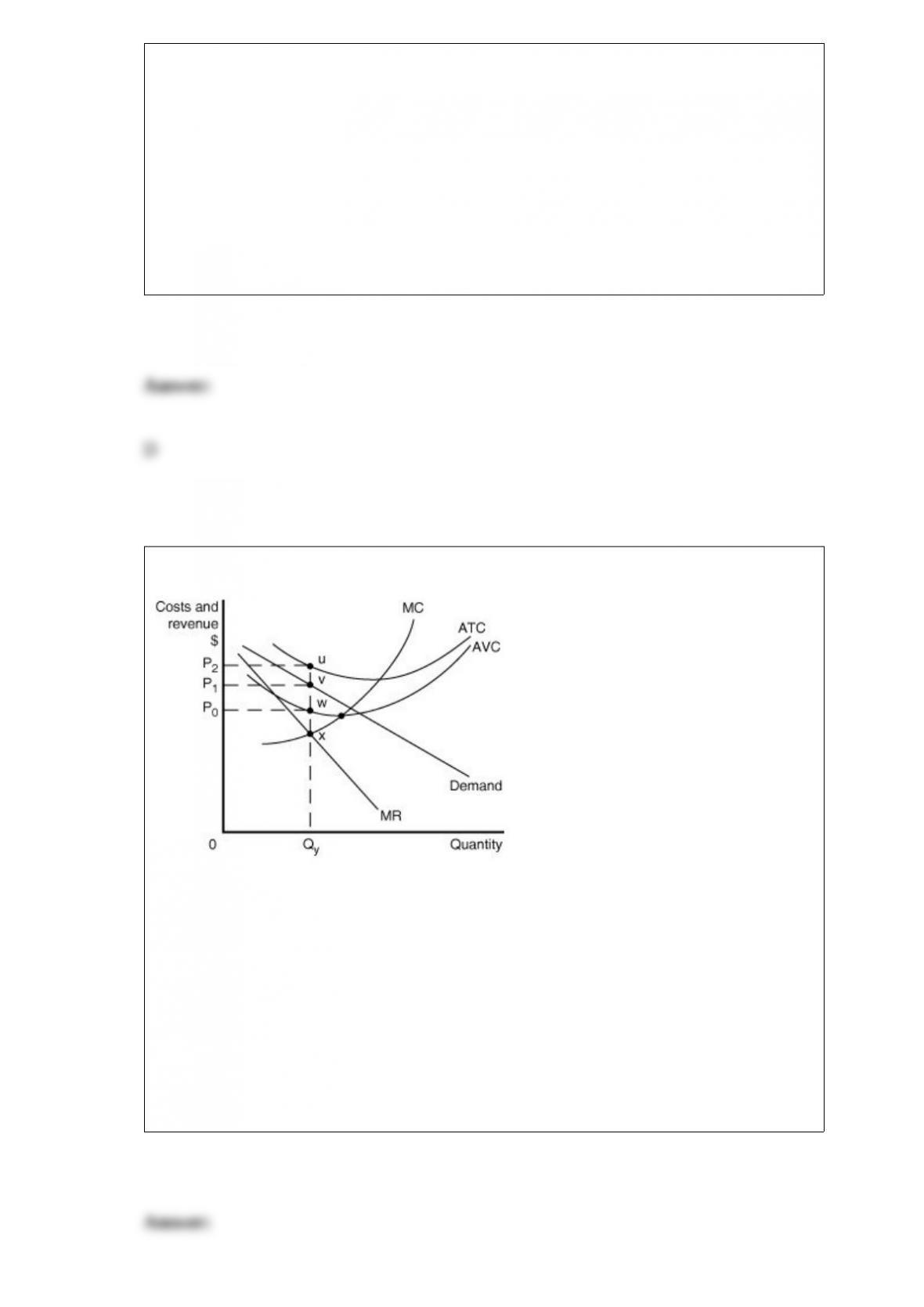
Figure 13-7
Figure 13-7 shows short-run cost and
demand curves for a monopolistically competitive firm in the footwear market. Which
of the following is the area that represents the profit or loss experienced by the firm?
A) A loss represented by the rectangle P2uvP1.
B) A loss represented by the rectangle P2uwP0.
C) A loss represented by the rectangle P1vwP0.
D) An accounting profit equal to P1vwP0.

When a firm produces 50,000 units of output, its total cost equals $6.5 million. When it
increases its production to 70,000 units of output, its total cost increases to $9.4 million.
Within this range, the marginal cost of an additional unit of output is
A) $41.43.
B) $134.29.
C) $135.
D) $145.
Consider the following types of demand curves:
a. a vertical demand curve
b. a horizontal demand curve
c. a linear downward-sloping demand curve Which of the demand curves listed exhibits
a price elasticity of demand coefficient that remains constant along the demand curve?
A) a only
B) b only
C) a and b only
D) a, b, and c
If property rights are not well enforced, all of the following are likely to occur except
A) fewer goods and services will be produced.
B) economic efficiency will be reduced.
C) an economy will produce inside its production possibilities frontier.
D) a significant number of people will be willing to risk their funds by investing them
in local businesses.
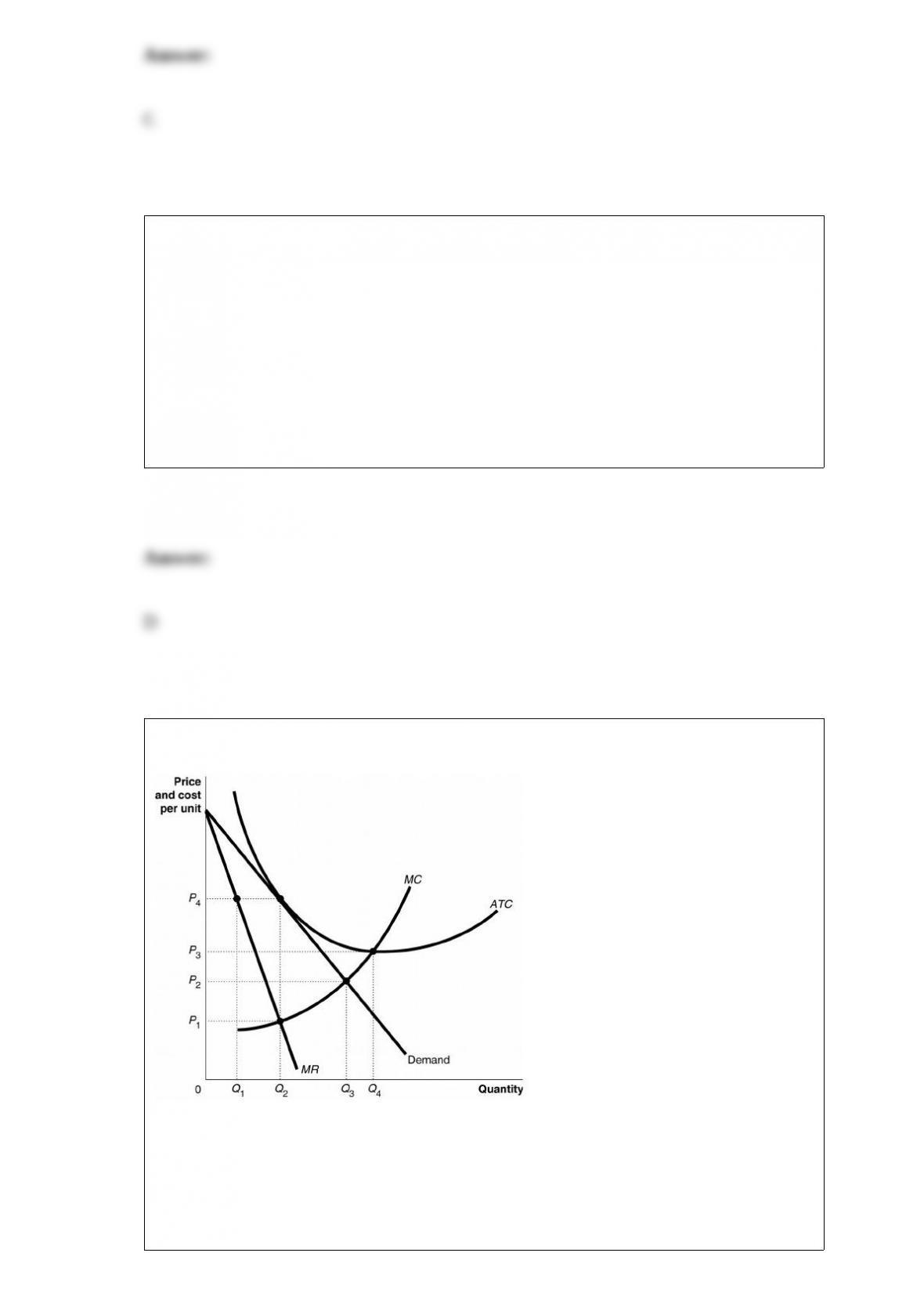
Figure 13-11
The firm represented in the diagram
A) makes zero economic profit.
B) makes zero accounting profit.
C) should exit the industry.
D) should expand its output to take advantage of economies of scale.
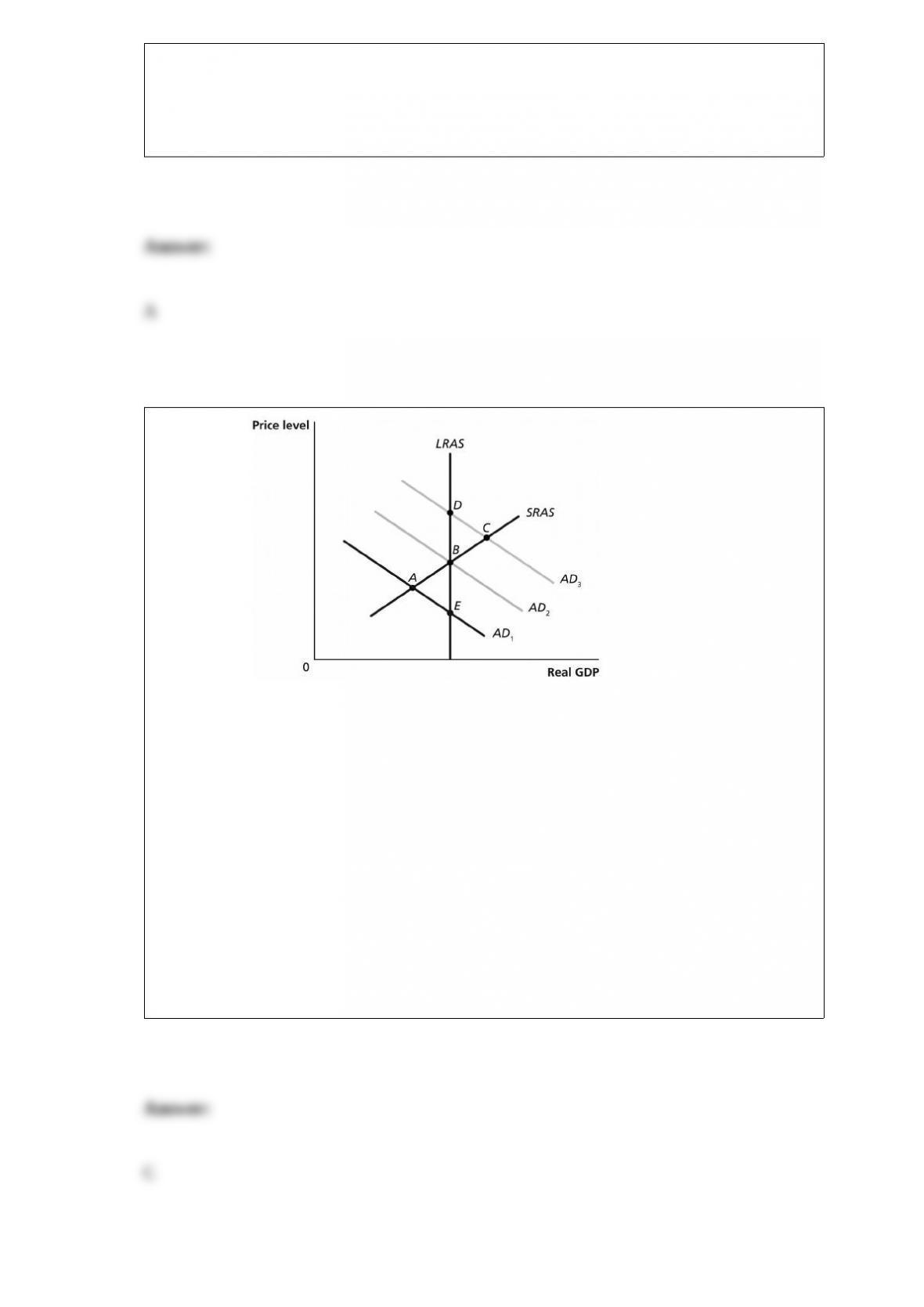
Figure 15-7
Suppose the Fed sells Treasury Bills in pursuit of contractionary monetary policy. Using
the static AD–AS model in the figure above, this situation would be depicted as a
movement from
A) A to B.
B) B to D.
C) C to B.
D) B to C.
E) C to D.

Which of the following statements is true?
A) All individuals in both countries are made better off as a result of international trade.
B) Within each country, some individuals are made better off as a result of international
trade, but one of the countries will be worse off overall.
C) Although some individuals are made better off as a result of international trade, both
countries may be made worse off overall.
D) Each country as a whole is made better off as a result of international trade, but
individuals within each country may be made worse off.
Article Summary. In 2012, Colorado and Washington legalized marijuana for
recreational use, and one of the major selling points in each state’s pro-marijuana
campaign was the possibility of generating millions of dollars in tax revenue from
sales which could be used for funding general education. The Colorado legislature
was weighing a proposal to tax marijuana at 30 percent, of which 15 percent would
be a sales tax on consumers and 15 percent an excise tax on growers. Washington
has set a tax rate of 44 percent on consumers and 25 percent each for growers and
retailers. Since the legalization of marijuana is relatively new, projecting the
economic impact of its sale is difficult, leading to many questions as to the
quantities that will be produced and sold and what actual tax revenues will be
generated. Source: Elizabeth Dwoskin, “Colorado and Washington Try to Figure
Out How to Tax Marijuana,” Bloomberg Businessweek, April 26, 2013.
Colorado is weighing a proposal to tax marijuana at 30 percent, of which 15 percent
would be a sales tax on consumers and 15 percent would be an excise tax on growers.
Does this necessarily mean that each group will bear half the burden of the tax?
A) Yes, since the taxes are divided equally between consumers and producers, each will
bear half the burden.
B) Yes, despite the even split of the 30 percent tax, consumers and producers always
bear equal burdens of a tax.
C) No, the burden of a tax is always 100 percent on the consumer.
D) No, the burden of the tax will depend on the elasticity of demand and supply.
If it is difficult for a firm to attribute the output it produces to a particular worker then
A) its employees are likely to form a union.
B) a commission system of compensation will be preferable to a salary system.
C) a salary compensation system will be preferable to a commission system.
D) a piece-rate system of compensation will be preferable to a salary system.
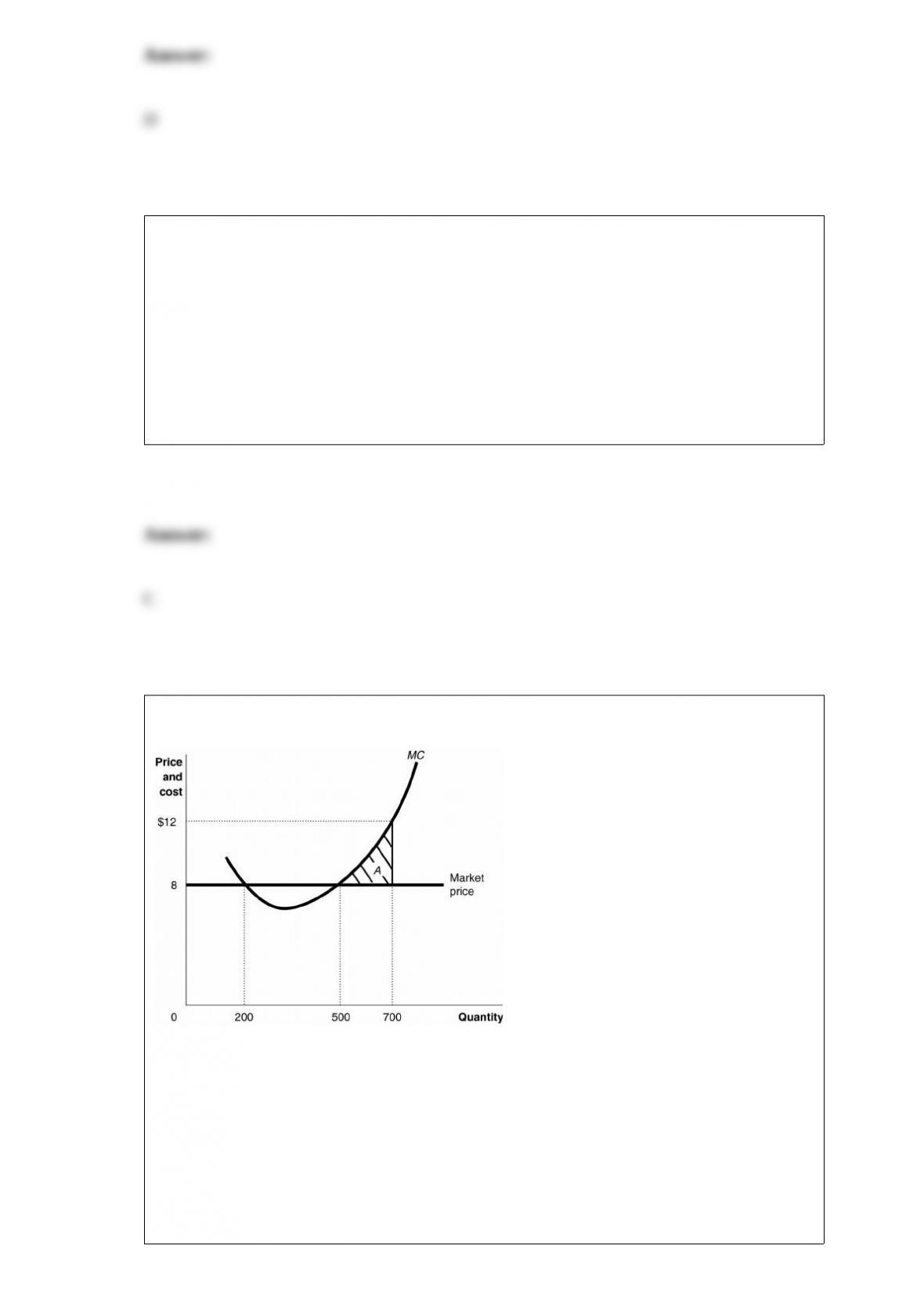
Figure 12-1
If the firm is producing 500 units
A) it is making a profit.
B) it is making a loss.
C) it should maintain its output to maximize profit.

D) it should increase its output to maximize profit.
A proportional tax is a tax for which people with lower incomes
A) pay a higher percentage of their incomes in tax than do people with higher incomes.
B) pay a lower percentage of their incomes in tax than do people with higher incomes.
C) pay the same percentage of their incomes in tax as do people with higher incomes.
D) pay the same amount of taxes as people with higher incomes pay.
Which of the following describes the growth in real GDP per person in the United
States from 1900 to the present?
A) It has decreased.
B) It has increased by more than eight times.
C) It has doubled.
D) It has increased twenty times.

If the U.S. dollar increases in value relative to other currencies, how does this affect the
aggregate demand curve?
A) This will move the economy up along a stationary aggregate demand curve.
B) This will move the economy down along a stationary aggregate demand curve.
C) This will shift the aggregate demand curve to the left.
D) This will shift the aggregate demand curve to the right.
Intel is the world’s largest semiconductor manufacturer and a major supplier of the
microprocessors and memory chips found in most personal computers. During the
recession of 2007-2009, Intel’s revenues ________ and it ________ the size of its
workforce.
A) fell; increased
B) fell; decreased
C) rose; increased
D) rose; decreased
Many airlines have not reduced or eliminated fuel surcharges despite the price of oil
dropping. A logical reason for this is that the decline in fuel prices

A) shifted the supply curve for airline tickets to the left, and at the same time an
increase in demand for airline tickets shifted the demand curve to the right, so prices
did not decline.
B) shifted the supply curve for airline tickets to the right, and at the same time a
decrease in demand for airline tickets shifted the demand curve to the left, so prices still
increased.
C) shifted the supply curve for airline tickets to the right, and at the same time an
increase in demand for airline tickets shifted the demand curve to the right, so prices
still increased.
D) shifted the supply curve for airline tickets to the left, and at the same time a decrease
in demand for airline tickets shifted the demand curve to the left, so prices did not
decline.
Suppose the price of capital and labor remain constant but that the average educational
level of workers has increased and therefore, productivity of labor increases. This
would lead a firm
A) to adopt a more capital-intensive production technology.
B) to adopt a more labor-intensive technology.
C) to keep its output and production technology unchanged, but to use fewer units of
labor.
D) to use only labor to produce the product.