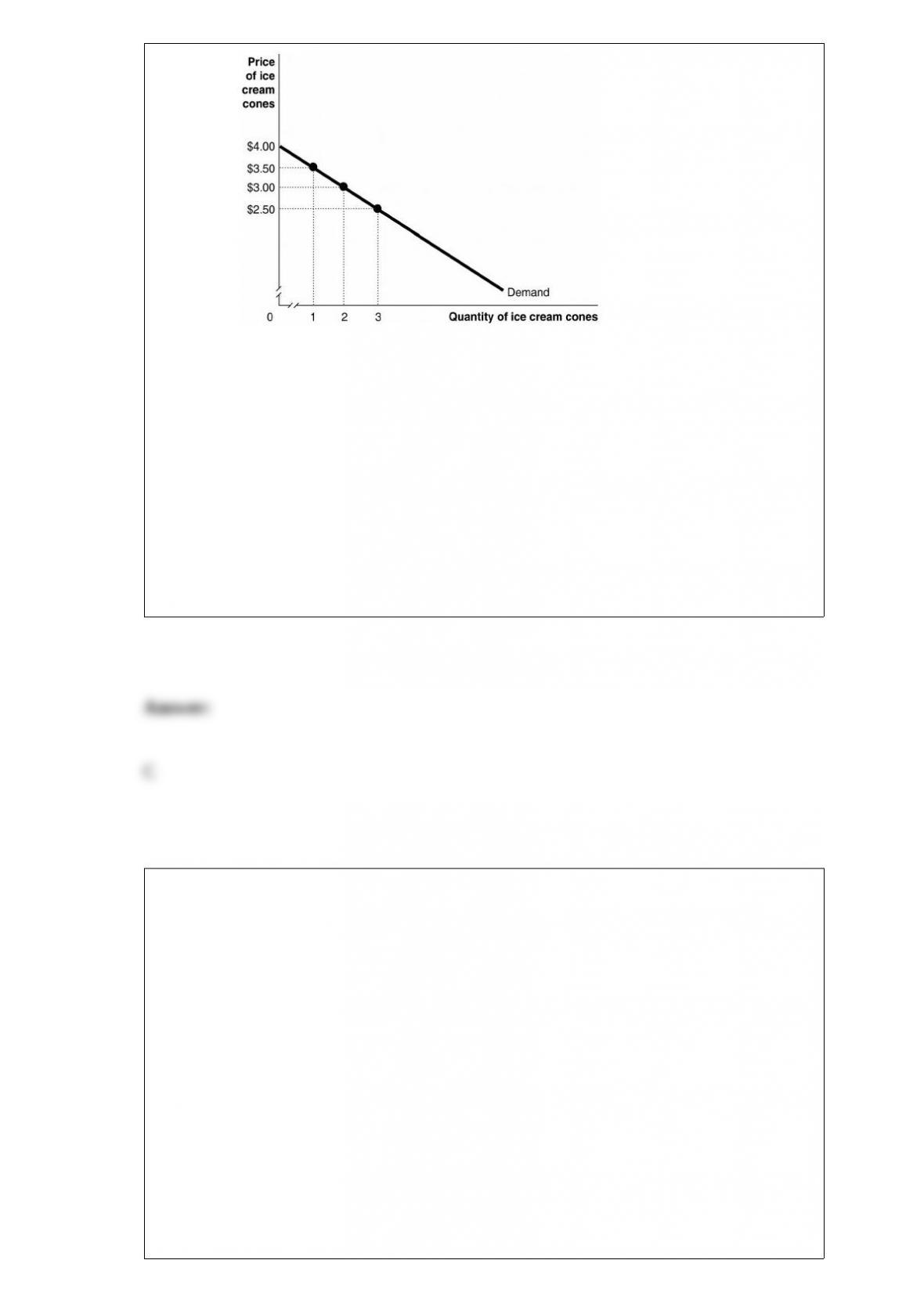
Figure 4-1 Figure 4-1 shows Kendra’s
demand curve for ice-cream cones.
If the market price is $2.50, what is the maximum number of ice cream cones that
Kendra will buy?
A) 1
B) 2
C) 3
D) 4
Scenario 1-2
Suppose a hat manufacturer currently sells 2,000 hats per week and makes a profit of
$5,000 per week. The plant owner observes, “Although the last 300 hats we produced
and sold increased our revenue by $1,000 and our costs by $1,100, we are still making
an overall profit of $5,000 per week so I think we’re on the right track. We are
producing the optimal number of hats.”
Using marginal analysis terminology, another economic term for the incremental cost of
producing the last 300 hats is
A) marginal cost.
B) operating cost.
C) explicit cost.

D) Any of the above terms are correct.
A firm’s total profit can be calculated as all of the following except
A) total revenue minus total cost.
B) average profit per unit times quantity sold.
C) (price minus average total cost) times quantity sold.
D) marginal profit times quantity sold.
Exemptions and deductions are used
A) to add to taxes that must be paid.
B) by taxpayers to reduce the amount of income subject to tax.
C) to determine the type of tax structure.
D) to determine what items are subject to sales taxes.
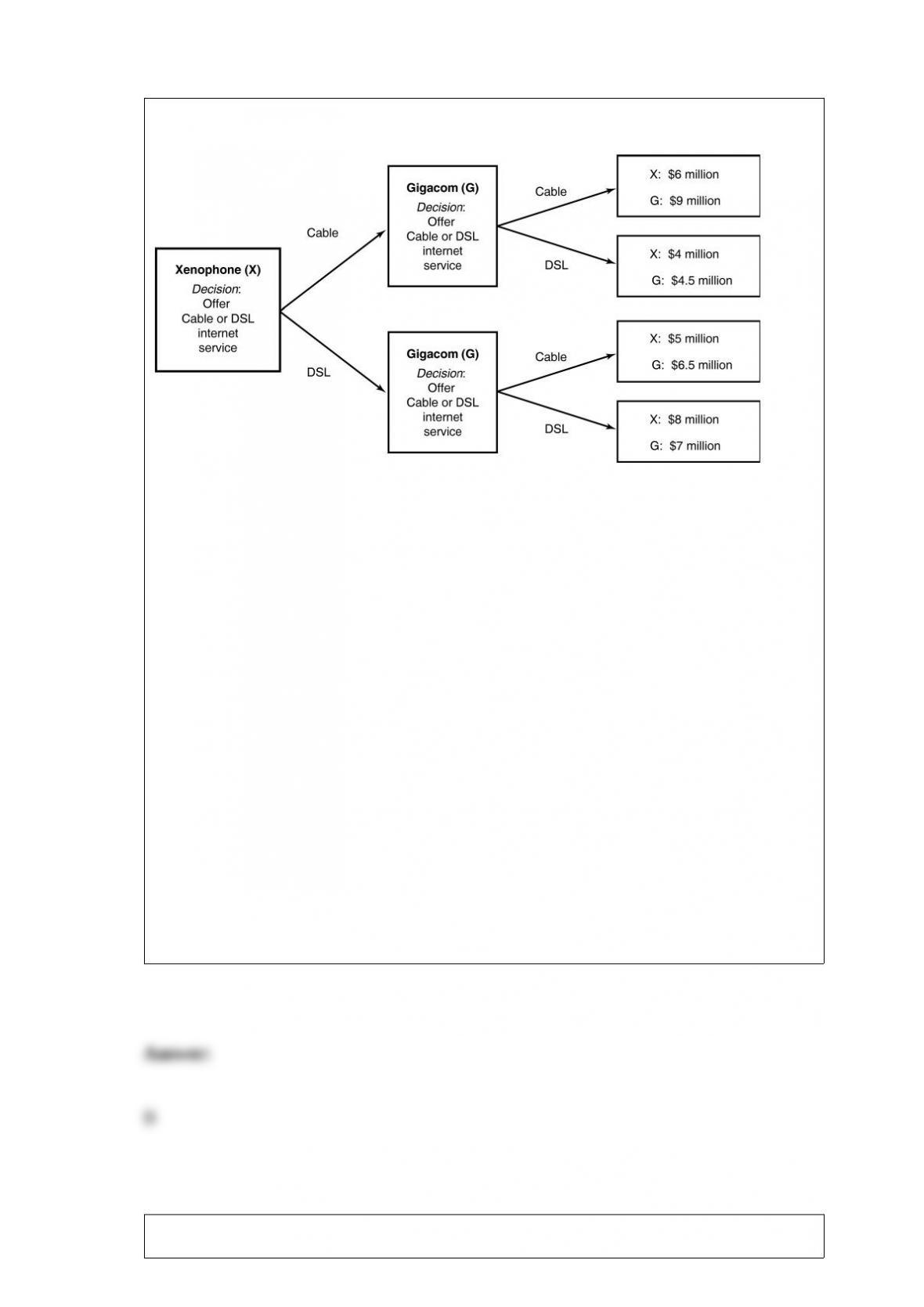
Figure 14-2
The
government of a developing country plans to award two firms, Gigacom and
Xenophone, the exclusive rights to share the market for high speed Internet service.
Gigacom and Xenophone can both provide the service either via television cable lines
or via direct subscriber line (dbl). Suppose the government is considering a proposal to
delay one firm’s entry into the market on the grounds that it wants to prevent “harmful”
competition. Figure 14-2 shows the decision tree for this game.
If the government delays Gigacom’s entry and Xenophone moves first, what is the
likely outcome in the market?
A) Both offer Internet service via cable line; Xenophone earns a profit of $6 million,
and Gigacom earns a profit of $9 million.
B) Both offer DSL Internet service; Xenophone earns a profit of $8 million, and
Gigacom earns a profit of $7 million.
C) Xenophone offers DSL Internet service and earns a profit of $5 million, while
Gigacom offer Internet service via cable line and earns a profit of $6.5 million.
D) Xenophone offers Internet service via cable line and earns a profit of $4 million,
while Gigacom offers DSL Internet service and earns a profit of $4.5 million.
Consumers are willing to purchase a product up to the point where
A) the marginal benefit of consuming the product is equal to the marginal cost of
consuming it.
B) the consumer surplus is equal to the producer surplus.
C) the marginal benefit of consuming the product equals the area below the supply
curve and above the market price.
D) the marginal benefit of consuming a product is equal to its price.
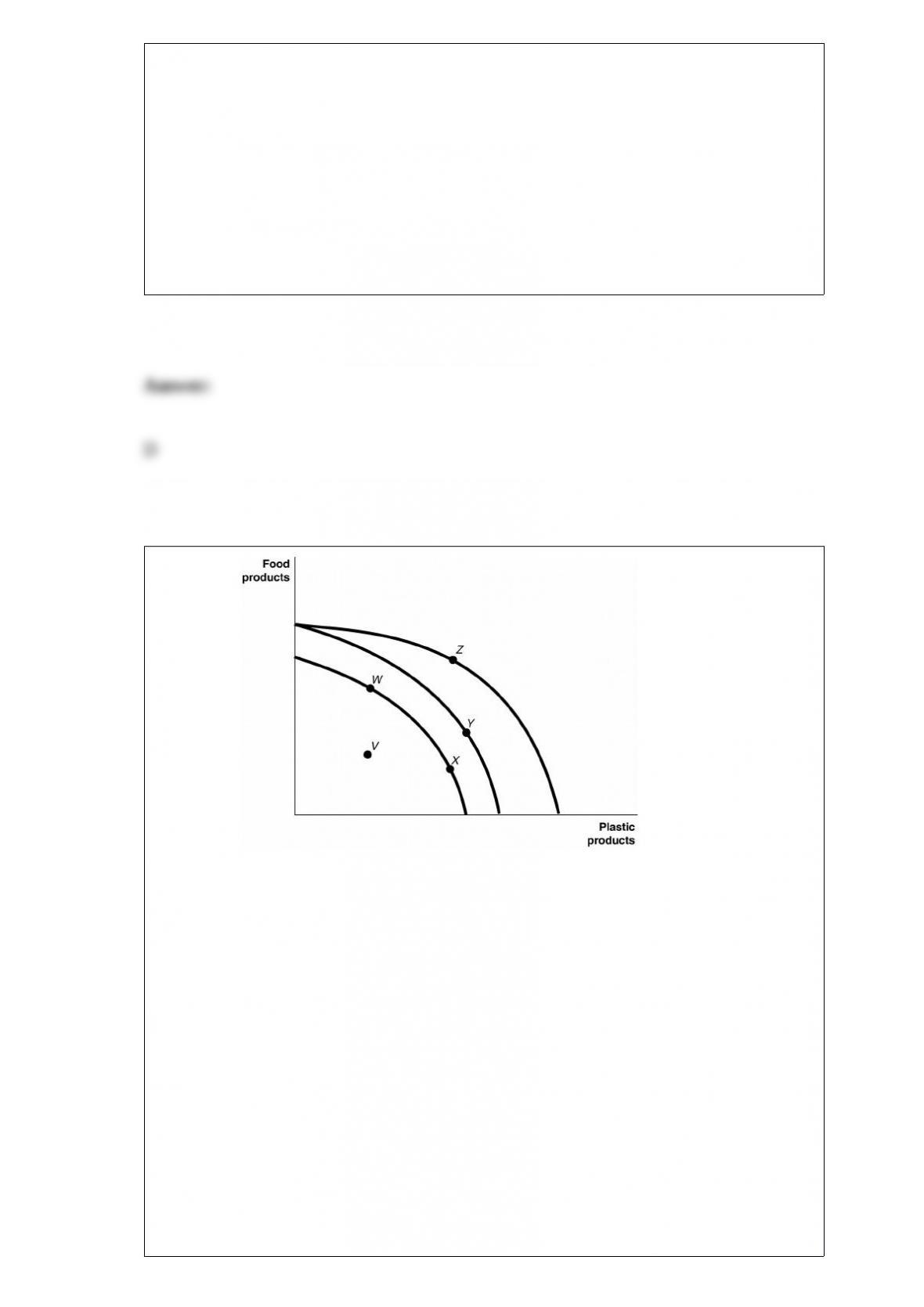
Figure 2-4 Figure 2-4 shows
various points on three different production possibilities frontiers for a nation. Consider
the following events:
a. a decrease in the unemployment rate
b. an increase in technology with respect to both food and plastic production
c. a war that kills a significant portion of a nation’s population Which of the events
listed above could cause a movement from W to Y ?
A) a, b and c
B) a and b only
C) a and c only
D) b only

E) c only
If the required reserve ratio is 5 percent, then the simple deposit multiplier is
A) 2.
B) 5.
C) 10.
D) 20.
When you buy previously-issued shares of Facebook stock, this transaction takes place
in the
A) primary market.
B) bond market.
C) secondary market.
D) bear market.

A consequence of increasing marginal costs of producing digital music players in Japan
is
A) Japan will not export digital music players.
B) Japan will stop short of complete specialization in the production of digital music
players.
C) Japan will import digital music players from countries that don’t experience
increasing marginal costs.
D) Japan will likely impose trade restrictions on imported digital music players.
Which of the following is a reason why airline yield management is an effective method
to increase revenue?
A) because airlines have invested heavily in developing computer models that identify
optimal pricing strategies in the various market segments
B) because airlines have successfully induced customers to reveal their resources and
preferences by offering them different versions of the product such as business class
and coach plane tickets
C) because a ticket is a contract to transport a specific person, and is not transferable
D) because airlines have a monopoly in long-distance carriage
Suppose a drought resulted in a major reduction in the California lettuce crop. In the
market for lettuce,
A) the supply curve shifted to the left, resulting in an increase in the equilibrium price.
B) the supply curve shifted to the left, resulting in a decrease in the equilibrium price.
C) the demand curve shifted to the right, resulting in an increase in the equilibrium
price.
D) the demand curve shifted to the left, resulting in a decrease in the equilibrium price.
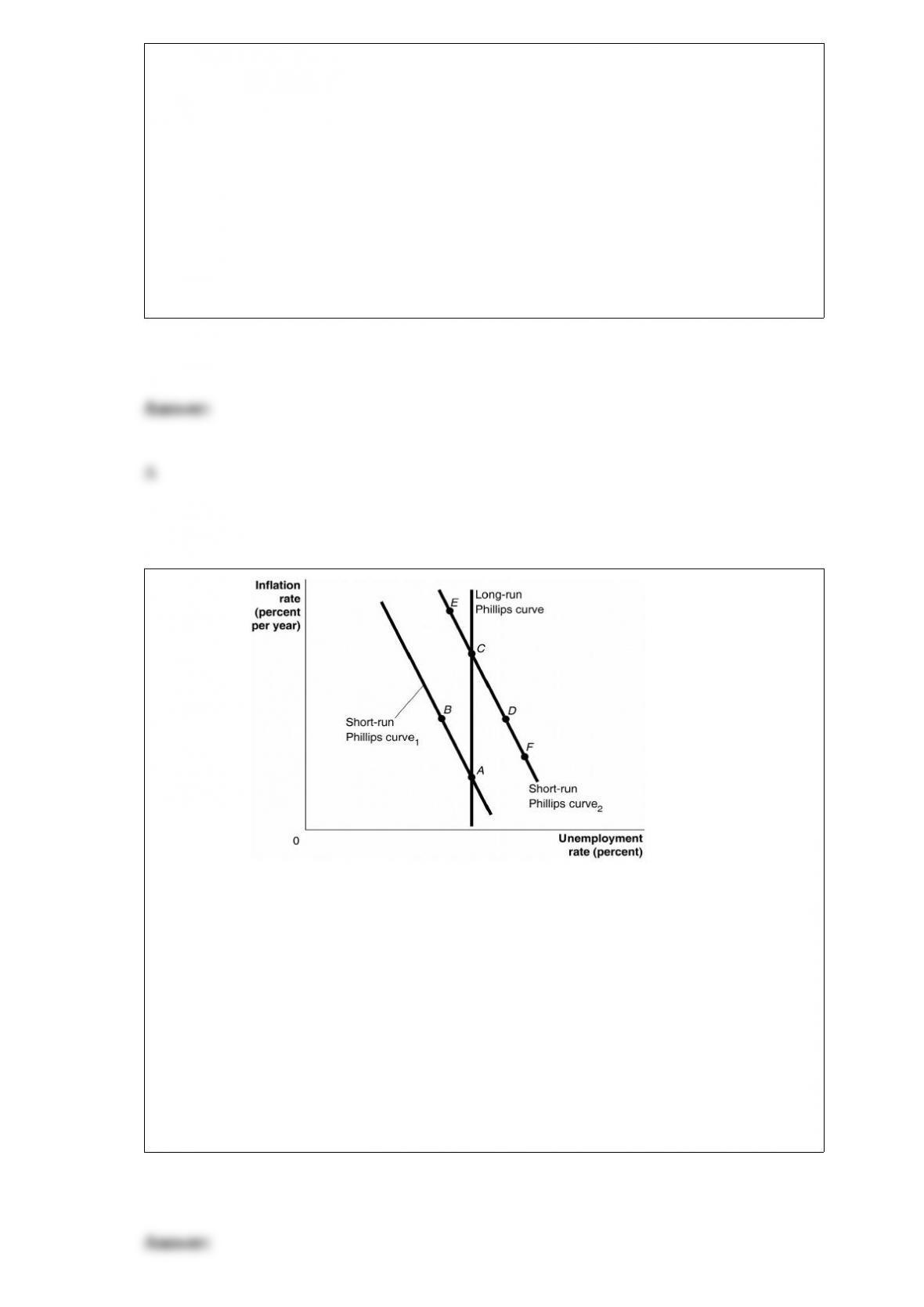
Figure 28-9
A supply shock, such as rising oil prices, would be depicted as a movement from
A) A to D to C.
B) C to B to A.
C) C to D to A.
D) C to E to B.
E) A to B to C.

Which of the following is not a requirement for a successful price discrimination
strategy?
A) A firm must have the ability to charge a price greater than marginal cost.
B) Some consumers must have a greater willingness to pay for the product than other
consumers, and the firm must be able to know what prices consumers are willing to pay.
C) The firm must be able to prevent arbitrage.
D) Transactions costs must be the same for all consumers.
Each of the following is one of the four main categories of spending identified by John
Maynard Keynes except
A) consumption.
B) net exports.
C) government purchases.
D) taxes.
Which of the following is an example of rent seeking behavior?

A) Apple earned large profits from the development and sale of the iPhone.
B) Amazon introduced the Kindle to compete with Sony’s Digital Reader. Amazon was
motivated by the desire to earn profits from the Kindle but also increased the choice of
digital music players available to consumers.
C) U.S. sugar firms convinced Congress to impose a quota on imports of sugar.
D) Recent increases in cigarette taxes faced little opposition from voters, many of
whom were rationally ignorant with respect to the tax.
To reduce the bias in the consumer price index, the Bureau of Labor Statistics
A) updates the market basket every two years, rather than every 10 years.
B) updates the market basket every 10 years, rather than every two years.
C) incorporates substitutions by consumers when prices of specific products rise
rapidly.
D) incorporates substitutions by consumers when prices of specific products fall
rapidly.