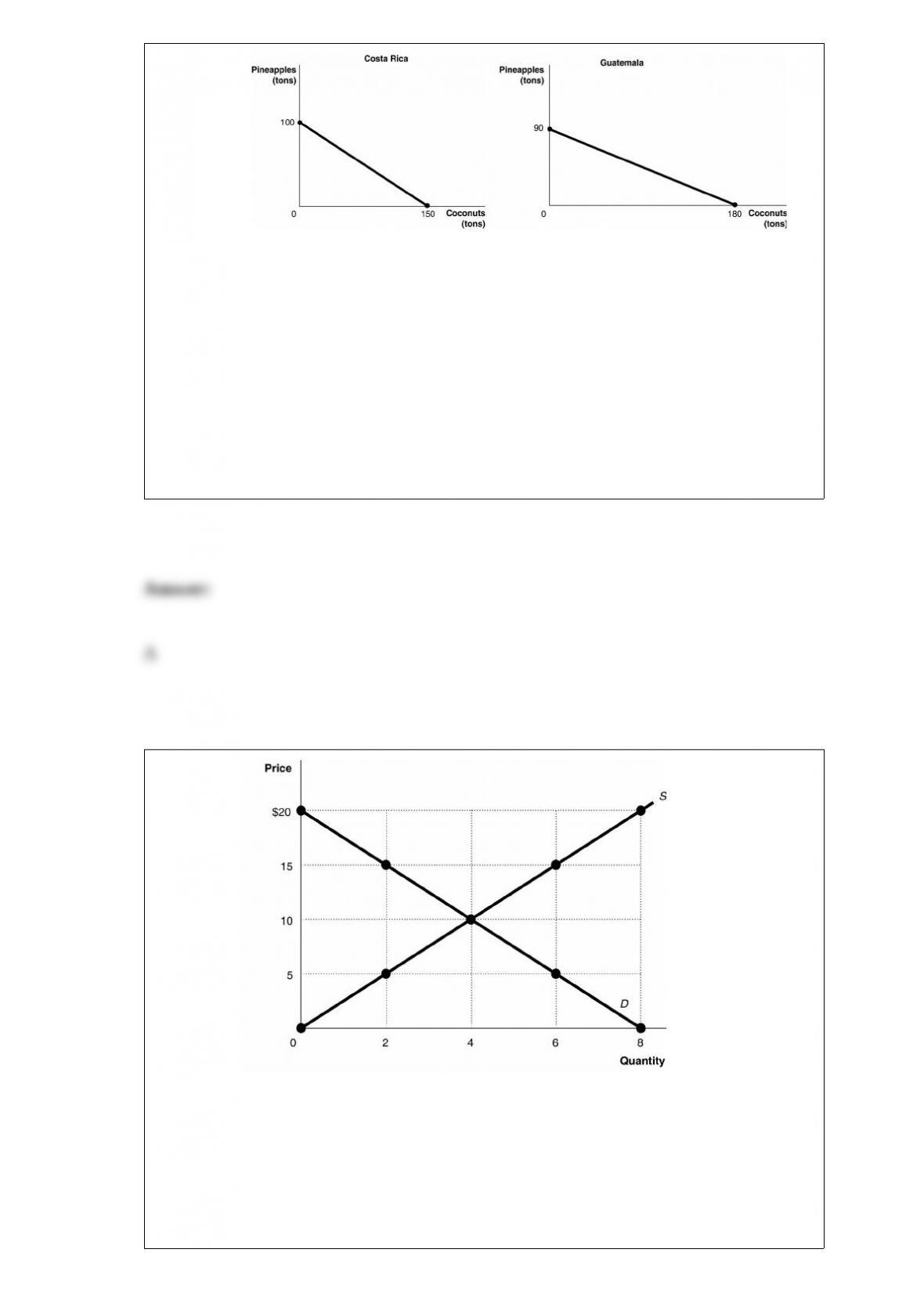
Figure 2-14
Figure 2-14 shows the production possibilities frontiers for Costa Rica and Guatemala.
Each country produces two goods, pineapples and coconuts. What is the opportunity
cost of producing 1 ton of coconuts in Guatemala?
A) 1/2 of a ton of pineapples
B) 1 1/3 tons of pineapples
C) 2 tons of pineapples
D) 90 tons of pineapples
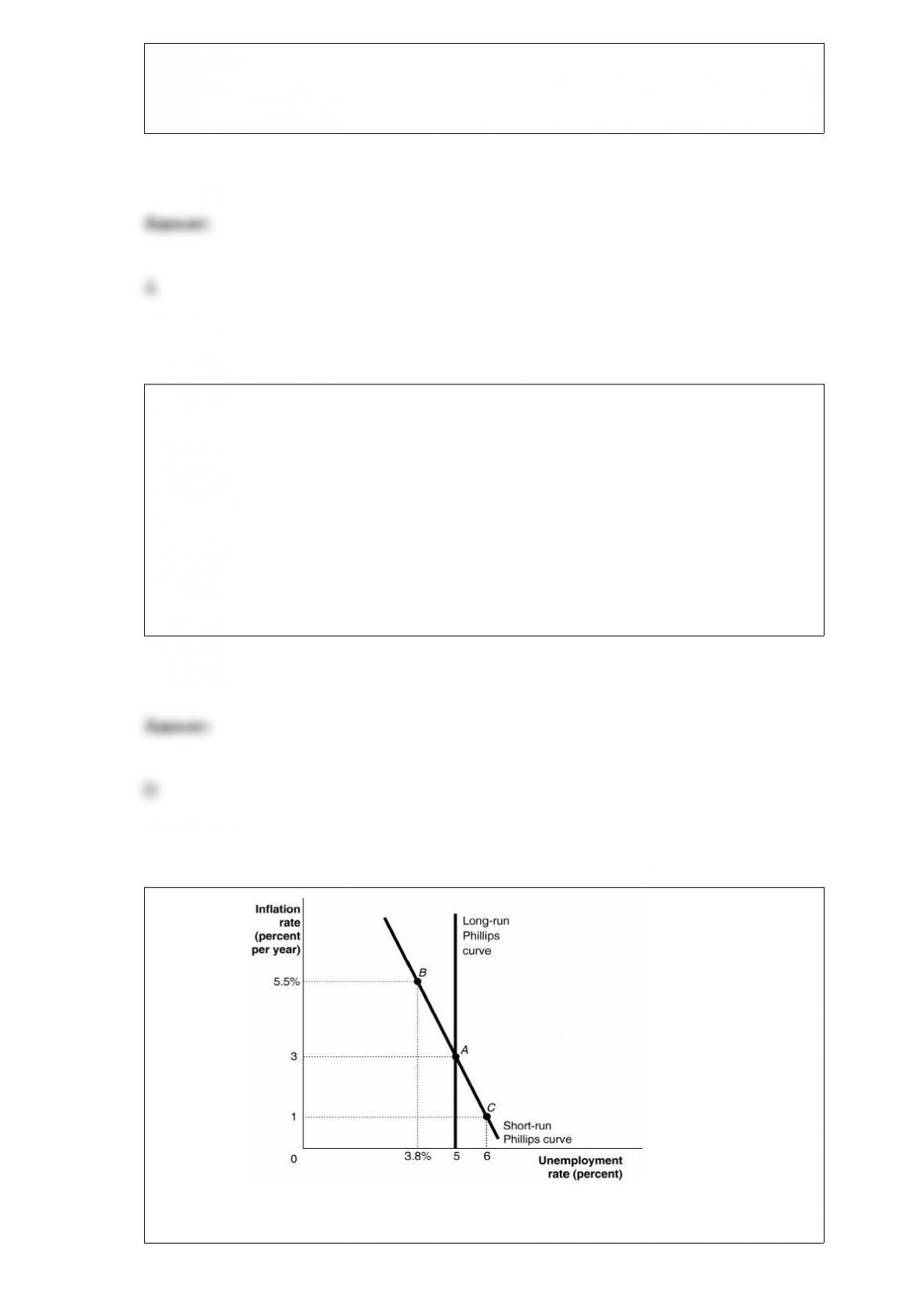
Figure 3-5
At a price of $20, the quantity sold
A) is 0 units.
B) is 4 units.
C) is 8 units.
D) cannot be determined.
The Difference between the highest price a consumer is willing to pay for a good and
the price the consumer actually pays is called
A) producer surplus.
B) the substitution effect.
C) the income effect.
D) consumer surplus.
Figure 17-2
Suppose the economy is at point B in the figure above. Which of the following is true?

A) The expected rate of inflation is 3%.
B) The natural rate of unemployment is 3.8%.
C) The current unemployment rate is 5%.
D) The economy is producing at potential GDP.
E) Expected inflation and actual inflation are the same.
If the price of beef jerky rises, the substitution effect due to the price change will cause
A) an increase in the demand for beef jerky.
B) an increase in the demand for hot sauce, a complement for beef jerky.
C) an increase in the quantity of beef jerky demanded.
D) a decrease in the quantity of beef jerky demanded.
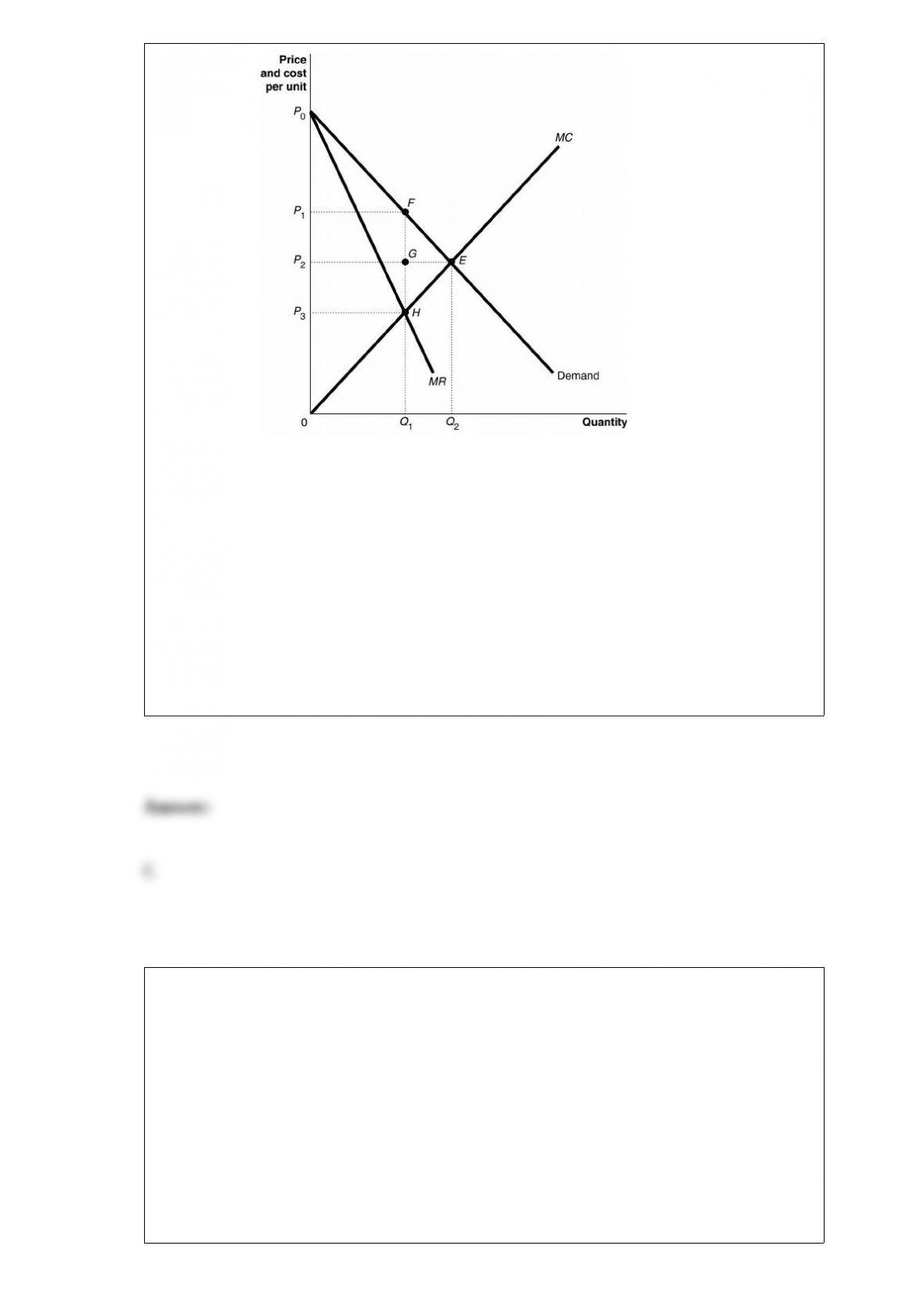
Figure 15-10
Compared to a perfectly competitive market, consumer surplus is lower in a monopoly
by an amount equal to the
A) area FHE.
B) area FGE.
C) area P1P2EF.
D) area P1P2GF.
Apple introduced its iPhone 3G in July 2008 and within a month sales had topped 3
million units. By April 2009, more than 25,000 apps for the iPhone 3G were available
in the iTunes store, an indication that in a competitive market,
A) the ease at which a new firm can enter a competitive market is low.
B) the ease at which a new firm can enter a competitive market is high.
C) entry into the market is blocked.
D) entry into the market is restricted in the short run, but becomes easier in the long

run.
Which of the following statements is true about advertising by a monopolistically
competitive firm?
A) Since the monopolistic competitor, like the perfect competitor, makes zero profit in
the long run, it is a waste of resources to advertise its products.
B) Advertising could make the monopolistic competitor’s demand more inelastic, but
advertising has no effect on a perfect competitor’s demand.
C) Advertising will be more beneficial if a monopolistic competitor colludes with other
firms to advertise the products of the industry as a whole rather than an individual firm’s
product.
D) Monopolistically competitive firms tend to shun advertising because advertising
draws attention to the variety of differentiated products available in the industry.
Protectionism is the use of ________ to protect domestic firms from foreign
competition.
A) military force
B) trade barriers
C) cheap labor
D) dumping
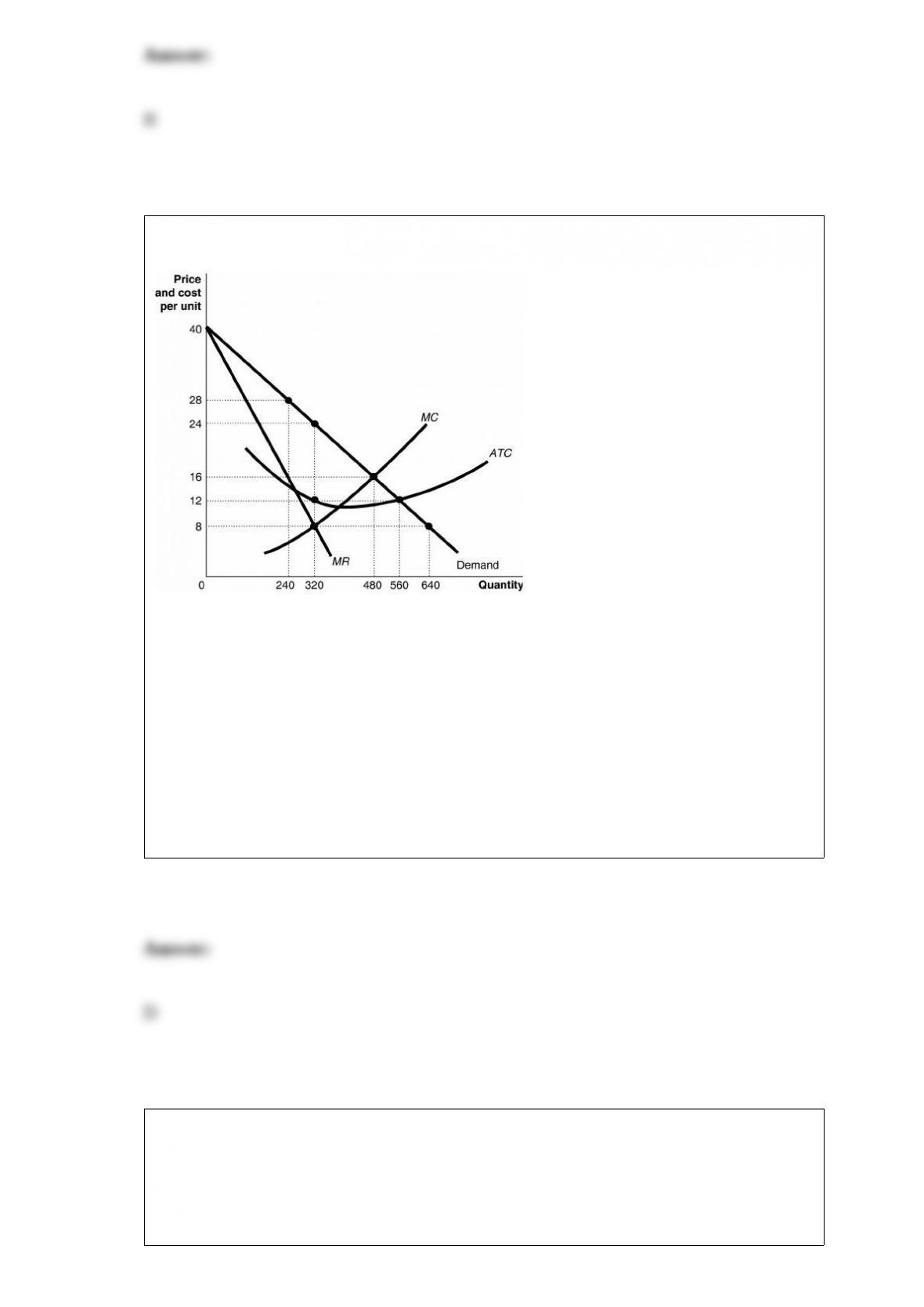
Figure 16-5
Suppose the firm represented in the diagram decides to practice perfect price
discrimination. What is the total revenue collected by the firm?
A) $6,720
B) $7,680
C) $10,240
D) $13,440
The River Rouge plant was built by the Ford Motor Company in the 1920s to produce
the company’s Model A car. Which of the following is evidence that the River Rouge
plant suffered from diseconomies of scale?
A) Despite an expensive advertising campaign, the Model A did not earn the company a

profit.
B) Model A cars made at the River Rouge plant failed to earn Ford a profit. Ford
eventually constructed smaller plants to make the Model A at a lower average cost.
C) Model A cars made at the River Rouge plant failed to earn a profit. Ford reduced the
average cost of the Model A by cutting its employees’ wages.
D) Model A cars made at the River Rouge plant failed to earn a profit because the price
of steel used to manufacture the Model A rose when workers in the steel industry went
on strike.
If currencies around the world are based on the gold standard, and the EU lowers the
amount of gold for which the euro will trade, then holding all else constant,
A) the euro will depreciate against the dollar.
B) the euro will appreciate against the dollar.
C) the value of the euro relative to the dollar will stay constant.
D) the value of U.S. exports to EU countries in terms of the euro will decrease.
Which of the following is a characteristic of a firm in a perfectly competitive market?
A) The firm cannot make a profit in the short run because it is too small a part of the
total market.
B) The firm can make a profit in the long run but not in the short run.
C) The firm can sell as much as it wants without having to lower its price.
D) The firm must lower its price in order to increase quantity demanded.
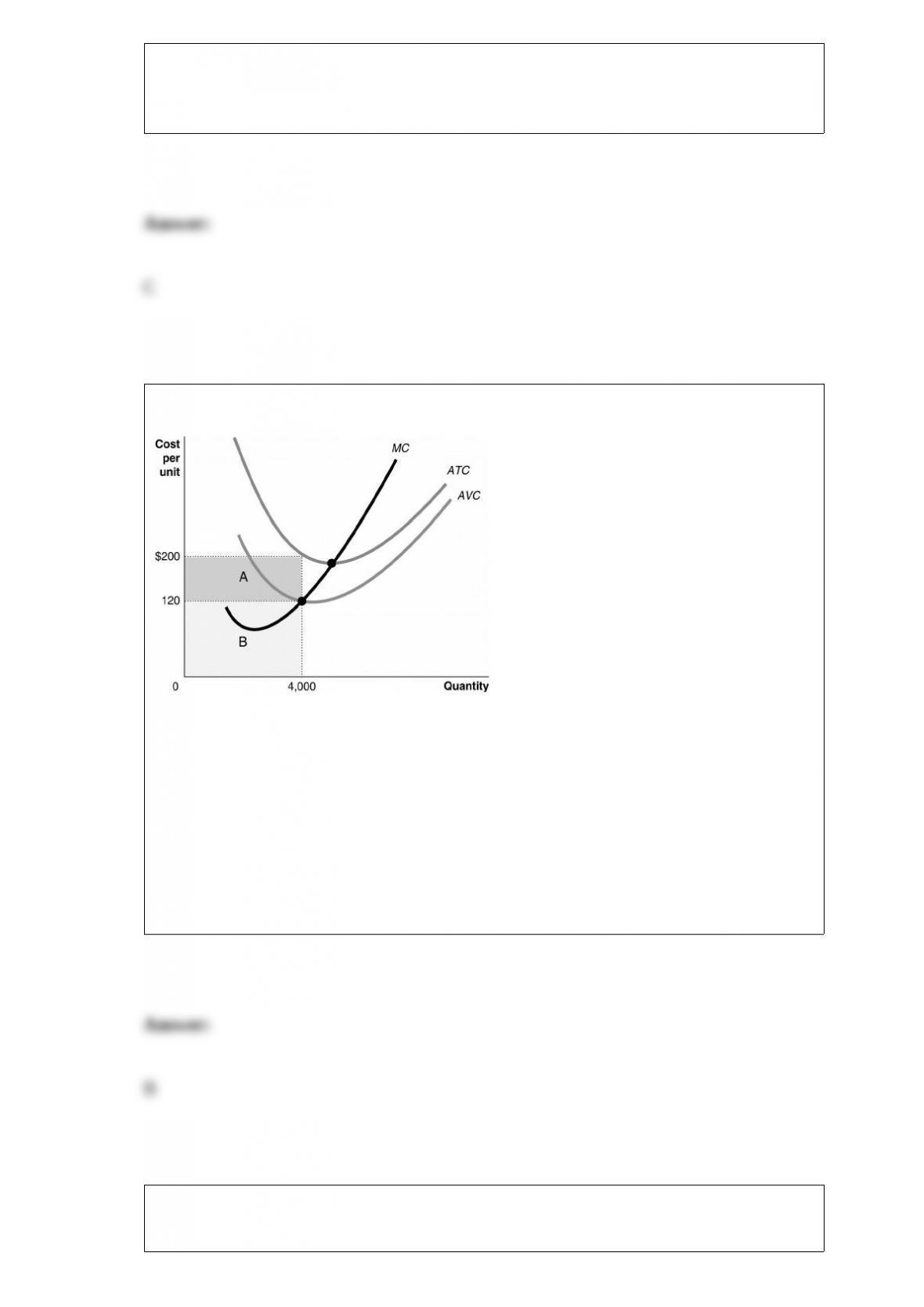
Figure 12-8
Suppose the firm produces 4,000 units. What does the shaded area labeled B represent?
A) the firm’s economic loss
B) total variable cost
C) average variable cost
D) total fixed cost
China began pegging its currency, the yuan, to the dollar in 1994. Because the yuan was
________ at the pegged exchange rate, the level of Chinese exports remained ________

than they would have been if the exchange rate were allowed to float freely.
A) undervalued; higher
B) undervalued; lower
C) overvalued; higher
D) overvalued; lower
Ceteris paribus, an increase in the current or actual rate of inflation will cause
A) the short-run Phillips curve to shift upward.
B) the unemployment rate to decrease (a movement along the short-run Phillips curve).
C) the long-run Phillips curve to shift leftward.
D) expectations of future inflation rates to be revised downward.
When we graph consumption as a function of ________ rather than as a function of
disposable income, the slope of this consumption function is ________.
A) national income; the MPC
B) personal income; (MPC – MPS)
C) national income; the MPS
D) personal income; the MPS

A decrease in aggregate expenditure has what result on equilibrium GDP?
A) Equilibrium GDP rises.
B) Equilibrium GDP is not affected by a decrease in aggregate expenditure.
C) Equilibrium GDP falls.
D) Equilibrium GDP may rise or fall depending on the size of the decrease in aggregate
expenditure relative to the initial level of GDP.
A decrease in real GDP can
A) shift money demand to the right and decrease the interest rate.
B) shift money demand to the right and increase the interest rate.
C) shift money demand to the left and decrease the interest rate.
D) shift money demand to the left and increase the interest rate.
What are the key differences between how we illustrate an expansionary fiscal policy in
the basic aggregate demand and aggregate supply model and in the dynamic aggregate
demand and aggregate supply model?
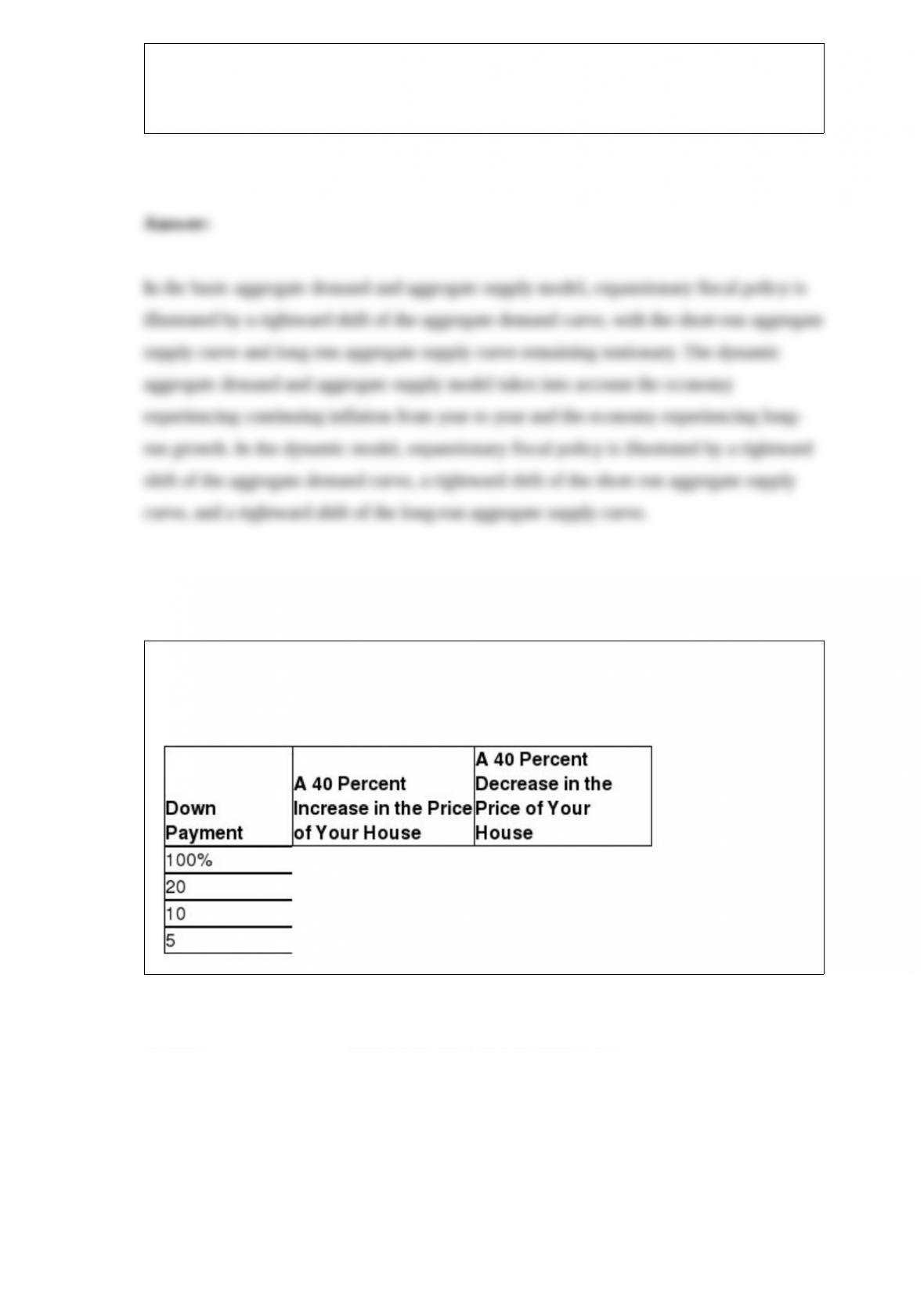
In the following table, fill in the columns for your return on investment if the price of
your house increased or decreased by 40 percent, based on the down payments
specified in the first column. Return on Your Investment From
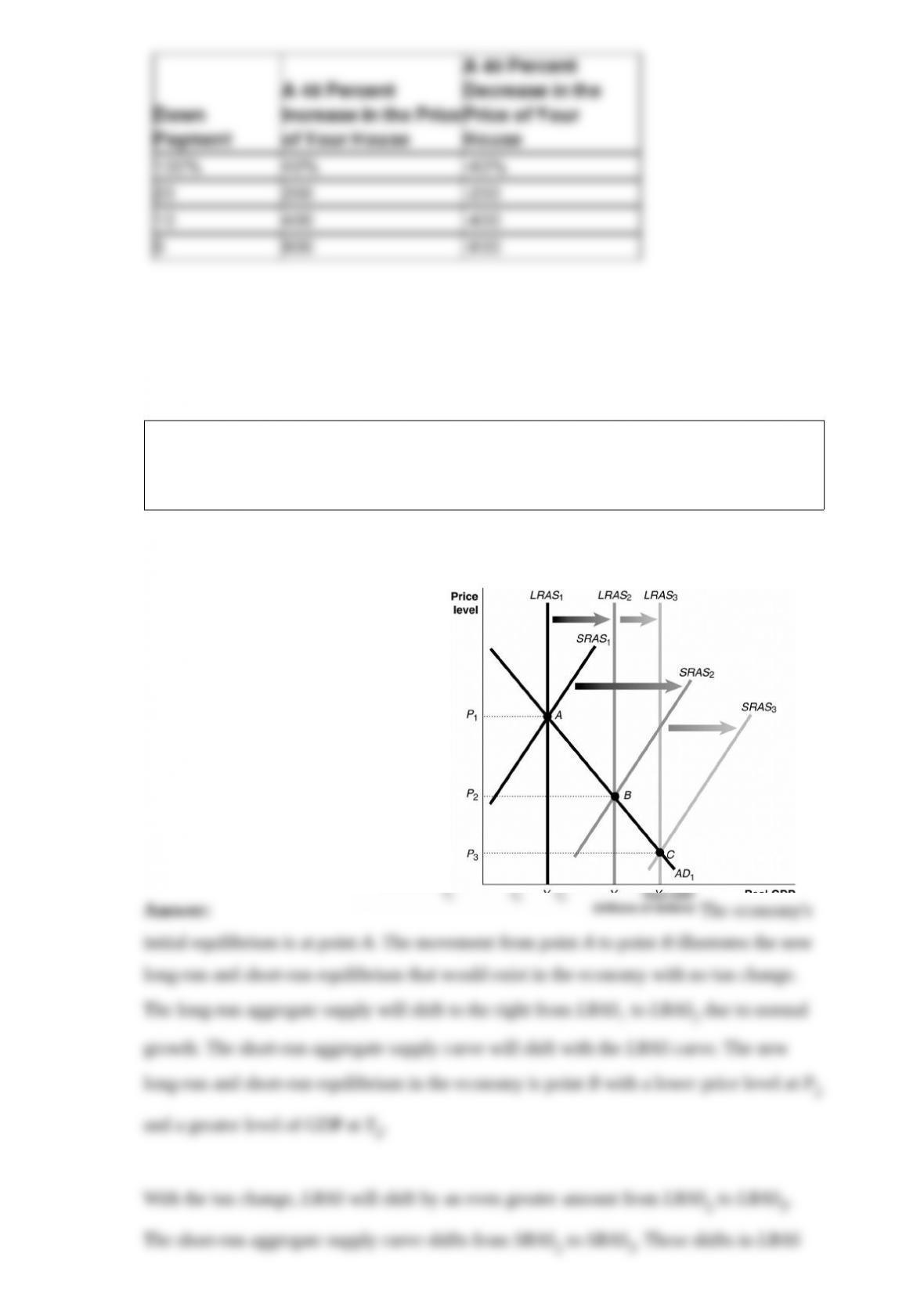
Illustrate and explain the effects of tax reduction and simplification using the dynamic
aggregate demand and supply model. To simplify the analysis, assume that aggregate
demand is not affected by the tax cut.
What is a private cost of production? What is a social cost of production? When is the
private cost of production equal to the social cost of production?
What is a marginal benefit?
What is an economic market?
What is an economic model?