1) State whether the following statement is true or false AND explain why: “An
increase in the interest rate paid on excess reserves will always cause an increase in the
federal reserve funds rate.”
2) State whether the following statement is true or false AND explain why: “A decrease
in the discount rate will always cause a decrease in the federal reserve funds rate.”
3) The financing of government spending by issuing debt
A) causes both reserves and the monetary base to rise
B) causes both reserves and the monetary base to decline
C) causes reserves to rise, but the monetary base to decline
D) has no net effect on the monetary base
4) If you buy a put option on Treasury futures at 115, and at expiration the market price
is 110, the ________ will ________ exercised.
A) call; be
B) put; be
C) call; not be
D) put; not be
5) A phenomenon closely related to market overreaction is
A) the random walk
B) the small-firm effect
C) the January effect
D) excessive volatility
6) The seller of an option has the
A) right to buy or sell the underlying asset
B) obligation to buy or sell the underlying asset
C) ability to reduce transaction risk
D) right to exchange one payment stream for another
7) Countries that experience very high rates of inflation may also have
A) balanced budgets
B) rapidly growing money supplies
C) falling money supplies
D) constant money supplies
8) In the market for reserves, if the federal funds rate is between the discount rate and
the interest rate paid on excess reserves, a ________ in the reserve requirement
increases the demand for reserves, ________ the federal funds interest rate, everything
else held constant.
A) rise; lowering
B) decline; raising
C) decline; lowering
D) rise; raising
9) Money ________ transaction costs, allowing people to specialize in what they do
best.
A) reduces
B) increases
C) enhances
D) eliminates
10) As a source of funds for nonfinancial businesses, stocks are relatively more
important in
A) the United States
B) Germany
C) Japan
D) Canada
11) One factor contributing to the decline in cost advantages that banks once had is the
A) decline in the importance of checkable deposits from over 60 percent of banks’
liabilities to 2 percent today
B) decline in the importance of savings deposits from over 60 percent of banks’
liabilities to under 15 percent today
C) decline in the importance of checkable deposits from over 40 percent of banks’
liabilities to 15 percent today
D) decline in the importance of savings deposits from over 40 percent of banks’
liabilities to under 20 percent today
12) The first country to adopt inflation targeting was
A) the United Kingdom
B) Canada
C) New Zealand
D) Australia
13) A central bank’s attempt to prevent an appreciation of its currency can stimulate
domestic inflation if the ________ of its currency leads to ________ international
reserves which ________ the monetary base.
A) purchase; higher; increases
B) purchase; lower; decreases
C) sale; lower; decreases
D) sale; higher; increases
14) A debt contract is incentive compatible
A) if the borrower has the incentive to behave in the way that the lender expects and
desires, since doing otherwise jeopardizes the borrower’s net worth in the business
B) if the borrower’s net worth is sufficiently low so that the lender’s risk of moral
hazard is significantly reduced
C) if the debt contract is treated like an equity
D) if the lender has the incentive to behave in the way that the borrower expects and
desires
15) Everything else held constant, a change in workers’ expectations about inflation will
cause ________ to change.
A) aggregate demand
B) short-run aggregate supply
C) the production function
D) long-run aggregate supply
16) Keynes’s theory of the demand for money is consistent with
A) countercyclical movements in velocity
B) a constant velocity
C) procyclical movements in velocity
D) a relatively stable velocity
17) Banks that actively manage liabilities will most likely meet a reserve shortfall by
A) calling in loans
B) borrowing federal funds
C) selling municipal bonds
D) seeking new deposits
18) The Second Bank of the United States
A) was disbanded in 1811 when its charter was not renewed
B) had its charter renewal vetoed in 1832
C) is considered to be the primary cause of the bank panic of 1907
D) None of the above
19) The yield to maturity is ________ than the ________ rate when the bond price is
________ its face value.
A) greater; coupon; above
B) greater; coupon; below
C) greater; perpetuity; above
D) less; perpetuity; below
20) If the expected path of 1-year interest rates over the next four years is 5 percent, 4
percent, 2 percent, and 1 percent, then the expectations theory predicts that today’s
interest rate on the four-year bond is
A) 1 percent
B) 2 percent
C) 3 percent
D) 4 percent
21) The National Bank Act of 1863, and subsequent amendments to it,
A) created a banking system of state-chartered banks
B) established the Office of the Comptroller of the Currency
C) broadened the regulatory powers of the Federal Reserve
D) created insurance on deposit accounts
22) ATMs were developed because of breakthroughs in technology and as a
A) means of avoiding restrictive branching regulations
B) means of avoiding paying interest to corporate customers
C) way of concealing transactions from the SEC
D) increasing the competition from foreign banks
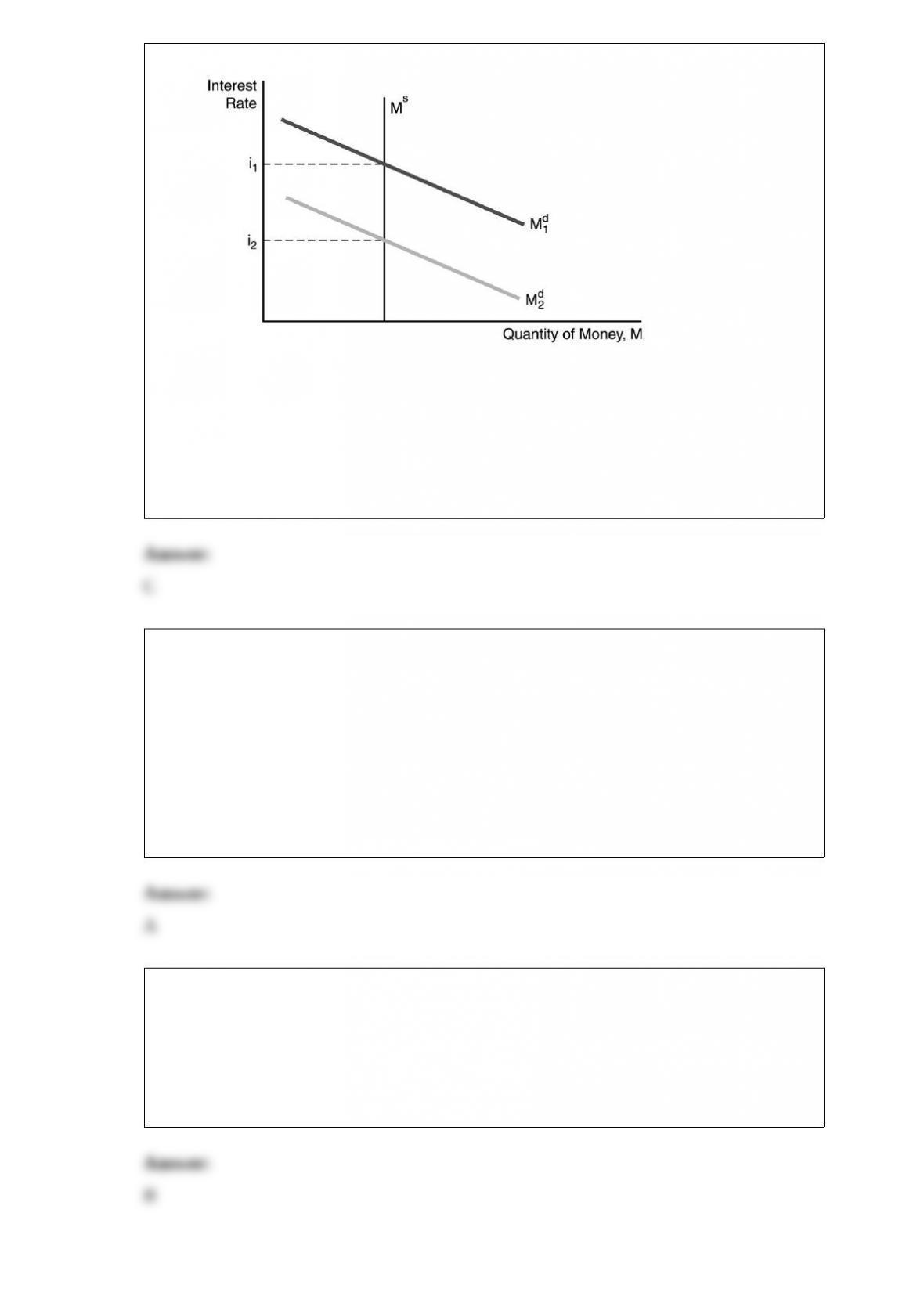
23)
In the figure above, one factor not responsible for the decline in the demand for money
is
A) a decline the price level
B) a decline in income
C) an increase in income
D) a decline in the expected inflation rate
24) The chaebols encouraged the Korean government to open up Korean financial
markets to foreign capital. The Korean government responded by
A) allowing unlimited short-term foreign borrowing but maintained quantity restrictions
on long-term foreign borrowing by financial institutions
B) allowing unlimited short-term and long-term foreign borrowing by financial
institutions
C) maintaining quantity restrictions on short-term foreign borrowing but allowing
unlimited long-term foreign borrowing by financial institutions
D) not allowing any foreign borrowing by financial institutions
25) The Policy Trilemma states that a country or a monetary union can’t pursue the
following three policies at the same time:
A) capital control, a fixed exchange rate, and an independent monetary policy
B) free capital mobility, a fixed exchange rate, and an independent monetary policy
C) free capital mobility, a flexible exchange rate, and an independent monetary policy
D) capital control, a flexible exchange rate, and an independent monetary policy
26) The fact that banks operate on a ‘sequential service constraint” means that
A) all depositors share equally in the bank’s funds during a crisis
B) depositors arriving last are just as likely to receive their funds as those arriving first
C) depositors arriving first have the best chance of withdrawing their funds
D) banks randomly select the depositors who will receive all of their funds
27) Factors likely to cause a financial crisis in emerging market countries include
A) severe fiscal imbalances
B) decreases in foreign interest rates
C) a foreign exchange crisis
D) too strong oversight of the financial industry
28) The advantage of a “buy-and-hold strategy” is that
A) net profits will tend to be higher because there will be fewer brokerage commissions
B) losses will eventually be eliminated
C) the longer a stock is held, the higher will be its price
D) profits are guaranteed
29) Using the liquidity preference framework, show what happens to interest rates
during a business cycle recession.
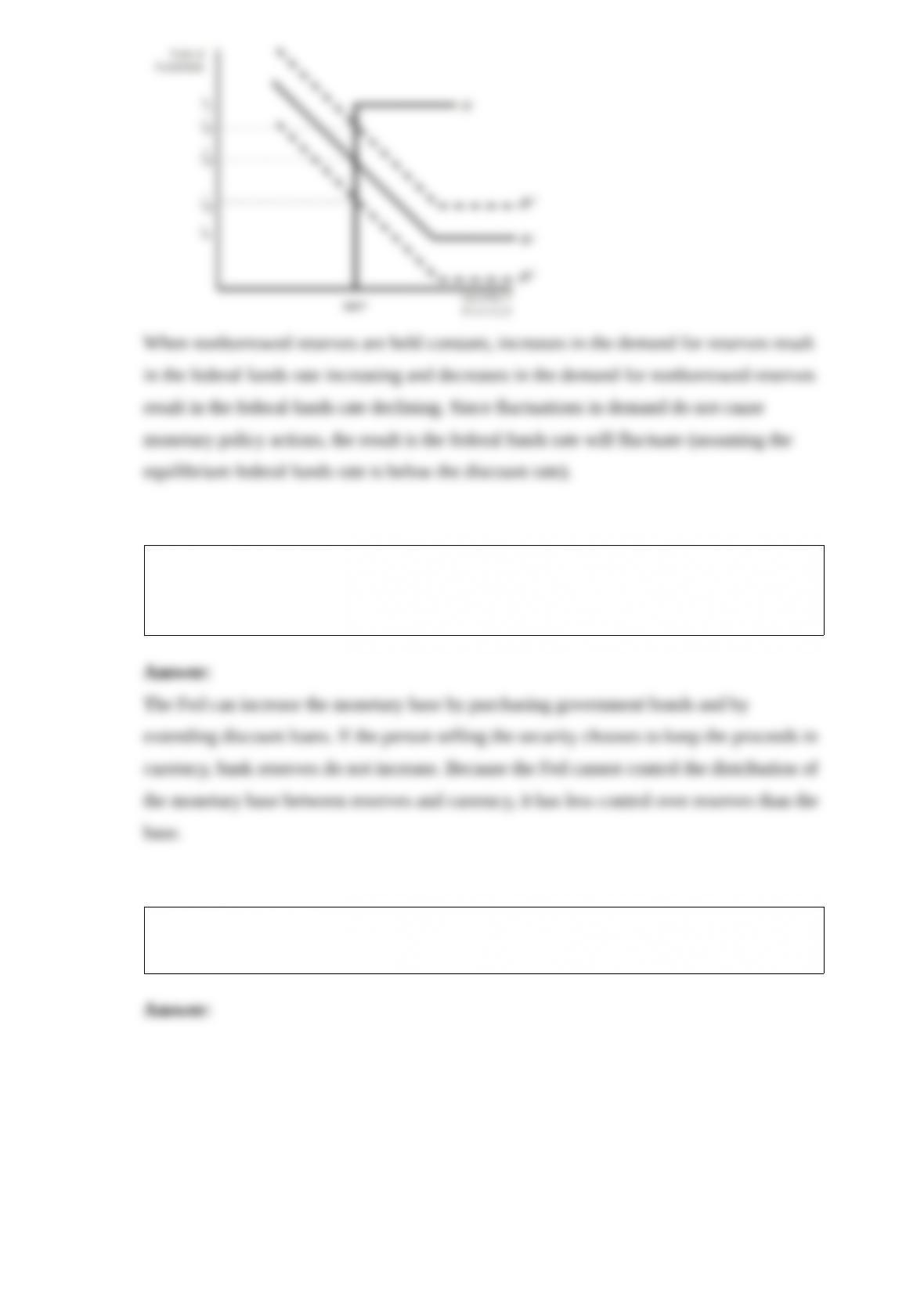
30) Explain and demonstrate graphically how targeting nonborrowed reserves can result
in federal funds rate instability.
31) Explain two ways by which the Federal Reserve System can increase the monetary
base. Why is the effect of Federal Reserve actions on bank reserves less exact than the
effect on the monetary base?
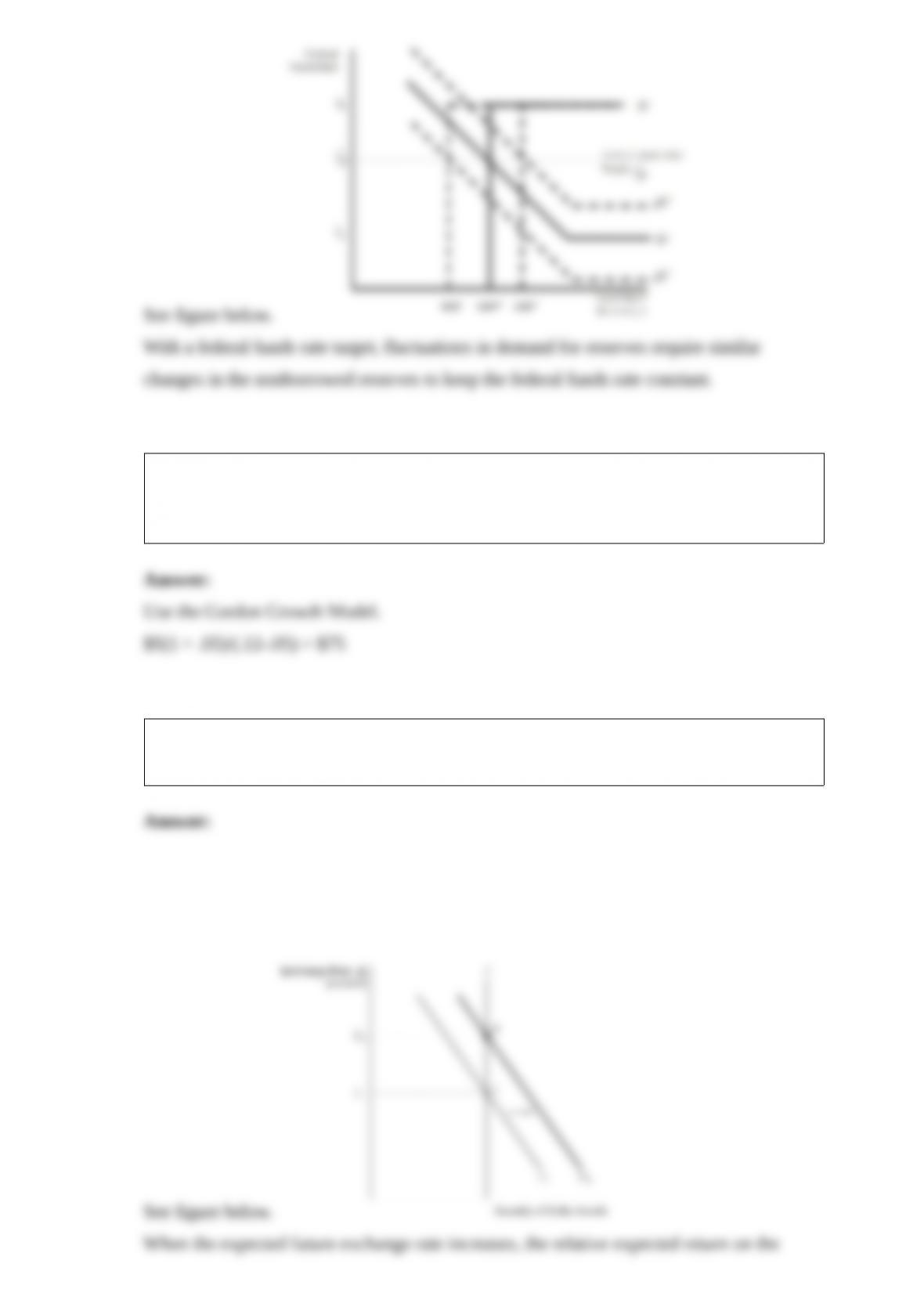
32) Explain and demonstrate graphically how targeting the federal funds rate can result
in fluctuations in nonborrowed reserves.
33) You believe that a corporation’s dividends will grow 5% on average into the
foreseeable future. If the company’s last dividend payment was $5 what should be the
current price of the stock assuming a 12% required return?
34) Explain and show graphically the effect of an increase in the expected future
exchange rate on the equilibrium exchange rate, everything else held constant.