
Cal’s Cab Company (CCC) has a taxi monopoly in Wen Kroy. The demand for taxi
services in Wen Kroy is given by Q = 1,500 ” P. CCC’s costs are given by TC = 100 ”
Q2 + 5Q3. Its maximum monopoly profit is:
a. $0.
b. $5,500.
c. $6,600.
d. $7,700.
e. $9,900.
Principal”agent problems can exist between:
a. workers and managers.
b. workers and owners.
c. workers and customers.
d. owners and customers.
e. all the above.
The root-mean-squared error (RMSE) is:

a. the proportion of the variation in the dependent variable that is explained by the
regression.
b. the coefficient estimate divided by the standard error of the estimate.
c. an increasing function of the number of independent variables.
d. the square root of the coefficient of determination.
e. useful for constructing confidence intervals for estimates of the dependent variable.
Ramblin” Randy’s Dude Ranch’s daily total cost of accommodating overnight guests is
given by TC = 100 + 5Q. On the basis of this information, the average fixed cost, when
there are 25 overnight guests, is:
a. $4.
b. $5.
c. $6.
d. $7.
e. $9.
A decreasing-cost industry is one in which:

a. input prices fall over time.
b. technology deteriorates over time.
c. input prices and technology do not change over time.
d. firms are in the growth phase of the industry’s life cycle.
e. input prices fall or technology improves as firms enter the industry.
Framjam Sports Equipment produces basketballs at its factory in Kentucky and soccer
balls at its factory in Illinois. At its current annual rate of production, the cost of
producing basketballs is $70,000 and the cost of producing soccer balls is $45,000. If
the firm consolidates production at a single location, the annual cost of production will
be $100,000. What is the degree of economies of scope in this case?
a. 15.
b. 0.25.
c. 0.15.
d. 0.85.
e. None of the above.

To maximize profit, the firm must:
a. mark up average variable costs.
b. mark up marginal costs.
c. mark up average fixed costs.
d. set the markup equal to “1/(h + 1).
e. b and d
The product rule of differentiation is:
a. Y = U(X)W(X) dY/dX = (U dW/dX)(W dU/dX).
b. Y = U(X)W(X) dY/dX = (W dW/dX) / (U dU/dX).
c. Y = U(X)W(X) dY/dX = (U dW/dX) ” (W dU/dX).
d. Y = U(X)W(X) dY/dX = (U dW/dX) + (W dU/dX).
e. Y = U(X)W(X) dY/dX = (W dW/dX) + (U dU/dX).
If price is above the average variable cost but below the average total cost of a
representative firm in a competitive industry:

a. there will be entry to the industry over time.
b. there will be exit from the industry over time.
c. the firms in the industry are just earning a normal rate of return.
d. the firms in the industry are earning a supranormal rate of return.
e. the industry is in long-run equilibrium.
If the perfectly competitive market supply of pork bellies shifts from QS,93 = 250 + 50P
to QS,94 = 400 + 40P, and the market demand is given by QD = +10,000 ” 200P, then
the change in equilibrium price will be:
a. $2.
b. $1.
c. $0.
d. “$1.
e. “$2.
Fred Stickwick produces fixed proportion goods A and B, with QA = QB, marginal costs
MC, and marginal revenues MRA and MRB. If demand for A is greater than demand for

B, Fred should only:
a. produce B to the quantity where MRB = 0.
b. sell B to the quantity where MRB = 0 if MRA is still > MC.
c. produce B to the quantity where MRB = MC.
d. sell B to the quantity where MRB = MC.
e. produce B to the quantity where MRB = MRA.
Using the coefficient of variation instead of the standard deviation accounts for the:
a. timing of payoffs.
b. risk attendance of managers.
c. riskiness of different projects.
d. size of different projects.
e. use of a weighted average of different profits.
Betty Gamble is willing to pay exactly, but not more than, $20 to get a deal where she
has a 1/3 chance of winning $30 and a 1/6 chance of winning $6 and will win $20
otherwise. Betty is:
a. risk-averse and profit maximizing.
b. risk-averse, not profit maximizing.
c. risk loving and profit maximizing.
d. risk loving, not profit maximizing.
e. risk-neutral.
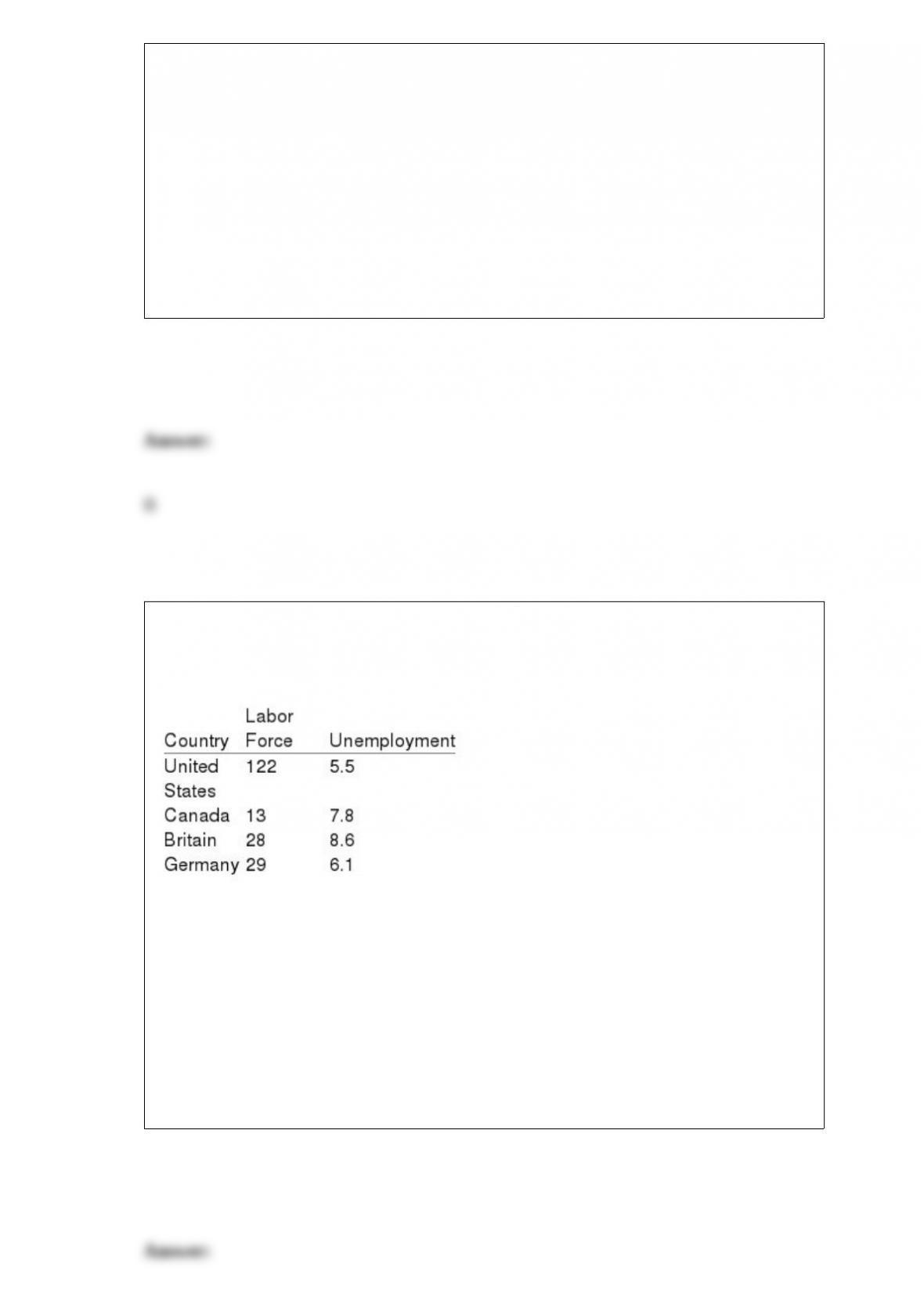
Suppose the labor force and unemployment rate in 2001 are given in the following
table. What is the slope coefficient estimate b of the regression of the unemployment
rate as a function of the labor force?
a. “0.20.
b. “0.020.
c. “0.0020.
d. “2.0.
e. 0.020.

A technique for dealing with the principal”agent problem is to:
a. require managers to purchase shares of stock in the firm.
b. establish a profit-sharing plan for managers.
c. establish year-end bonuses based on the profits of the firm.
d. all the above.
e. none of the above.
If Y = X3(5 + X 2)4, then dY/dX is:
a. 3X 2(5 + X 2)4 + 8X3(5 + X 2)3.
b. 3X 2(5 + X 2)4 + 8X4(X 2)3.
c. 3X 2(5 + X 2)3.
d. 3X 2(5 + X 2)4 + 8X4(5 + X 2)3.
e. 3X 2(5 + X 2)4 + 8X4(5 + X 2)2.
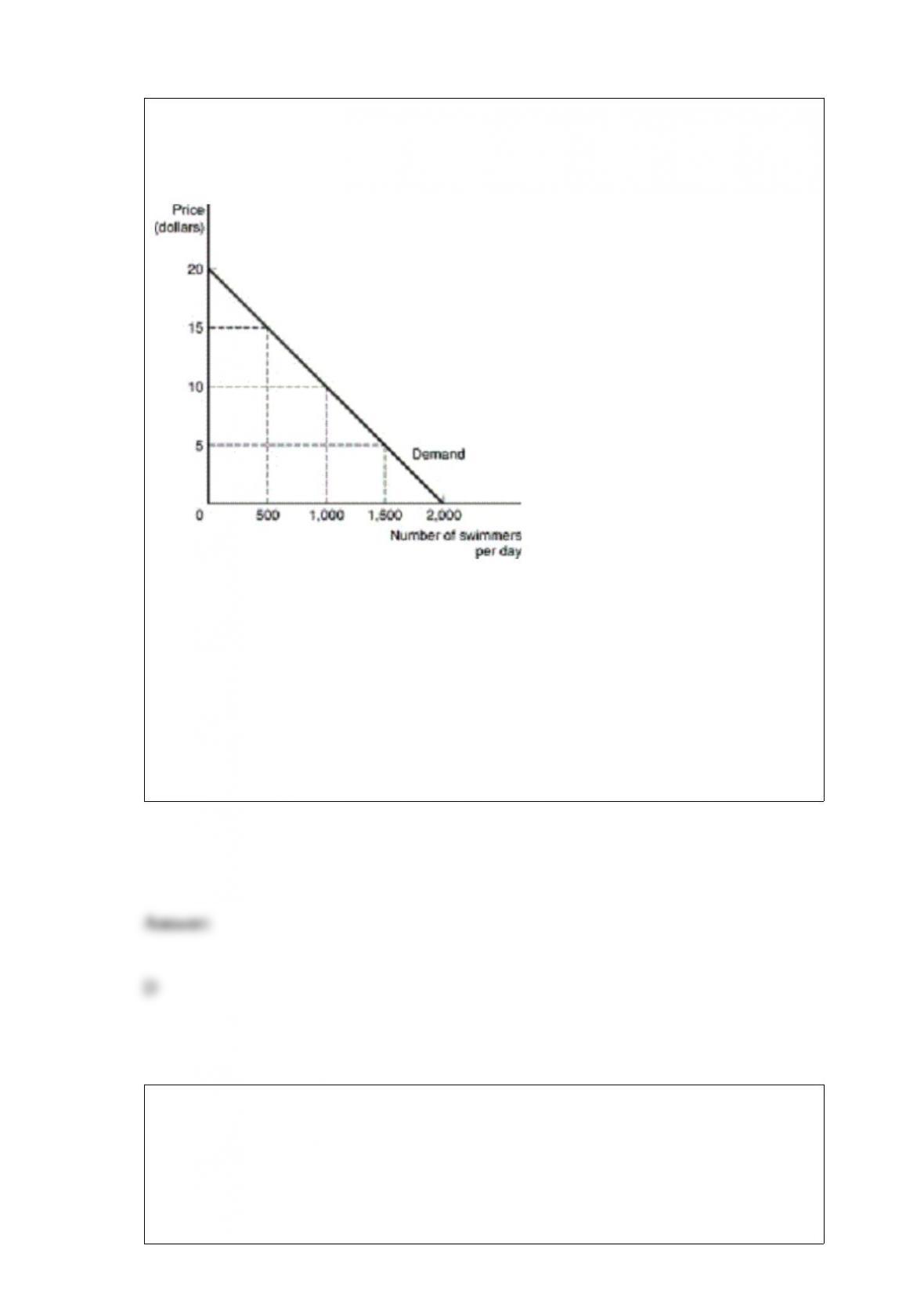
The following diagram represents the demand for trips to a local swimming pool during
the summer. If the city subsidizes the swimming pool so that swimming is free,
consumer surplus will be:
a. $0.
b. $1,500.
c. $11,250.
d. $20,000.
e. none of the above.
The per-week demand for use of the Golden Gate Bridge in San Francisco is P = 13 ”
0.15Q during peak traffic periods and P = 10 ” 0.1Q during off-peak hours, where Q is
the number of cars crossing the bridge in thousands and P is the toll in dollars. If the
marginal congestion cost of using the bridge is MC = 5 + 0.2Q, what is the optimal peak
load toll for crossing the bridge?

a. 6.5.
b. 8.0.
c. 8.7.
d. 9.9.
e. 10.5.
If Y = “2 + X + 32X3, then dY/dX is:
a. 1 + 96X3.
b. “1 + 96X2.
c. 1 + 96X2.
d. 96X2.
e. X + 32X3.
A straight line drawn from the origin is tangent to a short-run production function with
only one input, labor. At the quantity of labor where the tangency occurs:
a. the average product of labor is at a maximum.

b. the marginal product of labor is at a maximum.
c. the marginal product of labor is increasing.
d. the average product of labor is increasing.
e. the total product of labor is at a maximum.
The demand for answering machines is Q = 1,000 ” 150P + 25I. Assume that per capita
disposable income I is $200. When the price of answering machines is P = $10, the
income elasticity of demand is:
a. 2.5.
b. 0.11.
c. 1.0.
d. 25.
e. 1.11.
The formula for the income elasticity of demand can be written as:
a. hI = (DQ / DI)(I / Q).

b. hI = (DI / DQ)(I / Q).
c. hI = (DQ / DI)(Q / I).
d. hI = (DI / DQ)(Q / I).
e. none of the above.
Regardless of the rules of an auction, the winner will pay:
a. his or her reservation price for the good at auction.
b. the true value of the good at auction.
c. the expected value of the good at auction.
d. the maximum amount that he or she is willing to pay for the good at auction.
e. the reservation price of the second highest bidder for the good at auction.
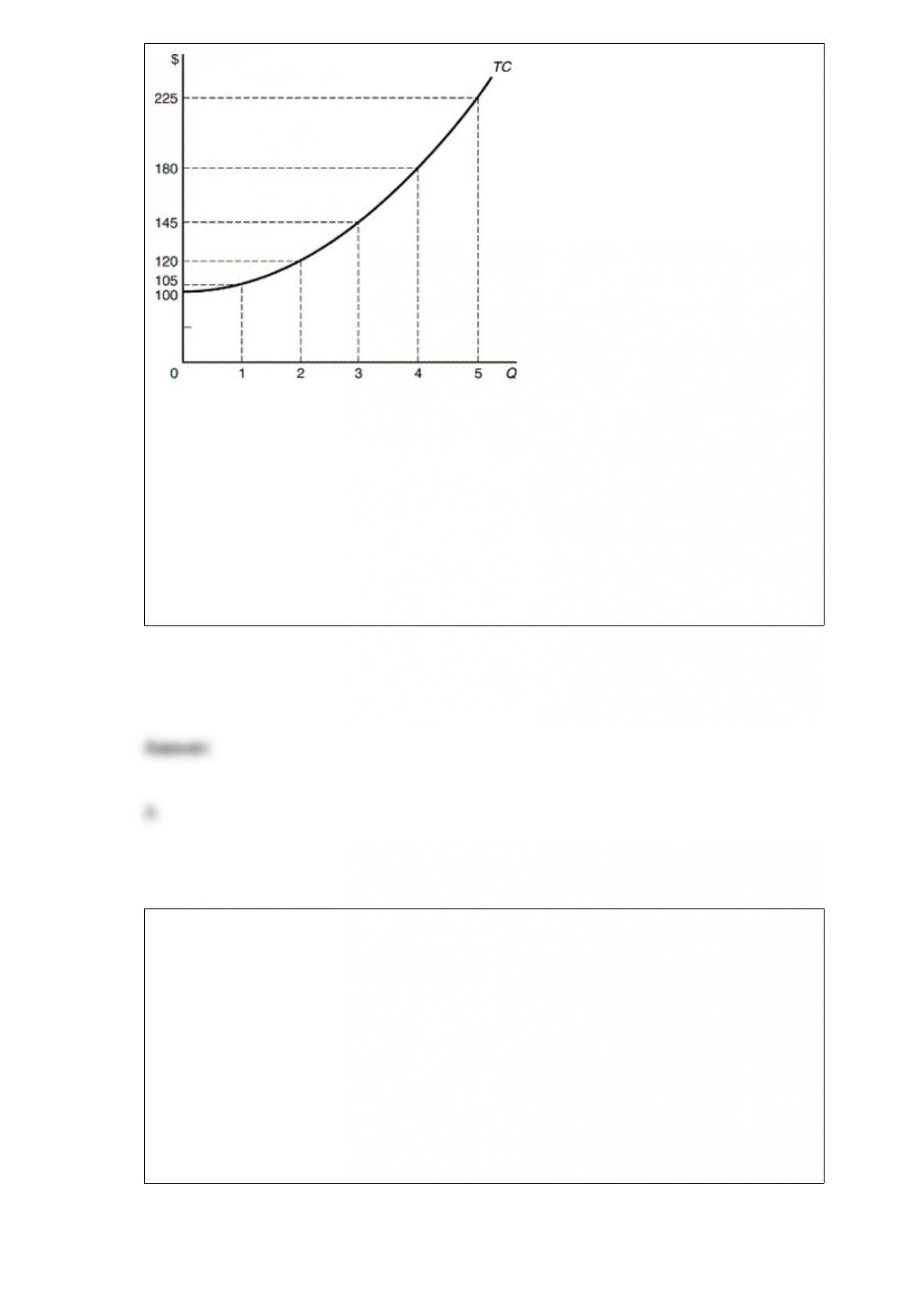
The following figure represents the short-run total cost function for the Fidget
Company, which produces widgets. The fixed costs are:
a. FC = $100.
b. FC = 10Q.
c. FC = 5Q2.
d. FC = $500.
e. not estimable from the information given.
A function of one argument is maximized when the first derivative:
a. is zero and the second derivative is positive.
b. is positive and the second derivative is negative.
c. is zero and the second derivative is negative.
d. is negative and the second derivative is positive.
e. and the second derivative are both zero.
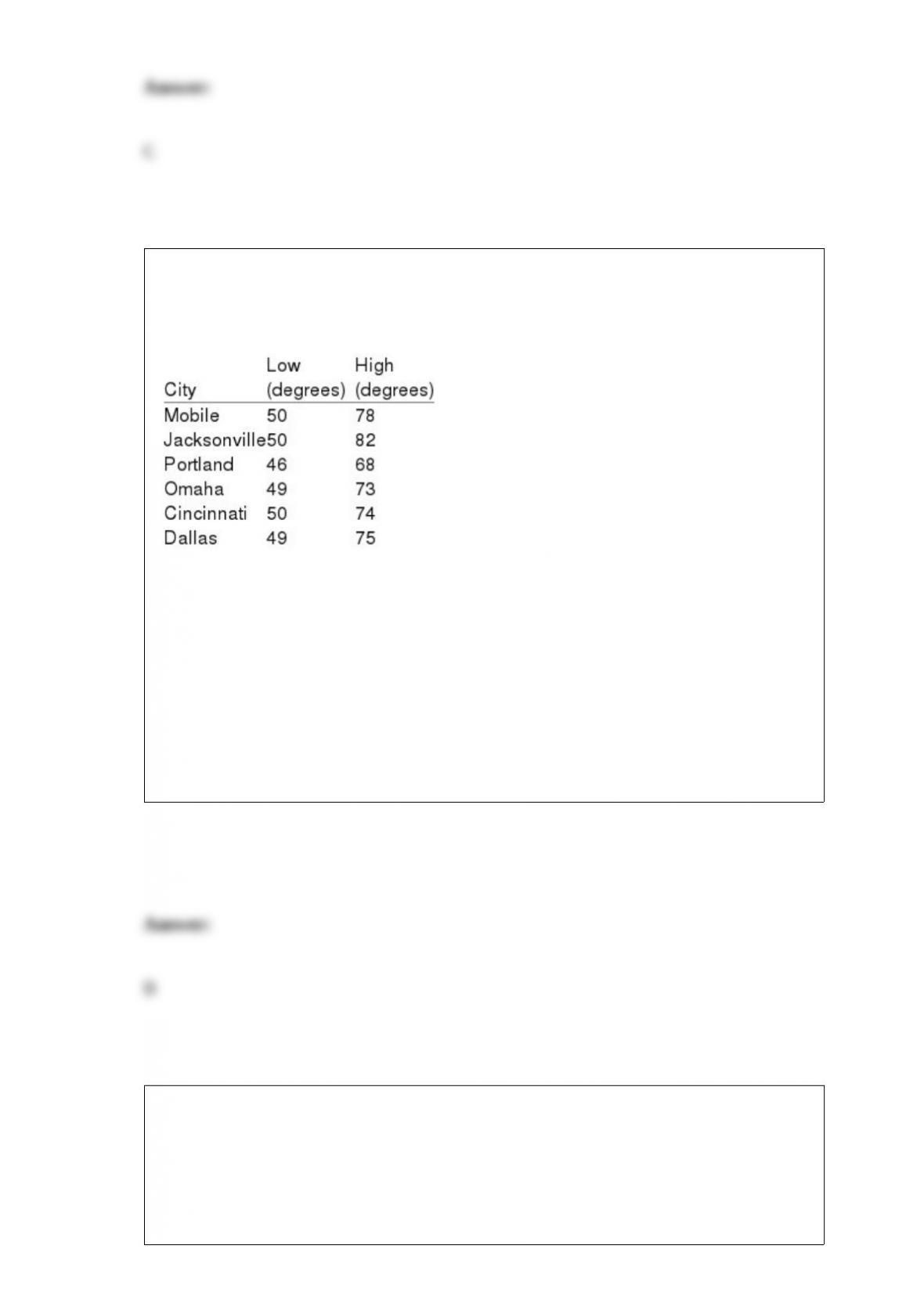
The annual mean daily high and low temperatures by selected cities are given in the
following table. What is the R-squared of the regression of the mean daily high
temperature as a function of the mean daily low temperature?
a. 0.67
b. 0.25
c. 0.75
d. 0.50
e. 0.85
The demand for answering machines is Q = 1,000 ” 150P + 25I. Assume that per capita
disposable income I is $200. When the price of answering machines is P = $10, the
price elasticity of demand is:
a. “3.0.

b. “3.33.
c. “1.33.
d. “0.33.
e. “1.0.
Instructed to choose the combination of inputs that minimizes the cost of producing
2,000 pan-head screws, your assistant returns with the startling news that the
Lagrangian multiplier is $0.10. From this you conclude that:
a. costs have not been minimized.
b. the average cost of producing screws at 2,000 units is $0.10.
c. the marginal cost of producing screws at 2,000 units is $0.10.
d. marginal cost equals average cost.
e. the price of the screws must be $0.10.
When a monopolist requires a customer to pay an initial fee for the right to buy a
product as well as a usage fee for each unit of the product bought, this is known as a(n):
a. bundling contract.

b. price differentiation.
c. oligopolistic device.
d. two-part tariff.
e. maximizing device.
With the price leadership strategy:
a. the many small firms set the market price, and the large firm must follow their
behavior.
b. the large firm sets the market price, and the many small firms must follow its
behavior.
c. firms collude to determine optimal price and output for the industry.
d. firms determine price and output independent of one another.
e. firms are not profit maximizers.