
Because an increase in the nominal interest rate raises the opportunity costs of holding
money, the money demand curve:
A. shifts to the right.
B. shifts to the left.
C. slopes upward.
D. slopes downward.
One of the serious drawbacks of the deposit insurance system in the United States is
that:
A. bank failures continue to occur regularly.
B. the system took away the Federal Reserve’s ability to conduct open-market
operations.
C. the system took away the Federal Reserve’s ability to change reserve requirements.
D. if insured intermediaries make many bad loans, the taxpayers may be responsible for
covering the losses.
Which of the following is NOT a condition for maximizing total economic surplus in a
particular market?
A. All private costs of production must be included.
B. All social costs of production must be included.

C. All private benefits of consumption must be included.
D. Government regulation of the market is needed.
The value of a worker’s marginal product of labor:
A. is not affected by a worker’s stock of human capital.
B. is lower for workers with more human capital
C. is higher for workers with more human capital.
D. only depends on a worker’s stock of human capital.
Falling growth rates during the 2007-2009 recession occurred:
A. only in the high-tech sectors of the U.S. economy.
B. only in the United States.
C. in the United States, Canada, Germany, the United Kingdom, and Japan.
D. in the United States and Canada, but not in Germany, the United Kingdom, or Japan.

Which of the following expenditures would increase the investment component of U.S.
GDP?
A. You purchase a new house.
B. You purchase a new car.
C. You purchase 1,000 shares of stock.
D. You pay a commission to your stock broker for selling some stocks that you owned.
Which of the following best describes how a perfectly competitive industry would
respond to a sudden increase in popularity of the product? The market demand curve
would shift to the right, leading to:
A. a higher equilibrium price in the short run and entry into the market in the long run.
B. a higher equilibrium price in the short run and a permanent increase in economic
profit.
C. no change in the short-run equilibrium price, and a higher long-run equilibrium
quantity.
D. a lower short-run equilibrium price due to the entry of firms into the market.
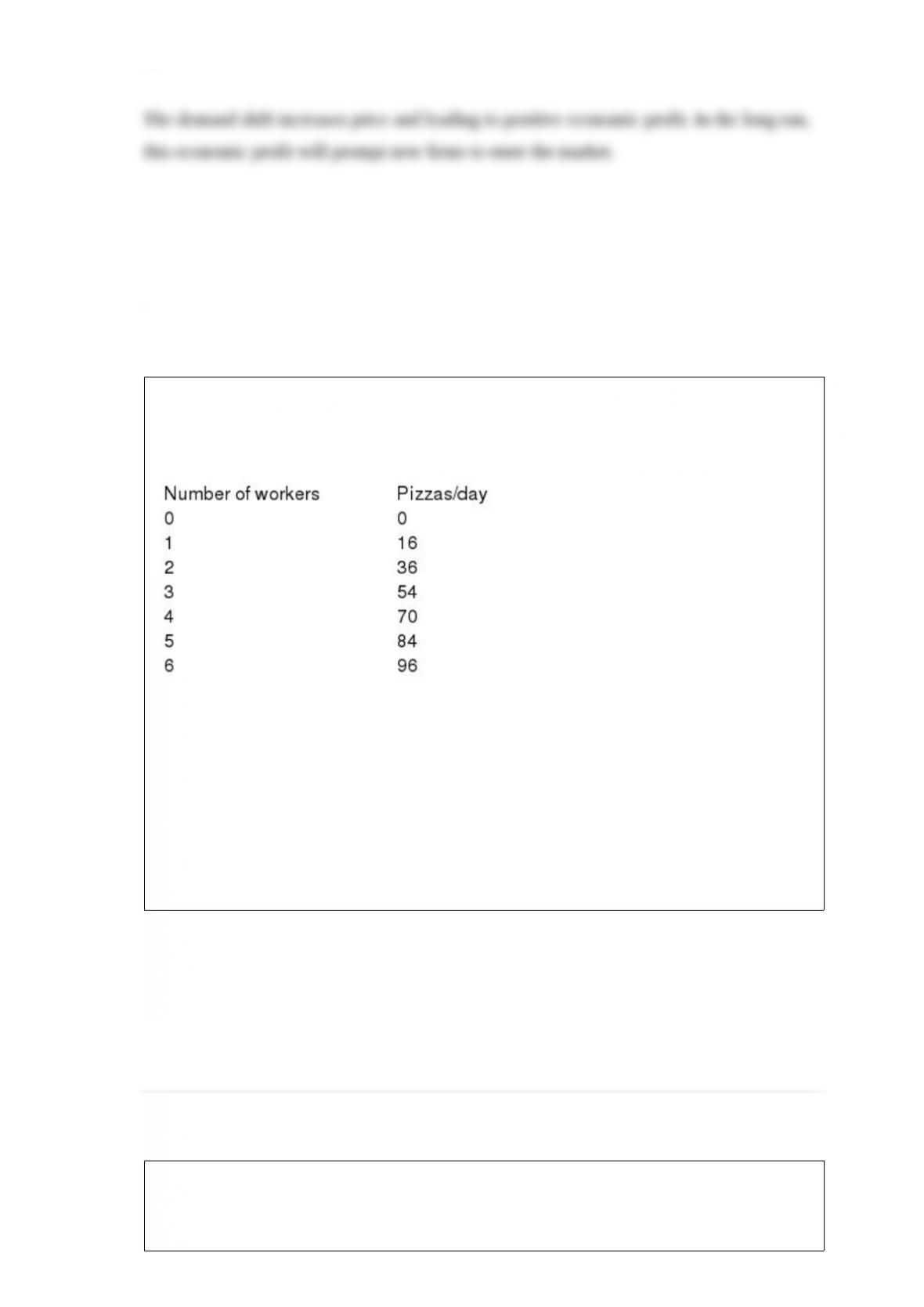
Gino’s Pizza shop hires workers in a competitive market to make pizza. The ingredients
required to make each pizza cost $5. Daily output at Gino’s Pizza varies with the
number of workers hired, as shown in the table below:
The marginal product of the 3rd worker is ______ pizzas per day.
A. 12
B. 14
C. 16
D. 18
Matt is offered a job driving the campus shuttle bus from 4 p.m. to 6 p.m. each Monday.
His reservation wage for this job is $7 per hour. Suppose the campus transportation
director offers Matt $50 per hour. Will Matt accept this job?

A. Yes, accepting the job means a positive economic surplus for Matt.
B. No, accepting the job means a negative economic surplus for Matt.
C. Yes, although accepting the job means a negative economic surplus for Matt, it’s still
better than having no job.
D. No, although accepting the job means a positive economic surplus for Matt, still it’s
not the best option for him.
If country A can produce more of practically everything than can country B, then which
of the following statements is true?
A. Country A has no incentive to trade with country B.
B. Country B cannot have a comparative advantage in the production of any good that
country A wants to buy.
C. Trade can benefit both countries.
D. Country B has no incentive to trade with country A.
Which of the following hypotheses is a plausible explanation for why U.S. households
save so little?
A. Government assistance to the elderly has reduced the need for life-cycling saving.
B. Most American already own homes and, therefore, have less need for life-cycle
saving.
C. The highly developed financial markets in the U.S. have reduced the need for
precautionary saving by Americans.
D. Government assistance to low-income U.S. households has increased the
demonstration effects on spending by the poor.
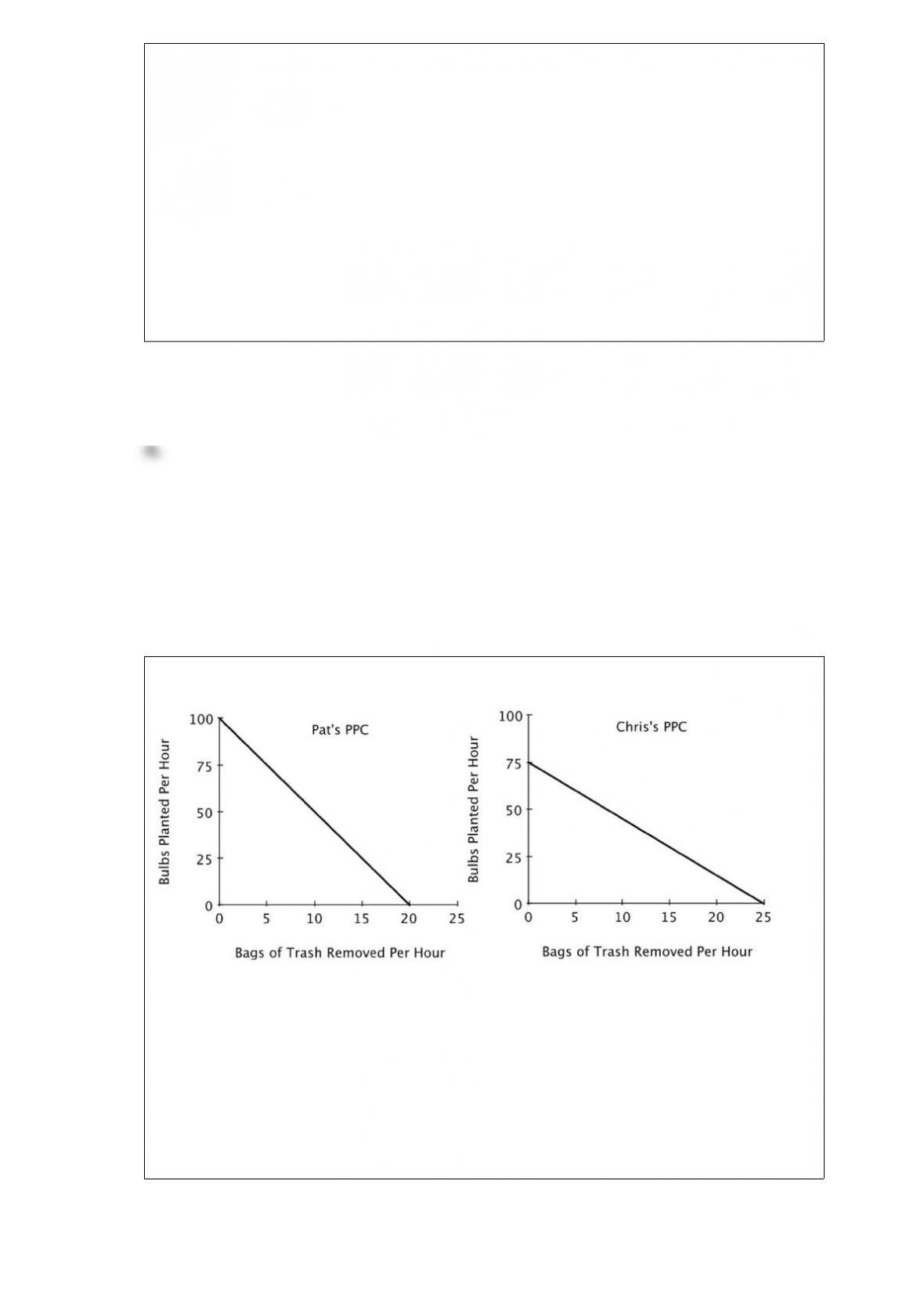
Refer to the figure below. If Pat and Chris each spend half their time on each task, then:
A. the outcome will be efficient.
B. they will plant more bulbs and remove fewer bags of trash than if they had each
specialized in the task at which they have a comparative advantage.
C. they will plant fewer bulbs and remove fewer bags of trash than if they each had
specialized in the task at which they have a comparative advantage.
D. the outcome will be unattainable.
Economists recognize that because people have limited resources:
A. government intervention is necessary.
B. they have to make trade-offs.
C. they will never be happy.
D. our future is bleak.
The real interest rate equals the:
A. nominal interest rate plus the inflation rate.
B. nominal interest rate minus the inflation rate.
C. inflation rate minus the nominal interest rate.
D. inflation rate times the nominal interest rate.
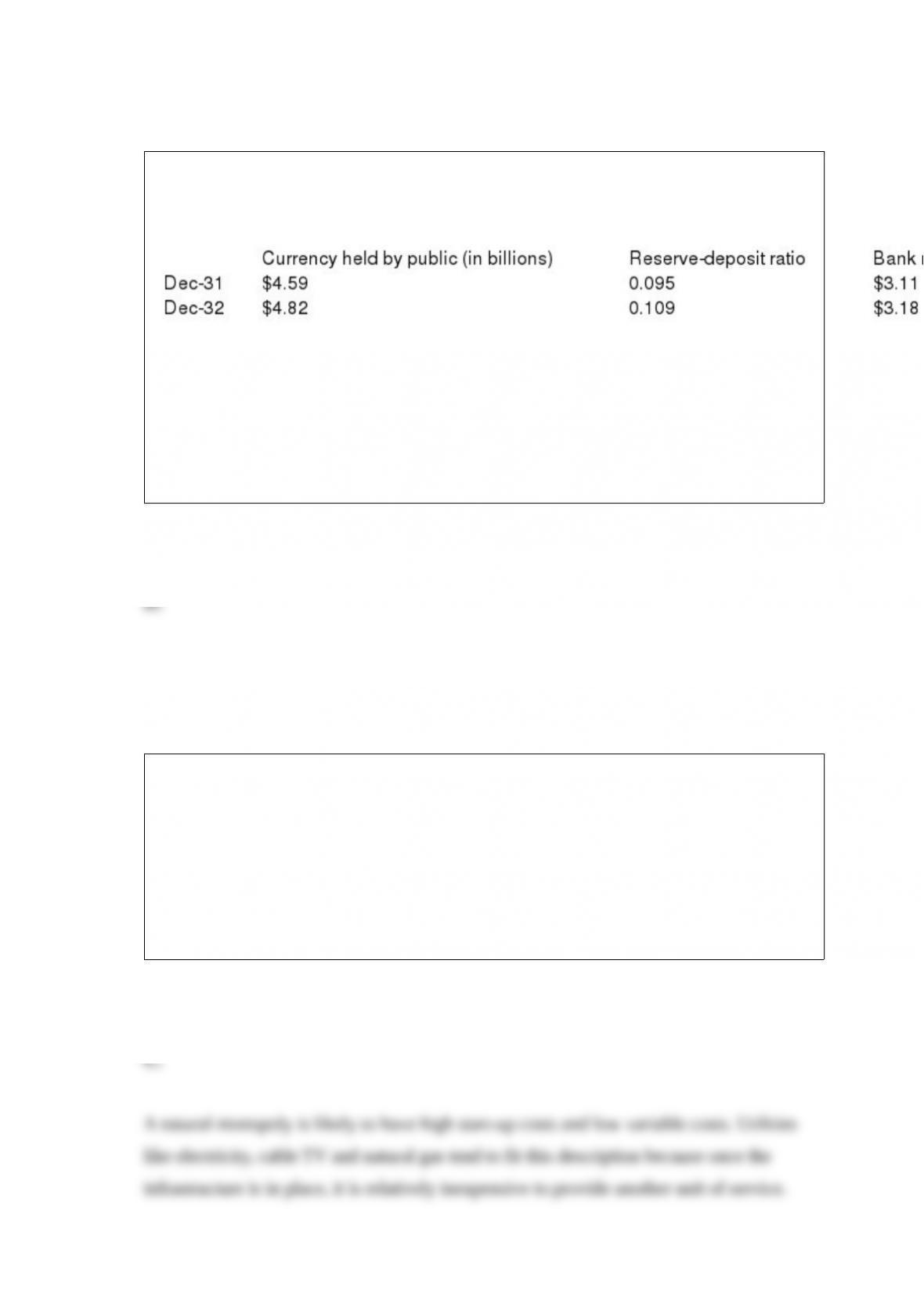
Refer to the table below. The amount of currency held by the public ______, and the
amount of reserves held by banks ______. It must be the case that, in 1932, the Federal
Reserve ______.
A. increased; also increased; increased the discount rate
B. decreased; also decreased; kept the rate of inflation low
C. decreased; increased; performed open-market operations
D. increased; also increased; injected reserves into the economy
Which of the following industries does not fit the natural monopoly model?
A. Electricity
B. Cable TV
C. Fast food restaurants
D. Natural gas

Commercial banks create new money:
A. when they increase their desired reserve/deposit ratio.
B. by issuing checks.
C. through multiple rounds of lending.
D. when they buy government bonds from the Federal Reserve.
Proponents of fixed exchange rates, who argue that these rates eliminate uncertainty
and therefore promote international trade, sometimes fail to recognize:
A. that fixed exchange rates may not remain fixed forever.
B. that fixed exchange rates are more volatile than flexible exchange rates.
C. that exchange rates do not matter to businesses, so the uncertainty has no impact.
D. that international trade is bad for the economy and should not be promoted.
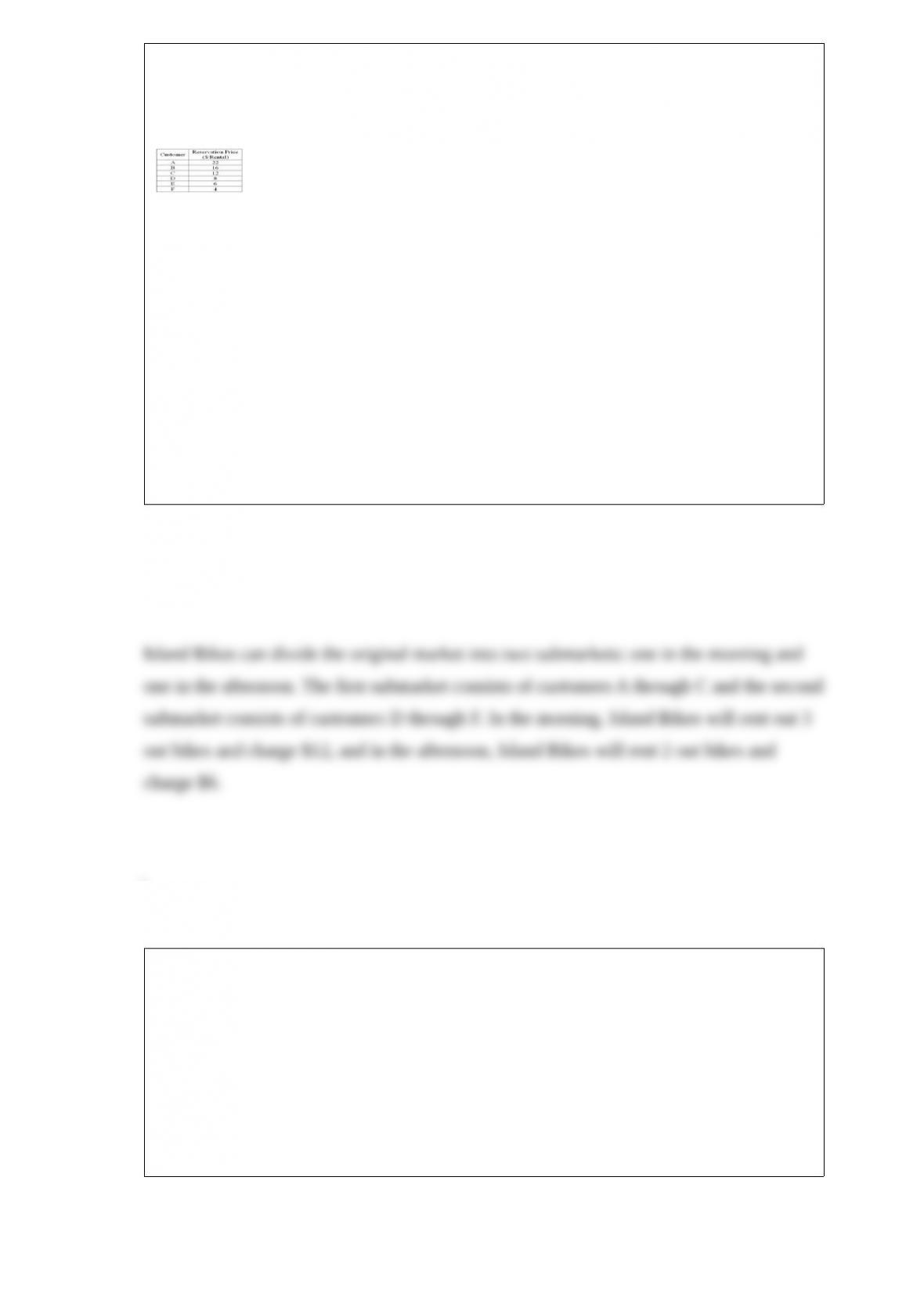
Suppose Island Bikes, a profit-maximizing firm, is the only bike rental company in a
small resort town. The marginal cost to Island Bikes of renting out a bike is $3, and
Island Bikes has no fixed costs. Each day Island Bikes has six potential customers,
whose reservations prices are listed below.
Suppose Island Bikes knows that customers whose reservation prices are at least $10
always rent bikes before noon, while those whose reservation prices are below $10
never do so. If Island bikes can charge a different price in the morning and in the
afternoon, then in the morning, it will rent out ______ bike(s) and charge ______ per
bike.
A. 1; $22
B. 2; $16
C. 3; $12
D. 4; $8
If a bank’s desired reserve/deposit ratio is 0.33 and it has deposit liabilities of $100
million and reserves of $50 million, it:
A. has too few reserves and will reduce its lending.
B. has too many reserves and will increase its lending.
C. has the correct amount of reserves and outstanding loans.
D. should increase the amount of its reserves.

The nominal exchange rate is the:
A. market on which currencies of various nations are traded for one another.
B. price of the average domestic good or service relative to the price of the average
foreign good or service, when prices are expressed in terms of a common currency.
C. quantity of foreign currency assets held by a government for the purpose of
purchasing the domestic currency in the foreign exchange market.
D. rate at which two currencies can be traded for each other.
An example of a government policy to increase human capital formation is:
A. the construction of an interstate highway system.
B. the provision of publicly-funded education.
C. government support for basic research.
D. maintaining a well-functioning legal system.

Consider an industry with two firms producing similar products. Each firm’s total cost
(in dollars) is given below.
Mega Corp: TC = 5,000 + 100Q.
Big Inc: TC = 4,000 + 200Q.
When each firm produces 8 units, ______ has a lower total cost, and when each firm
produces 12 units, ______ has a lower total cost.
A. Big Inc; Mega Corp
B. Mega Corp; Big Inc
C. Big Inc; Big Inc
D. Mega Corp; Mega Corp
If you wish to maintain a constant purchasing power when you retire, you should
choose retirement income options that are:
A. deflated.
B. nominal.
C. indexed.
D. inflated.

An exchange rate that is set by official government policy is called a ______ exchange
rate.
A. real
B. nominal
C. fixed
D. flexible
The U.S. dollar exchange rate, e, expressed as Japanese yen per U.S. dollar, will
depreciate when:
A. real GDP in the U.S. increases.
B. real GDP in Japan increases.
C. the U.S. Federal Reserve tightens monetary policy.
D. U.S. consumers decrease their preference for Japanese cars.

Minimum wage laws are an example of:
A. mandated equilibrium wages.
B. a price ceiling.
C. a regulated price.
D. comparative advantage for unskilled workers.
You paid $35 for a ticket (which is non-refundable) to see SPAM, a local rock band, in
concert on Saturday. Assume that $35 is the most you would have been willing to pay
for a ticket. Your boss called, and she is looking for someone to cover a shift on
Saturday at the same time as the concert. You would have to work 4 hours and she
would pay you $11/hr. The psychic cost to you of working is $2/hr. Your economic
surplus from going to work instead of seeing SPAM on Saturday is:
A. $0
B. $1
C. $35
D. $36

For a given inflation rate, if bright prospects for the future of the economy cause
businesses to increase spending on new capital, then the ______ shifts _____.
A. aggregate demand curve; right
B. aggregate demand curve; left
C. aggregate supply curve; left
D. aggregate supply curve; right
If a natural monopoly increases the quantity of output it produces, then:
A. its average cost will decrease.
B. its average cost will increase.
C. it will have to increase its price.
D. its profit will increase.

For a single seller, the figure below shows the relationship between the number of units
produced and the opportunity cost of producing an additional unit of output. If the
market consists of 50 identical sellers, how much would be supplied in the market at a
price of $14 per unit?
A. 350
B. 1,750
C. 17,500
D. 175,000
Information about the quality of a product is:
A. intangible, and therefore not subject to economic principles.
B. impossible to objectively assess, and therefore not subject to economic principles.
C. both beneficial to have and costly to obtain, and therefore subject to economic
principles.
D. subject to economic principles only when it is paid for, for example by subscribing
to Consumer Reports or by hiring a financial advisor.