
________ is a change that makes some people better off and nobody worse off.
A) A government transfer program such as Social Security
B) A reduction in interest rates
C) A price floor that increases income to suppliers
D) Voluntary exchange
If the marginal product of labor is greater than the average product of labor, then the
A) marginal product must be increasing.
B) average product must be increasing.
C) marginal product must be decreasing.
D) average product must be decreasing.
You have been hired by a data processing firm to provide economic advice. The owner
of the firm tells you that the firm’s only variable input is the number of data-entry
operators. The hourly wage for data-entry operators is $15.00. The marginal revenue
product curve for data-entry operators reaches its maximum at three workers with a
marginal revenue product of $12.00. What advice would you give this firm?
A) Hire three data-entry operators so as to minimize the amount of money the firm will
lose.
B) Shut down immediately, as the firm is not able to cover all of its variable costs.
C) Increase the wage rate paid to data-entry operators so that their marginal revenue
product will increase.
D) Produce as much as possible so as to maximize the difference between the wage
paid to data-entry operators and their marginal revenue product.
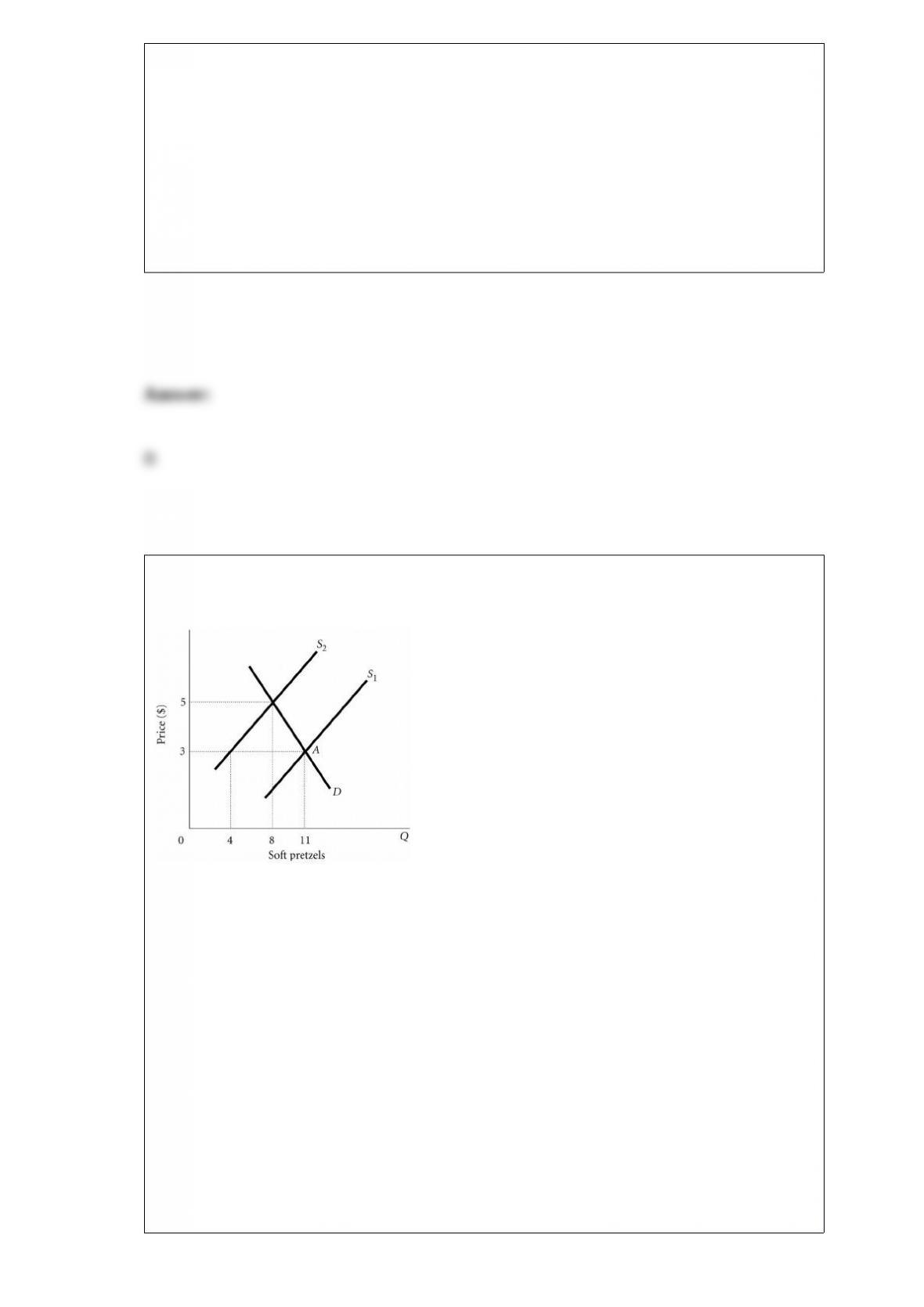
Figure 4.2
Refer to Figure 4.2. The market is initially in equilibrium at the intersection of S2 and
D, and supply shifts from S2 toS1. Which of the following statements is true?
A) Price will still serve as a rationing device causing quantity demanded to rise from 8
to 11 soft pretzels.
B) There is no need for price to serve as a rationing device in this case because the new
equilibrium quantity is lower than the original equilibrium quantity.
C) Price will still serve as a rationing device causing quantity supplied to fall from 8 to
4 soft pretzels.
D) The market cannot move to a new equilibrium until there is also a change in supply.

A movement along the demand curve to the left may be caused by a
A) rise in income.
B) decrease in supply.
C) fall in the number of substitute goods.
D) fall in the price of inputs.
Monopolistically competitive firms have ________ market power due to producing
differentiated products.
A) unlimited
B) some
C) no
D) complete
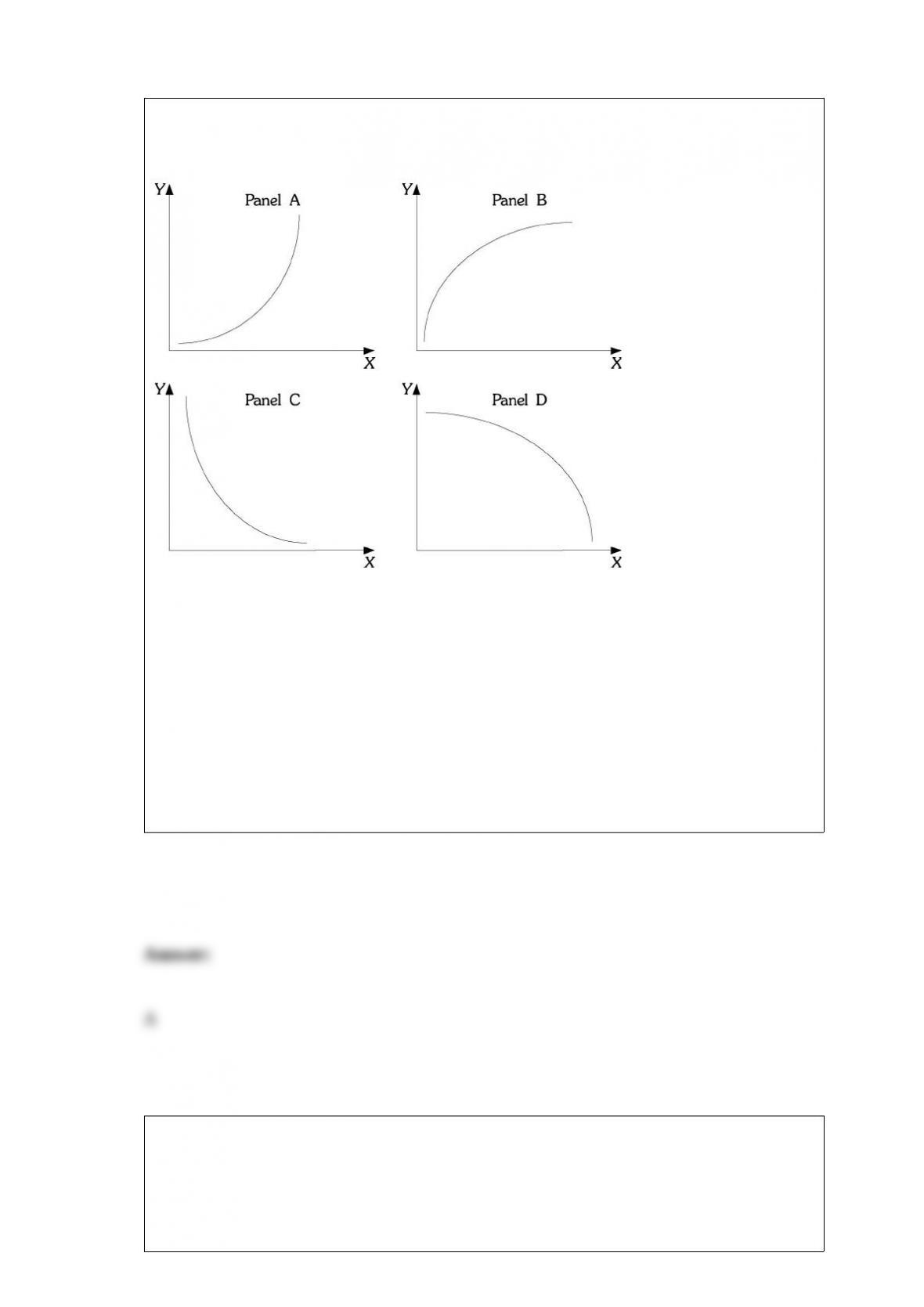
Figure 1.5
Refer to Figure 1.5. Which of the curves has a slope that is positive and increasing?
A) A
B) B
C) C
D) D
Which statement is NOT true? Variable costs
A) are equal to total costs in the long run.
B) are zero if output is zero.

C) are equal to the difference between total cost and total fixed cost.
D) remain constant as output goes up.
For a particular product, an effective price ceiling results in
A) quantity demanded greater than quantity supplied.
B) quantity supplied greater than quantity demanded.
C) quantity demanded equal to quantity supplied.
D) demand equal to supply.
A monopolist is NOT guaranteed positive economic profits solely because it is a
monopoly since there may be no output for which
A) TR = TVC.
B) TR > TC.
C) MC = MR.
D) ATR < MR.

Investors put up $1,040,000 to construct a building and purchase all equipment for a
new restaurant. The investors expect to earn a minimum return of 10 per cent on their
investment. The restaurant is open 52 weeks per year and serves 900 meals per week.
The fixed costs are spread over the 52 weeks (i.e. prorated weekly). Included in the
fixed costs is the 10% return to the investors and $2,000 in other fixed costs. Variable
costs include $2,000 in weekly wages, and $600 per week in materials, electricity, etc.
The restaurant charges $8 on average per meal.
Economic profit per week is
A) -$400.
B) $0.
C) $600.
D) $900.
A car manufacturing company adopts a new technology that,ceteris paribus, increases
the productivity of capital. At the same time, workers unionize and demand higher
wages. Assume that for this firm capital and labor are substitutable. Which of the
following is most likely to occur?
A) Capital will be substituted for labor.
B) Labor will be substituted for capital.
C) Output increases as do the prices of capital and labor.
D) Output decreases as does the price of cars.
________ firms use a product differentiation strategy to achieve market power.
A) Monopolistically competitive
B) Monopolistic
C) Oligopolistic
D) Perfectly competitive
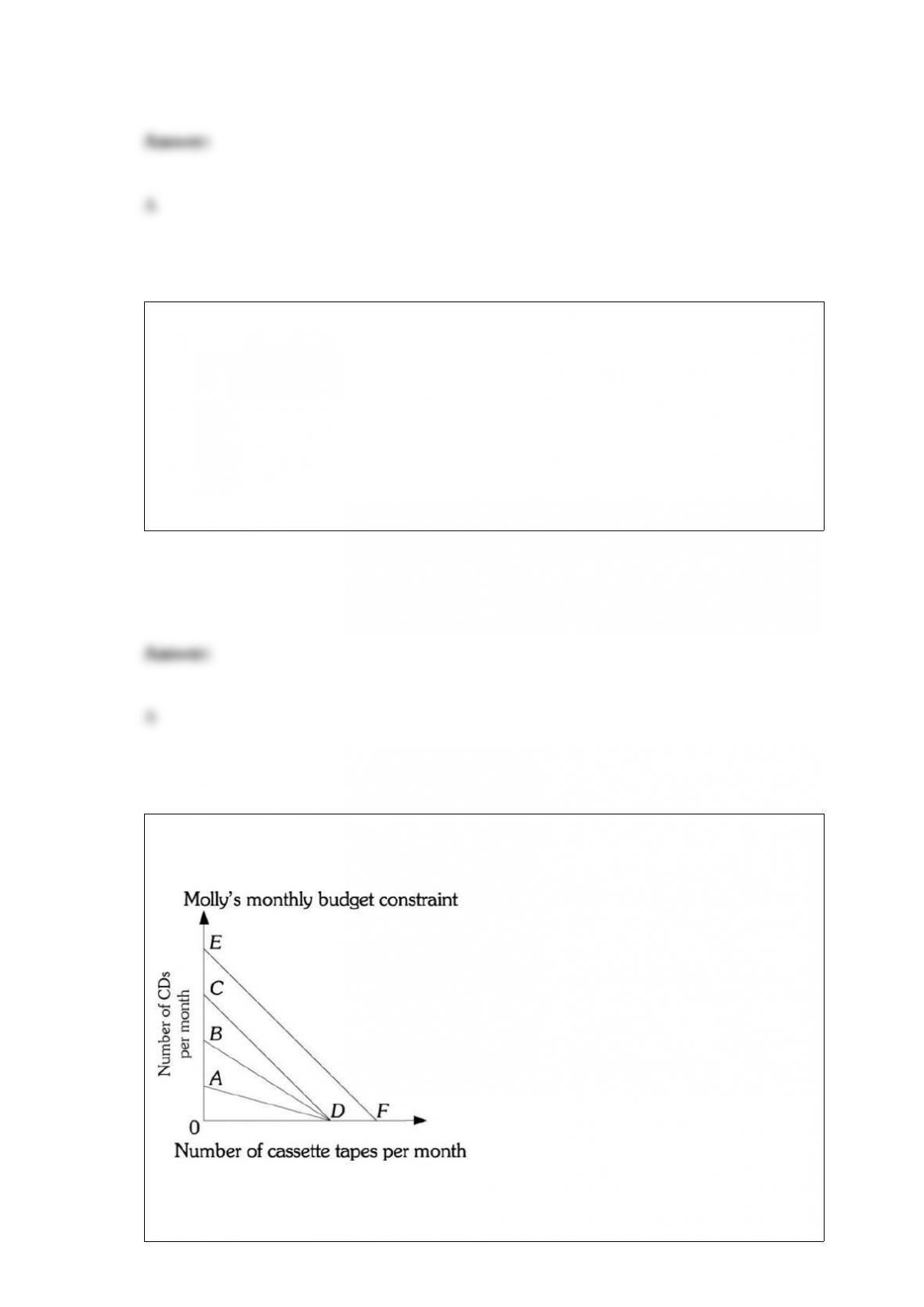
Figure 6.5
Refer to Figure 6.5. Molly’s budget constraint is CD. Molly’s income is $200, the price

of a cassette tape is $7.50 and the price of a CD is $10. At point C, she is buying
________ cassette tapes and ________ CDs.
A) 0; 20
B) 20; 0
C) 20; 15
D) 40; 30
In which of the following ways has the Internet has had a significant influence on
advertising?
A) The Internet limits firms from actively interacting with customers.
B) The Internet has improved firms’ ability to target specific markets.
C) The Internet has reduced the level and transparency of informational advertising.
D) The Internet has increased spending on advertising.
Which of the following would NOT be considered an act of investing in capital?
A) a father paying for his daughter’s college education
B) a firm buying a new energy-saving machine

C) the state government building a new road
D) the Postal Service delivering the mail
Any point inside the utility possibilities frontier is ________.
A) inefficient because both people could be made better off simultaneously
B) inefficient because it is only possible to make one person better off by making the
other person worse off
C) efficient because it is only possible to make one person better off by making the
other person worse off
D) efficient because both people could be made better off simultaneously
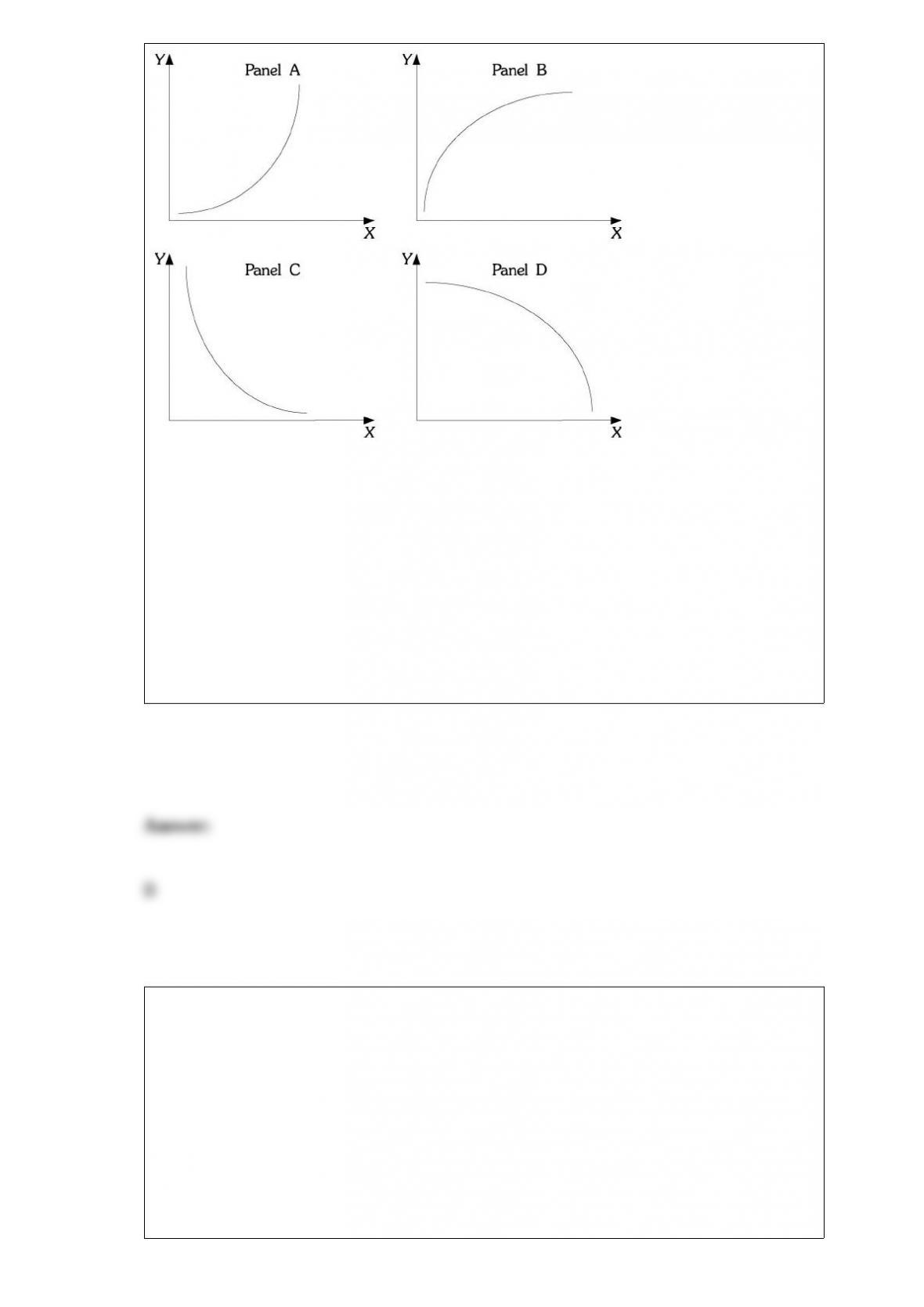
Figure 1.5
Refer to Figure 1.5. Which of the curves has a slope that is positive and decreasing?
A) A
B) B
C) C
D) D
If there are external costs in production and firms do not have to account for these costs,
then firms will produce
A) at the efficient level.
B) an output level that is below the efficient level.
C) an output level that is above the efficient level.
D) an output level that is either above or below the efficient level.

Opponents of income redistribution argue that redistribution ________ the proposition
that “one is entitled to the fruits of one’s efforts.”
A) violates
B) promotes
C) legalizes
D) enforces
A concentrated industry has ________ that dominate a market.
A) a large number of firms
B) three or fewer firms
C) a relatively small number of firms
D) an infinite number of firms

If the marginal product of labor equals the average product of labor, then the
A) average product is maximized.
B) marginal product is maximized.
C) marginal product is still increasing.
D) average product is still increasing.
If the interest rate is 15%, the current market value of $1 to be delivered in one year is
A) $0.87.
B) $0.91.
C) $1.00.
D) $1.15.
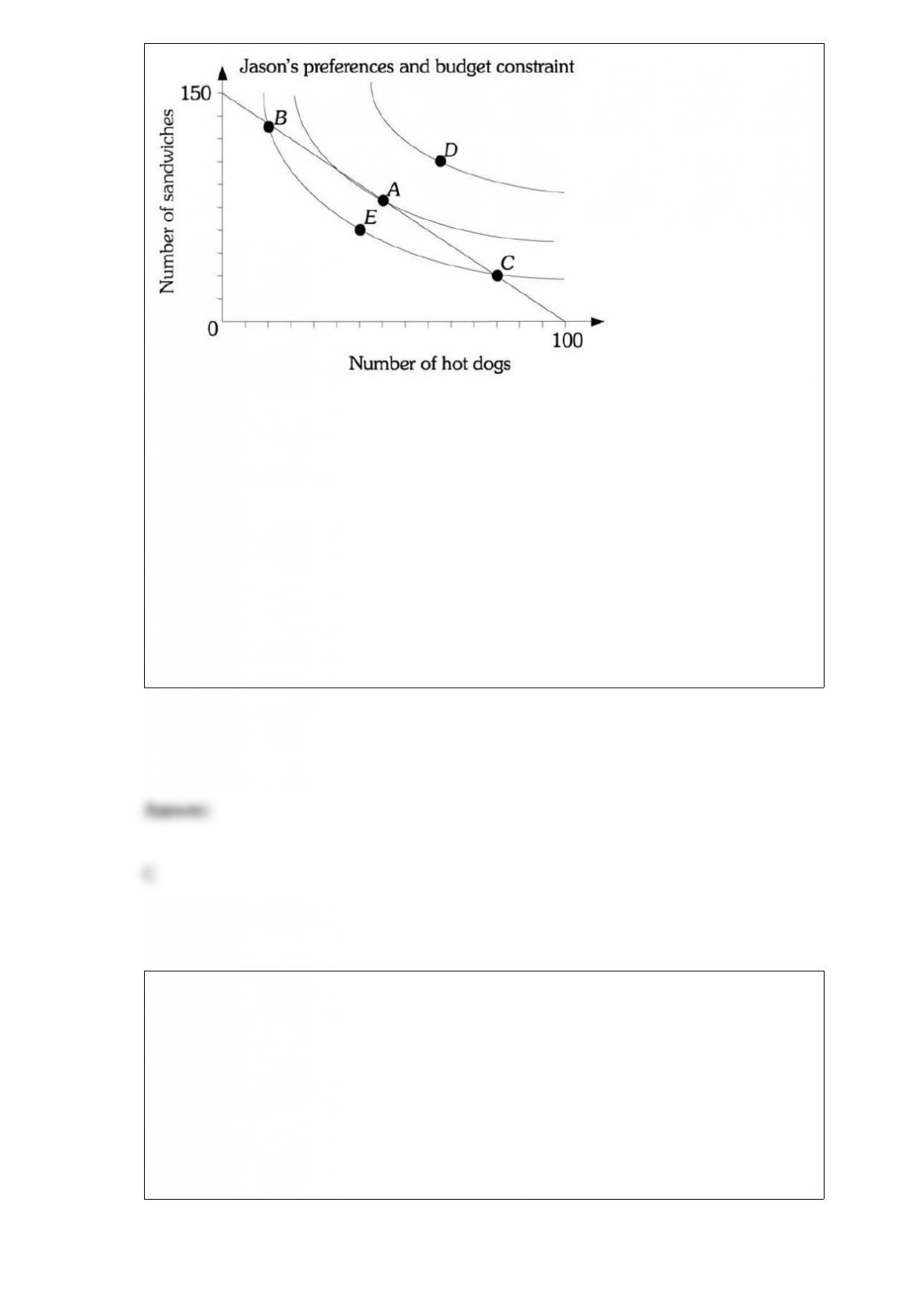
Figure 6.16
Refer to Figure 6.16. Why was Jason NOT maximizing his utility at point B?
A) He is not spending his entire budget.
B) His marginal utility per dollar spent on the last sandwich is greater than his marginal
utility per dollar spent on his last hot dog.
C) His marginal utility per dollar spent on the last sandwich is less than his marginal
utility per dollar spent on his last hot dog.
D) He is maximizing his utility at point B.
Profit is equal to
A) marginal revenue minus marginal cost.
B) total revenue divided by total cost.
C) total revenue minus total cost.
D) total revenue divided by marginal revenue.
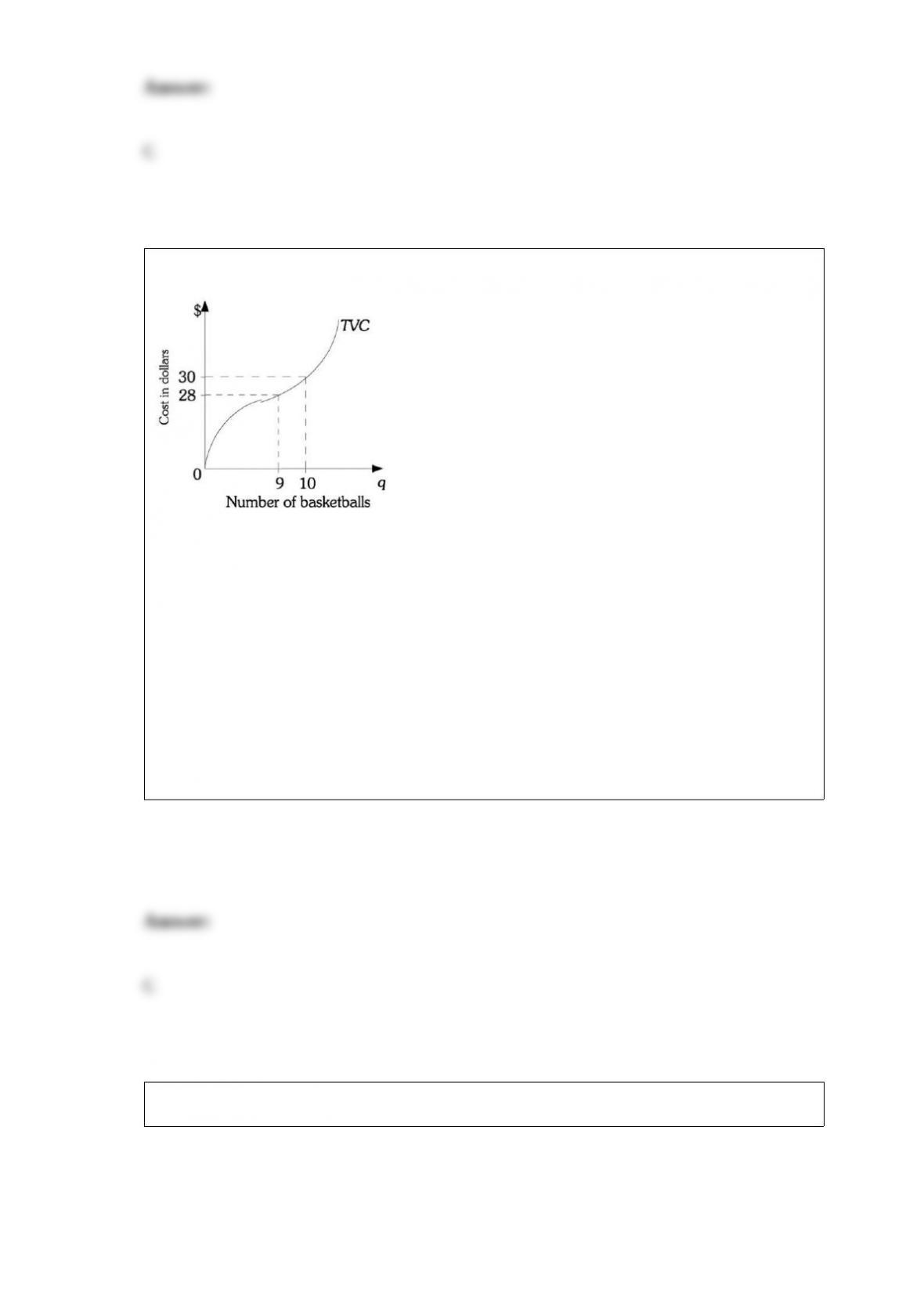
Figure 8.3
Refer to Figure 8.3. If the total fixed cost is $50, then average total cost of producing 10
basketballs is
A) $3.
B) $5.
C) $8.
D) $80.
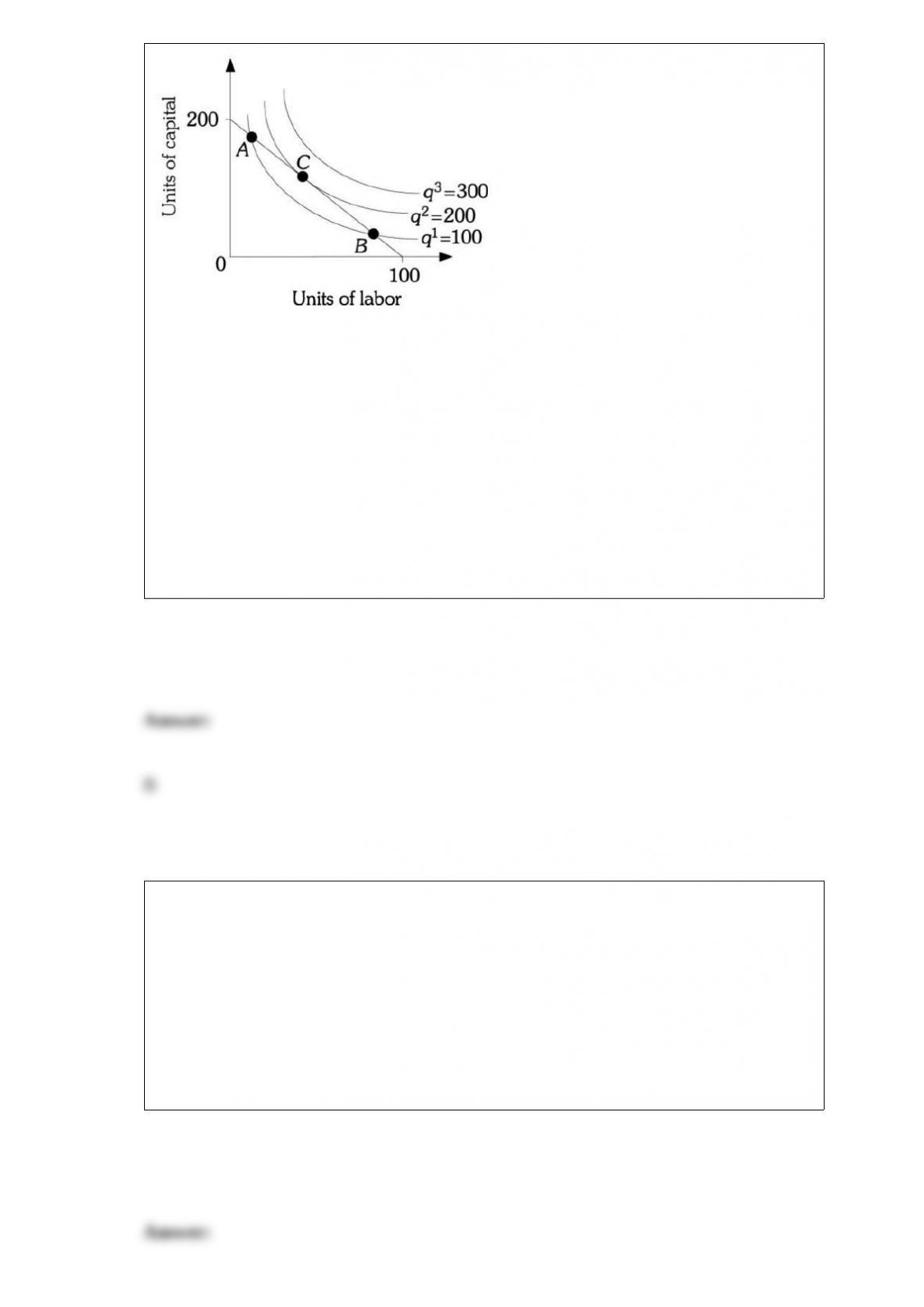
Figure 7.12
Refer to Figure 7.12. If the firm’s cost of capital is $15 per unit and its cost of labor is
$30 per unit, the isocost line represents a total cost of
A) $2,000.
B) $3,000.
C) $6,000.
D) $8,000.
The type of non-price rationing that most closely approaches the market outcome is
A) favored customer rationing.
B) first-come, first-served basis or queuing.
C) coupon rationing with coupons that can be resold.
D) coupon rationing with coupons that cannot be resold.
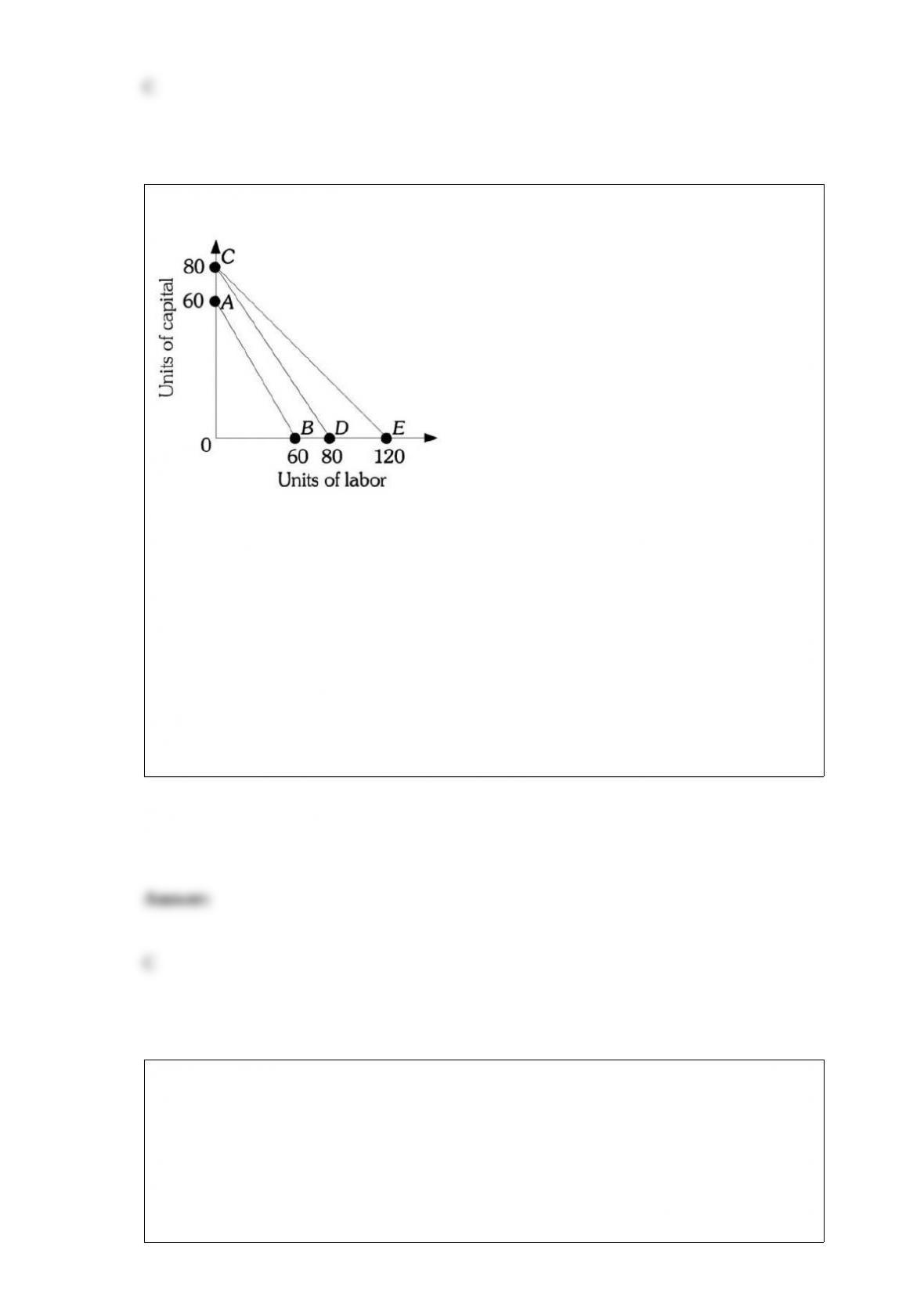
Figure 7.9
Refer to Figure 7.9. The firm’s isocost line could shift from CD to CE if the
A) price of labor increased.
B) firm’s total expenditures increased by 50%.
C) price of labor decreased by 50%.
D) firm’s total expenditures increased by 50% or the price of capital and labor each
decreased by 33%.
A perfectly competitive firm breaks even at the level of output where
A) P > ATC.
B) P < ATC.
C) P = ATC.

D) P = MC.
You are in the market for a used 2006 Honda Accord. You know that half of the 2006
Accords are lemons and half are peaches. If you could be assured that the Accord you
were buying was a peach, you would be willing to pay up to $10,000. On the other
hand, you would only be willing to pay $2,000 for a lemon. You have no ability to
discern whether any particular Accord is a lemon or a peach. Sellers of Accords, on the
other hand, are likely to know whether their particular car is a lemon or a peach.
Suppose sellers of lemons will sell their cars for $1,500 or more and peach sellers will
be willing to sell their cars for $8,500 or more. You are willing to offer ________ for a
car of unknown quality and ________ are willing to sell you their car.
A) $2,000; lemon owners only
B) $5,000; lemon owners only
C) $6,000; lemon owners only
D) $8,500; both lemon and peach owners
A monopolistically competitive firm produces where
A) marginal revenue equals price.
B) its marginal revenue curve lies above its demand curve.

C) its marginal revenue curve intersects the quantity axis.
D) marginal revenue equals marginal cost.