
When a park is funded by visitors, but not by taxpayers in general,
a. there will be too few parks because most people simply will not pay to use a park.
b. visitors will be better served because poor service would lead to reductions in
revenues.
c. maintenance in the park will suffer because budgets will decline.
d. we cannot predict what will happen because park funding by visitors has not been
tried before.
Since 1970, union membership, as a percent of the labor force, has
a. remained virtually unchanged.
b. increased slightly.
c. declined steadily.
d. increased significantly.
The velocity of money is the
a. rate at which the price index for consumer goods rises.
b. multiple by which an increase in government expenditures will cause output to
expand.

c. average number of times a dollar is used to buy goods and services included in GDP.
d. number of times a dollar is taken out of the country during a year.
When the conditions in a competitive price-taker market are such that the firms are
consistently unable to cover their production costs,
a. the firms will suffer short-run economic losses that will be exactly offset by long-run
economic profits.
b. all firms will go out of business since consumers will not pay prices that enable firms
to cover their production costs.
c. some firms will exit from the industry, and market price will rise until the remaining
firms can earn the normal rate of return.
d. resource prices will increase, competition will decline, and eventually the firms in the
industry will earn monopoly profit.
The Fed’s low short-term interest rate policy from 2002-2004, along with housing
regulations promoting low down-payment loans to sub-prime borrowers, encouraged
a. conventional 30-year, fixed rate mortgages which have relatively high default and
foreclosure rates.
b. conventional 30-year, fixed rate mortgages which have relatively low default and
foreclosure rates.
c. adjustable rate mortgages which have relatively low default and foreclosure rates.
d. adjustable rate mortgages which have relatively high default and foreclosure rates.
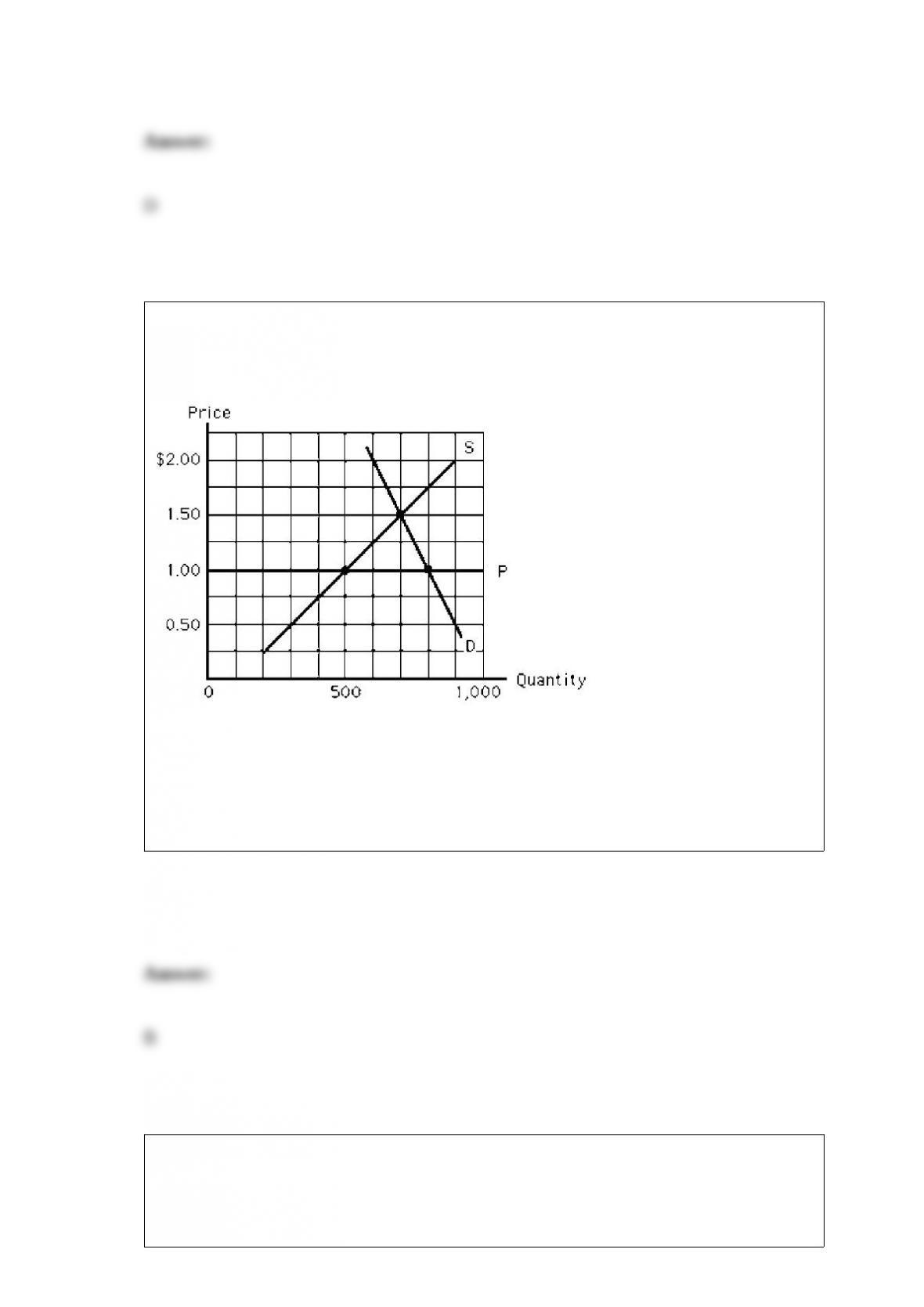
Figure 4-14
In Figure 4-14, which of the following is true at the price ceiling, P?
a. The excess quantity supplied equals 300 gallons.
b. The excess quantity demanded equals 300 gallons.
c. The excess quantity supplied equals 500 gallons.
d. The excess quantity demanded equals 800 gallons.
e. Sales will be equal to 800 gallons.
The burden of a tax will fall primarily on sellers when the
a. demand for the product is highly inelastic and the supply is relatively elastic.

b. demand for the product is highly elastic and the supply is relatively inelastic.
c. tax is legally (statutorily) imposed on the seller of the product.
d. tax is legally (statutorily) imposed on the buyer of the product.
In contrast with unanticipated inflation, anticipated inflation implies that
a. the government was informed about inflation.
b. most decision makers expected the general increase in the price level.
c. the increase in the general level of prices was growth of GDP.
d. the increase in the general level of prices was expected by borrowers but not lenders.
Suppose you received a 3 percent increase in your nominal wage. Over the year,
inflation ran about 6 percent. Which of the following is true?
a. Your real wage fell.
b. Your nominal wage fell.
c. Both your nominal and real wages decreased.
d. Although your nominal wage fell, your real wage increased.
e. Both nominal and real wages increased.

Willingness to pay
a. measures the value that a buyer places on a good.
b. is the amount a seller actually receives for a good minus the minimum amount the
seller is willing to accept.
c. is the maximum amount a buyer is willing to pay minus the minimum amount a seller
is willing to accept.
d. is the amount a buyer is willing to pay for a good minus the amount the buyer
actually pays for it.
Which of the following is true about those graduating with college degrees?
a. The proportion of college degrees earned by women has been declining in recent
decades.
b. The proportion of college degrees earned by women has been virtually constant
during the last four decades.
c. In 2013, only about 43 percent of those graduating from college were women.
d. In 2013, only about 43 percent of those graduating from college were men.

When the government both provides a service and covers its costs through taxation,
a. the government has a strong incentive to supply consumers with desired goods at a
low cost.
b. consumers are in a weak position to either discipline the suppliers or alter the
quantity or quality of the service provided.
c. the invisible hand will direct decision makers toward the most efficient level of
output.
d. Consumers have strong incentive to be cost conscious.
In economics, secondary effects refer to the
a. best alternative that must be forgone as the result of a choice.
b. unintended consequences of a change that are not immediately identifiable but are
felt only with time.
c. immediate and visible intended consequences of a change.
d. impact of the scarcity of resources on the scarcity of the goods that are produced with
those resources.

It will be difficult to institute fiscal policy in a stabilizing manner because politicians
will find
a. it more attractive to raise taxes than to increase spending.
b. it attractive to increase taxes during a recession, but they will be reluctant to reduce
them during an expansion.
c. budget deficits attractive during a recession, but they will be reluctant to run budget
surpluses during an expansion.
d. budget surpluses attractive during a recession, but they will be reluctant to run budget
deficits during an expansion.
Which of the following conditions will be present when a price-taker market is in
long-run equilibrium?
a. Price will exceed marginal revenue.
b. Firms will earn economic profit.
c. Marginal revenue will exceed marginal cost.
d. Average total cost will be at a minimum.
If resource prices rise and the average total cost of producing a product increases as the
firms in an industry expand output in response to an increase in demand, the long-run
market supply curve for the product will
a. be perfectly elastic (a horizontal line).

b. be perfectly inelastic (a vertical line).
c. slope upward to the right.
d. be more inelastic than the short-run supply curve for the product.
When economists say an individual possesses a “positive rate of time preference,” they
mean that she prefers to
a. save rather than consume.
b. invest now rather than in the future.
c. consume goods and services in the future rather than now.
d. consume goods and services now rather than in the future.
If the price of gloves increases, total expenditures on gloves will decline if
a. the demand for gloves is inelastic.
b. the demand for gloves is elastic.
c. the quantity of gloves purchased is unresponsive to changes in price.
d. there are few good substitutes for gloves.

Which of the following is an obstacle that would reduce the likelihood of effective
collusion among oligopolists?
a. a highly inelastic market demand for the product
b. a small number of firms in the market
c. production of a homogeneous product
d. highly unstable demand for the product
In a market that lacks sufficient competition,
a. output will generally be less than the output that is ideal from the standpoint of
economic efficiency.
b. output will generally be greater than the output that is ideal from the standpoint of
economic efficiency.
c. price will generally be less than the price that would result if the market was
competitive.
d. profit rates will generally be so low that government subsidies will be necessary to
ensure that the firms remain in business.
Which of the following is an example of a good that is produced by the public sector
but consumers purchase it in proportion to the benefit received?
a. milk
b. public education
c. first-class mail delivery from the U.S. Post Office
d. national defense
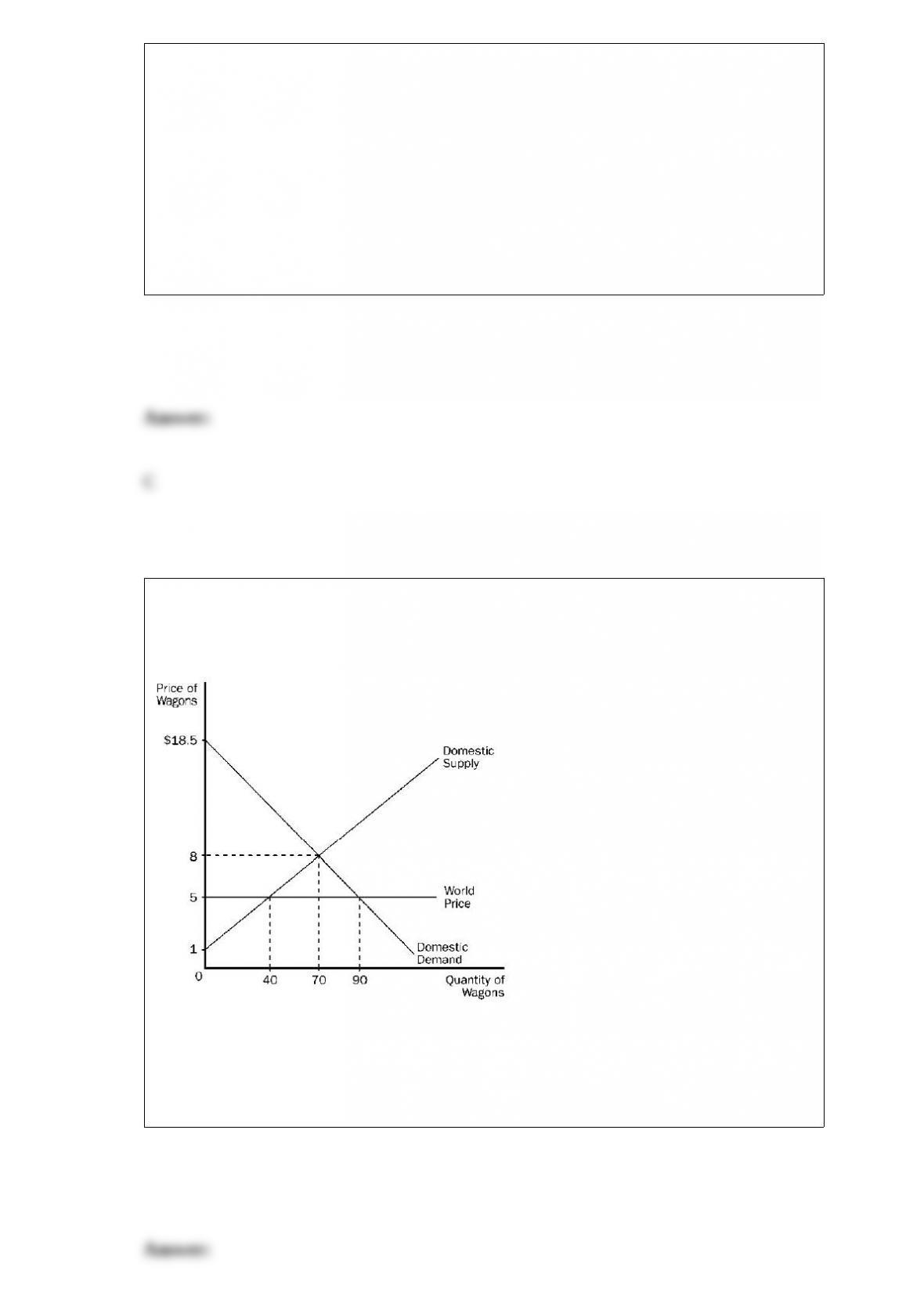
Figure 17-8
Refer to Figure 17-8. The horizontal line at the world price of wagons represents the
a. demand for wagons from the rest of the world.
b. supply of wagons from the rest of the world.
c. level of inefficiency in the domestic market caused by trade.
d. surplus in the domestic wagon market.

Inclusion of the Social Security Trust Fund in the overall budget calculation
a. reduces the reported size of the budget deficit because the Social Security system is
currently running a surplus.
b. increases the size of the reported budget deficit because the Social Security system is
currently running a deficit.
c. decreases the size of the reported budget deficit because the Social Security system is
currently running a deficit.
d. increases the size of the reported budget deficit because the Social Security system is
currently running a surplus.
The supply of both physical and human resources in the long run is determined
primarily by
a. the presence or absence of economies of scale.
b. investment choices and resource depreciation.
c. sunk costs; what happens in the present cannot change the future.
d. the law of diminishing marginal returns.
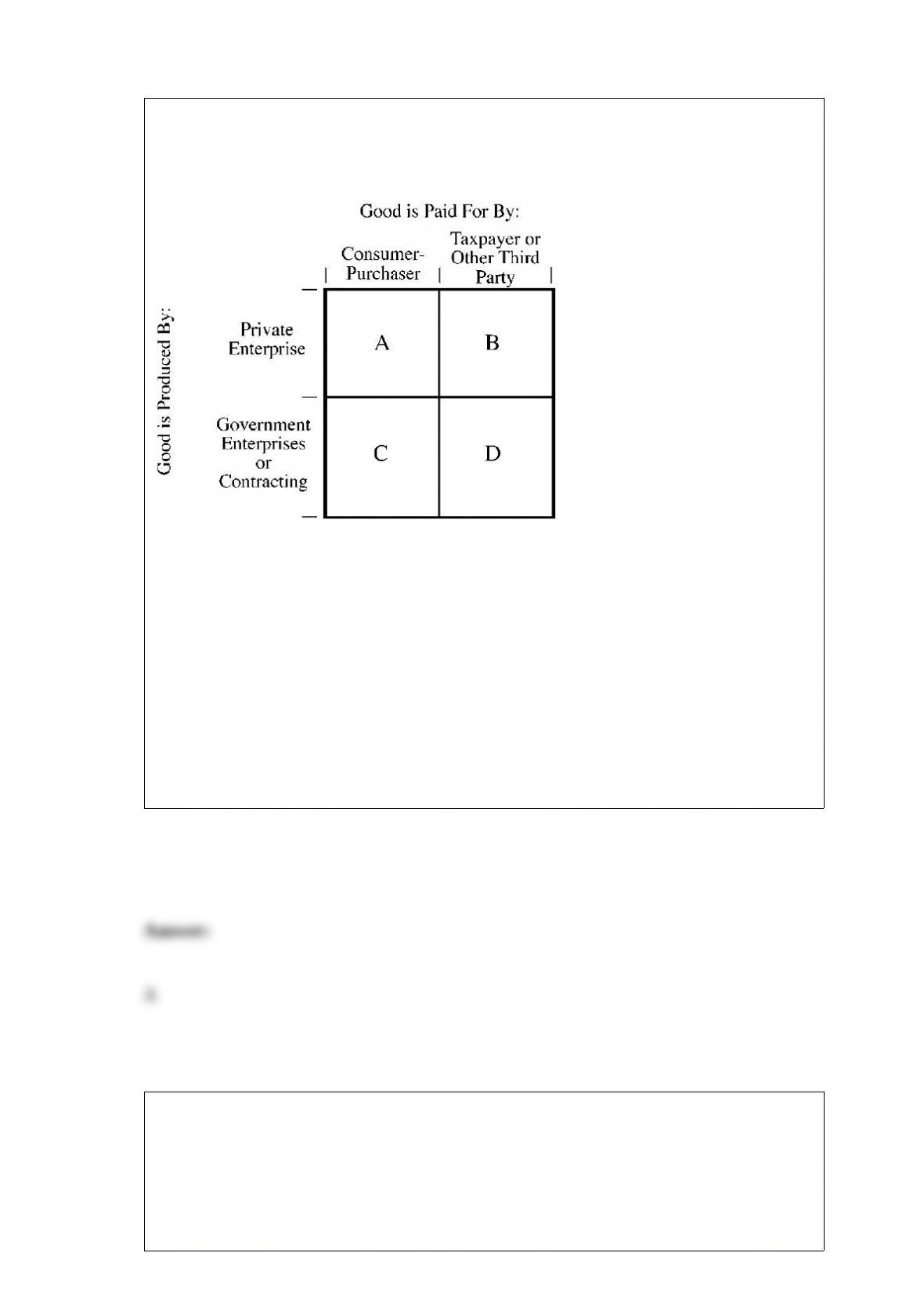
Use the figure below to answer the following question(s).
Figure 6-2
Figure 6-2 illustrates the four possibilities of the structure of production and
consumption for a good or service. In which case is the incentive of producers and
consumers to economize the strongest?
a. A
b. B
c. C
d. D
Economists consider tariffs to be
a. necessary for the protection of domestic industries and the achievement of full
employment.
b. harmful to domestic consumers.
c. obstacles that hinder voluntary exchange and gains from trade.

d. both b and c above
The rule for the optimal use of any input states that
a. when MRP is less than price, profit will increase when more of that resource is
utilized.
b. when MRP is greater than resource price, profit will increase when more of that
resource is utilized.
c. when MRP equals price, profit will increase when less of that resource is utilized.
d. when MRP is greater than resource price, profit will increase when less of that
resource is utilized.
e. resources should be used only if MRP exceeds product price.
Where marginal cost is less than average total cost,
a. opportunity cost must have been excluded from the calculation of marginal cost.
b. marginal cost must be falling.
c. marginal cost must be rising.
d. marginal cost may be rising, falling, or constant.

Full employment means which of the following is zero?
a. structural unemployment
b. cyclical unemployment
c. frictional unemployment
d. aggregate unemployment
If households fail to recognize that debt-financing represents a future liability (in the
form of higher taxes), they will tend to consume
a. less and pass less net wealth on to future generations.
b. more and pass more net wealth on to future generations.
c. less and pass more net wealth on to future generations.
d. more and pass less net wealth on to future generations.

A positive level of net exports contributes directly to
a. demand in the resources market.
b. supply in the loanable funds market.
c. demand in the loanable funds market.
d. demand in the goods and services market.
If Xavier can produce sandwiches at a lower opportunity cost than Kimani, then
a. Xavier has a comparative advantage in the production of sandwiches.
b. Kimani has a comparative advantage in the production of sandwiches.
c. Xavier should not produce sandwiches.
d. Xavier is capable of producing more sandwiches than Kimani in a given amount of
time.
The earnings of all employees in a competitive economy would be equal if
a. all individuals were homogeneous.
b. all jobs were equally attractive.
c. workers were perfectly mobile among jobs.
d. all of the above are true.