An increase in liabilities will reduce a firm’s net worth.
Suppose a monopoly is producing its profit-maximizing output level. Now suppose the
government imposes a lump-sum tax on the monopoly, independent of its output. As a
result the monopolist will increase the price of its product to cover its higher cost.
If the price of a product is expected to increase in the future, the supply today will
increase.
If inflation is unanticipated, no redistribution of income can occur.
If the demand for a product decreases and the supply of the same product decreases, the
equilibrium price will decrease.
The fact that the prices for McDonald’s Big Mac sandwich are not the same around the
world illustrates one reason why purchasing power does not hold: Many goods are not
traded internationally.
The General Agreement on Tariffs and Trade (GATT) was formed to replace the World
Trade Organization (WTO) because the WTO was empowered only to reduce barriers
to trade in goods. The GATT is an agreement to reduce barriers to trade in goods,
services and intellectual property.
In recent years, economists have come to rely more on the establishment survey rather
than the household survey to analyze current labor market statistics.

The nominal interest rate plus the inflation rate equals the real interest rate.
Health insurance companies impose deductibles on policies and co-payments on claims
to reduce the problem of adverse selection.
Seth’s grandmother gave him a $50 savings bond for his birthday. The bond pays $50 at
maturity, which is in five years. If the interest rate is 5%, the bond has a present value
of $43.19.
If an increase in crime causes households to spend money on police and security
systems, GDP will rise.

The formula for the multiplier is (1 – MPC).
If real equilibrium GDP is above potential GDP, expansionary fiscal policy should be
pursued.
One example of physical capital is the amount of savings that you have.
Marginal revenue product of labor for a competitive seller is
A) the change in total product from hiring one more worker.
B) equal to the marginal product of labor multiplied by the output price.
C) the output price multiplied by the quantity sold.
D) the marginal revenue of the product multiplied by the output price.
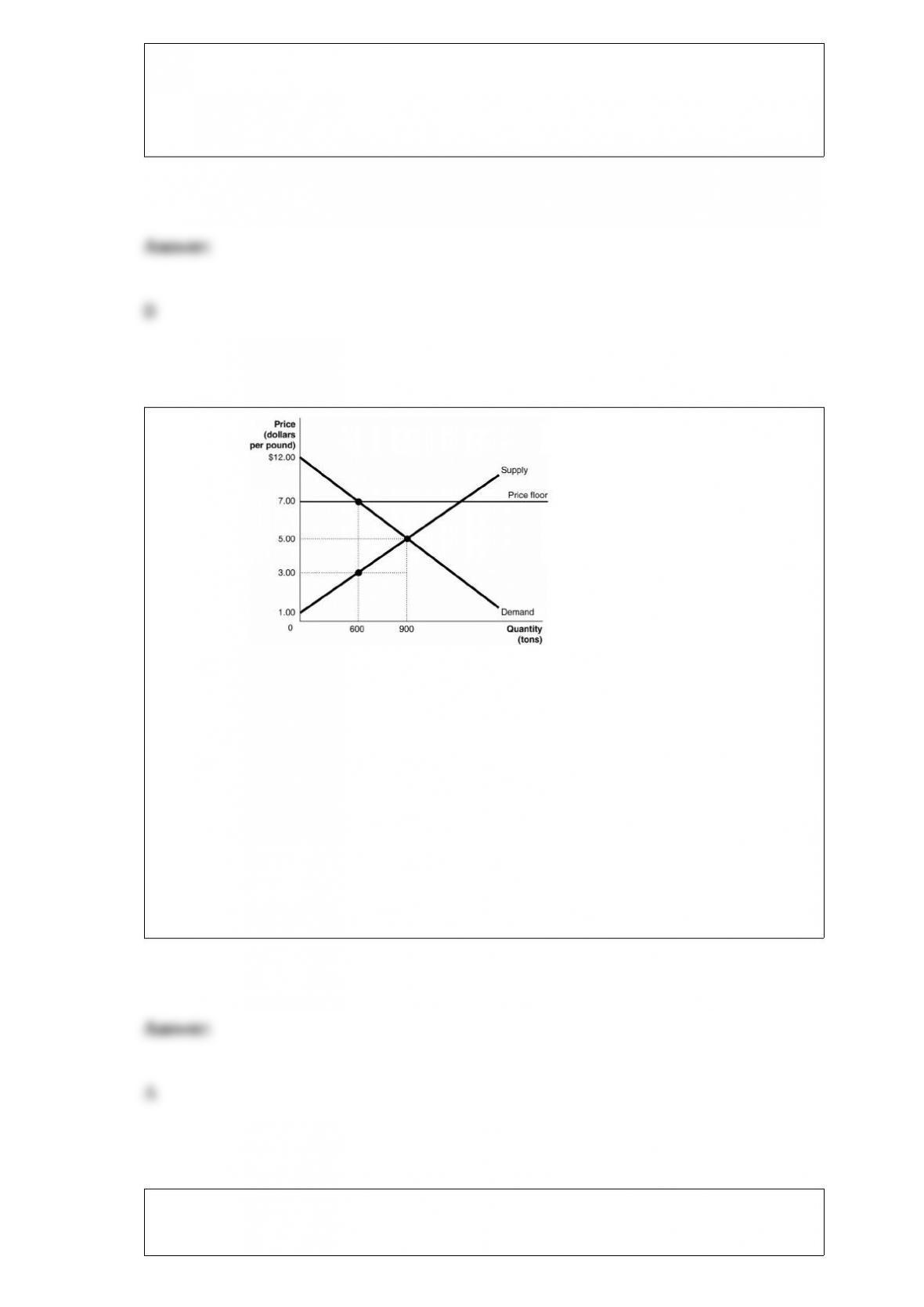
Figure 4-11 Figure 4-11 shows the demand
and supply curves for the coffee market. The government believes that the equilibrium
price is too low and tries to help almond growers by setting a price floor at $7.00. What
is the value of the portion of consumer surplus that has been transferred to producer
surplus as a result of the price floor?
A) $1,200
B) $1,500
C) $1,800
D) $3,000
Which of the following is true for a monopolist?
A) Being the only seller in the market, the monopolist faces a perfectly inelastic
demand curve.
B) Being the only seller in the market, the monopolist faces a perfectly elastic demand
curve.
C) Being the only seller in the market, the monopolist faces the market demand curve.
D) Being the only seller in the market, the monopolist faces a downward sloping
demand curve that lies below the marginal revenue curve.
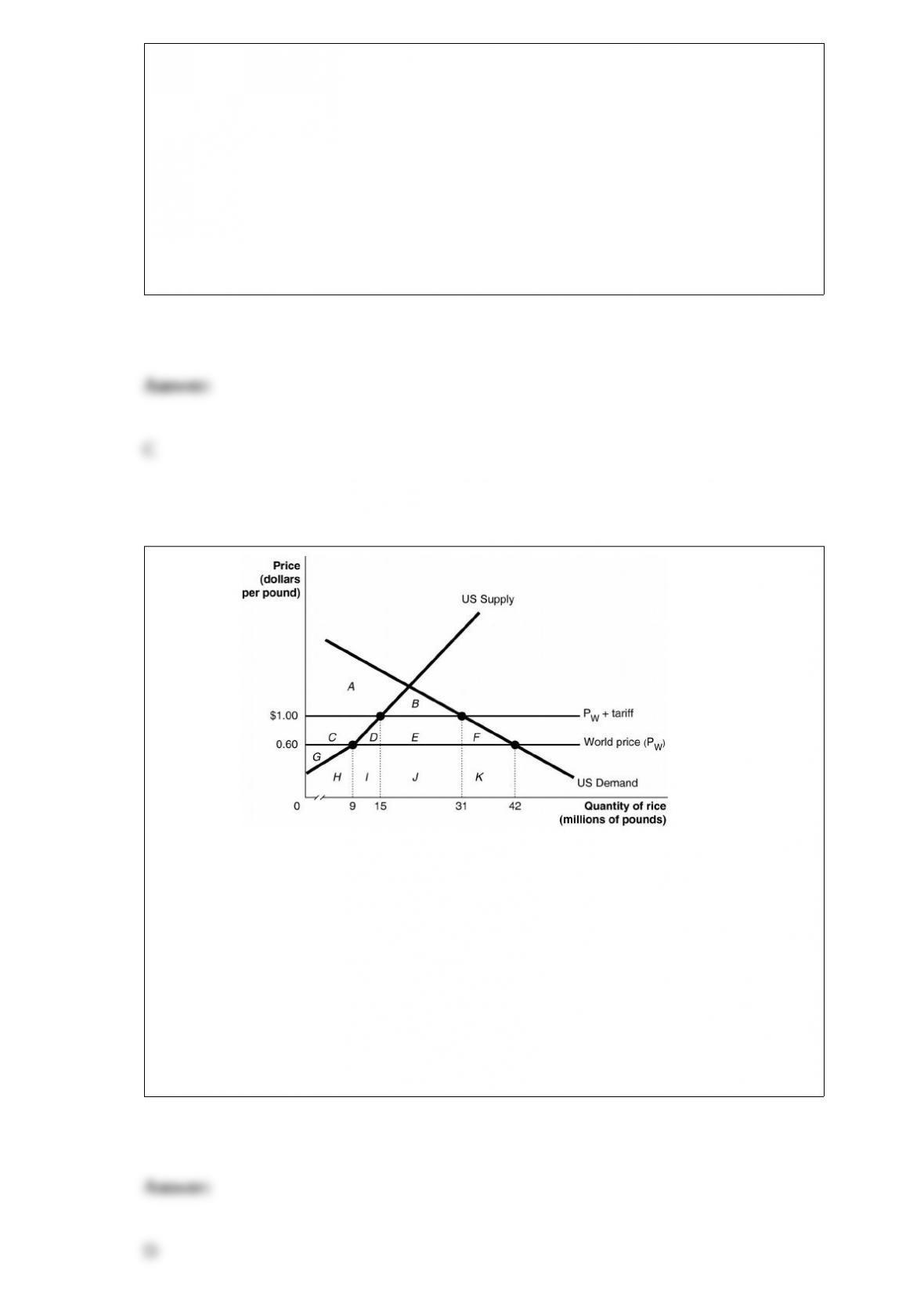
Figure 9-2 Suppose the U.S.
government imposes a $0.40 per pound tariff on rice imports. Figure 9-2 shows the
impact of this tariff. As a result of the tariff, domestic producers increase their quantity
supplied by
A) 31 million pounds of rice.
B) 22 million pounds of rice.
C) 15 million pounds of rice.
D) 6 million pounds of rice.

Goodyear’s sales were negatively affected by the tariff on Chinese tires because
A) Goodyear operates factories in China, and some of the tires produced there were
exported to the United States and subject to the tariff.
B) China retaliated and imposed a tariff on Goodyear tires exported to China.
C) despite being a U.S. company, all of Goodyear’s tires are produced in China.
D) the tariff raised the price on Chinese tires, allowing these tires to compete more
directly with the more expensive Goodyear tires.
Following the September 11, 2001, terrorist attacks, the managers of many hotels
expected a prolonged period of reduced travel and responded by laying off workers and
postponing or canceling new construction. Isadore Sharp, the chairman and CEO of
Four Seasons Hotels, decided to
A) continue expanding and was able to maintain or enhance the company’s market
share.
B) continue expanding and the company ended up losing significant market share.
C) curtail expansion plans, and by significantly cutting back on expansion was able to
maintain the company’s market share.
D) curtail expansion plans and the company ended up losing significant market share.
Countries with high rates of economic growth tend to have
A) a labor force that is more productive.
B) a lower life expectancy at birth.
C) low rates of technological advancement.
D) a declining incidence of business cycle fluctuations.
The relationship between consumer spending and disposable personal income is
A) an inverse relationship.
B) a direct relationship.
C) a negative relationship.
D) independent.
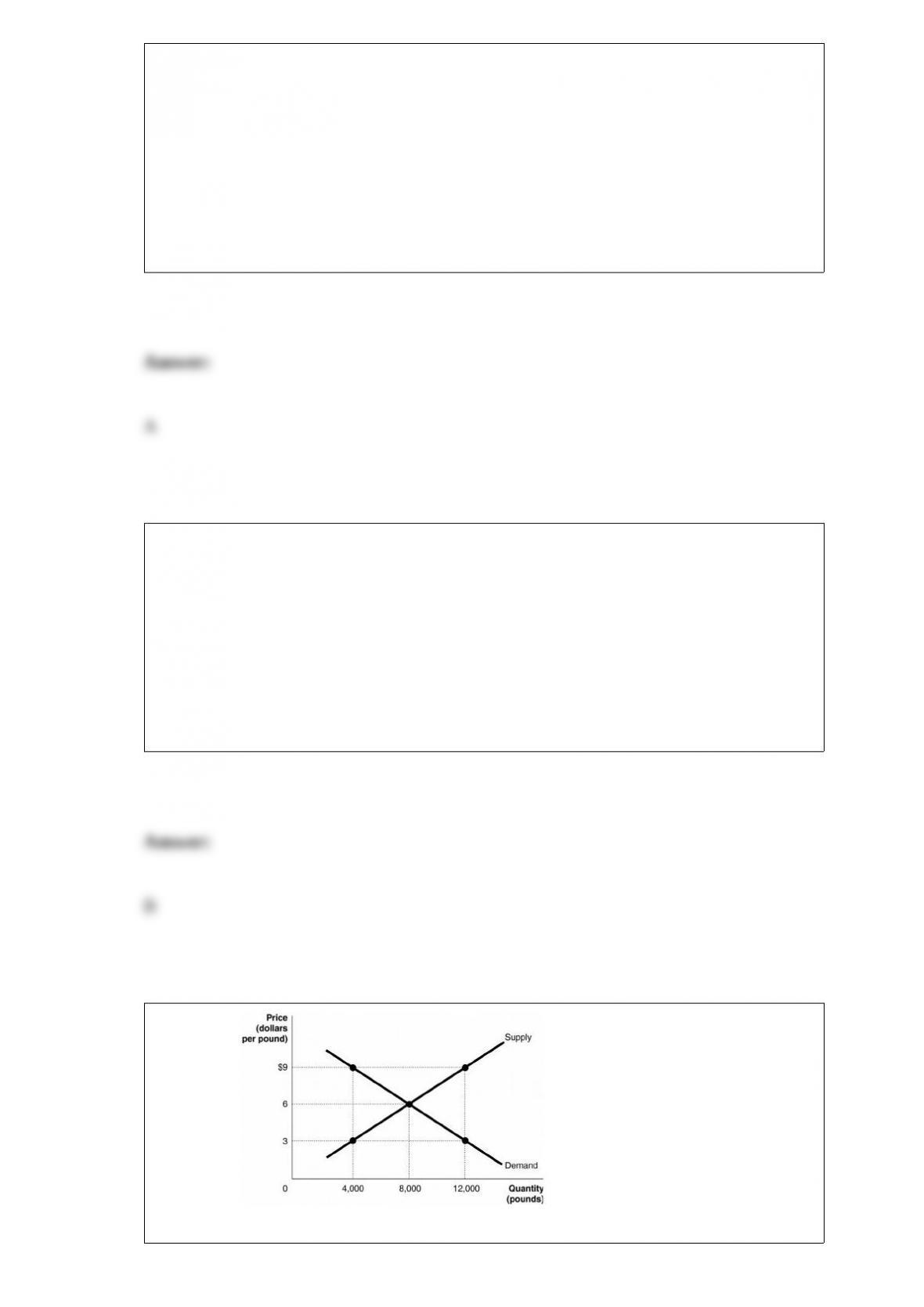
Figure 4-5

The figure above represents the market for pecans. Assume that this is a competitive
market. Which of the following is true?
A) If the price of pecans is $3, the output will be economically efficient, but there will
be a deadweight loss.
B) If the price of pecans is $9, consumers will purchase more than the economically
efficient output.
C) Both 4,000 pounds and 12,000 pounds are economically inefficient rates of output.
D) If the price of pecans is $3, producers will sell 12,000 pounds of pecans, but this
output will be economically inefficient.
A decrease in expected inflation will
A) reduce real wages.
B) increase the natural rate of unemployment.
C) shift the long-run Phillips curve to the left.
D) shift the short-run Phillips curve to the left.
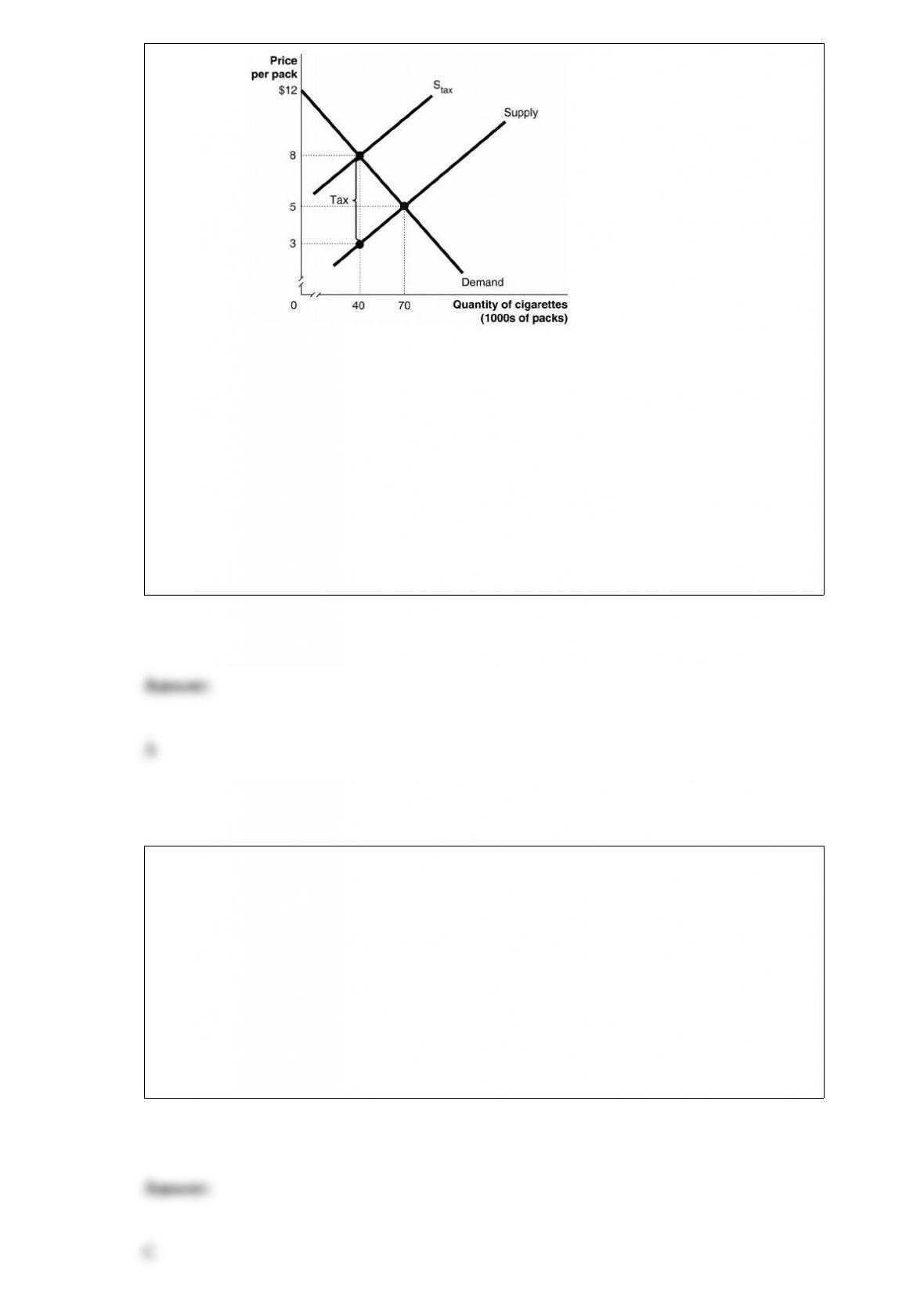
Figure 4-18 Figure 4-18 shows the market
for cigarettes. The government plans to impose a unit tax in this market.
As a result of the tax, is there a loss in producer surplus?
A) Yes, because producers are not selling as many units now.
B) No, because the consumer pays the tax.
C) No, because the market reaches a new equilibrium
D) No, because producers are able to raise the price to cover their tax burden.
The three most widely followed stock indexes in the United States include all of the
following except
A) the Dow Jones Industrial Average.
B) the S&P 500.
C) the Fortune 500.
D) The NASDAQ.

Automobile insurance companies have a problem with people who buy insurance and
then drive recklessly or take less care to avoid losses after being insured. In other
words, the automobile insurance market is subject to
A) asymmetric information.
B) market signaling.
C) moral hazard.
D) adverse selection.
All of the following are ways by which existing firms can deter the entry of new firms
into an industry except
A) continuously producing new and improved products.
B) earning less than maximum profit.
C) advertising products aggressively.
D) threatening to raise prices.
Foreign direct investment in the United States declined 42 percent in the first quarter of
2009. This means that
A) people or firms in other countries reduced their purchases of stocks and bonds in the
United States by 42 percent in the first quarter of 2009.
B) people or firms in the United States reduced their purchases of stocks and bonds in
foreign countries by 42 percent in the first quarter of 2009.
C) people or firms in other countries reduced their building of facilities of purchases of
facilities in the United States by 42 percent in the first quarter of 2009.
D) people or firms in the United States reduced their building of facilities or purchases
of facilities in foreign countries by 42 percent in the first quarter of 2009.
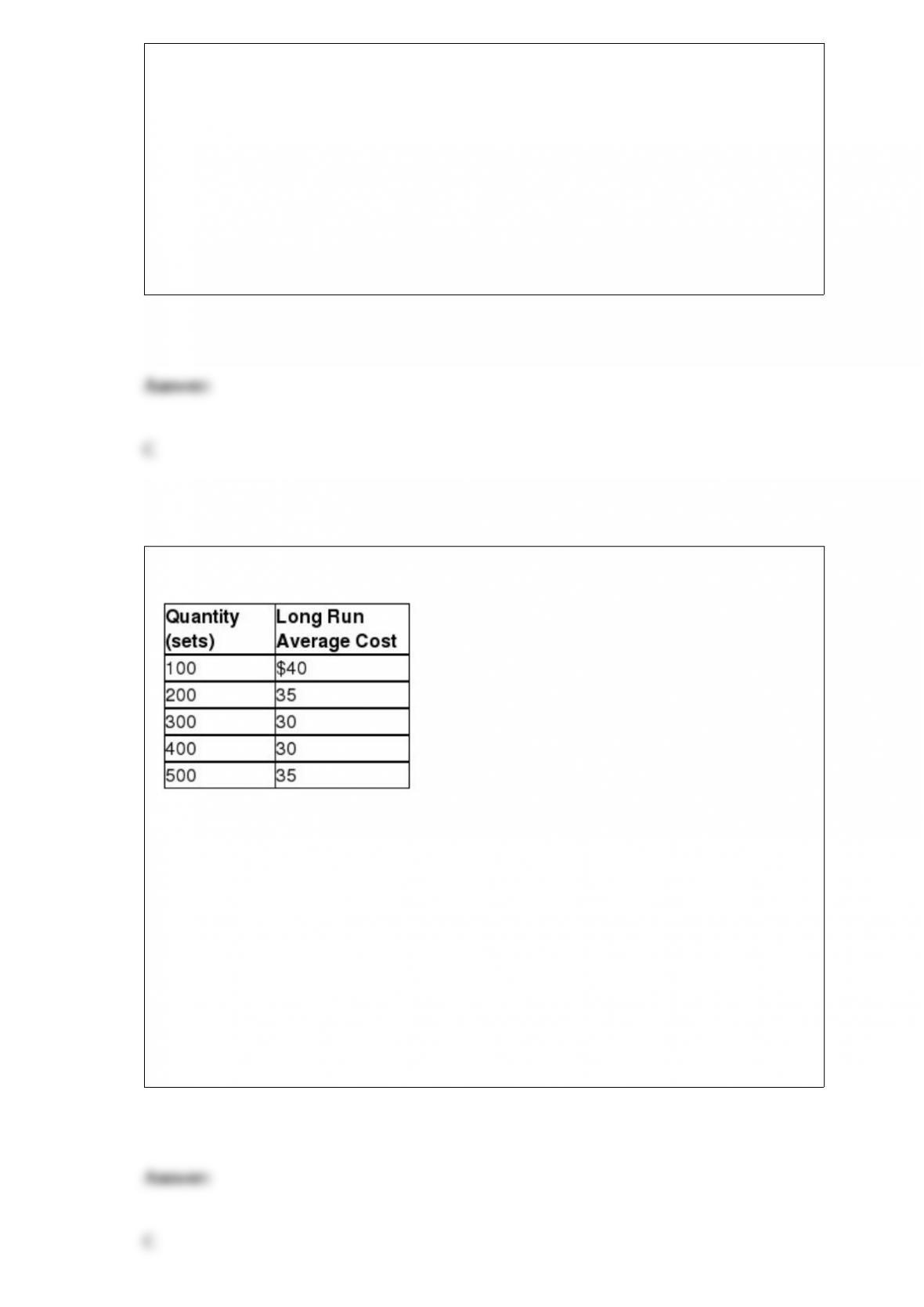
Table 11-8
Elegant Settings manufactures stainless steel cutlery. Table 11-8 shows the company’s
cost data.
What is the minimum efficient scale of production?
A) 100 units
B) 200 units
C) 300 units
D) 400 units
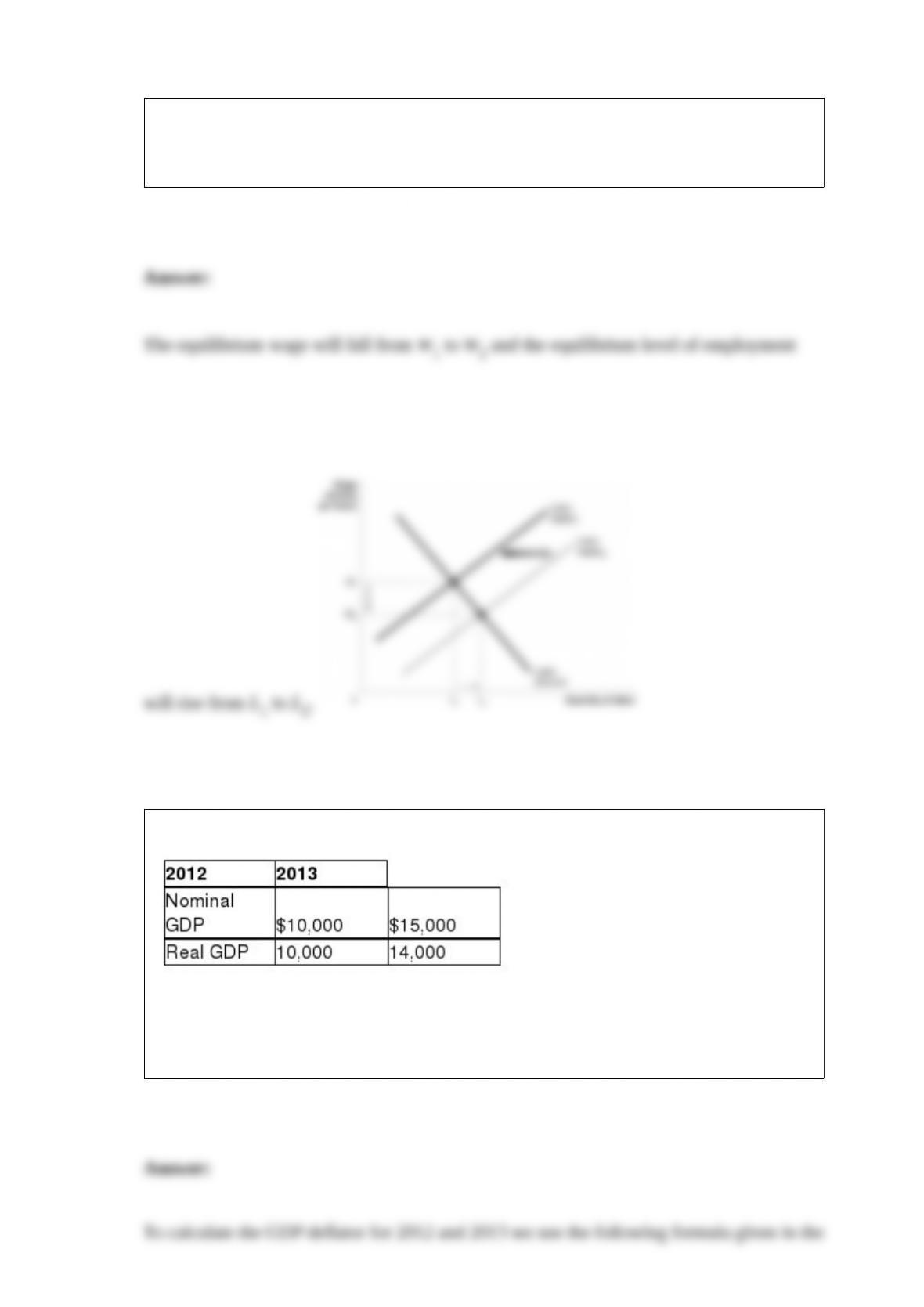
If the labor supply curve shifts to the right and the labor demand curve remains
unchanged, what will happen to the equilibrium wage and the equilibrium level of
employment? Illustrate your answer with a graph.
Table 19-26
Given the information above, calculate the GDP deflator for both 2012 and 2013. What
does the value of the deflator in the year 2012 tell you about that year with respect to
the base year? What happened to prices in 2013 as compared to 2012?
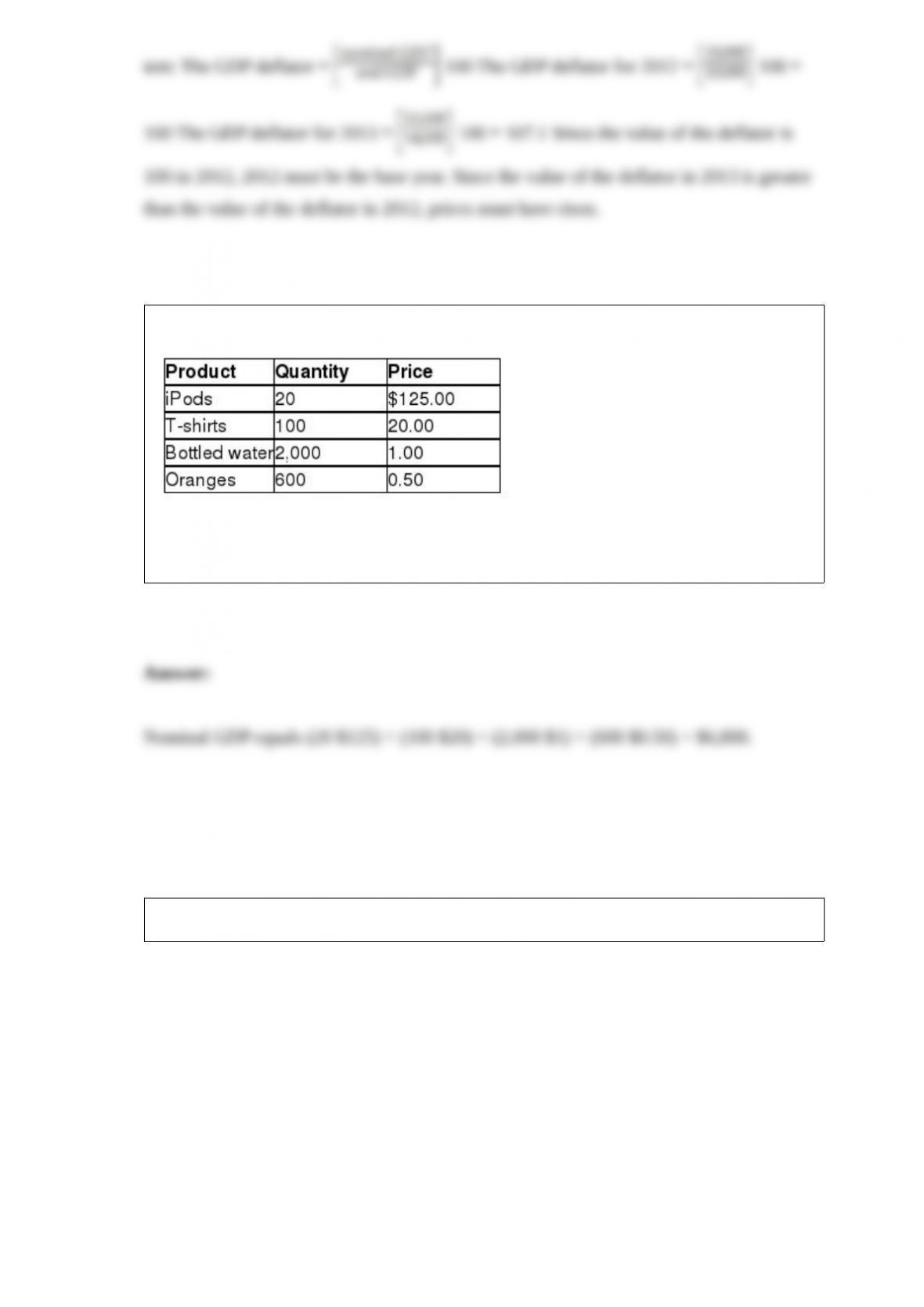
Table 8-7
Suppose that a simple economy produces only four goods and services: iPods, t-shirts,
bottled water, and oranges. Calculate nominal GDP for this simple economy.
Table 18-1
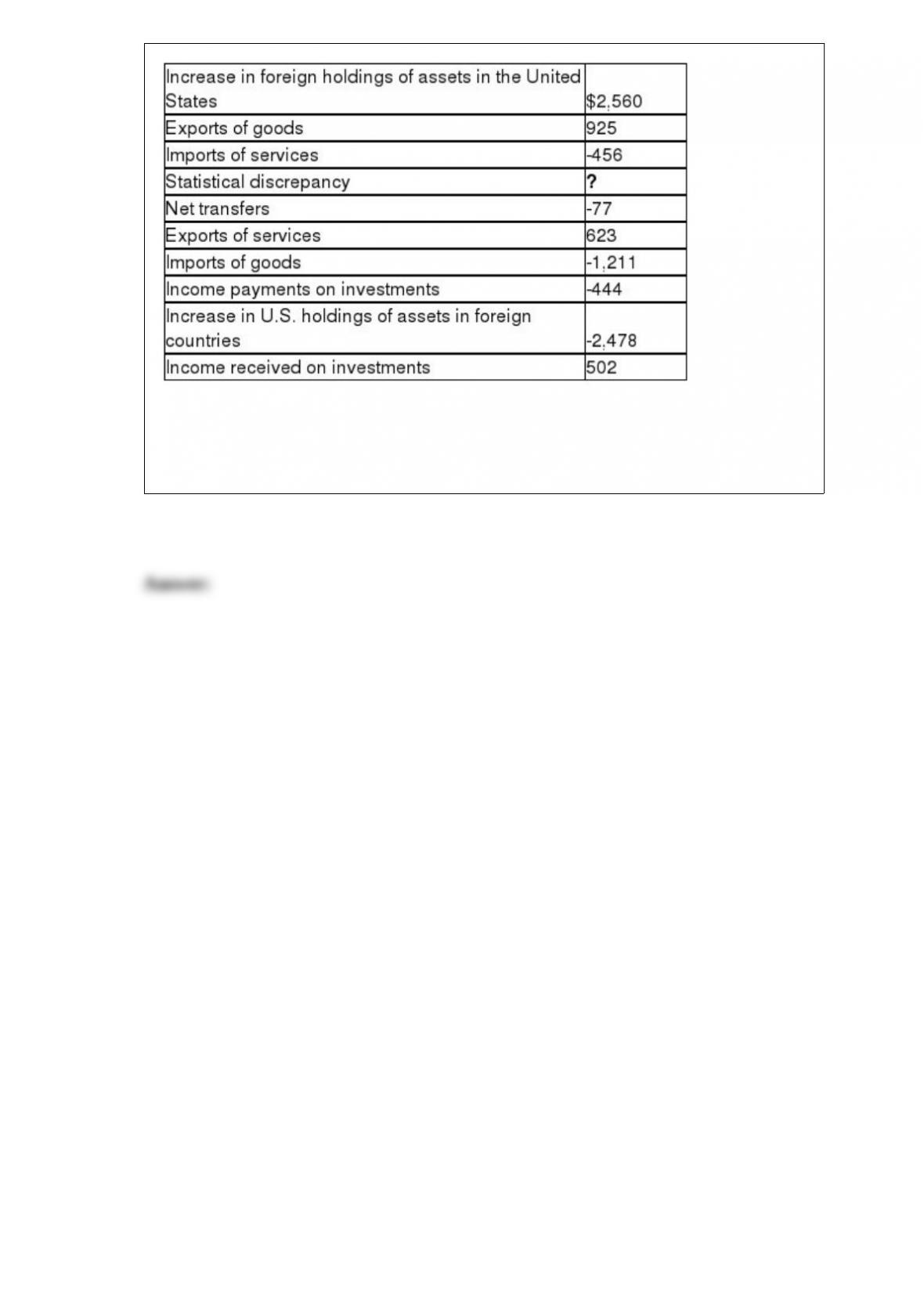
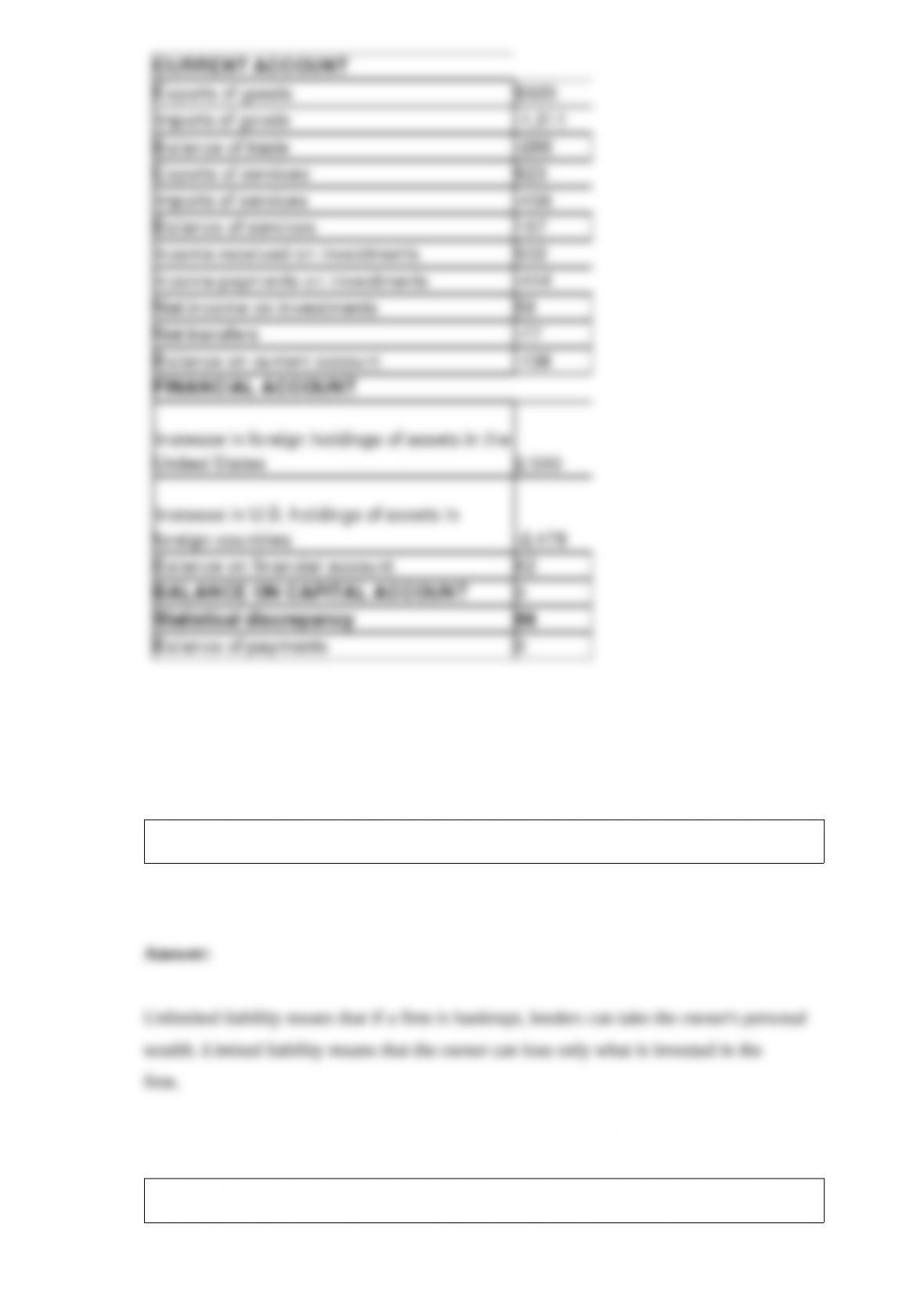
Use the information in the table to prepare a balance of payments account and find the
value of the statistical discrepancy. Assume that the balance on the capital account is
zero.
How do unlimited and limited liability differ?
How are unemployment, inflation, and the business cycle related?