
In evaluating the degree of economic efficiency in a market, we can state that the size
of the deadweight loss in a market will be smaller
A) the greater the difference between marginal cost and price.
B) the smaller the difference between marginal cost and average total cost.
C) the smaller the difference between marginal cost and price.
D) the greater the difference between marginal cost and average revenue.
If price = marginal cost at the output produced by a perfectly competitive firm and the
firm is earning an economic profit, then
A) marginal revenue is less than price.
B) average total cost is at a minimum.
C) total revenue equals total cost.
D) price exceeds average total cost.
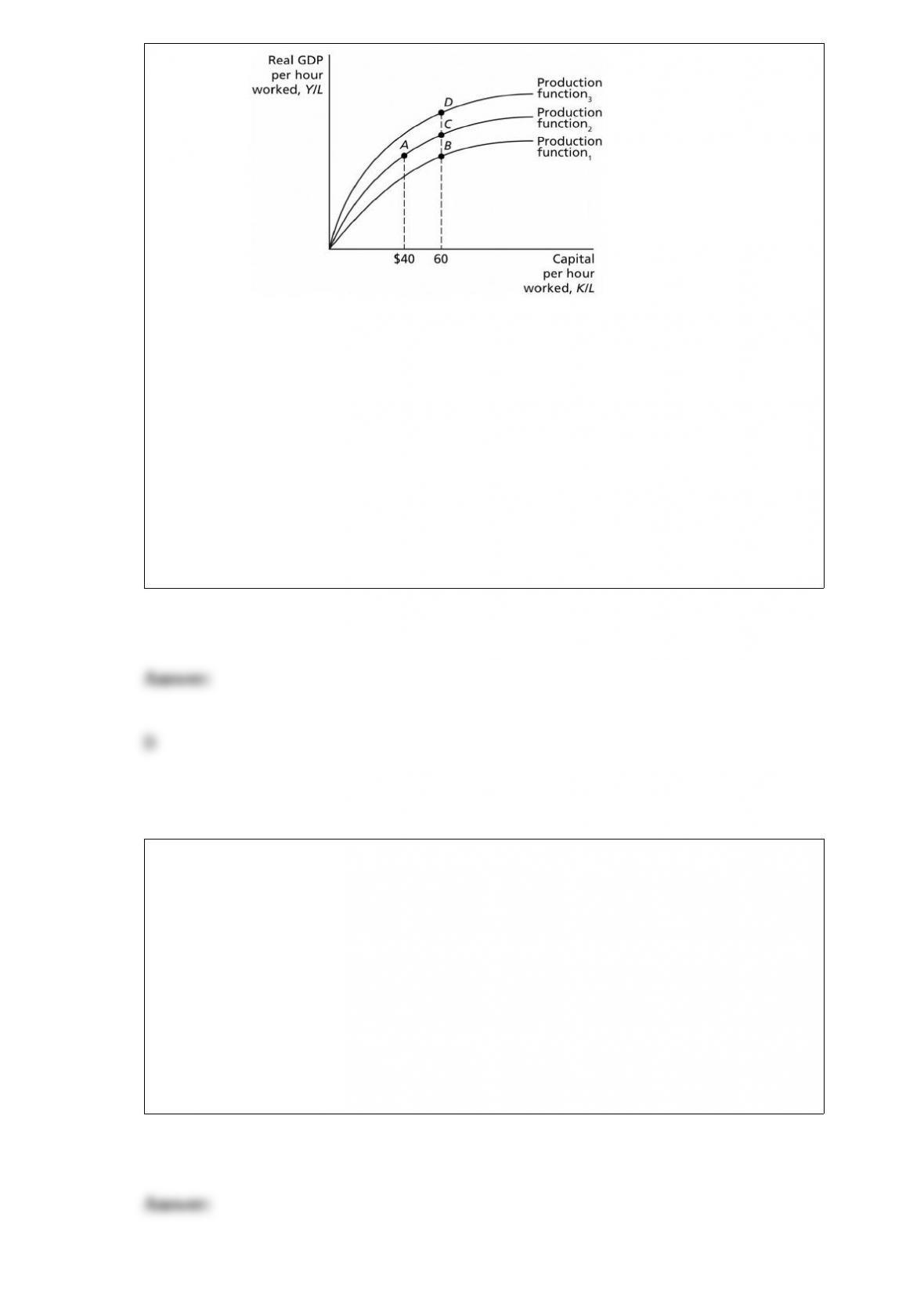
Figure 22-1
Suppose the per-worker production function in the figure above represents the
production function for the U.S. economy. If the United States decided to double its
support of university research, this would cause a movement from
A) A to B.
B) B to C.
C) B to A.
D) D to C.
The three categories of federal government expenditures, in addition to government
purchases, are
A) interest on the national debt, grants to state and local governments, and transfer
payments.
B) interest on the national debt, defense spending, and transfer payments.
C) defense spending, budgets of federal agencies, and transfer payments.
D) defense spending, Social Security, and Medicare.

The Sarbanes-Oxley Act of 2002 was passed in response to what event?
A) a series of accounting scandals
B) unexpected increases in dividend payments to stockholders at various corporations
C) volatility in NASDAQ indexes
D) historically low bond prices
An increase in the demand for green tea raises the price of apples from $16 a pound to
$20 a pound. As a result, quantity supplied increases by 30 percent. Using the midpoint
formula, calculate the value of the price elasticity of supply?
A) 1.35
B) 1.875
C) 2.22
D) 7.5
If, in response to a decrease in the price of coffee, the quantity demanded of coffee
increases, economists would describe this as

A) an increase in demand.
B) an increase in quantity demanded.
C) a change in consumer income.
D) an increase in consumers’ taste for coffee.
Suppose your expenses for this term are as follows: tuition: $12,000, room and board:
$6,500, books and other educational supplies: $1,500. Further, during the term, you can
only work part-time and earn $3,500 instead of your full-time salary of $14,000. What
is the opportunity cost of going to college this term, assuming that your room and board
expenses would be the same even if you did not go to college?
A) $13,500
B) $20,000
C) $24,000
D) $30,500
Which of the following is the most liquid asset?
A) a Renoir painting
B) bonds
C) a car

D) money
To offset the effect of households and firms deciding to hold more of their money in
checking account deposits and less in currency, the Federal Reserve could
A) raise bank taxes.
B) sell Treasury securities.
C) raise government spending.
D) lower the required reserve ratio.
Which of the following is the source of revenue for Medicare and Social Security in the
United States?
A) individual income taxes
B) sales taxes
C) social insurance taxes
D) property taxes

A game in which pursuing dominant strategies results in noncooperation that leaves all
parties worse off is a
A) prisoner’s dilemma.
B) cooperative equilibrium.
C) first-price auction.
D) zero-sum game.
The change in a firm’s total cost from producing one more unit of a good or service is
A) the result of economies of scale.
B) the definition of marginal product
C) the definition of marginal cost.
D) impossible to observe in large firms with many manufacturing plants.
In theory, in the long run, monopolistically competitive firms earn zero profits.
However, in reality there are some ways by which a firm can avoid losing profits.
Which of the following is one such way?
A) gradually increase the mark up on the goods produced

B) lower the price of its products to expand its market share
C) identify new markets and develop products precisely for those markets
D) find a market niche and keep it as narrow as possible so as to prevent other
producers from entering this market segment
Monopolistically competitive firms have downward-sloping demand curves. In the long
run, monopolistically competitive firms earn zero economic profits. These two
characteristics imply that in the long run
A) monopolistically competitive markets achieve productive efficiency.
B) monopolistically competitive markets achieve allocative efficiency.
C) monopolistically competitive firms earn economic profits.
D) monopolistically competitive firms have excess capacity.
Table 20-14
The table above reports the nominal average hourly earnings in private industry and the
consumer price index for 1965 and 2010. The real average hourly earnings for 1965 in
2010 dollars equal
A) $3.87.
B) $5.80.
C) $12.10.
D) $18.14.
If prices in the economy rise, then
A) the purchasing power of a dollar rises.
B) the purchasing power of a dollar stays constant.
C) the purchasing power of a dollar declines.
D) the purchasing power of a dollar cannot be determined.
Table 23-14
Using the table above, answer the following questions. The numbers in the table are in
billions of dollars.
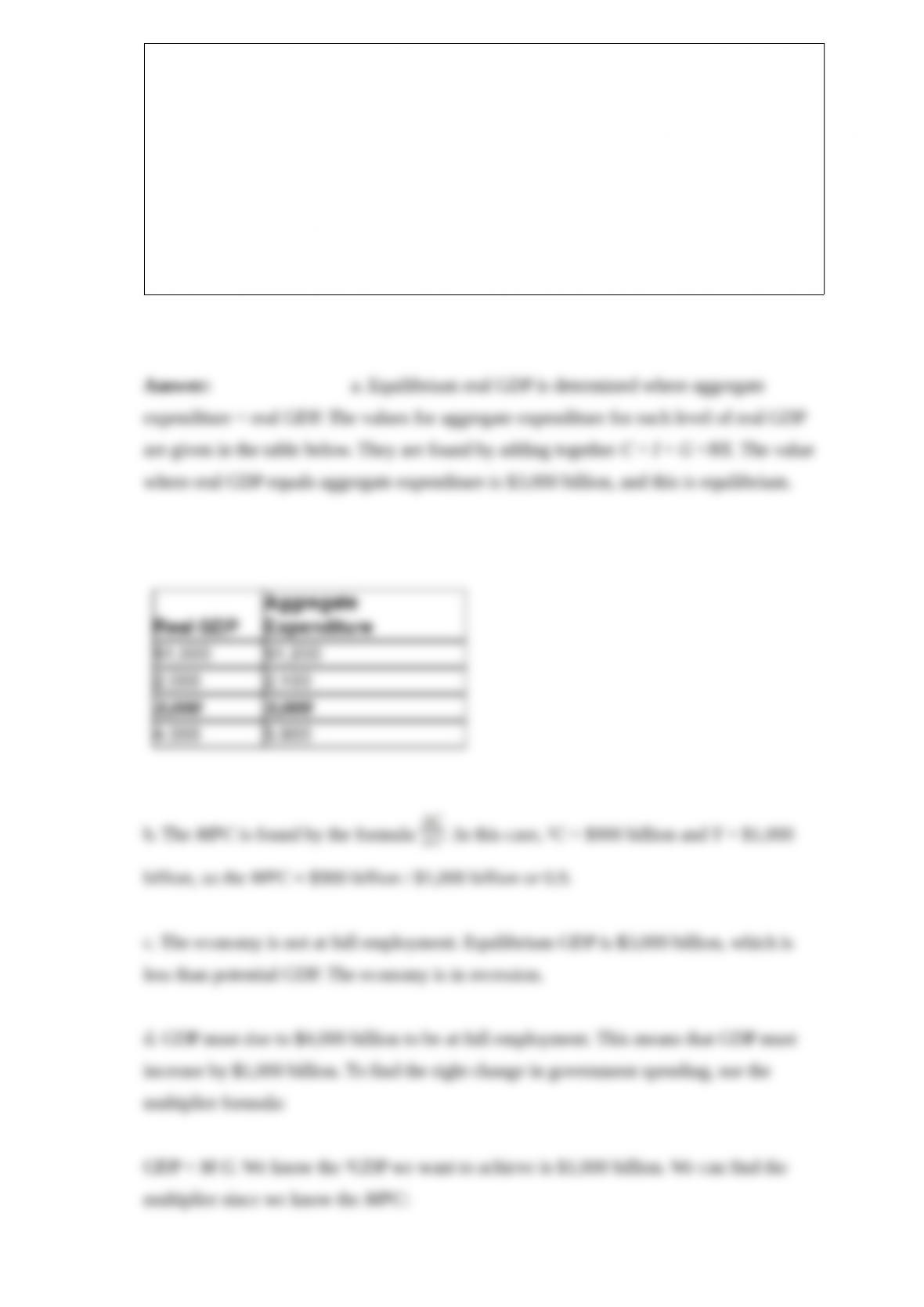
a. What is the equilibrium level of real GDP?
b. What is the MPC?
c. If potential GDP is $4,000 billion, is the economy at full employment? If not, what is
the condition of the economy?
d. If the economy is not at full employment, by how much should government spending
increase so that the economy can move to the full employment level of GDP?
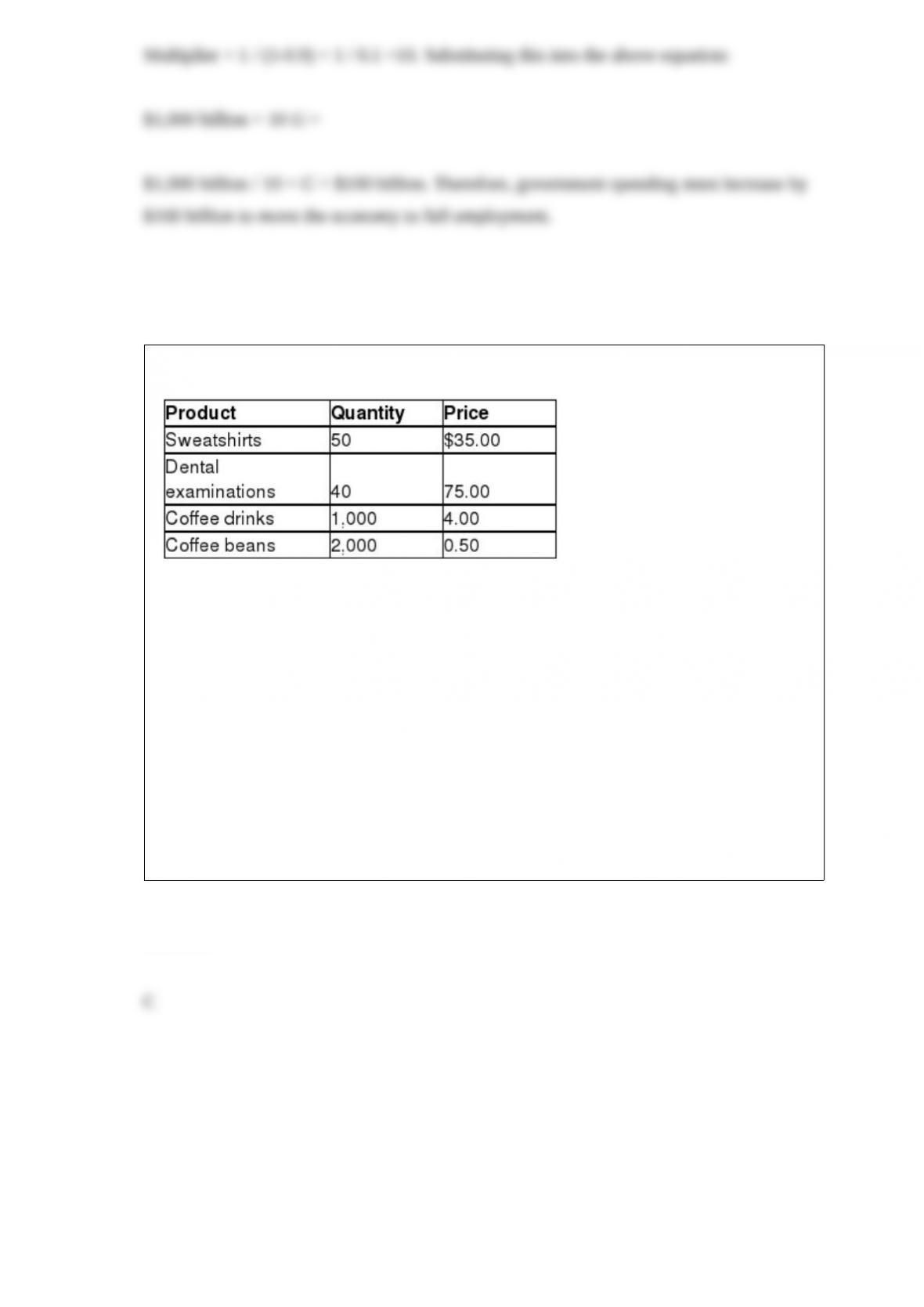
Table 19-1
Suppose that a simple economy produces only four goods and services: sweatshirts,
dental examinations, coffee drinks, and coffee beans. Assume all of the coffee beans are
used in the production of the coffee drinks. Using the information in the above table,
nominal GDP for this simple economy equals
A) 3,090 units.
B) $7,250.
C) $8,750.
D) $9,750.