1) in the circular flow model:
a.households sell resources to firms.
b.households receive income through the product market.
c.households spend income in the resource market.
d.businesses neither buy nor sell resources.
2)
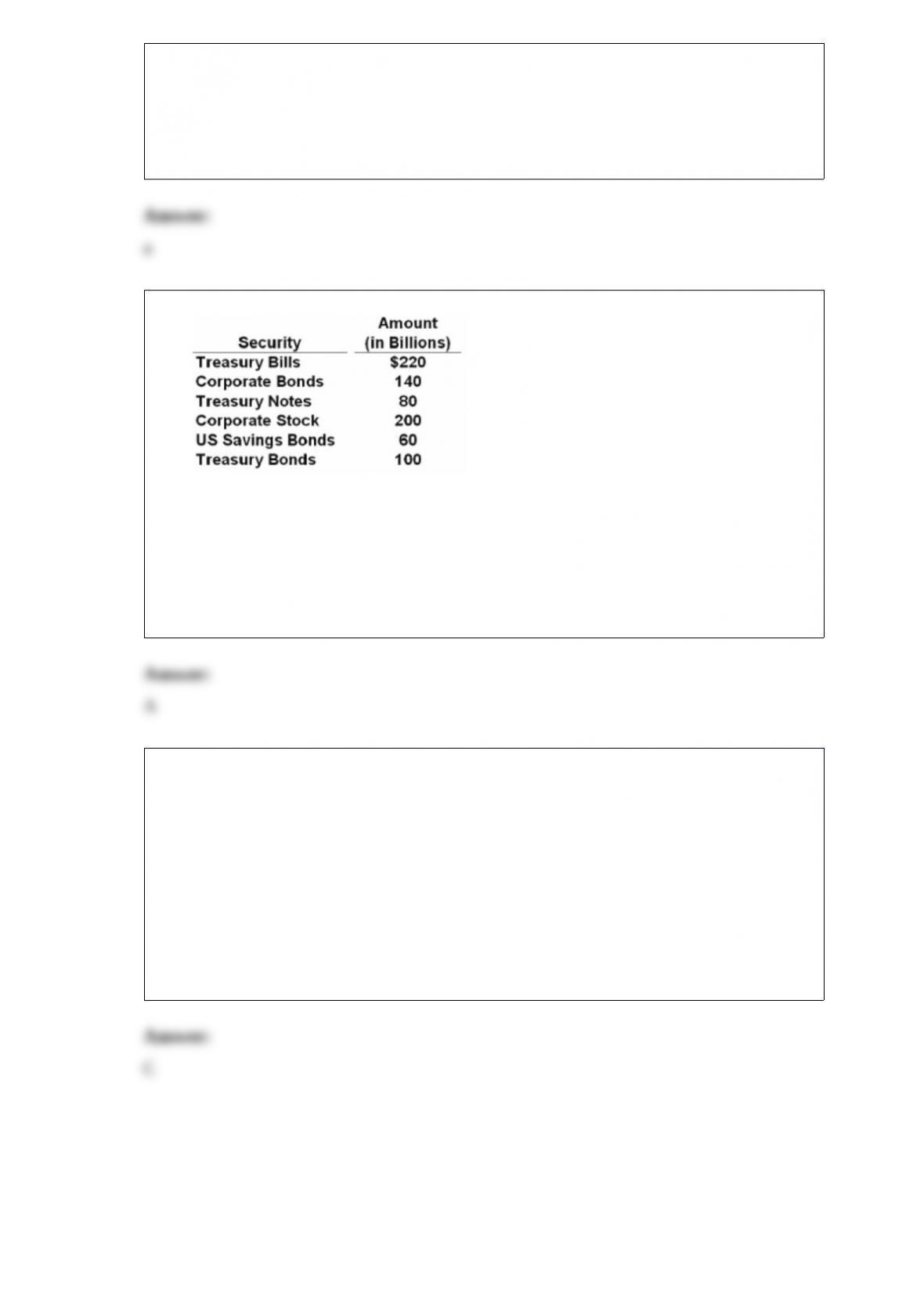
Other things equal, an increase of corporate bonds from $140 billion to $150 billion in
the above economy would:
A.not change the size of the public debt.
B.increase the public debt from $460 billion to $470 billion.
C.increase the public debt from $600 billion to $610 billion.
D.decrease the public debt by $20 billion.
3) Suppose a firm hires both labor (L) and capital (C) under purely competitive
conditions. The price of labor is PL and that of capital is PC. The marginal product of
labor is MPL and that of capital is MPC. The firm sells its product competitively at a
price of PX.
Refer to the above information. Which of the following must pertain if the firm is to
minimize the cost of producing any output?
A.MPC = MPL = PX
B.MPC = PC and MPL = PL
C.MPC/PC = MPL/PL
D.MPC/PX = MPL/PX
4)
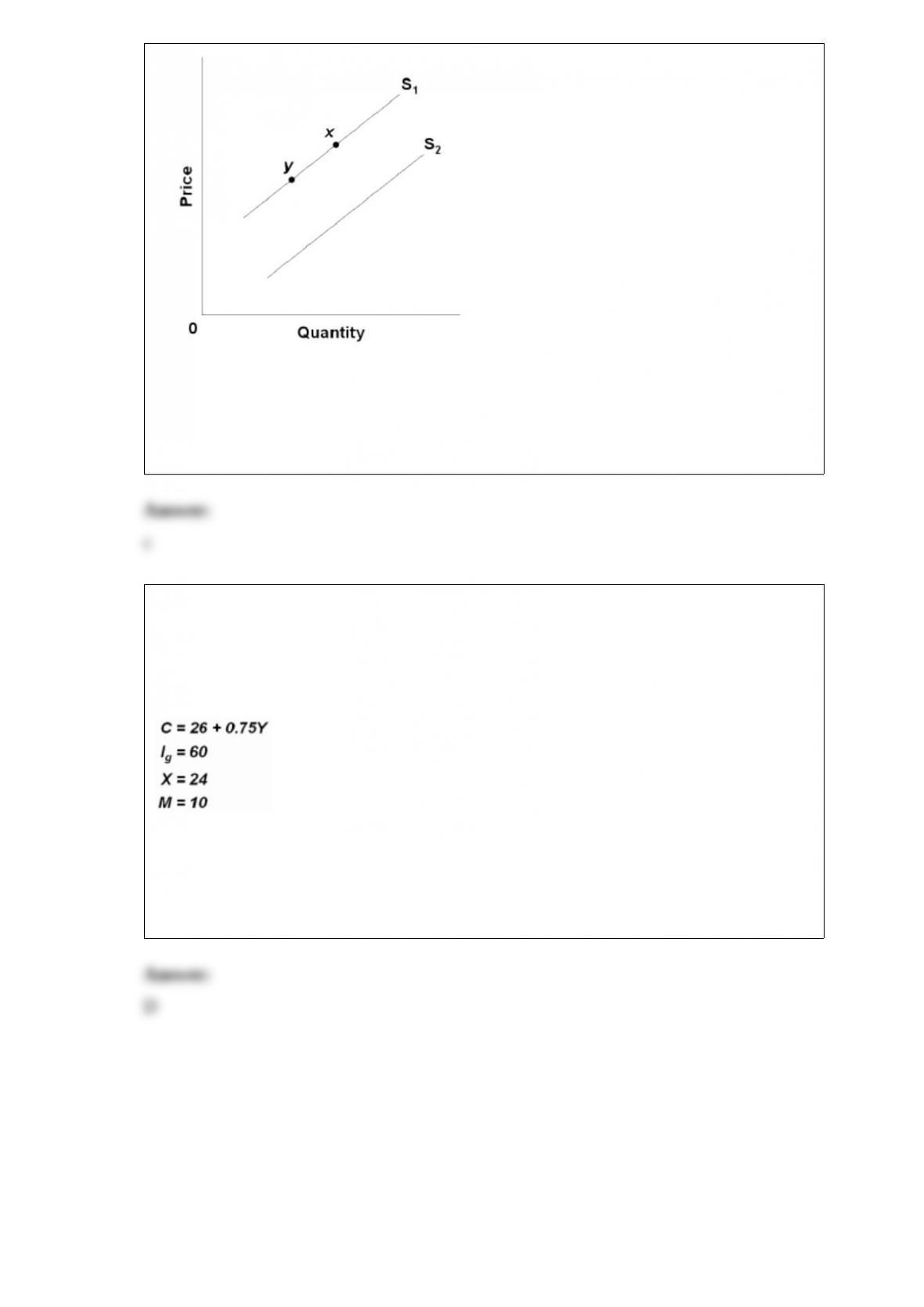
refer to the above diagram. a decrease in supply is depicted by a:
a.move from point x to point y.
b.shift from s1 to s2.
c.shift from s2 to s1.
d.move from point y to point x.
5) (Advanced analysis) Answer the next question(s) on the basis of the following
information for a private open economy. The letters Y, C, Ig, X, and M stand for GDP,
consumption, gross investment, exports, and imports respectively. Figures are in
billions of dollars.
The equilibrium GDP for the above open economy is:
A.$390.
B.$375.
C.$320.
D.$400.
6)
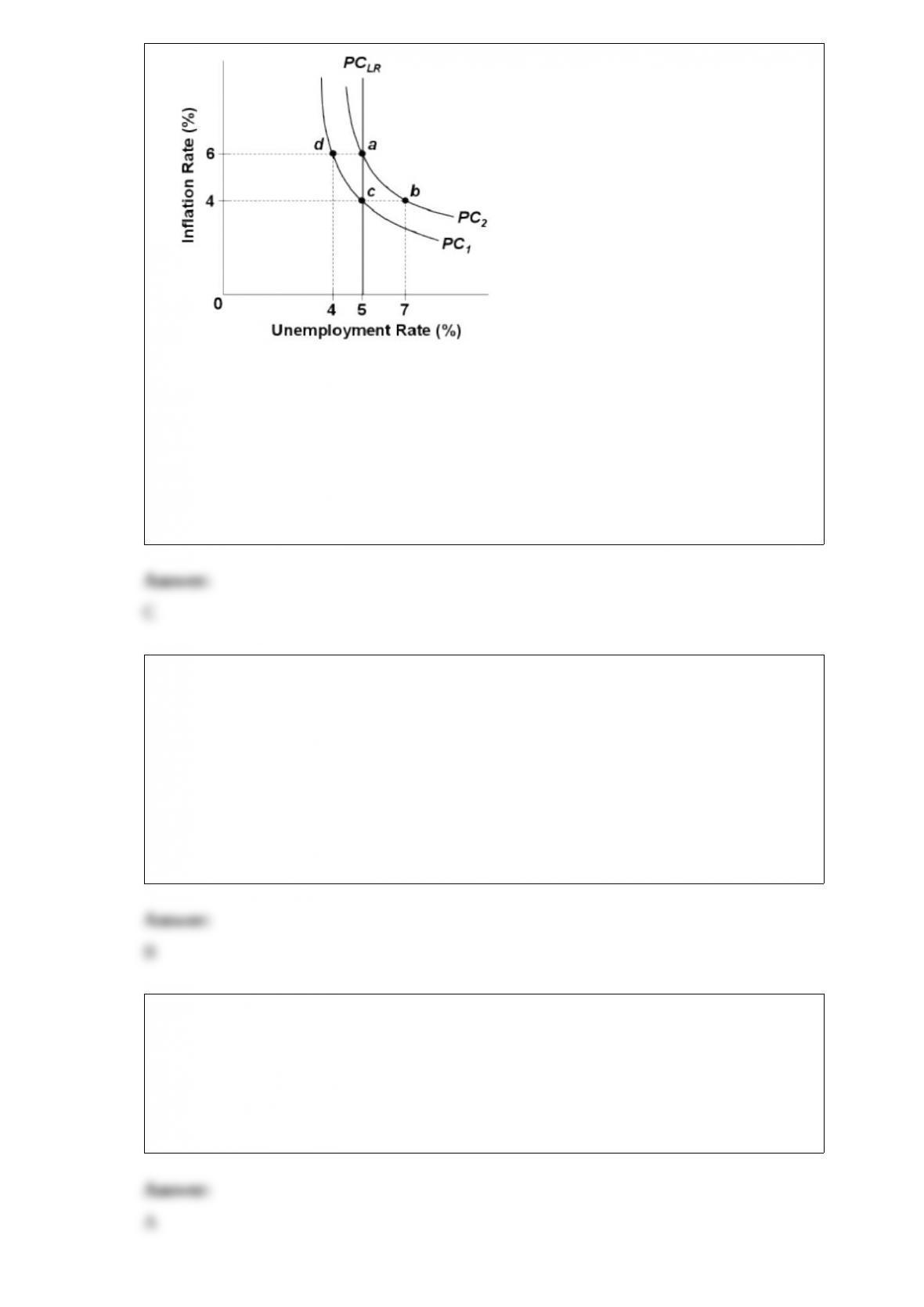
Refer to the above diagram. Assume that the natural rate of unemployment is 5 percent
and that the economy is initially operating at point a where the expected and actual rates
of inflation are each 6 percent. In the long run, the decline in the actual rate of inflation
from 6 percent to 4 percent will:
A.reduce the unemployment rate.
B.reduce corporate profits in real terms.
C.have no effect on the unemployment rate.
D.reduce real domestic output.
7) The following information about a banking system: new currency deposited in the
system = $40 billion; legal reserve ratio = 0.20; excess reserves prior to the currency
deposit = $0.
Refer to the above information. The $40 billion deposit of new currency will support
total checkable deposits of:
A.$160 billion.
B.$200 billion.
C.$40 billion.
D.$128 billion.
8) The group of three economists appointed by the President to provide fiscal policy
recommendations is the:
A.Council of Economic Advisers.
B.Joint Economic Committee.
C.Bureau of Economic Analysis.
D.Federal Reserve Board of Governors.

9) suppose that an economy’s labor productivity fell by 3 percent and its total
worker-hours remained constant between year 1 and year 2. we could conclude that this
economy’s:
a.real gdp declined.
b.capital stock increased.
c.production possibilities curve shifted outward.
d. actual production moved from one point to another on a fixed production possibilities
curve.
10) according to economists, gift registries, returning gifts for cash refunds, and
“recycling gifts”:
a.are inefficient because the time spent is these activities is never worth the benefit
recipients receive from doing them.
b.are selfish acts and morally wrong.
c.are more efficient than if givers simply gave cash gifts.
d.increase the efficiency of gift-giving because they allow the recipient to consume
goods that provide greater utility and transfer away those goods that are less satisfying.
11) Which one of the following acts declared “Every contract, combination … or
conspiracy, in restraint of trade or commerce among the several states … to be illegal”?
A.the Wheeler-Lea Act
B.the Federal Trade Commission Act
C.the Sherman Act
D.the Interstate Commerce Act
12) a major implication of asymmetric information is that:
a.health care suppliers may reduce the supply of health care.
b.health care suppliers may increase the demand for health care.
c.collusion between health care suppliers and purchasers may accelerate the rise in
costs.
d.resources may be underallocated to the health care industry.
13) Which of the following is not a tool of monetary policy?
A.open market operations
B.changes in banking laws
C.changes in the amount of reserves available at the term auction facility
D.changes in the reserve ratio
14) economic cost can best be defined as:
a.any contractual obligation that results in a flow of money expenditures from an
enterprise to resource suppliers.
b.any contractual obligation to labor or material suppliers.
c.compensations that must be received by resource owners to insure their continued
supply.
d.all costs exclusive of payments to fixed factors of production.
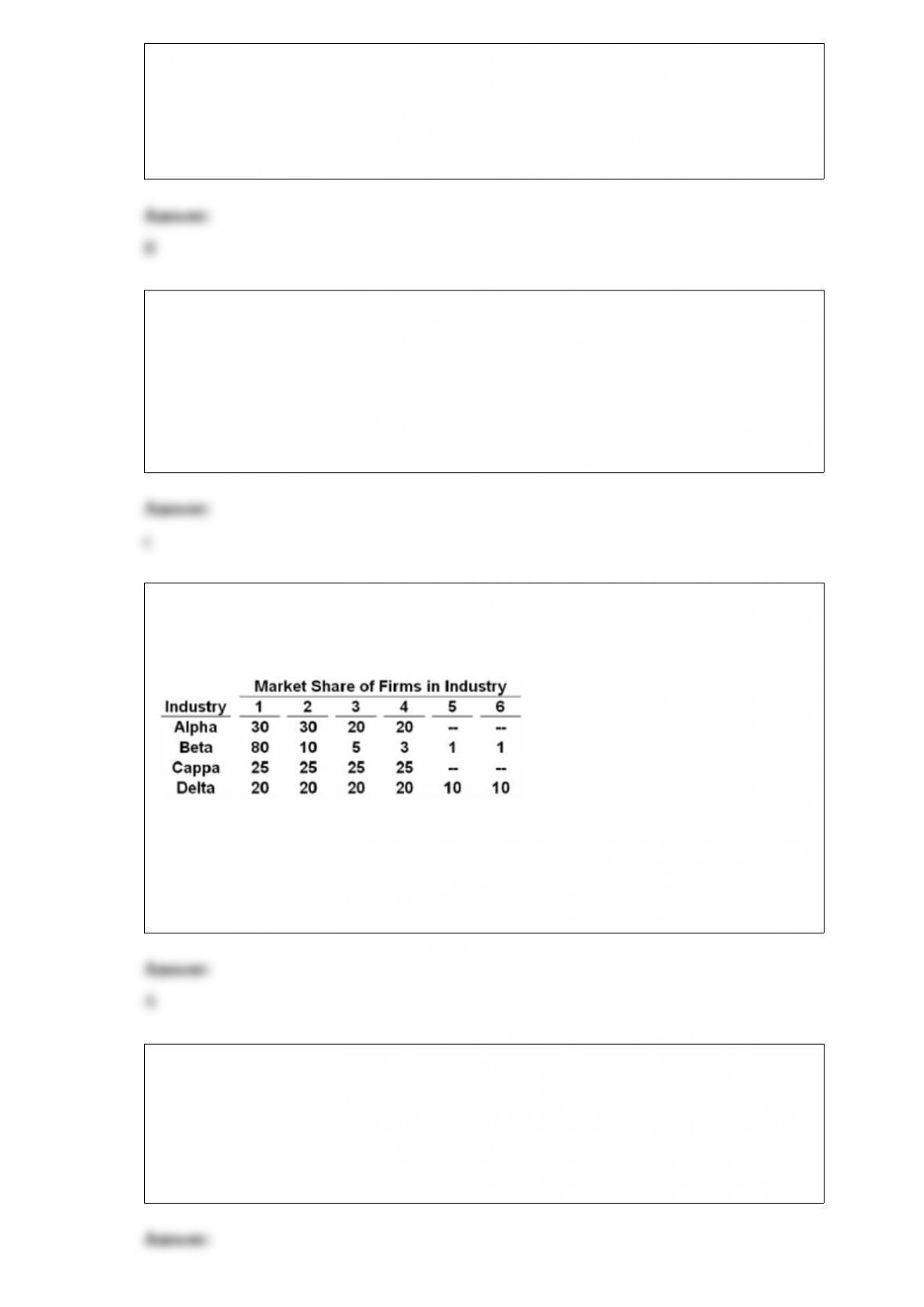
15) The following table shows market shares of firms in hypothetical industries.
Assume these are distinct industries with no buyer-seller relationships or competition
among them.
Refer to the above table. The Herfindahl index for Cappa is:
A.2,500.
B.100.
C.100,000.
D.5,000.
16) A situation in which society may not be able to rank its preferences consistently
through paired-choice majority voting refers to:
A.logrolling.
B.the paradox of voting.
C.the median-voter model.
D.the special-interest effect.
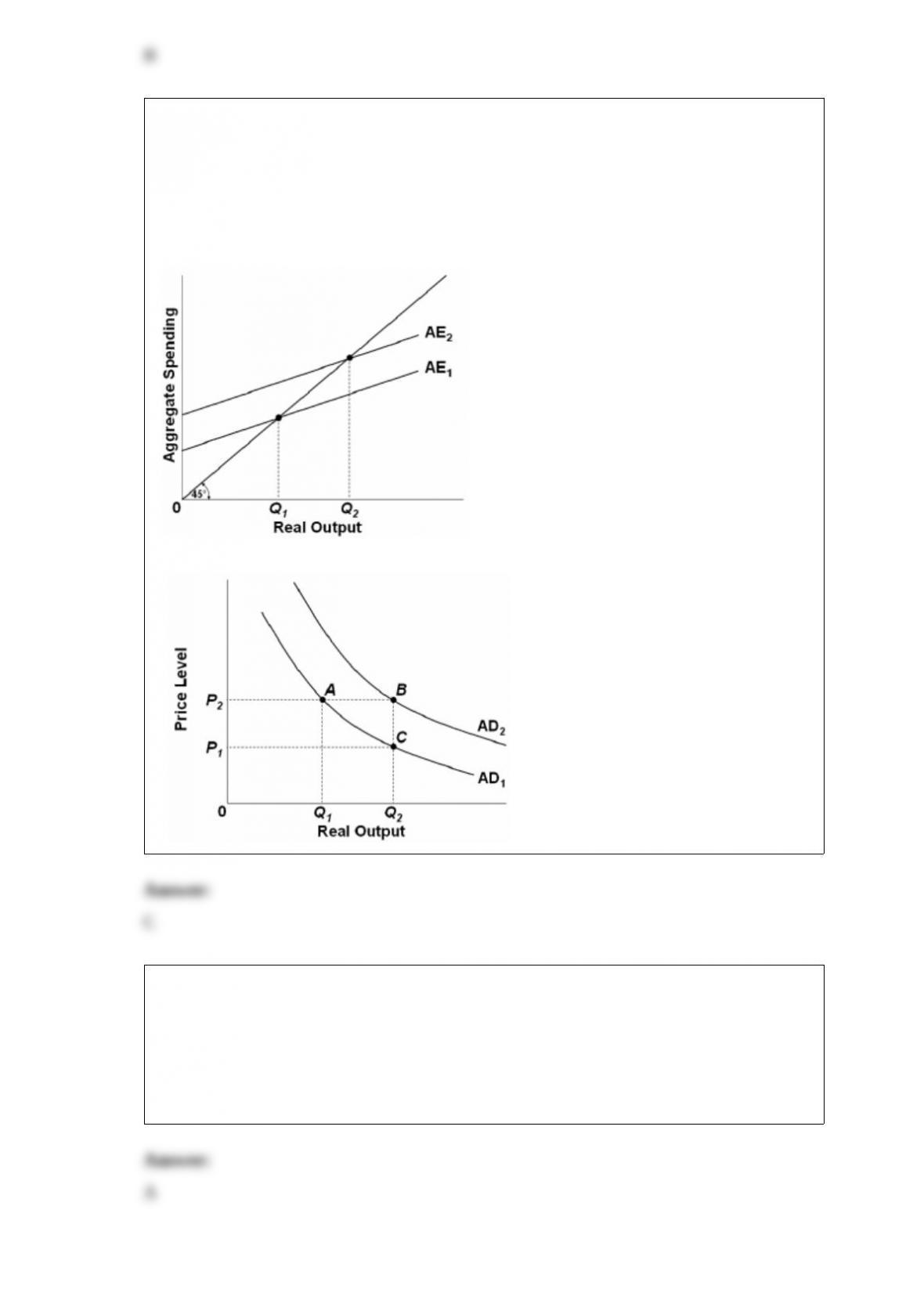
17) An increase in aggregate expenditures resulting from a decrease in the price level is
equivalent to a:
A.rightward shift of the aggregate demand curve.
B.leftward shift of the aggregate demand curve.
C.movement downward along a fixed aggregate demand curve.
D.decrease in aggregate supply.
18) To say that land rent performs no incentive function means that:
A.higher rental payments will not bring forth a larger quantity of land.
B.rent is not a cost to specific firms but it is a cost from the standpoint of the economy
as a whole.
C.rent does not allocate land in terms of productive efficiency.
D.rent tends to allocate land into the most productive uses.

19) Which of the following occupations is not among the ten projected fastest growing
U.S. occupations in terms of percentage increases?
A.school teachers
B.data communication analysts
C.medical assistants
D.personal and home care aides