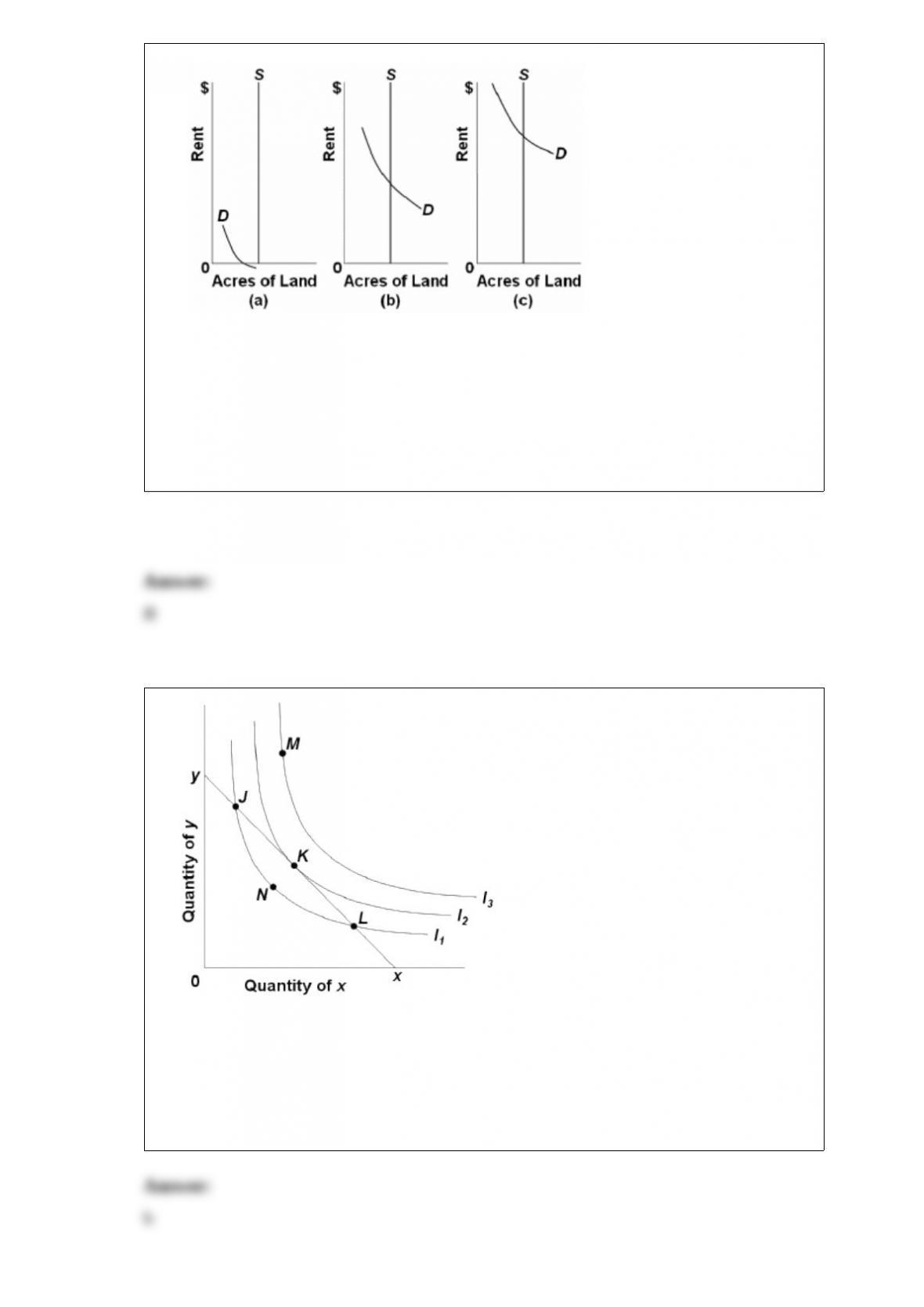
1)
Refer to the above diagrams. Assume that only wheat can be grown on the three grades
of land shown in Figures a, b, and c. Also assume that identical amounts of labor,
capital, and other needed inputs are used in farming each grade of land. On the basis of
these three figures we can say that:
A.the land shown in both Figures (a) and (b) is a “free good.”
B.the land shown in Figure (a) only is a “free good.”
C.the land shown in all three figures is a “free good.”
D.land is not a “free good” in any of the three figures.
2)
refer to the above diagram where xy is the relevant budget line and i1, i2, and i3 are
indifference curves. point m:
a.is the consumer’s equilibrium position.
b.is unattainable.
c.is inferior to point n.
d.entails the highest attainable level of total utility.
3) Compare pure competition, pure monopoly, monopolistic competition, and oligopoly
on each of the following points:
(a)Ability to manipulate price.
(b)Flexibility of prices.
(c)Expenditures on advertising and sales promotion.
(d)Efficiency in allocation of resources.
4) The interest-rate effect suggests that:
A.a decrease in the supply of money will increase interest rates and reduce
interest-sensitive consumption and investment spending.
B.an increase in the price level will increase the demand for money, reduce interest
rates, and decrease consumption and investment spending.
C.an increase in the price level will increase the demand for money, increase interest
rates, and decrease consumption and investment spending.
D.an increase in the price level will decrease the demand for money, reduce interest
rates, and increase consumption and investment spending.
5) Assuming no other changes, if balances in money market deposit accounts increase
by $50 billion and small time deposits decrease by $50 billion, the:
A.M1 and M2 money supplies will not change.
B.M2 money supply will increase.
C.M1 money supply will decline.
D.M2 money supply will increase and the M1 money supply will decrease.
6) assume an economy that is producing only one product. output and price data for a
three-year period are as follows. answer the next question(s) on the basis of these data.
refer to the above data. if year 2 is chosen for the base year, in year 3 nominal gdp and
real gdp, respectively, are:
a.$180 and $30.
b.$30 and $5.
c.$180 and $120.
d.$120 and $100.
7) a purely competitive seller is:
a.both a “price maker” and a “price taker.”
b.neither a “price maker” nor a “price taker.”
c.a “price taker.”
d.a “price maker.”
8) the marginal utility of the last unit of apples consumed is 12 and the marginal utility
of the last unit of bananas consumed is 8. what set of prices for apples and bananas,
respectively, would be consistent with consumer equilibrium?
a.$4 and $6
b.$6 and $4
c.$8 and $12
d.$16 and $9

9) Individual Transferable Quotas are limited in their effectiveness because:
A.they are only enforceable within 200 miles of a nation’s shores.
B.government, rather than the market, sets their price.
C.they encourage wasteful spending by fishers in ITQ areas.
D.they are not tradable.
10) the historical reallocation of labor from agriculture to manufacturing in the united
states has:
a.been inflationary.
b.had no effect on the average productivity of labor.
c.increased the average productivity of labor.
d.reduced the average productivity of labor.
11) The equilibrium rate of interest in the market for money is determined by the
intersection of the:
A.supply of money curve and the asset demand for money curve.
B.supply of money curve and the transactions demand for money curve.
C.supply of money curve and the total demand for money curve.
D.investment demand curve and total demand for money curve.
12) Unlike a private good, a public good:
A.has no opportunity costs.
B.has benefits available to all, including nonpayers.
C.produces no positive or negative externalities.
D.is characterized by rivalry and excludability.
13) According to public choice theorists, the private sector is more efficient than the
public sector mainly because:
A.the private sector has a clear test of performance: profit and loss.

B.wages, salaries, and fringe benefits are higher in the private sector.
C.worker turnover is higher in the public sector.
D.of extensive negative externalities in the public sector.
14) a perfectly elastic demand curve implies that the firm:
a.must lower price to sell more output.
b.can sell as much output as it chooses at the existing price.
c.realizes an increase in total revenue which is less than product price when it sells an
extra unit.
d.is selling a differentiated (heterogeneous) product.