
Which of the following is true?
a. In a competitive capital market, private investors have a strong incentive to evaluate
projects carefully and allocate their funds toward those projects expected to yield the
highest rates of return.
b. In a competitive environment, profitable investment projects will tend to increase the
wealth of the nation.
c. When investment funds are allocated by governments (rather than capital markets),
political clout rather than the expected rate of return will generally determine which
projects are undertaken.
d. All of the above are correct.
Gross domestic product is equal to the market value of all goods and services
a. exchanged during a period.
b. produced domestically during a period.
c. produced by the citizens of a nation during a period.
d. produced domestically during a period minus the depreciation of productive assets.
In computing the consumer price index, a base year is chosen. Which of the following
statements about the base year is correct?
a. The base year is always the first year among the years for which computations are
being made.

b. It is necessary to designate a base year only in the simplest case of two goods; in
more realistic cases, it is not necessary to designate a base year.
c. The value of the consumer price index is always 100 in the base year.
d. All of the above are correct.
Discounting is a procedure used to
a. determine the present value of income or costs expected in the future.
b. adjust future income for the effects of inflation.
c. adjust the money interest rates for the effects of inflation.
d. compare the value of income after taxes with its value prior to taxes.
Which of the following is true?
a. A budget deficit will reduce the national debt.
b. A budget deficit will increase the national debt.
c. A balanced budget will increase the national debt.
d. A budget surplus will increase the national debt.

If there is a “long and variable time lag” between when a change in monetary policy is
instituted and when it impacts aggregate demand and output, this will
a. make it easier for the Fed to properly time changes in monetary policy.
b. make it more difficult for the Fed to properly time changes in monetary policy.
c. not affect the Fed’s ability to time monetary policy changes correctly.
d. make it easier for the Fed to control inflation and achieve price stability.
A nation’s trade deficit will tend to shrink when its
a. economy is expanding.
b. economy is shrinking.
c. investment environment is attractive to foreigners.
d. economy is growing at a normal rate.

The price that a person must pay in order acquire purchasing power now rather than in
the future is called
a. the interest rate.
b. the foreign exchange rate.
c. the inflationary premium.
d. the risk premium.
According to the Keynesian view, if purchasers buy more goods and services than
businesses expect,
a. the inventories of firms would decline, and the firms would expand output in order to
restore their inventories to desired levels.
b. the inventories of firms would increase, and the firms would reduce output until
inventories were cut back to the desired level.
c. the current level of income would persist in the future.
d. firms would reduce their investment, and the economy would fall into a recession.
Suppose a market is initially competitive with many firms selling an identical product.
Over time, however, suppose the merging of firms results in the market being served by
only three or four firms selling this same product. As a result, we would expect
a. an increase in market output and an increase in the price of the product.
b. an increase in market output and an decrease in the price of the product.

c. a decrease in market output and an increase in the price of the product.
d. a decrease in market output and a decrease in the price of the product.
A wheat farmer sells wheat to a grain broker Chicago. Since the market for wheat is
generally considered to be competitive, the wheat farmer maximizes his profit by
choosing
a. to produce the quantity at which average variable cost is minimized.
b. to produce the quantity at which average fixed cost is minimized.
c. to sell its wheat at a price where marginal cost is equal to average total cost.
d. the quantity at which the farm’s marginal cost of production is equal to the market
price.
Which of the following is most likely to belong to a union?
a. a government employee
b. a salesperson
c. a chef at a four-star restaurant
d. a taxi driver

To gain from price discrimination, price searchers
a. must charge a higher price to those with a more inelastic demand.
b. must be pure monopolists.
c. must have small economies of scale
d. must have access to widely available natural resources.
Structural unemployment is a result of
a. difficulties in matching qualified workers with available jobs.
b. inaccurate or costly information about job opportunities.
c. slow or negative economic growth, as during a recession.
d. not enough workers to fill available jobs.

When a country’s inflation rate varies substantially from year-to-year and is therefore
difficult to predict, this will
a. reduce the volume of trade and the gains derived from it.
b. reduce the risk accompanying investment.
c. encourage entrepreneurs to innovate and develop better products.
d. increase the level of foreign investment in the country.
The primary benefit that results when a nation employs its resources in accordance with
the principle of comparative advantage is
a. an expansion in investment resulting from a reallocation of resources away from
consumption.
b. a larger output resulting from a more efficient use of resources.
c. greater equality of income resulting from an increase in the number of workers.
d. an increase in the profitability of business enterprises resulting from an increase in
investment.
Computer forecasting models have
a. been able to forecast changes in the growth rate of real GDP with considerable

accuracy.
b. had only limited success predicting turns in key economic variables such as real
GDP.
c. been able to accurately forecast the future direction of inflation but not real GDP.
d. been able to accurately forecast the future direction of real GDP but not inflation.
Assume that supply increases greatly and demand increases slightly. Which of the
following will happen?
a. Equilibrium price will fall and equilibrium quantity will rise.
b. Equilibrium price will rise and equilibrium quantity will fall.
c. Equilibrium price will rise and equilibrium quantity will rise.
d. Equilibrium price will fall and equilibrium quantity will fall.
e. Neither equilibrium price nor equilibrium quantity will change.
Even though firms in competitive price-searcher markets do not produce at minimum
ATC, competitive price-searcher markets may still be consistent with economic
efficiency because
a. strict government regulations force the firms in these markets to keep their costs low.

b. they provide consumers with a greater diversity of products.
c. they encourage more advertising in both price-searcher and price-taker markets.
d. special legal protections for price searchers make it possible for them to more
efficiently use resources.
The effectiveness of monetary policy as a stabilization tool is limited by
a. activist economists, who exert pressure on politicians.
b. the inability to forecast the future and time policy changes in a stabilizing manner.
c. Congressional attempts to offset changes in monetary policy with modifications in
fiscal policy.
d. the inability of the Federal Reserve to alter the money supply.
Which of the following is a danger of high rates of inflation?
a. Price changes encourage long-term contracts at the expense of short-term contracts.
b. Rapid price changes reduce uncertainty.
c. Inflation increases the real value of assets, such as stocks and bonds.

d. Inflation will encourage people to spend less time producing and more time trying to
protect the value of their assets.
If the Federal Reserve unexpectedly increases the money supply, which of the following
will most likely happen in the short run?
a. real GDP will rise.
b. real GDP will fall.
c. real interest rates will rise.
d. the budget deficit will rise.
If a competitive price-taker firm is currently producing a level of output at which
marginal revenue exceeds marginal cost, then
a. a one-unit increase in output will increase the firm’s profit.
b. a one-unit decrease in output will increase the firm’s profit.
c. total revenue exceeds total cost.
d. total cost exceeds total revenue.

After eating six chocolate candy bars in ten minutes, Mia says, “You would have to pay
me to eat another chocolate candy bar!” This statement best illustrates
a. the law of demand.
b. the substitutability among goods.
c. the law of diminishing marginal utility.
d. that chocolate candy bars are an inferior good.
The natural rate of unemployment
a. is a temporary low rate that cannot be maintained.
b. is fixed; it cannot be altered by public policy.
c. is equal to the number of persons unemployed divided by the number in the labor
force.
d. is the unemployment rate accompanying the economy’s maximum sustainable rate of
output.
Which of the following best describes the crowding-out effect?
a. An increase in government expenditures will cause taxes to rise, which will reduce
both aggregate demand and output.

b. An increase in borrowing by the government will push interest rates upward, which
will lead to a reduction in private spending.
c. An increase in borrowing by the government will decrease the money supply and,
thereby, reduce aggregate demand.
d. An increase in government expenditures will cause the general level of prices to fall
and, thereby, reduce aggregate demand and output.
In which case is the political process most likely to result in the acceptance of efficient
projects and rejection of inefficient projects?
a. The benefits are highly concentrated, and costs are widespread among voters.
b. The costs are highly concentrated, and the benefits are widespread among voters.
c. Both the benefits and costs are widespread among voters.
d. The benefits accrue primarily in the future, while the costs are more visible during
the current period.
Use the figure to answer the following question(s).
Figure 9-9
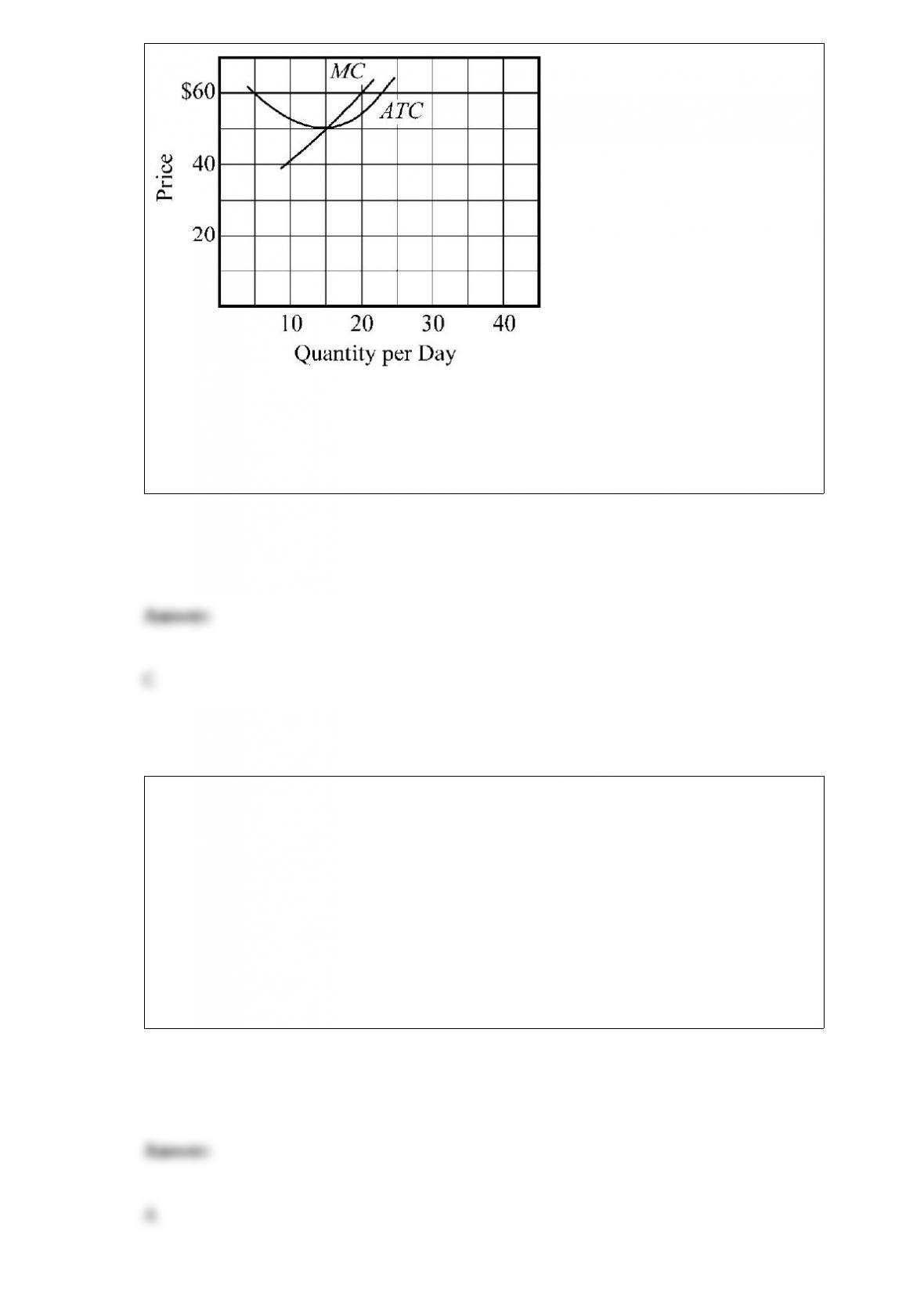
If the market price in Figure 9-9 increases to $60, what should the firm do?
a. produce 10 per day
b. produce 15 per day
c. produce 20 per day
d. increase its price to $70
Suppose we observe an economy experiencing an economic expansion and high
inflation. This means the expansion is attributed to
a. an anticipated increase in aggregate demand.
b. an increase in long-run aggregate supply.
c. an unanticipated decrease in aggregate demand.
d. an unanticipated decrease in aggregate supply.

Which of the following countries have the highest per person income levels?
a. Argentina, Brazil, and Mexico
b. China and India
c. France and Germany
d. Ireland, Norway, and the United States
If people decide to hold less money as currency and more as checking deposits, this will
most likely cause
a. a decrease in bank reserves.
b. a decrease in required reserves.
c. an increase in the discount rate.
d. an increase in the money supply.
If a price-taker firm selling in a competitive market offers its product at a higher price
than others, it will
a. increase its profits.

b. maintain its profit base if the demand for the product is inelastic.
c. be able to expand output.
d. not be able to sell any output.
In economics, actions by individuals and interest groups designed to influence public
policy in a manner that will either directly or indirectly redistribute more income to
themselves are known as
a. logrolling.
b. rent seeking.
c. influence peddling.
d. redistribution searching.