1) which of the following is incorrect?
a.total fixed cost does not change with output in the short run.
b.fixed costs exist only in the short run.
c.total fixed cost must be added to total variable cost to determine total cost.
d.total fixed cost equals total variable cost in the long run.
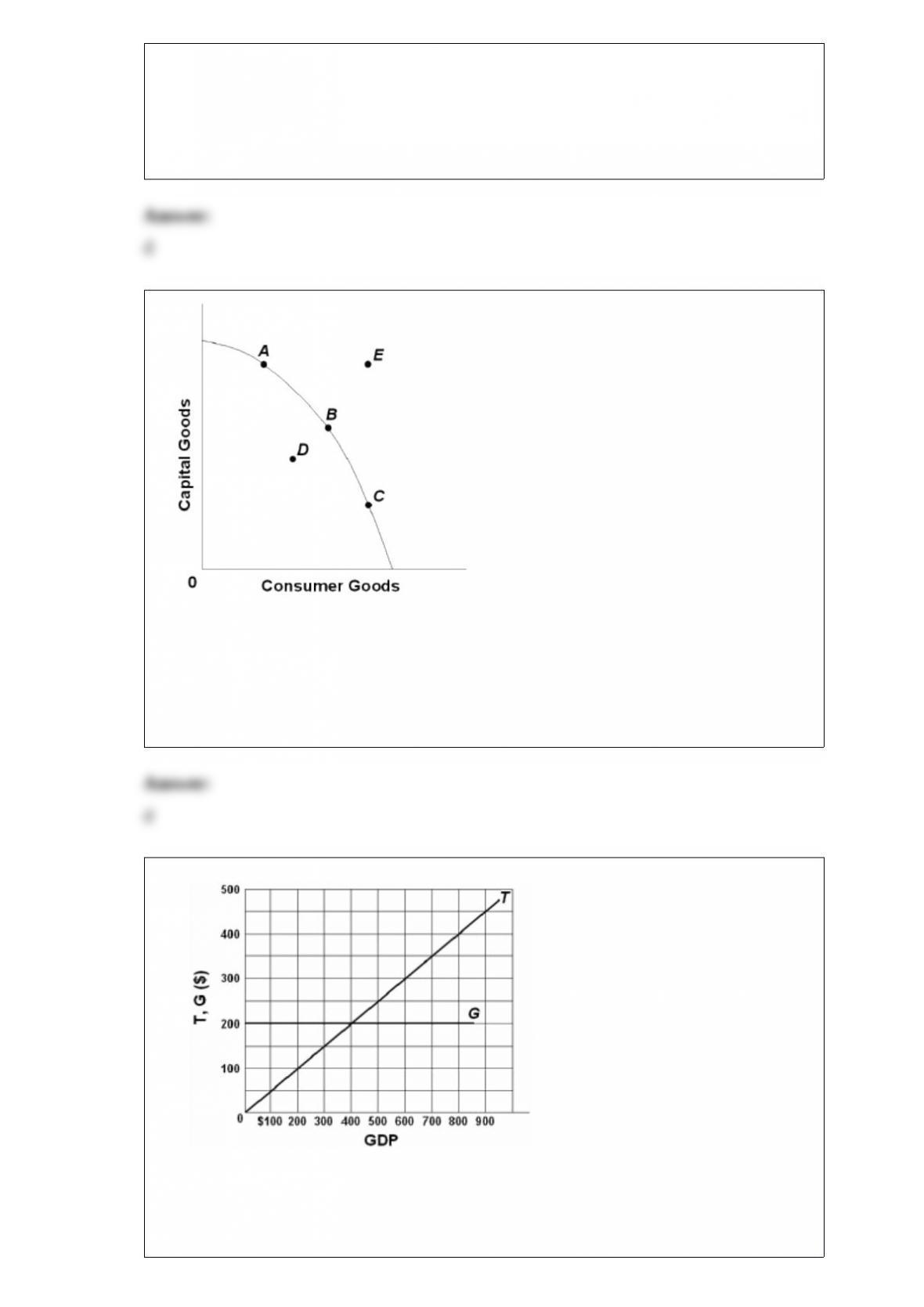
2)
refer to the above diagram. this economy will experience unemployment if it produces
at point:
a.a.
b.b.
c.c.
d.d.
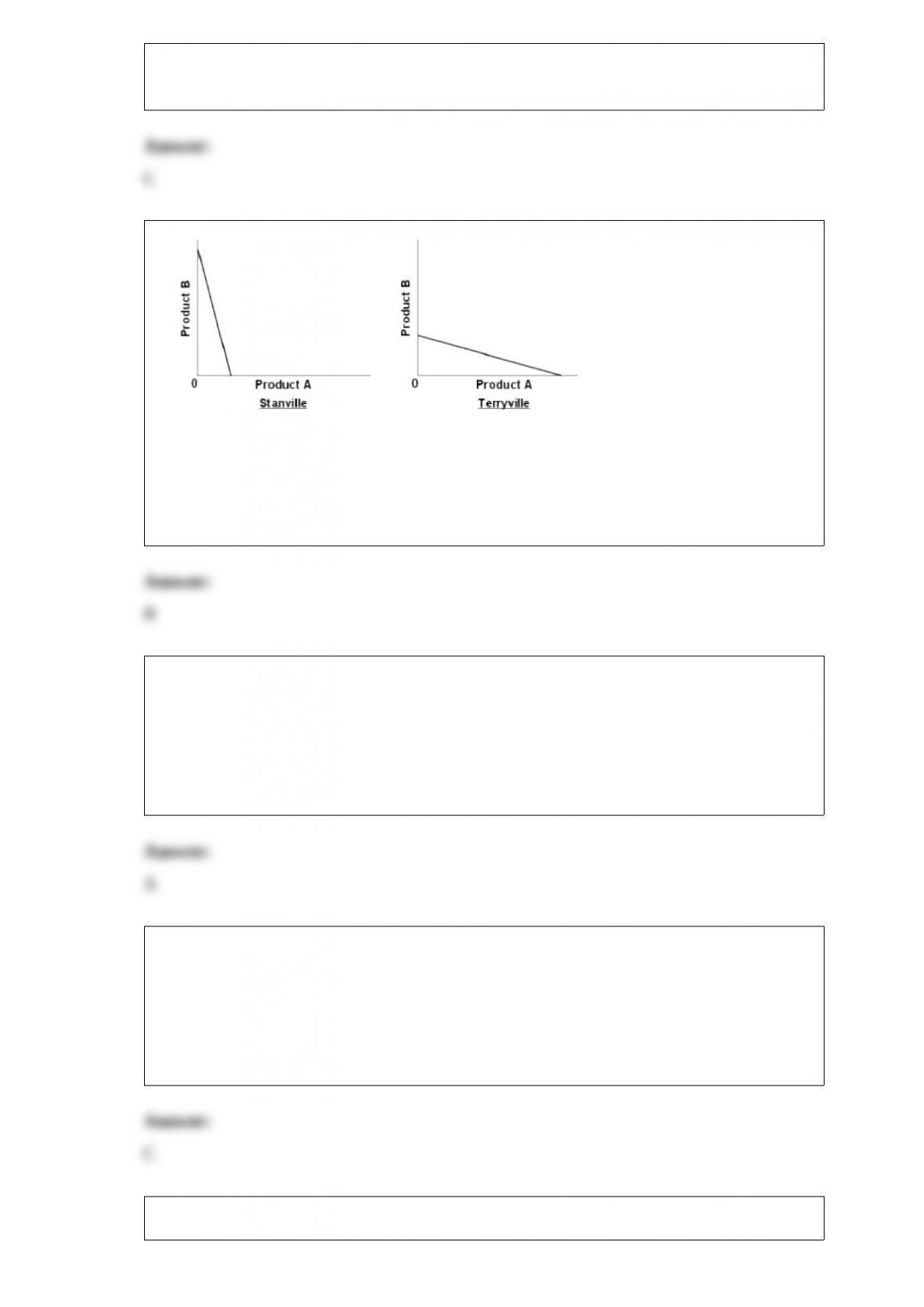
3)
Refer to the above diagram in which T is tax revenues and G is government
expenditures. All figures are in billions. If GDP is $400:
A.there will be a budget deficit.
B.there will be a budget surplus.

C.the budget will be balanced.
D. the macroeconomy will be in equilibrium.
4) in introducing the opportunity cost of time into the theory of consumer behavior we
find that, all else equal:
a.one should consume less of time-intensive goods.
b.one should consume more of time-intensive goods.
c.the consumer’s equilibrium position is not altered.
d.the marginal utility derived from each product must be multiplied by consumption
time in determining equilibrium.
5) which of the following lists includes only capital resources (and therefore no labor or
land resources)?
a.an ice arena; a professional hockey player; hockey uniforms.
b.the owner of a new startup firm; a chemistry lab; a researcher.
c.a hydroelectric dam; water behind the dam; power lines.
d.autos owned by a car rental firm; computers at the car rental agency; the vans that
shuffle rental customers to and from the airport.
6) which of the following is a shortcoming of the market system?
a.it leads to firms that are too large to achieve productive efficiency.
b.certain goods will not be produced because there is no way of excluding nonpaying
(“free-rider”) individuals from the associated benefits.
c.the resulting distribution of personal incomes might be too equal to maintain
incentives.
d.it is controlled by a handful of multinational corporations.
7) Higher interest rates will, all else equal:
A.increase the extraction cost of a resource.
B.increase the user cost of extracting a resource.
C.reduce the user cost of extracting a resource.
D.have no impact on either the user cost or extraction cost of a resource.
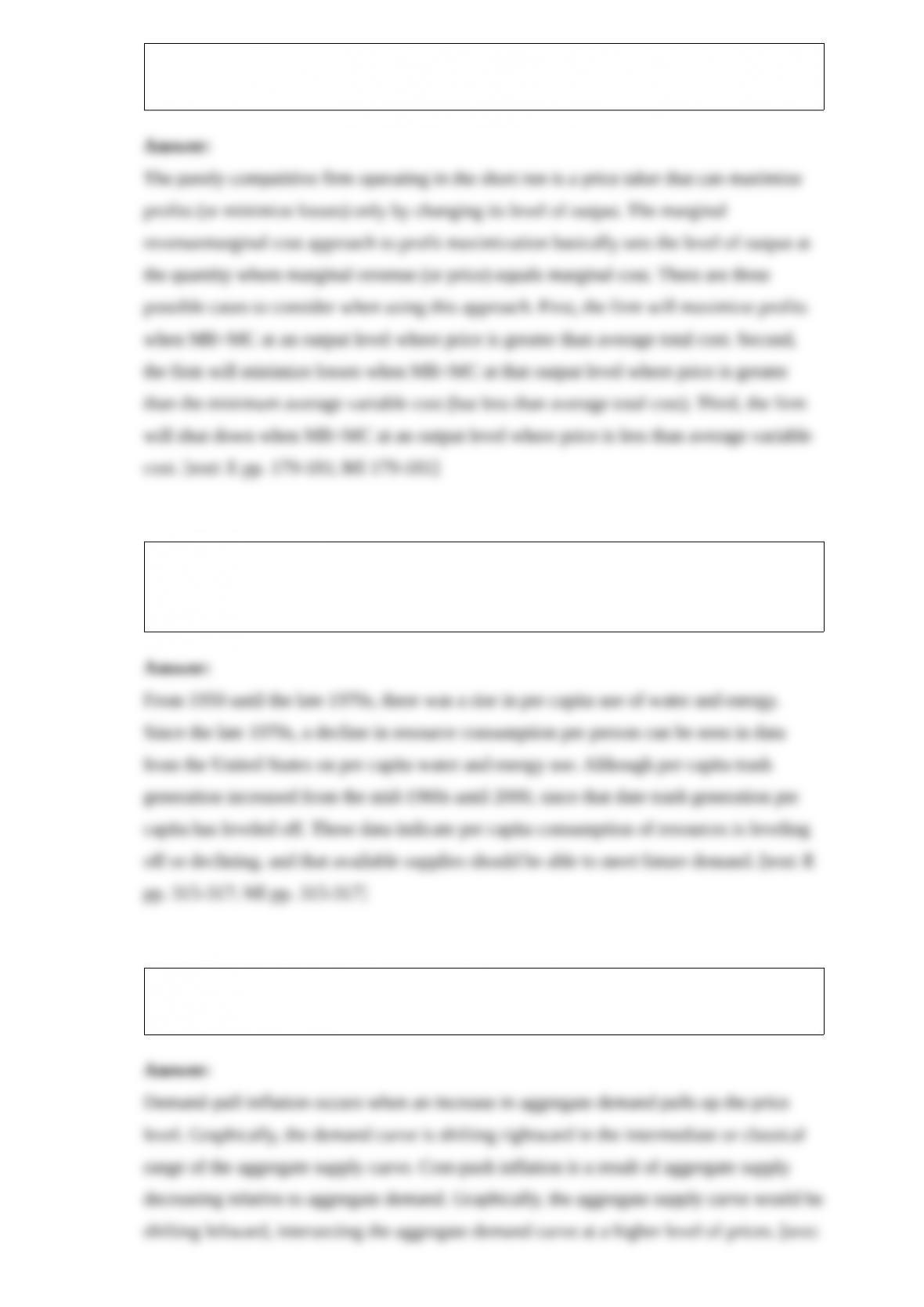
8)
Refer to the above graphs. Stanville has a comparative advantage in producing:
A.product A.
B.product B.
C.both product A and B.
D.neither product A nor B.
9) The following are hypothetical exchange rates: 2 euros = 1 pound; $1 = 2 pounds.
We can conclude that:
A.$1 = 4 euros.
B.$1 = .5 euros.
C.1 euro = $.50.
D.1 euro = $2.
10) If excess reserves in the banking system are $4,000, checkable deposits are
$40,000, and the legal reserve ratio is 10 percent, then actual reserves are:
A.$4,000.
B.$6,000.
C.$8,000.
D.$5,000.
11) Explain the marginal revenue and marginal cost approach to profit maximization
and use it to describe profit, loss, and shut down situations for the purely competitive
firm.
12) Describe the trends in total and per capita water use, energy consumption, and trash
generation in the United States from 1950 to 2000. What do they indicate about
resource use?
13) Differentiate between demand-pull and cost-push inflation in the basic aggregate
demand and aggregate supply model.
14) How might innovation create or reduce monopoly power?
15) How equal is the distribution of personal income by households in the United
States?
16) Compare and contrast the short-run Phillips Curve and the long-run Phillips Curve.