
1) Tariffs create larger gains to domestic producers than losses to domestic consumers.
2) Permanent tax reductions are more likely to be expansionary than temporary tax
reductions.
3) The real-business cycle theorists see aggregate supply as the “active” factor in
causing business cycles and aggregate demand as a “passive” factor.
4) In the United States since 1970, the poor have gotten poorer and the rich have gotten
richer in both relative and absolute terms.
5) the substitution effect suggests that when consumers judge product quality by price,
they will substitute high-priced products for low-priced products.
6) Those who contend that oligopolists are less likely than more competitive firms to
engage in R&D say that:
A.Oligopolists have little incentive to introduce costly new technology and produce
new products when they currently are earning large economic profit using existing
technology and selling existing products.
B.the undistributed profits of oligopolists give them a source of readily available,
relatively low cost funds for financing R & D.
C.entry barriers enable oligopolists to sustain the profits they gain from innovation.
D.the large size of oligopolists’ R&D departments allow them to use very specialized,
expensive R&D equipment and employ teams of specialized researchers.
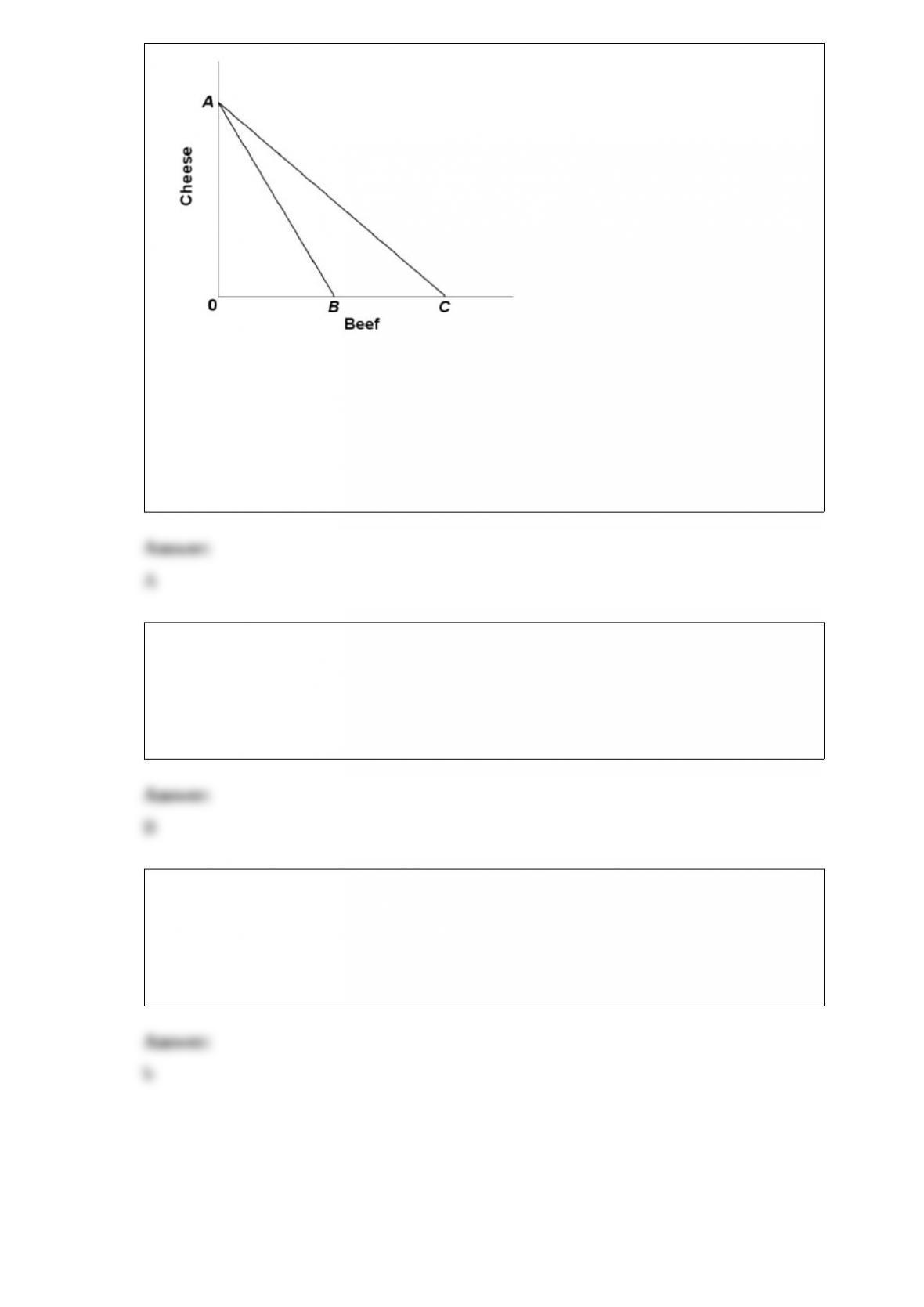
7)
Refer to the above diagram in which line AB is the United States production possibility
curve and AC is its trading possibilities curve. We can conclude that the United States:
A.has chosen to specialize in the production of cheese.
B.has chosen to specialize in the production of beef.
C.has decided to trade beef for cheese.
D.is relatively more efficient than its trading partners in producing both cheese and
beef.
8) The exports of the DVCs consist largely of:
A.high-technology goods.
B.raw materials and farm products.
C.manufactured goods.
D.services and financial capital.
9) purposeful behavior means that:
a.people are selfish in their decision-making.
b.people weigh costs and benefits to make decisions.
c.people are immune from emotions affecting their decisions.
d.decision-makers do not make mistakes when weighing costs and benefits.
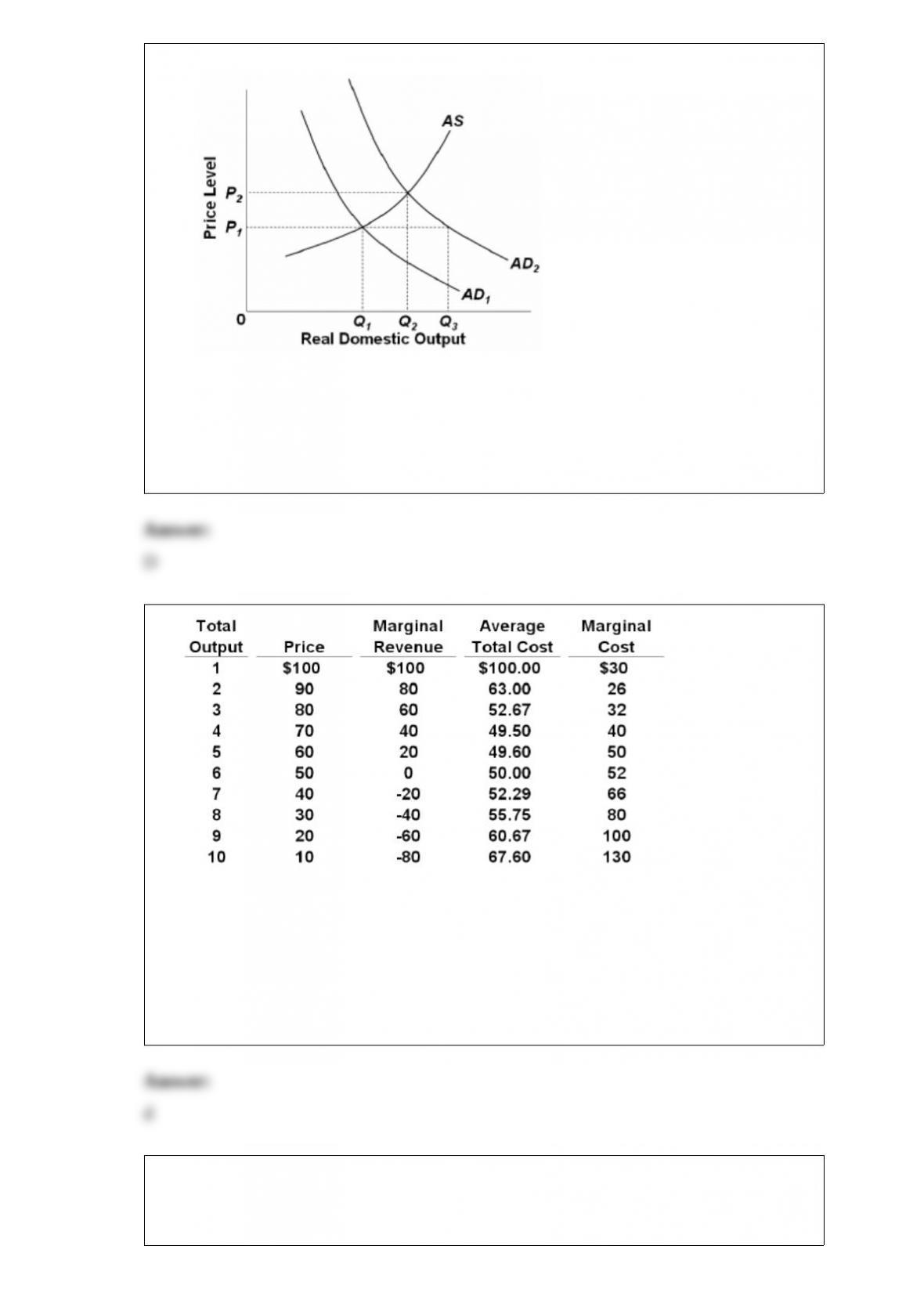
10)
Refer to the above diagram. If the equilibrium price level is P1, then:
A.aggregate demand is AD2.
B.the equilibrium output level is Q3.
C.the equilibrium output level is Q2.
D.producers will supply output level Q1.
11)
refer to the above data for a nondiscriminating monopolist. at its profit-maximizing
output, this firm’s price will exceed its marginal cost by ____ and its average total cost
by ____.
a.$20; $27.33
b.$10; $10.40
c.$24; $27.33
d.$30; $20.50
12) if the supply and demand curves for a product both decrease, then equilibrium:
a.quantity must fall and equilibrium price must rise.
b.price must fall, but equilibrium quantity may rise, fall, or remain unchanged.

c.quantity must decline, but equilibrium price may rise, fall, or remain unchanged.
d.quantity and equilibrium price must both decline.
13) an hypothesis is:
a.a fundamental truth that all economists accept.
b.a tentative, untested statement of possible cause and effect.
c.the same as a normative statement.
d.also known as a principle or law.
14) in calculating gdp, governmental transfer payments, such as social security or
unemployment compensation, are:
a.not counted.
b.counted as investment spending.
c.counted as government spending.
d.counted as consumption spending.
15) determine, other things equal, the effects of a given change in a determinant of
demand or supply for product x upon (1) the demand (d) for, or supply (s) of, x, (2) the
equilibrium price (p) of x and (3) the equilibrium quantity (q) of x.
refer to the above. an increase in the tastes and preferences for x will:
a.increase s, decrease p, and increase q.
b.decrease s, decrease p, and decrease q.
c.increase d, increase p, and increase q.
d.decrease d, decrease p, and decrease q.
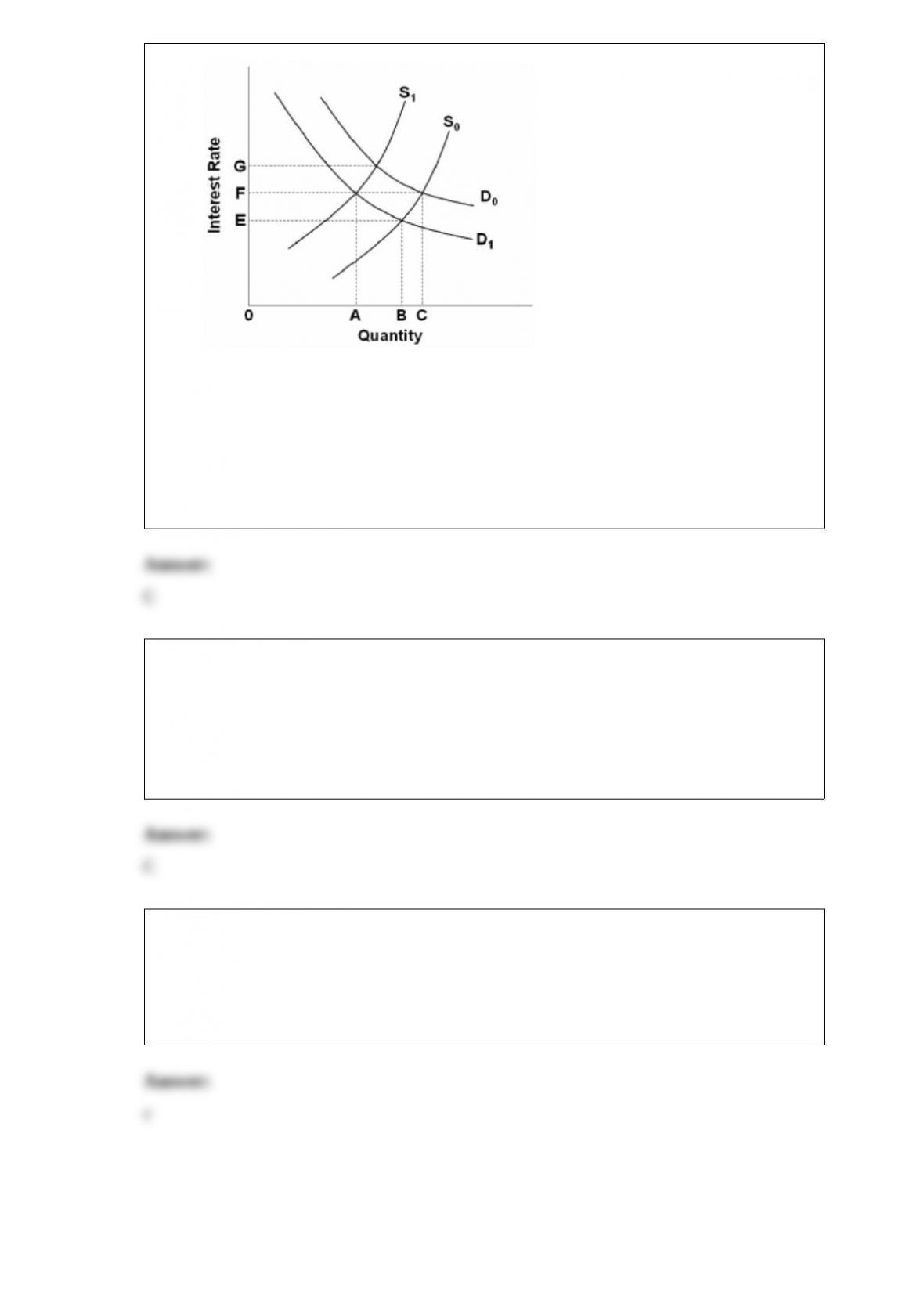
16)
Refer to the above diagram. If the supply of loanable funds is S0 and the demand for
loanable funds is D0, the equilibrium interest rate and quantity of funds borrowed will
be:
A.G and A.
B.F and A.
C.F and C.
D.E and A.
17) If a 10 percent wage increase in a particular labor market results in a 5 percent
decline in employment in that market, labor demand is:
A.unit elastic.
B.elastic.
C.inelastic.
D.perfectly elastic.
18) the pure food and drug act is an illustration of:
a.governmental provision of public goods.
b.the redistributional function of government.
c.governmental provision of a suitable legal framework for the market system.
d.governmental action designed to enhance competition.
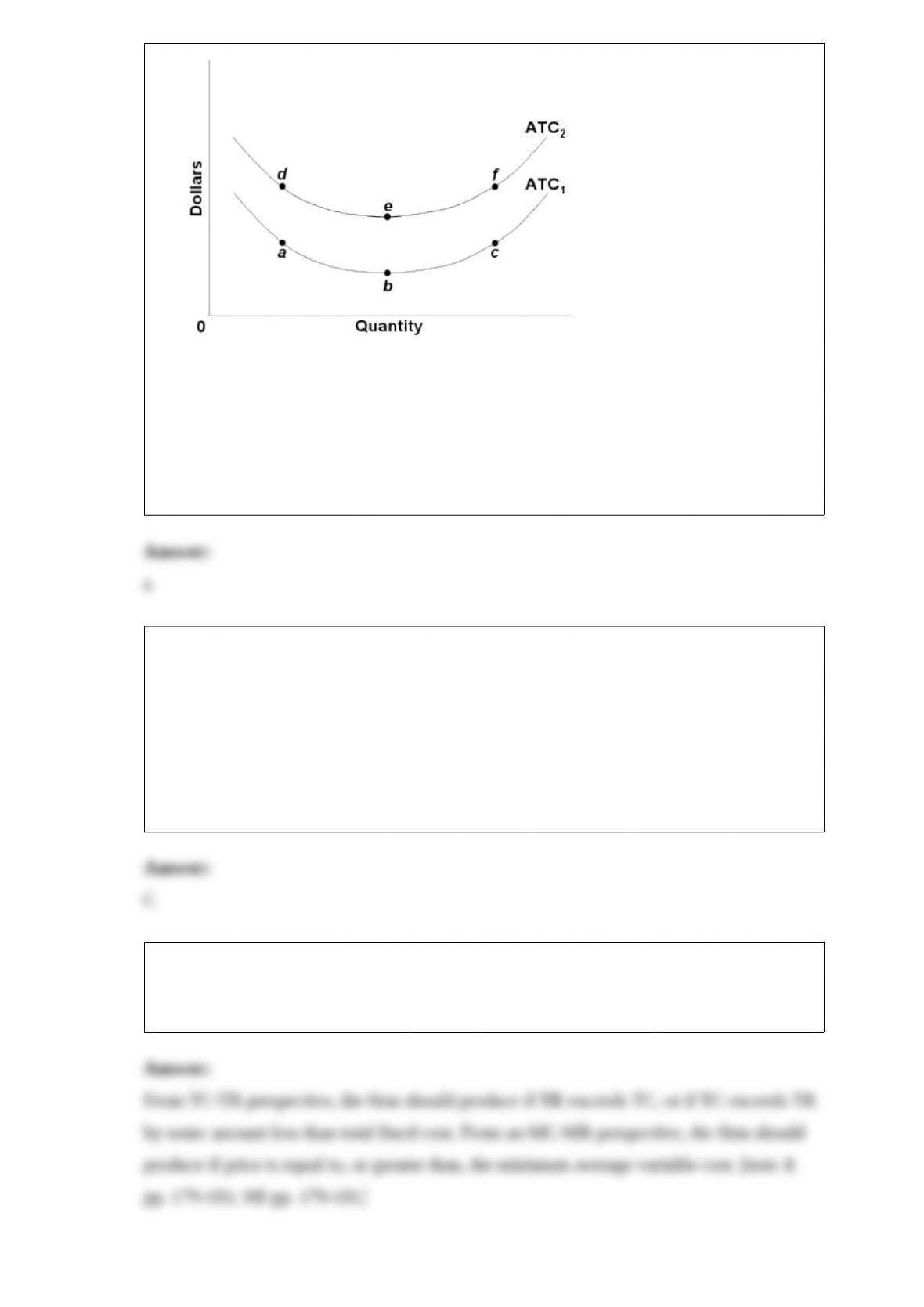
19)
refer to the above graph. which one of the following would cause a move from point e
on short-run average total cost curve atc2 to point b on short-run average cost curve
atc1?
a.a decline in total fixed costs
b.diminishing marginal returns
c.an increase in the wage rate
d.increasing marginal returns
20) In prosperous times banks are likely to hold very small amounts of excess reserves
because:
A.the Fed wants commercial banks to increase the money supply during economic
expansions.
B.it is very costly to transfer funds between commercial banks and the central banks.
C.the Federal Reserve Banks do not pay interest on bank reserves.
D.the Federal Reserve Banks want to minimize their interest payments on such
deposits.
21) What conditions are necessary to determine if the purely competitive firm should
produce in the short run? State the marginal revenue and marginal cost conditions and
the total revenue and total cost conditions.
22) Define asset liquidity. Provide an example of a highly liquid and highly illiquid
asset.
23) What is the sociopolitical significance of income shares; that is, what might income
shares tell us about the overall character of our society? What implications might
income shares have for economic stability? For economic growth?
24) Some economists argue that pure monopolists will purposely avoid the price-output
combination that will maximize their profits. Explain how this less-than-maximum
profit behavior could be rational.
25) Why is the money demand curve downward sloping?