If the velocity of circulation is seven and the money supply declines by 10 percent,
nominal GDP declines by ________ percent.
a. 0
b. 3
c. 7
d. 10
e. 70
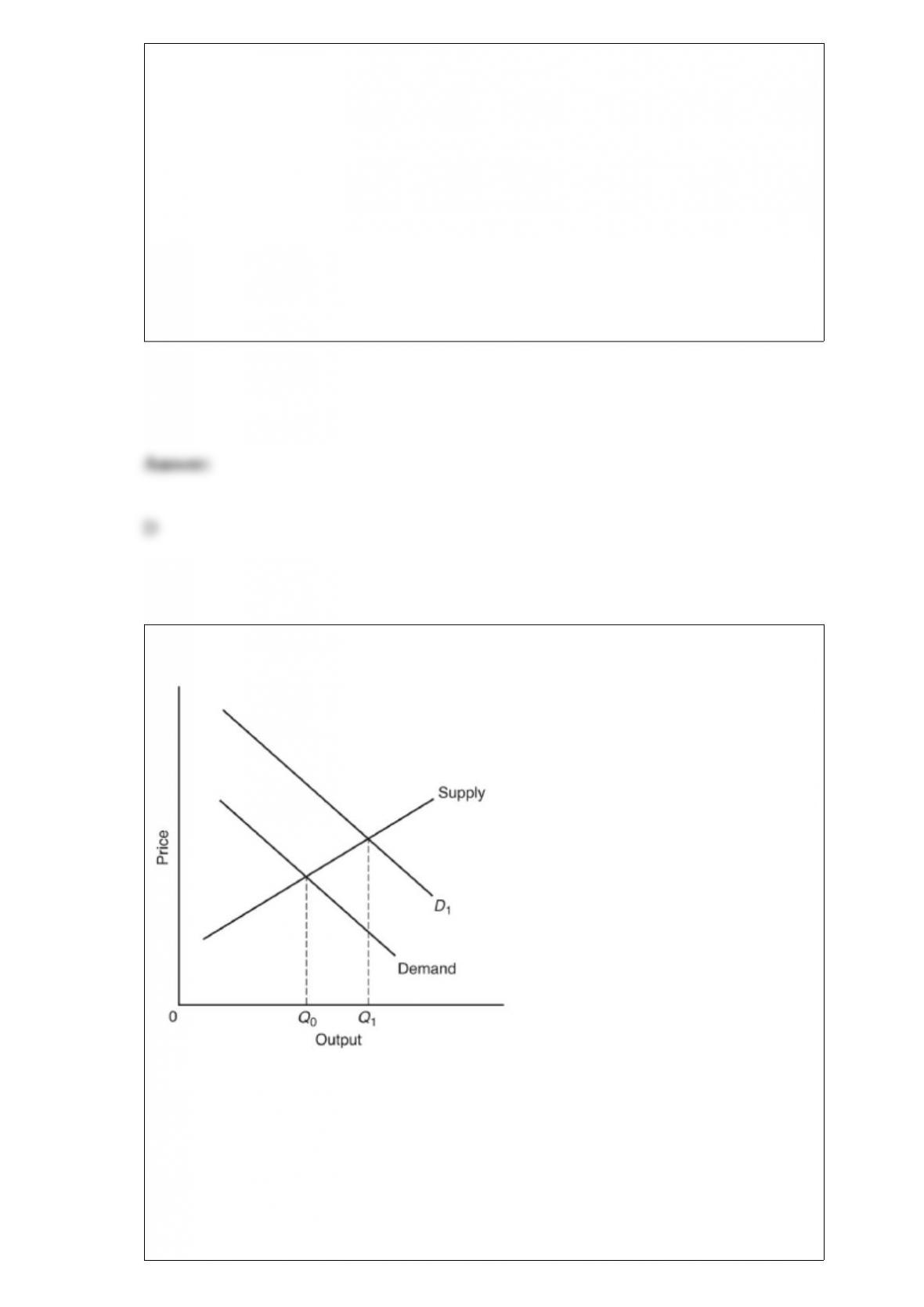
Shown in this diagram are demand and supply conditions for a competitive industry.
If D1 is the demand curve reflecting externalities in this industry
a. external diseconomies are present.
b. taxing producers is warranted to reduce output.
c. the optimal output from society’s standpoint is 0Q0.

d. the social benefits from production are greater than those measured by the industry’s
demand curve.
e. subsidies to producers are too high and should be reduced or eliminated altogether.
In the long run, under a system of flexible exchange rates
a. countries’ gold revenues will be proportional to their trade balances.
b. the exchange rate between any two currencies will reflect price level differences
between the two countries.
c. currency markets will no longer play an important role in international trade.
d. most countries will have balance-of-trade surpluses.
e. the foreign currency reserves of all countries will approach zero.
Innovation is
a. the application of a new technology for the first time.
b. another name for technological change.
c. the application of existing technologies to low-risk projects.

d. the reward for risk taking.
e. a basic managerial technique necessary at all levels of management.
The relationship between the amount of income tax revenue collected and the marginal
tax rate is called the
a. total revenue curve.
b. aggregate supply curve.
c. capital gains curve.
d. balanced budget multiplier.
e. Laffer curve.
Over the last 50 years, federal, state, and local governments have
a. increased their expenditures faster than the growth in total output.
b. gradually but steadily declined in importance in economic matters.
c. demonstrated a movement toward significant public ownership of the means of
production.
d. moved increasingly toward nationalization of the defense industry.

e. appreciably expanded public ownership in the electric power industry.
Pollution control efforts are justified whenever the marginal social benefits
a. exceed the total benefits to society.
b. are less than the average social costs.
c. are rising and costs are falling.
d. can be shown to be attainable.
e. exceed the marginal social costs.
When external diseconomies exist
a. the true demand curve is to the right of the market demand curve.
b. the actual market equilibrium price is too high from society’s perspective.
c. the supply curve slopes downward to the right.
d. industry output is less than socially optimal.
e. the supply curve reflecting the social costs is to the left of the industry supply curve.

The argument that the primary impact of the 1981 tax cut was on aggregate demand is
based on the fact that
a. output did not rise sufficiently to offset the effect of the tax cuts on the size of the
federal deficit.
b. unemployment rose significantly after the tax cut, necessitating increased federal
welfare.
c. after the tax cut, the velocity of circulation of the money supply rose at a rapid rate.
d. the inflationary pressures in the economy after the tax cut were greater than the
pre”tax cut rate of inflation.
e. the United States ran a balance of payments surplus for the first time in the
post”Vietnam War era two years after the tax cut.
The supply-side inflation episodes of the 1970s
a. occurred during periods of full employment of both human and capital resources.
b. shifted the aggregate supply curve downward to the right.
c. were largely the result of crude oil price increases.
d. were touched off by a sharp decline in the money supply.
e. were caused, in part, by the lack of market power of labor unions and large
corporations.
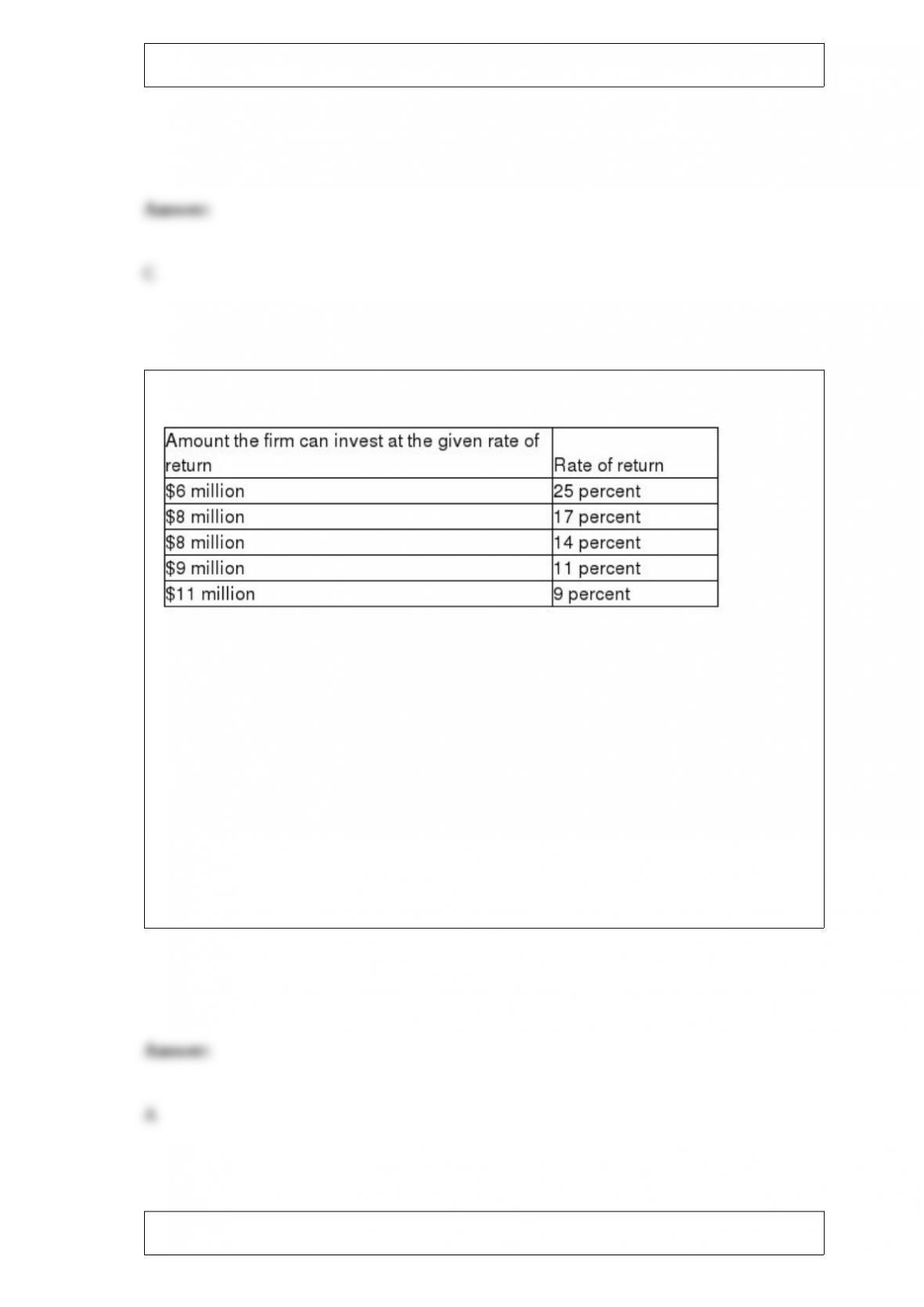
The following questions are based on the following schedule:
A 3-percentage-point increase in the rate of interest prior to making the investment
decision would reduce the amount invested by ________ million.
a. $8
b. $9
c. $20
d. $22
e. $28
The following questions are based on the following changes in the balance sheet of

Nowhere National Bank.
Assets Liabilities
a. Reserves No change Demand deposits $8,000
Loans and investments $8,000
Total $8,000 Total $8,000
b. Reserves $2,000 Demand deposits $10,000
Loans and investments $8,000
Total $10,000 Total $10,000
c. Reserves $10,000 Demand deposits $10,000
Loans and investments No change
Total $10,000 Total $10,000
d. Reserves “$8,000 Demand deposits “$8,000
Loans and investments No change
Total “$8,000 Total “$8,000
e. Reserves $10,000 Demand deposits No change
Loans and investments $10,000
Total $20,000 Total No change
Which letter best indicates the total effect on Nowhere National Bank’s balance sheet
after all the transactions just described have taken place?
a. a
b. b
c. c
d. d
e. e
Unemployment compensation and welfare payments tend to stabilize the economy by
a. holding government expenditures at a constant level.
b. accelerating the decrease in disposable income caused by a fall in GDP.
c. reducing corporate dividends when GDP increases.
d. being financed by taxes whose revenues rise and fall as the level of employment rises
and falls.
e. equalizing the burden of inflation.
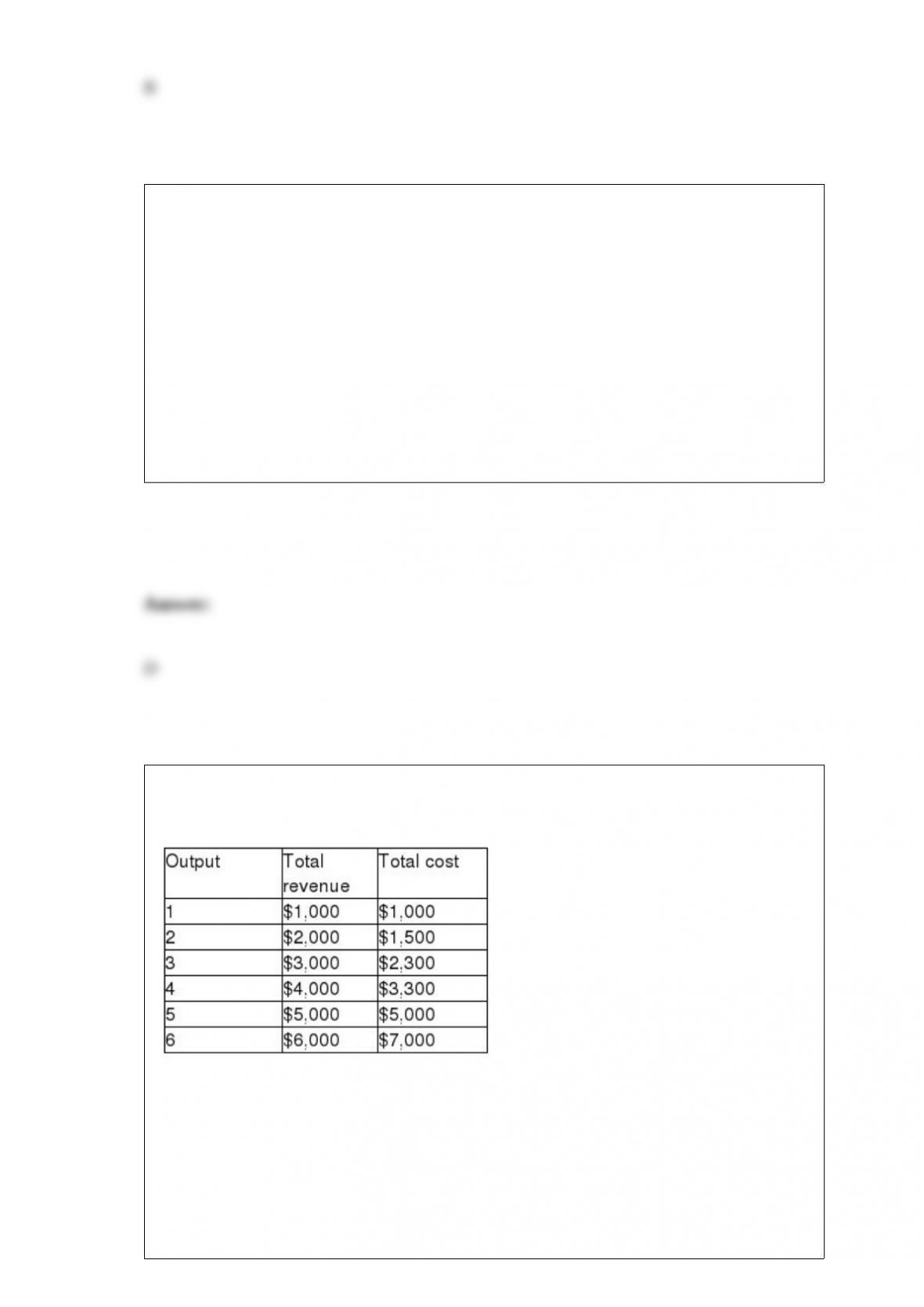
The following questions are based on the following cost and revenue schedule for the
Presto Piano Company:
If the firm finds that the market price per unit of output is $800, it should produce
between ________ units per period.
a. 1 and 2
b. 2 and 3

c. 3 and 4
d. 4 and 5
e. 5 and 6
The belief that the self-regulating capabilities of a market economy are insufficient to
ensure a stable, full-employment equilibrium is associated with
a. monetarists.
b. Keynesians.
c. supply siders.
d. rational expectations theorists.
e. new classical macroeconomists.
Educational expenditures may be viewed as an investment process when
a. the money spent increases the current income to teachers and other related
professionals.
b. college tuition expenses are tax deductible.
c. future gains in productivity follow from the sacrifice of current production and

consumption.
d. intellectual depreciation is counted as part of GDP.
e. such expenditures represent a noticeable share of our GDP.
The following questions are based on the following information: The country has a
fractional-reserve banking system, required reserves are 12.5 percent of demand
deposits, each bank initially has reserves exactly equal to the required amount, each
wants to maintain this equality, and no person withdraws cash from the banking system.
Mr. Smith now spends the exact amount of money he borrowed to buy equipment from
Ms. Jones, paying for it with a check drawn on his account at bank A. Ms. Jones
deposits the check in her account at bank B. Once the checks have cleared, compared to
its position just after the loan to Mr. Smith, bank A now has had its reserves decreased
by
a. $1,750.
b. $2,500.
c. $6,000.
d. $8,750.
e. $10,000.

Which best expresses the relationship between the market and individual demand
curves?
a. The market demand curve is an average of all individual demand curves.
b. The market demand curve is constructed by multiplying the price times the quantity
demanded by each consumer and summing the results.
c. The market demand curve is found by adding the quantities demanded by each
consumer at each possible price.
d. The market demand curve sums the prices each individual is willing to pay for a
given quantity.
e. Individual demand curves can be found by dividing the market demand by the
number of buyers.
Tax collections alter the equilibrium level of GDP by
a. causing a change in government spending.
b. changing the relationship between government expenditures and GDP.
c. changing the relationship between consumption expenditures and GDP.
d. shifting the 45-degree line to the left.
e. causing an increase in prices.

An increase in the money supply
a. shifts the aggregate demand curve to the left.
b. shifts the aggregate demand curve to the right.
c. shifts the aggregate supply curve to the left.
d. shifts the aggregate supply curve to the right.
e. affects neither the aggregate demand nor the aggregate supply curve, only the interest
rate.
Crystal Clear Glass Company uses a refinement method that creates air pollution,
causing the recreational industry in the area to suffer and forcing a number of citizens to
relocate. This behavior is an example of a(n)
a. private cost.
b. effluent fee.
c. positive externality.
d. external diseconomy.
e. transfer payment.

A rise in bond prices must mean that
a. interest rates have fallen.
b. interest rates have risen.
c. bond purchases and sales will cease.
d. money is tight and credit is no longer available.
e. the amount of money demanded for investment will fall.
Which of the following would be included in GDP when computed by the expenditures
approach?
a. fertilizer purchased by a farmer
b. flour purchased by a bakery
c. bread purchased by a restaurant
d. purchases of shares of common stock in a bakery
e. new production machinery purchased by a bakery
Economists generally classify economic resources into what three categories?

a. men, money, and machines
b. savings, spending, and investment
c. land, labor, and capital
d. physical, human, and technological
e. employed, unemployed, and free
Those who argue that discretionary fiscal and monetary policies are “time inconsistent”
advocate instead
a. fine-tuning.
b. policy activism.
c. governmental duplicity.
d. credible policies.
e. ongoing flexibility.
The price elasticity of demand will increase with the length of the period to which the
demand curve pertains because
a. consumers will be better able to find substitutes.

b. consumers’ incomes will increase.
c. advertising will have more time to take effect.
d. the demand curve will shift outward.
e. the arc elasticity of demand will decline.
An industry that contains a large number of firms selling goods that are similar but not
identical and into which entry of new sellers is relatively easy would be an example of
a. perfect competition.
b. pure monopoly.
c. regulated monopoly.
d. oligopoly.
e. monopolistic competition.
As a monopolist facing a downward-sloping demand curve increases sales from zero,
total revenue
a. remains unchanged.

b. rises steadily to equal price.
c. falls until it equals marginal revenue.
d. equals demand.
e. rises at first but eventually falls.
A major social and economic institution that came out of the Industrial Revolution was
a. the church.
b. universities.
c. serfdom.
d. the military.
e. the factory.
As of 1999, software purchases by businesses are
a. counted as a business transfer in GDP.
b. counted as a production input in GDP.
c. counted as consumer nondurables in GDP.

d. counted as a business investment in GDP.
e. not explicitly counted in GDP.
Which of the following best defines the difference between a recession and a
depression?
a. The terms are synonymous; there is no difference at all.
b. A depression is the correct term for recession experienced on a worldwide scale.
c. A depression is a period of economic hardship, while a recession generally is not.
d. A depression is a long, very severe recession.
e. A depression means potential GDP is falling. In a recession, only the actual GDP is
falling.
Which of the following could cause equilibrium GDP to fall?
a. an increase in autonomous investment
b. a downward shift in the saving function
c. an increase in amounts saved along an existing saving function
d. a downward shift in the consumption function
e. an increase in the nation’s population

One reason for the appearance of diminishing returns is that
a. each additional unit of an input has proportionately less of the other units with which
to work.
b. the fixed inputs cannot produce any more as more units of a variable input are added.
c. whenever inputs are added to a production process, output falls because of increased
inefficiency.
d. the marginal product continually rises whenever output is increased.
e. specialization becomes impossible as more units of a variable input are added to a
fixed input.
The Phillips curve for the 1970s, compared to that for the 1950s and 1960s
a. revealed a lower (3 percent) natural rate of unemployment.
b. was shifted downward to the left and appeared more nearly horizontal.
c. was a more predictable phenomenon and guide to policy formation.
d. resulted from a rightward shift in aggregate supply.
e. indicated the presence of strong inflationary expectations.