The increase in quality bias in the consumer price index refers to the idea that price
increases in the CPI reflect pure inflation, but ________ quality increases. This causes
the CPI to ________ the cost of the market basket.
A) also; understate
B) also; overstate
C) not; understate
D) not; overstate
Which of the following is not part of the “regulation of health insurance” provision of
the Patient Protection and Affordable Care Act (ACA)?
A) Individuals with pre-existing medical conditions will be able to acquire health
insurance.
B) All policies must provide coverage for dependant children up to age 26.
C) Lifetime dollar maximums on coverage will be prohibited.
D) Limits on the size of deductibles and on waiting periods before coverage takes effect
will be eliminated.
Which of the following will not occur as the result of a decrease in net taxes?
A) decreased household saving
B) decreased government saving

C) a shift to the left of the supply curve for loanable funds
D) all of the above
The United States usually exports ________ goods than it imports and exports
________ services than it imports.
A) more; more
B) more; fewer
C) fewer; more
D) fewer; fewer
When exchange rates are not determined in the market but are instead set by a country’s
central bank, we say that the country’s exchange rate is
A) flexible.
B) fixed.
C) a nominal exchange rate.
D) a real exchange rate.

Consumption spending will ________ when disposable income ________.
A) increase; increases
B) increase; decreases
C) decrease; increases
D) change unpredictably; decreases
If a country passes a labor law limiting the number of hours of work per week, GDP
would ________ and leisure would ________.
A) decrease; increase
B) increase; increase
C) decrease; decrease
D) increase; decrease
Which of the following countries actually experienced negative economic growth from
1960 to 2010?

A) Israel
B) Singapore
C) Niger
D) Malaysia
Suppose Warren Buffet withdraws $1 million from his checking account at Chase
Manhattan Bank. If the required reserve ratio is 20 percent, what is the maximum
change in deposits in the banking system?
A) -$5 million
B) -$4 million
C) -$200,000
D) $1 million
E) $5 million
Suppose your expenses for this term are as follows: tuition: $9,000, room and board:
$1,500, books and other educational supplies: $1,000. Further, during the term, you can
only work part-time and earn $3,000 instead of your full-time salary of $8,000. What is
the opportunity cost of going to college this term, assuming that your room and board
expenses would be the same even if you did not go to college?
A) $10,000

B) $13,000
C) $15,000
D) $18,000
All of the following are examples of spending on goods and services in the circular
flow model except
A) Amanda purchases a new electric guitar to pursue her hobby seriously.
B) Chaitanya buys a new spa pedicure chair for her expanding nail salon business.
C) Hernan buys a pizza at Papa C’s.
D) Lenny buys a new digital camera to take pictures at his son’s graduation.
If a corporate bond with face value of $5,000 has an interest rate of 4 percent paid once
a year for a term of 30 years, what is the size of the coupon payment?
A) $4
B) $200
C) $1,250
D) $5,000

If the consumption function is defined as C = 5,500 + 0.9Y, what is the autonomous
level of consumption expenditure?
A) $4,950
B) $5,500
C) $6,050
D) $6,111
According to the quantity theory of money, the inflation rate equals
A) the money supply minus real output.
B) the growth rate of the money supply minus the growth rate of real output.
C) real output minus the money supply.
D) the growth rate of real output minus the growth rate of the money supply.
Scenario 14-1
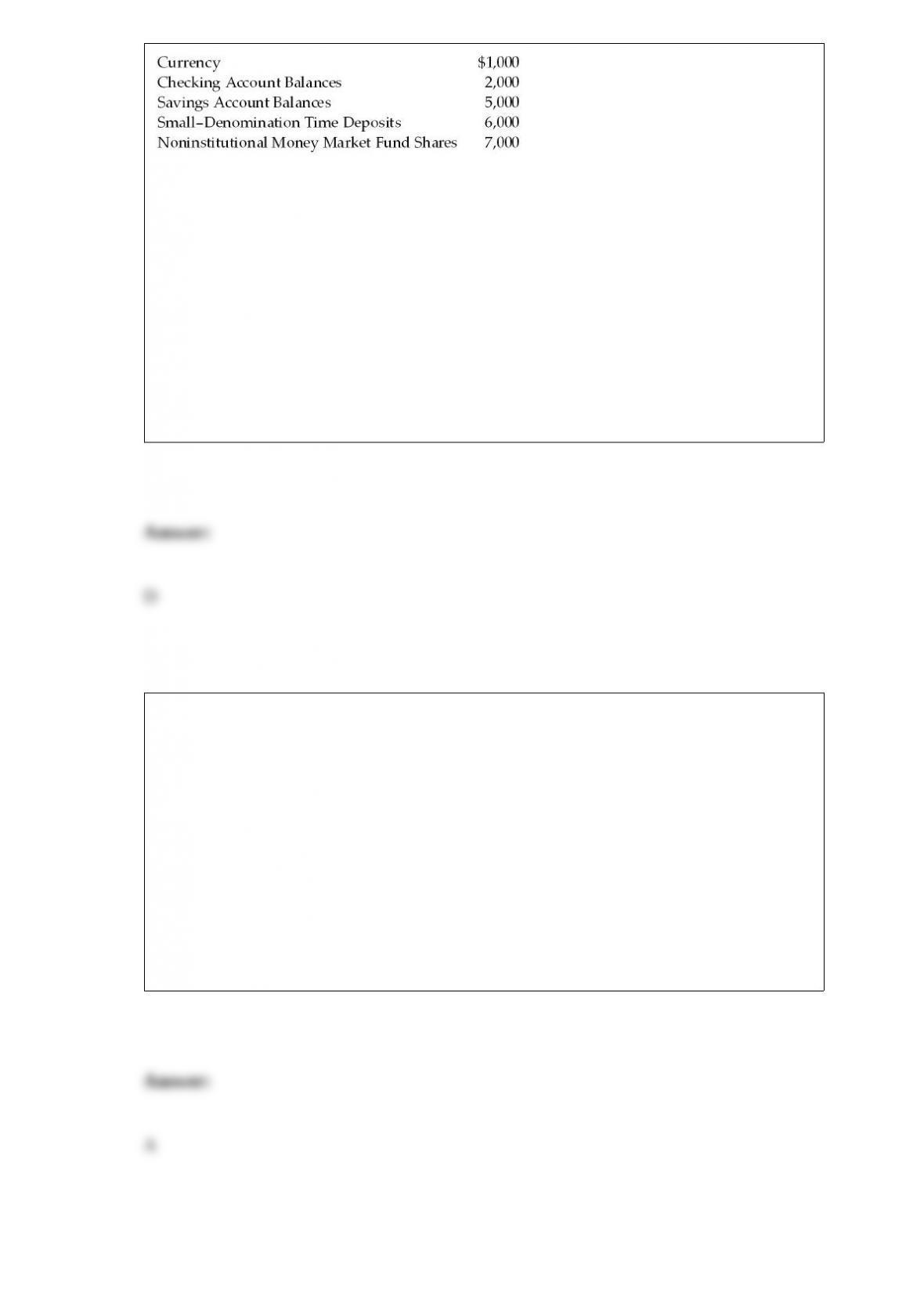
Consider the information above for a simple economy. Assume there are no traveler’s
checks.
Refer to Scenario 14-1. M2 in this simple economy equals
A) $3,000.
B) $8,000.
C) $14,000.
D) $21,000.
Establishing a state employment agency that speeds up the process of matching
unemployed workers with unfilled jobs is an attempt to lower
A) frictional unemployment.
B) structural unemployment.
C) cyclical unemployment.
D) seasonal unemployment.
E) unnatural unemployment.
Trade restrictions tend to preserve ________ in the protected industries and lead to
________ in other industries.
A) almost all jobs; economic growth
B) well over half of the jobs; price decreases
C) relatively few jobs; job losses
D) no jobs; increased productivity
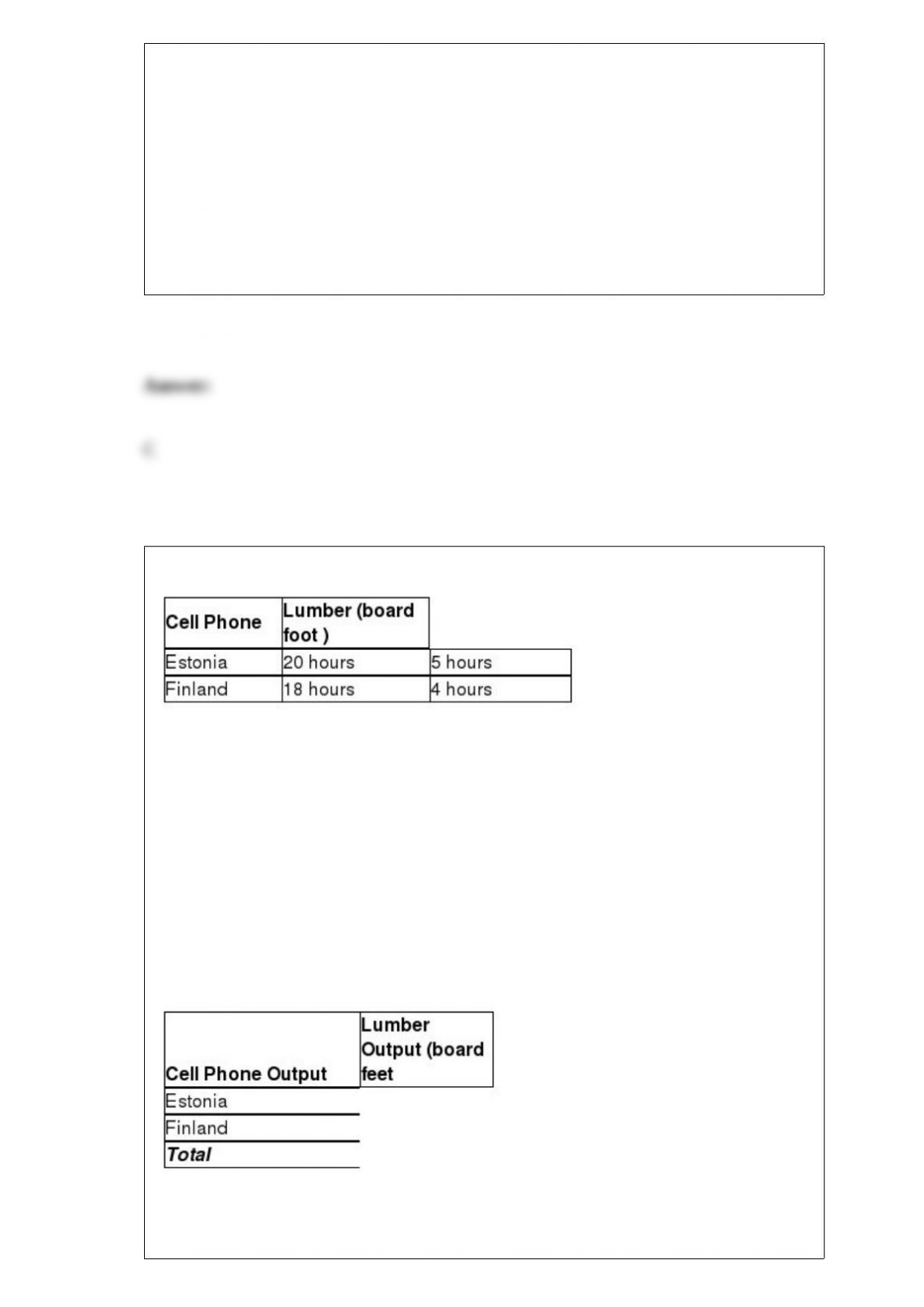
Table 2-12
Refer to Table 2-12. This table shows the number of labor hours required to produce a
cell phone and a board foot of lumber in Estonia and Finland.
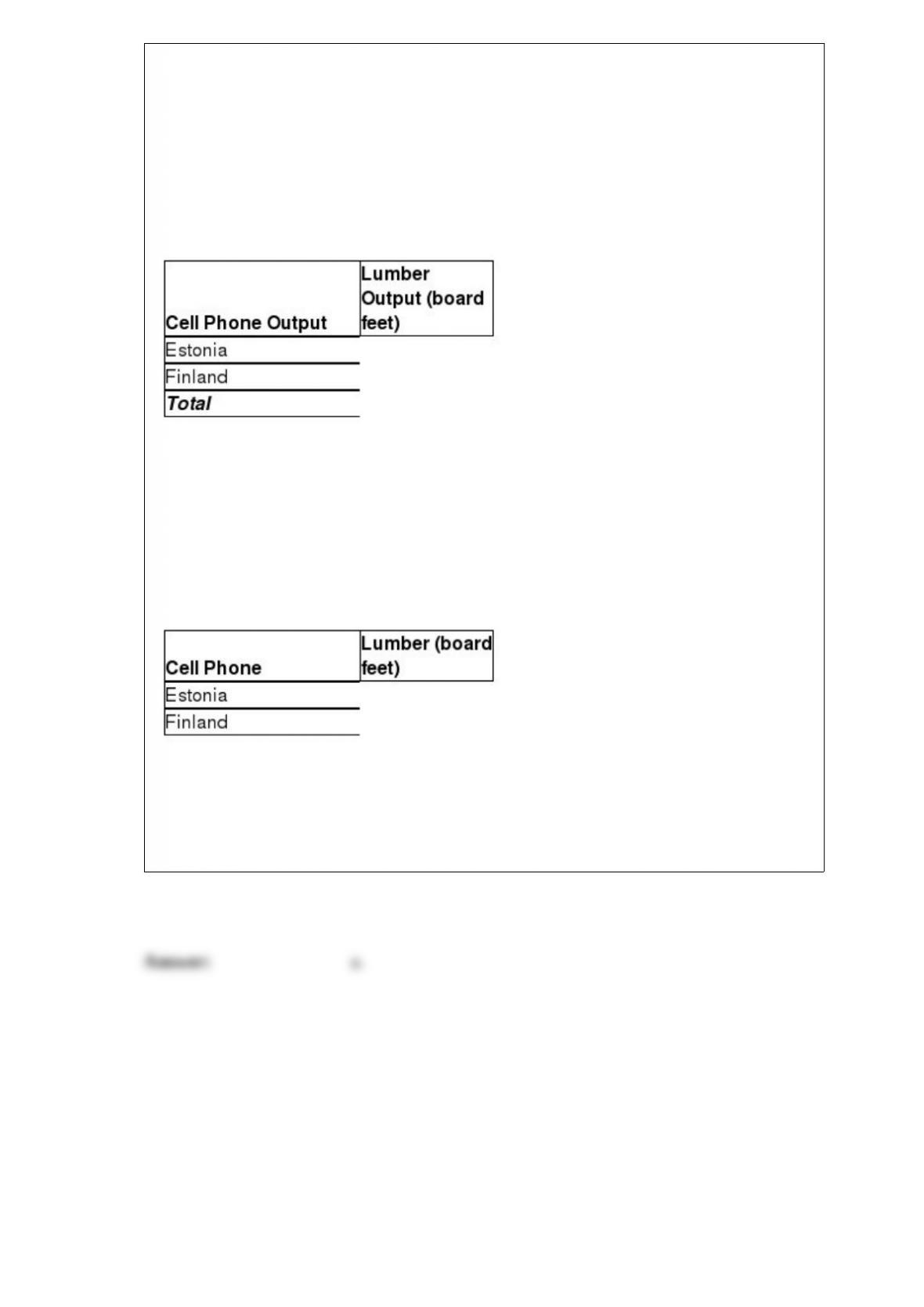
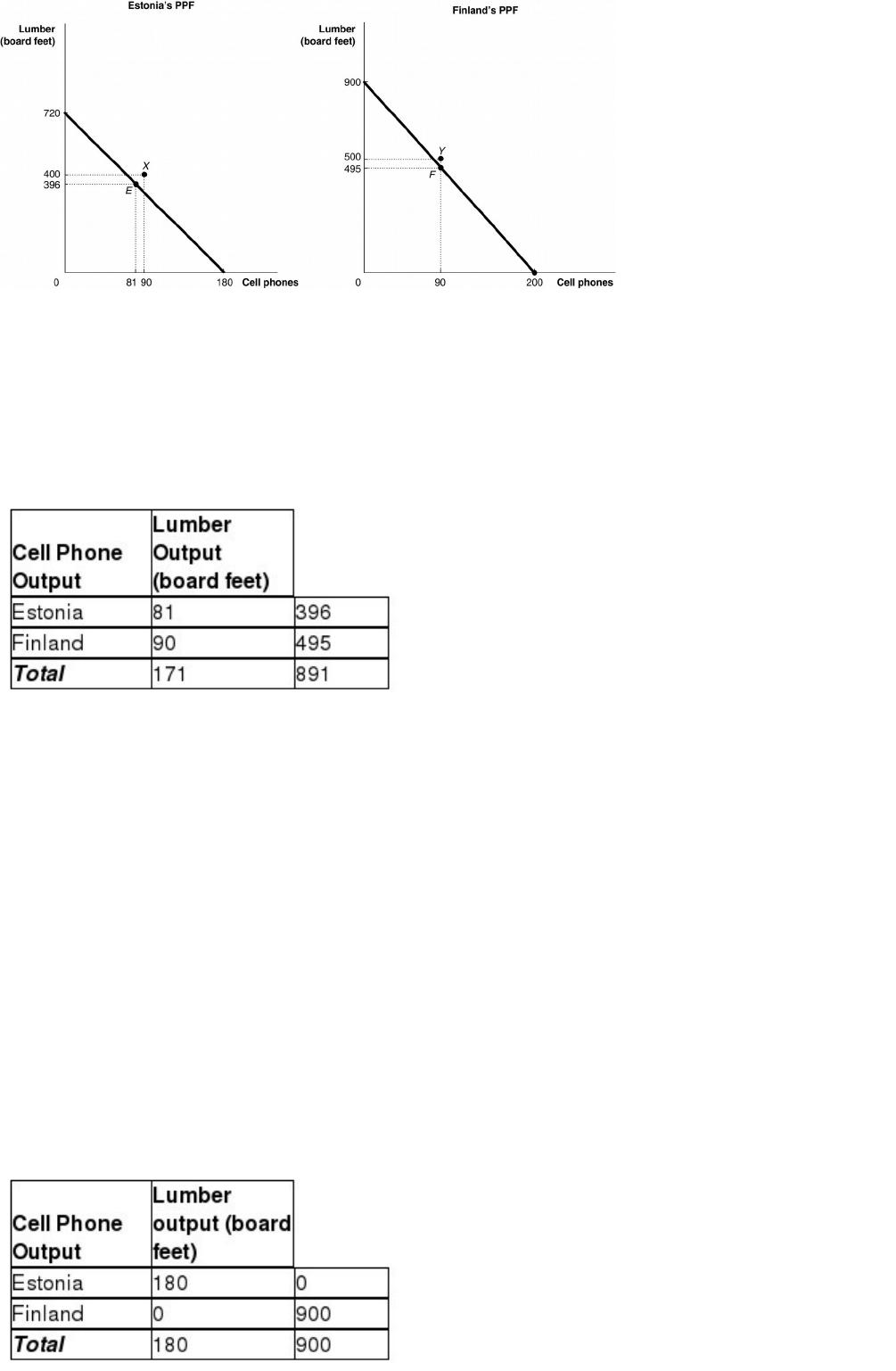
a. If each country has a total of 3,600 labor hours to devote to the production of the two
goods, draw the production possibilities frontier for each country. Put “Cell Phone” on
the horizontal axis and “Lumber” on the vertical axis. Be sure to identify the intercept
values on your graphs.
b. Suppose each country allocates 55% its labor hours to lumber production and 45% to
the production of cell phones. Complete Table 2-13 below to show each country’s
output of the two products.
Table 2-13: Production and Consumption with no Trade
c. If the two countries do not trade and consume whatever they produce, identify the
current production and consumption point for each country on their respective
production possibilities frontiers. Label Estonia’s consumption point “E” and Finland’s
consumption point, “F.”
d. Suppose the two countries specialize and trade. Who should produce cell phones and
who should produce lumber? Explain your answer.
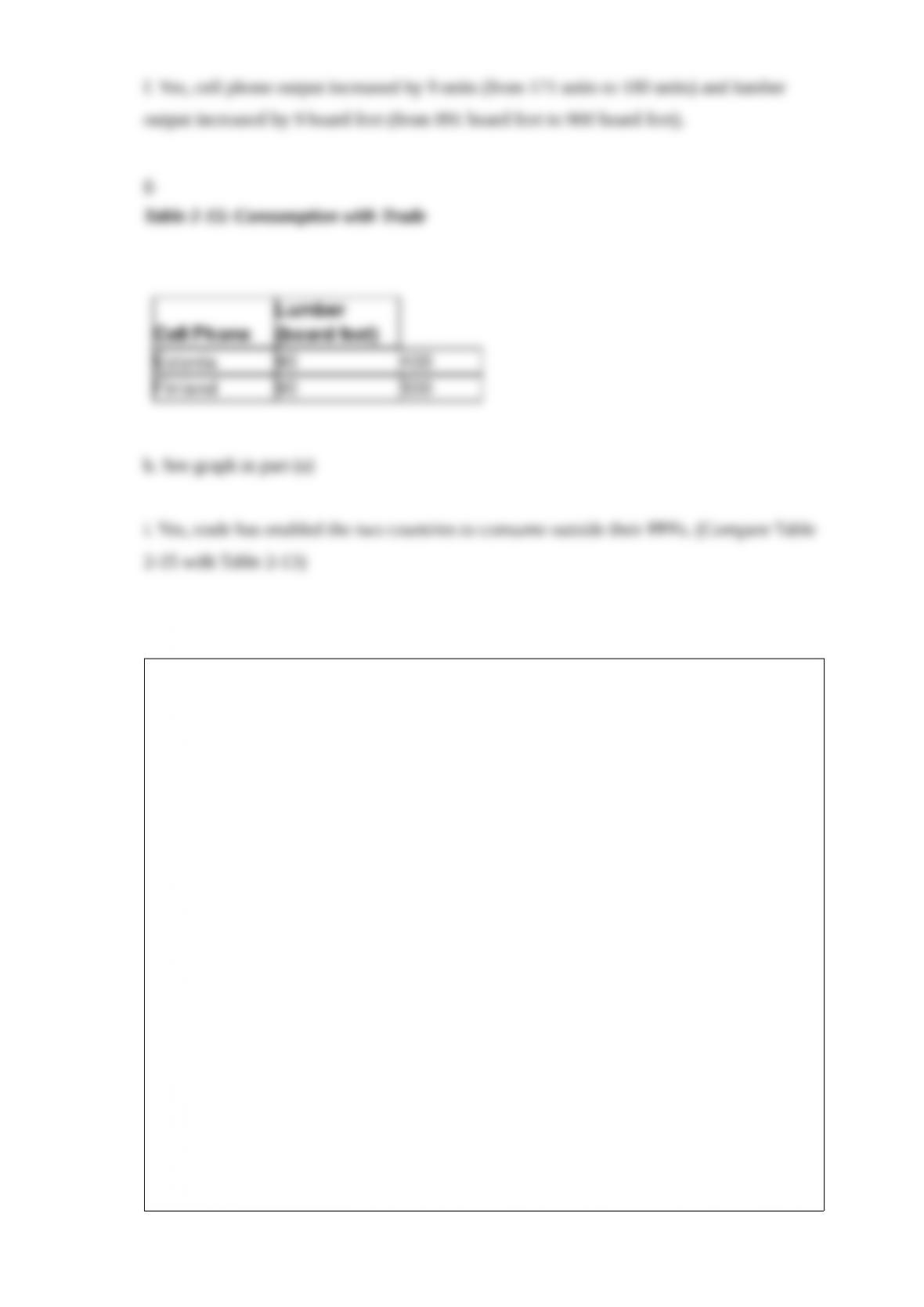
e. Complete Table 2-14 below to show each country’s output with specialization.
Table 2-14: Output with Specialization
f. Did specialization increase the combined output for the two countries without any
increase in resources? If so, by how much?
g. Suppose Estonia and Finland agree to trade so that in exchange for 400 board feet of
lumber, the exporter of lumber receives 90 cell phones. Complete Table 2-15 below to
show each country’s consumption bundle after trade.
Table 2-15: Consumption with Trade
h. Show the consumption points after trade on each country’s production possibilities
frontier. Label these points “X” for Estonia and “Y” for Finland.
i. Has trade made the two countries better off? Explain your answer.
Suppose in Vietnam a worker can produce either 16 units of cloth or 2 bicycles while in
China a worker can produce either 20 units of cloth or 5 bicycles.
a. Which country has an absolute advantage in cloth production? In bicycle production?
b. What is the opportunity cost of 1 unit of cloth in Vietnam? In China?
c. What is the opportunity cost of 1 bicycle in Vietnam? In China?
d. Which country has a comparative advantage in cloth production? In bicycle
production?
e. Suppose each country has 1,000 workers. Currently, each country devotes 40 percent
of its labor force to cloth production and 60 percent to bicycle production. What is the
output of cloth and bicycles for each country and what is the total output of cloth and
bicycles between the two countries?
f. Suppose each country specializes in the production of the good in which it has a
comparative advantage. What is the total output of cloth and bicycles in the two
countries?
g. Provide a numerical example to show how Vietnam and China can both gain from
trade. Assume that the terms of trade are established at 6 units of cloth for 1 bicycle.