1) which of the following statements pertains to macroeconomics?
a.because the minimum wage was raised, mrs. olsen decided to enter the labor force.
b.a decline in the price of soybeans caused farmer wanek to plant more land in wheat.
c.national income grew by 2.7 percent last year.
d.the pumpkin center state bank increased its interest rate on consumer loans by 1
percentage point.
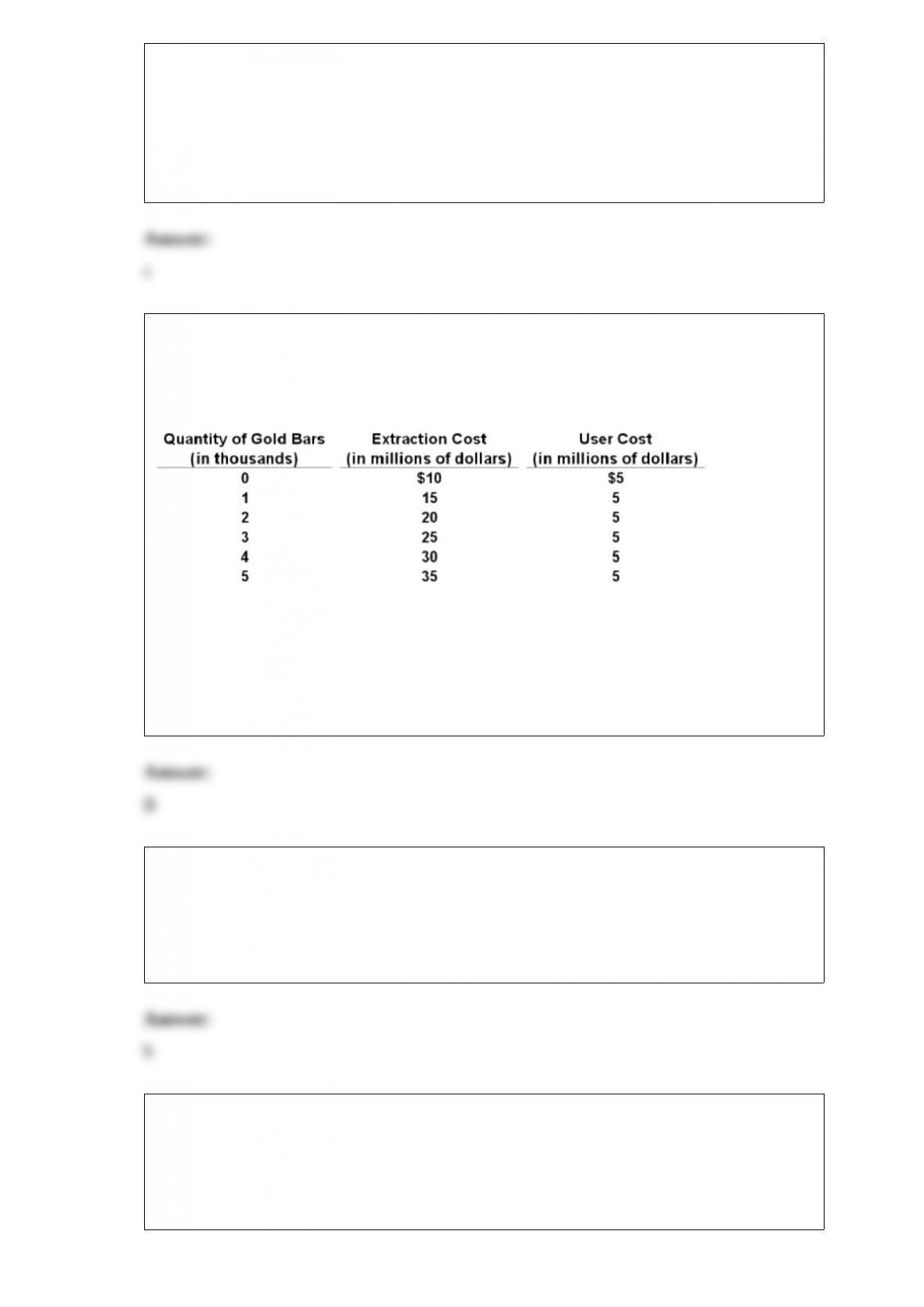
2) The table below shows the quantity of gold bars (Qb) in thousands, the extraction
cost for each thousand bars (in millions of dollars), and user cost of each thousand bars
(in millions of dollars) facing the OZ Mining Company this year.
If the current price of a bar of gold is $25,000, how many bars (in thousands) should
OZ extract and sell this year in order to maximize profits?
A.1
B.2
C.3
D.4
3) the optimal point on a production possibilities curve is achieved where:
a.the smallest physical amounts of inputs are used to produce each good.
b.each good is produced at a level where marginal benefits equal marginal costs.
c.large amounts of capital goods are produced relative to consumer goods.
d.large amounts of consumer goods are produced relative to capital goods.
4) the type of unemployment associated with recessions is called:
a.frictional unemployment.
b.structural unemployment.
c.cyclical unemployment.
d.seasonal unemployment.
5)
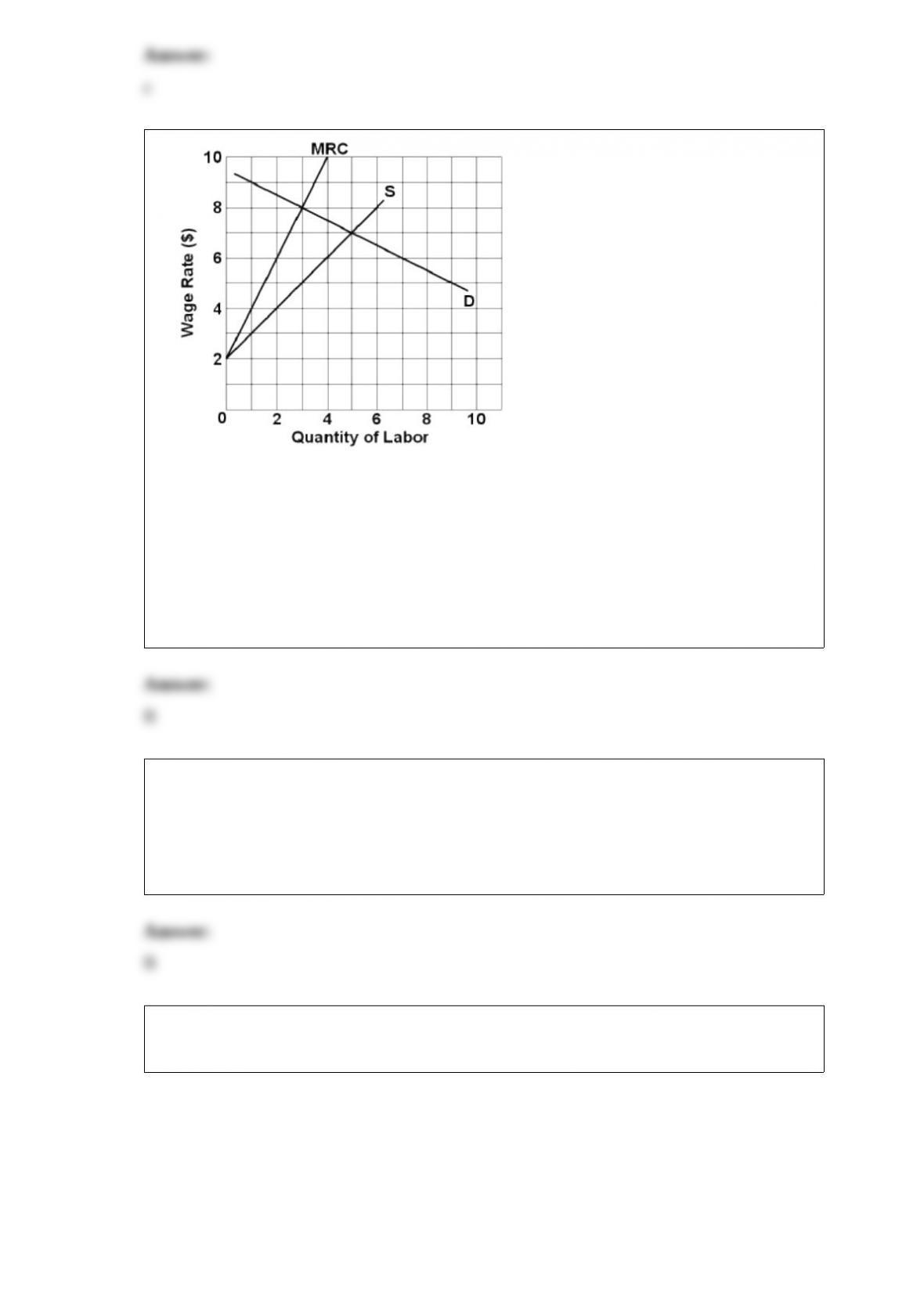
Refer to the above labor market diagram where D is the labor demand curve, S is the
labor supply curve, and MRC is the marginal resource (labor) cost curve. An inclusive
union could increase the level of employment above that which the monopsonist would
provide if it could get the monopsonist to agree to any wage rate:
A.below $7.
B.between $5 and $8.
C.above $5.
D.above $8.
6) If a firm is selling in an imperfectly competitive product market, then:
A.average product will be less than marginal product for any number of workers hired.
B.the marginal products of successive workers must be sold at lower prices.
C.the marginal products of successive workers can be sold at higher prices.
D.the marginal products of successive workers can be sold at a constant price.
7) Assume that the quantity of a certain type of farmland is 400,000 acres and the
demand for this land is that given in the table below.
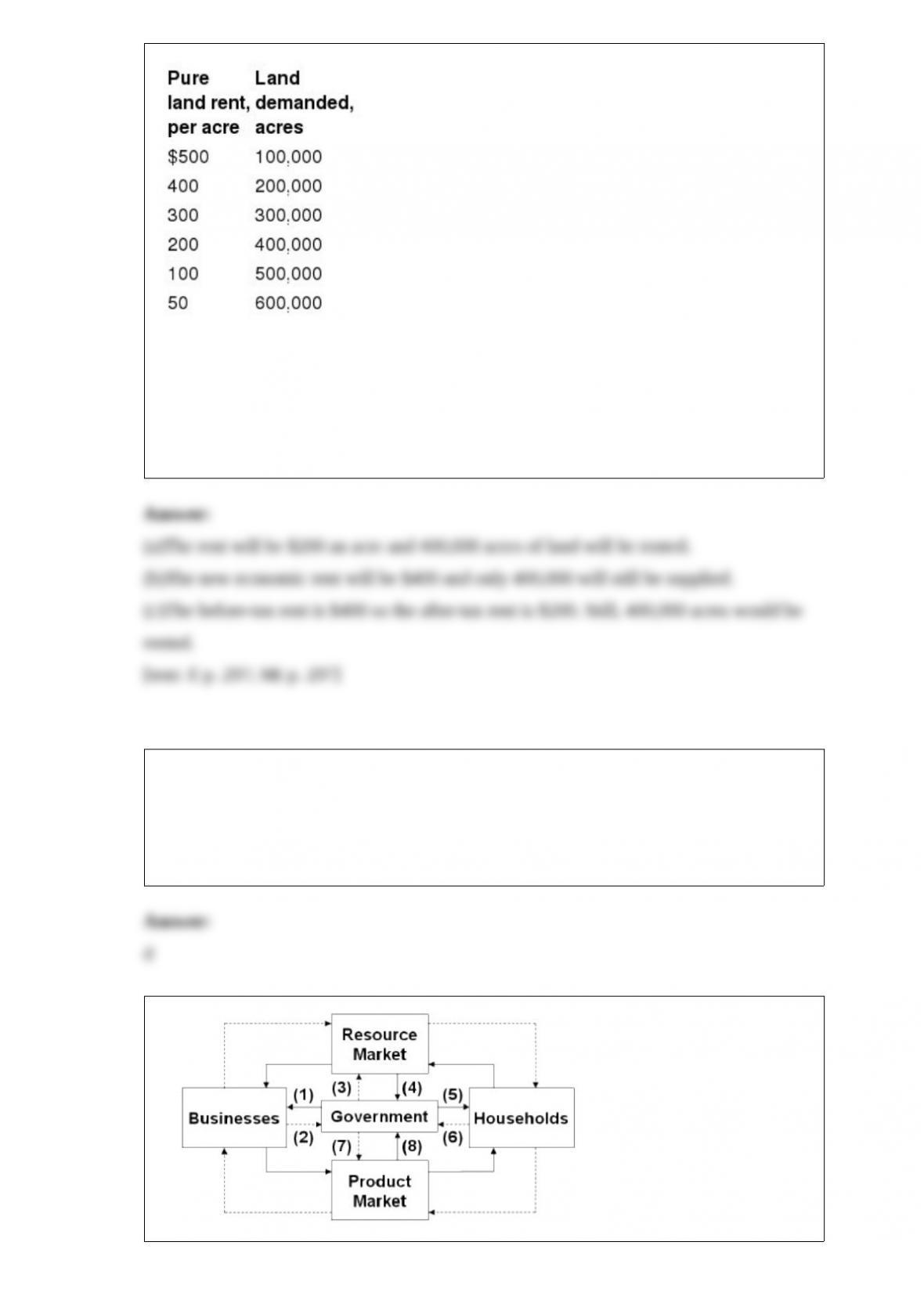
(a)What will be the economic rent and how much land will be rented?
(b)If the productivity of the land increases such that 200,000 more acres are demanded
at each price, what will the economic rent be and how much land will be supplied?
(c)Given the new demand schedule in (b), if landowners were taxed at a rate of $200
per acre for their land, what would be the economic rent on this land after taxes and
how many acres would be rented?
8) indifference curve analysis indicates that consumer equilibrium exists:
a.where an indifference curve has a slope of 1.
b.where any two indifference curves intersect.
c.at any point where the budget line intersects an indifference curve.
d.where the budget line touches the highest possible indifference curve.
9)

refer to the above diagram, in which solid arrows reflect real flows; broken arrows are
monetary flows. flow (2) might represent:
a.the provision of national defense by government.
b.a government subsidy to farmers.
c.corporate income tax payments.
d.welfare payments to low-income families.
10) Suppose an employer is considering hiring either a white worker or an
African-American worker for a position. Consider the following conditions and decide
which worker the employer is likely to hire.
(a)The employer is prejudiced against African-Americans and it costs him a disutility of
$3/hour to hire the African-American. Suppose the African-American is willing to work
for $9/hour, while the white worker will work for $11/hour. Whom will the employer
hire?
(b)The employer is prejudiced against African-Americans and it costs him a disutility of
$2/hour to hire the African-American. Suppose the African-American is willing to now
work for $8/hour, while the white worker will work for $11/hour. Whom will the
employer hire?
(c)The employer has no preference between the white and African-American workers.
Suppose the African-American and the white workers are both willing to work for $12
an hour. Whom will the employer hire?
11) Which of the following is considered a non-renewable natural resource?
A.wind.
B.timber.
C.oceans.
D.tin.
12)
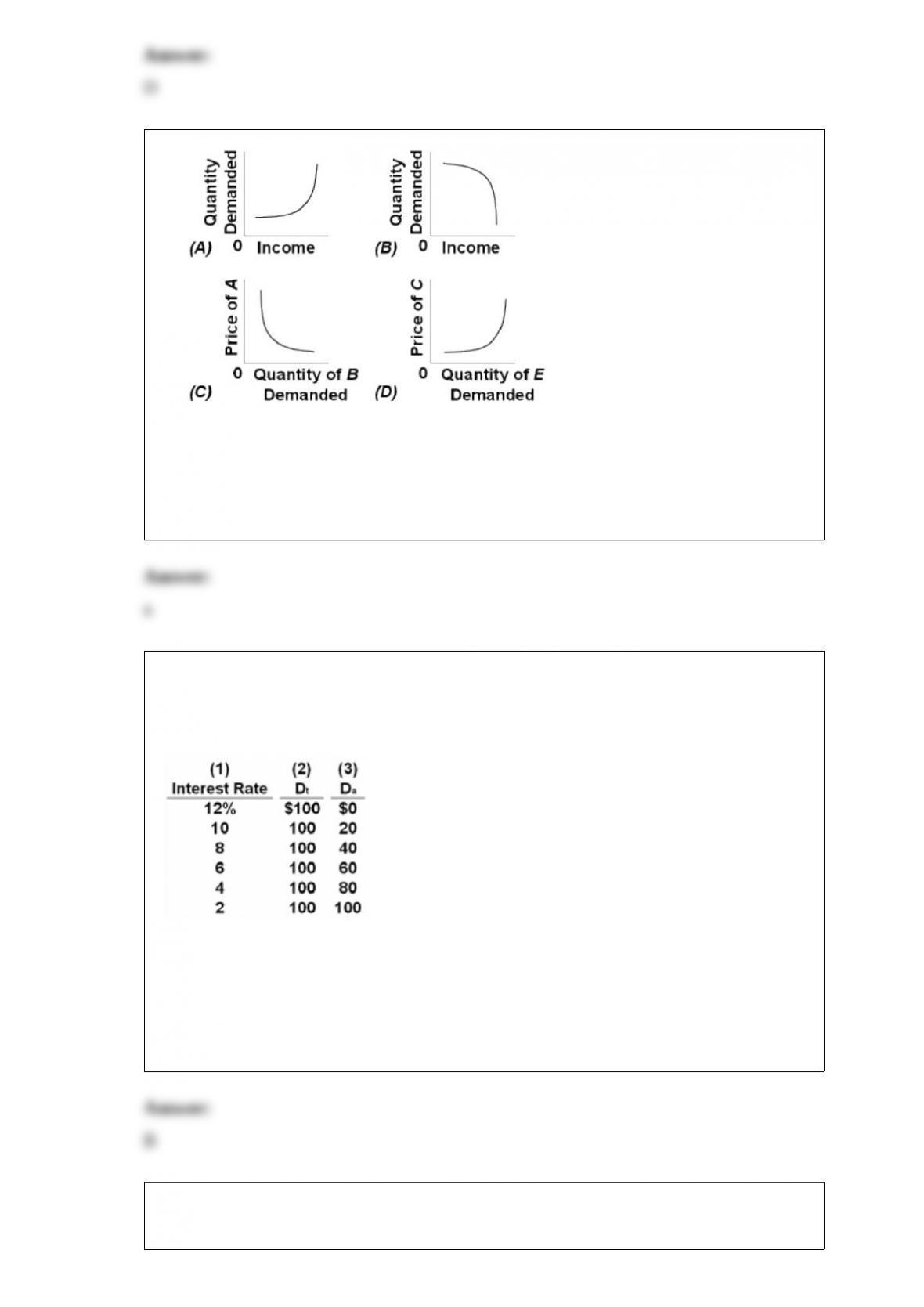
refer to the above diagrams. the case of a normal good is represented by figure(s):
a.a.
b.b.
c.c.
d.d.
13) The following table in which columns (1) and (2) indicate the transactions demand
(Dt) for money and columns (1) and (3) show the asset demand (Da) for money:
The above data suggest that the amount of money that society wishes to hold as an
asset:
A.varies directly with the interest rate.
B.varies inversely with the interest rate.
C.varies inversely with nominal GDP.
D.is independent of the interest rate.
14) Assume labor is the only variable input and that an additional input of labor
increases total output from 72 to 78 units. If the product sells for $6 per unit in a purely

competitive market, the MRP of this additional worker is:
A.$6.
B.$12.
C.$36.
D.$72.
15) One cause of income inequality in the United States is:
A.the free public school system.
B.differences in preferences for market work relative to nonmarket activities as well as
differences in preferences for types of work.
C.antidiscrimination laws.
D.the social security system.
16) in a typical year which of the following measures of aggregate output and income is
likely to be the smallest?
a.gross domestic product
b.national income
c.disposable income
d.personal income
17) which of the following will most likely cause backflows?
a.poor information that leads a migrant to overestimate the net benefits of migration.
b.high moving costs.
c.falling wages in a migrant’s origin nation.
d.high levels of skill transferability.