
1) As a percentage of GDP, U.S. exports are:
A.greater than U.S. imports.
B.about 20 percent.
C.considerably lower than in several other industrially advanced nations.
D.higher than in Canada but lower than Mexico.
2) which of the following countries has recently emerged as one of the world’s top
trading nations in terms of total trade volume?
a.chile
b.india
c.ireland
d.china
3) If there is a widespread bias against African-American workers, an increase in the
collective discrimination coefficients of employers will:
A.reduce the African-American wage rate, increase African-American employment, and
lower the actual African-American-white wage ratio.
B.reduce the African-American wage rate, decrease African-American employment,
and lower the actual African-American-white wage ratio.
C.increase the African-American wage rate, increase African-American employment,
and increase the actual African-American-white wage ratio.
D.increase the African-American wage rate, reduce African-American employment, and
increase the actual African-American-white wage ratio.
4) Suppose two nations are considering specializing in either calculators or personal
computers. If solely producing calculators, country A can produce 300 and country B
can produce 400. If solely producing personal computers, country A can produce 150
and country B can produce 100. Assume their labor forces are of equivalent size.
(a)Which country has the comparative advantage in calculators? In computers?
(b)It is predicted that current demand will yield an exchange of 3 calculators for every 1
computer. Will trade occur? If not, is it because both countries are against trade?
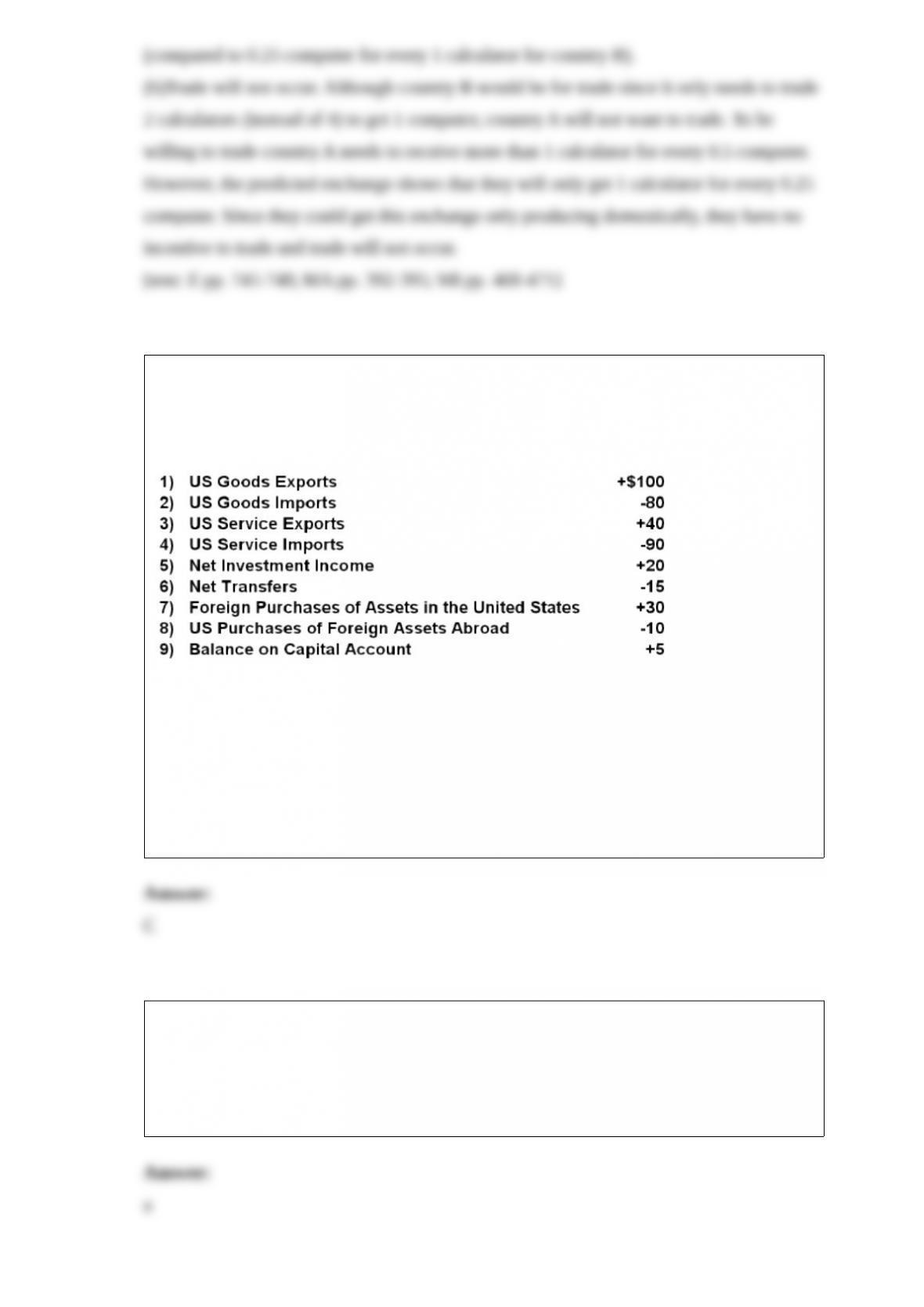
5) The following table contains hypothetical data for the 2010 U.S. balance of
payments. Answer the next question(s) on the basis of this information. All figures are
in billions of dollars.
Refer to the above data. Item (5) indicates:
A.that the United States’ current account was in surplus.
B.the size of the net inflow of foreign investment to the United States that occurred in
2010.
C.the net amount Americans received as interest and dividends on existing U.S.
investments abroad.
D.the net amount Americans paid as interest and dividends on existing foreign
investments in the United States.
6) economic growth can be portrayed as a:
a.outward shift of the production possibilities curve.
b.inward shift of the production possibilities curve.
c.movement from a point on to a point inside a production possibilities curve.
d.movement from one point to another point on a fixed production possibilities curve.
7) Assume that Smith deposits $600 in currency into her checking account in the XYZ
Bank. Later that same day Jones negotiates a loan for $1,200 at the same bank. In what
direction and by what amount has the supply of money changed?
A.decreased by $600
B.increased by $1,800
C.increased by $600
D.increased by $1,200
8) The current account in a nation’s balance of payments includes:
A.its goods exports and imports, and its services exports and imports.
B.foreign purchases of domestic assets.
C.purchases of foreign assets.
D.all of these.
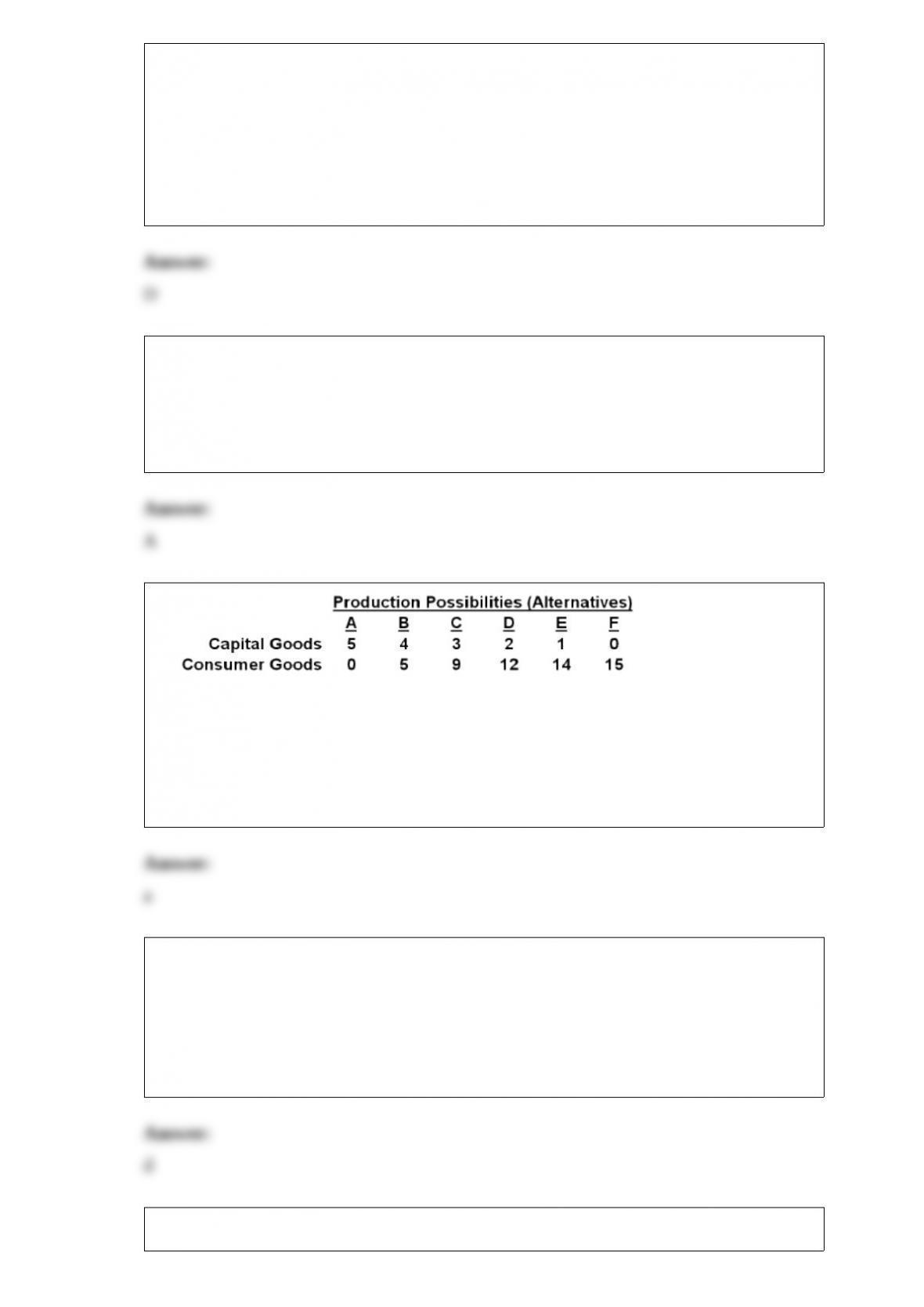
9)
refer to the above table. as compared to production alternative d, the choice of
alternative c would:
a.tend to generate a more rapid growth rate.
b.be unattainable.
c.entail unemployment.
d.tend to generate a slower growth rate.
10) the marginal rate of substitution measures the:
a.magnitude of the substitution effect.
b.total utility received by a consumer when equilibrium is achieved.
c.extra utility that a consumer derives from successive units of a product.
d.consumer’s willingness to substitute one product for another so that total utility will
remain constant.
11) Which of the following statements is most consistent with the benefits-received

principle of taxation?
A.A childless couple should not be required to pay taxes for the support of public
schools.
B.Prosperous corporations should pay substantial taxes even if they use few
government goods and services.
C.The best tax is the income tax.
D.People with high incomes should pay more taxes than people with low incomes.
12) suppose that tacos and pizza are substitutes, and that soda and pizza are
complements. we would expect an increase in the price of pizza to:
a.reduce the demand for tacos and increase the demand for sodas.
b.reduce the demand for soda and increase the demand for tacos.
c.increase the demand for both soda and tacos.
d.reduce the demand for both soda and tacos.
13) which of the following would not shift the demand curve for beef?
a.a widely publicized study that indicates beef increases one’s cholesterol
b.a reduction in the price of cattle feed
c.an effective advertising campaign by pork producers
d.a change in the incomes of beef consumers
14) What factors explain the high level of level of productivity in the United States?

15) Is it possible to impose a burden on future generations by increasing the public
debt?
16) Why do investors engage in arbitrage?
17) What is the consumer price index? How is it different from the GDP price index?
18) What is the difference between the M1 and M2 definitions of the money supply?
19) What are the shortcomings or limitations of the four-firm concentration ratios?
20) What happens to the money supply when a bank accepts deposits of currency from
the public and places it in checkable deposits (or checking accounts)?