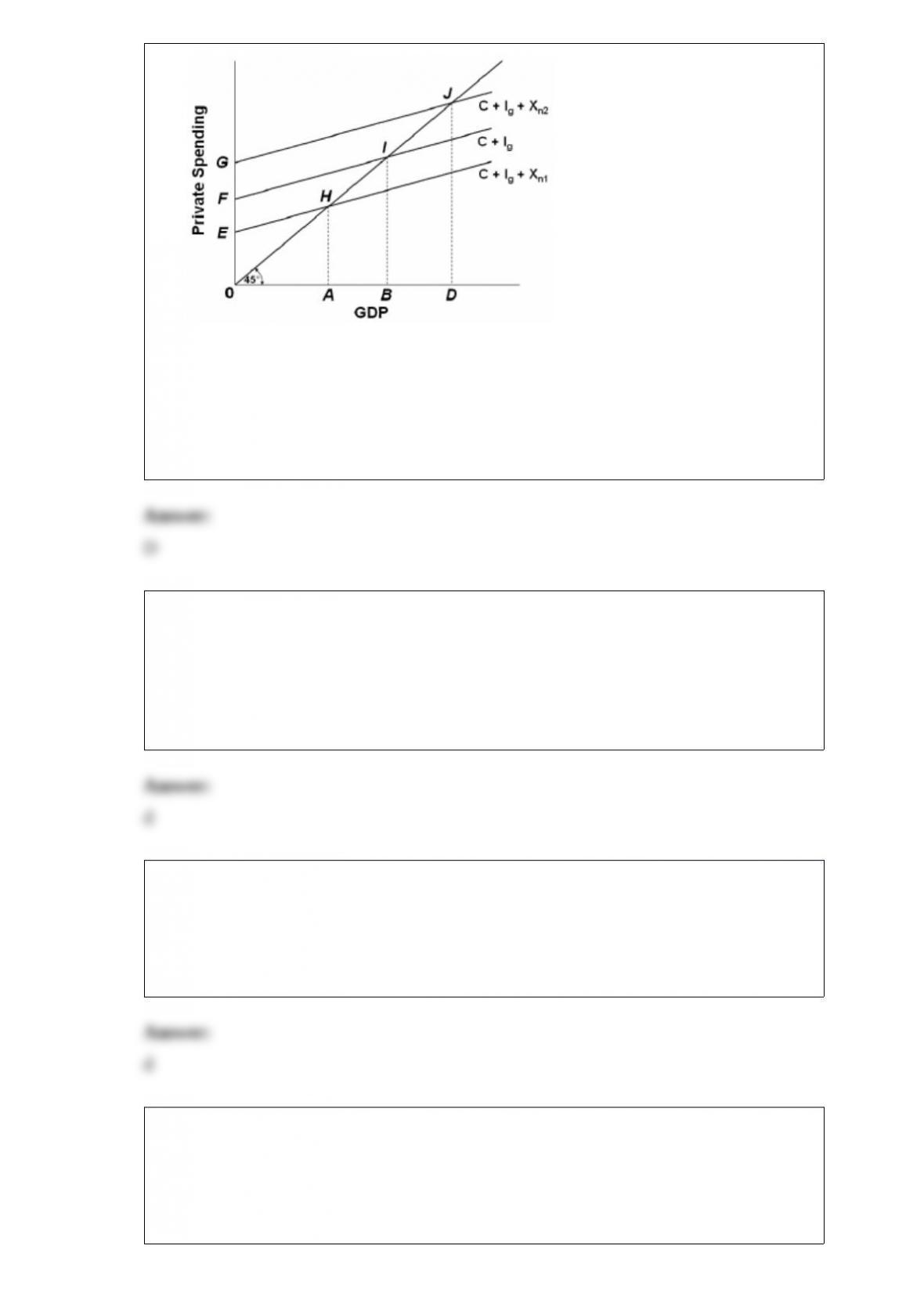
1)
Refer to the above diagram. If net exports are Xn2, the GDP in the open economy will
exceed GDP in the closed economy by:
A.AB.
B.AD.
C.FG.
D.BD.
2) opportunity cost is best defined as:
a.the monetary price of any productive resource.
b.the amount of labor that must be used to produce one unit of any product.
c.the ratio of the prices of imported goods to the prices of exported goods.
d.the amount of one product that must be given up to produce one more unit of another
product.
3) rapidly rising u.s. health care costs have:
a.reduced the ability of many americans to afford health care.
b.slowed the growth of real wages.
c.caused federal and state governments to restrict spending on nonhealth budget items.
d.done all of these.
4) Suppose that wages for African-American and white workers of equal productivity
are $12 and $13 an hour, respectively. If a particular firm hires only whites, its
discrimination coefficient must be:
A.greater than $1.
B.less than $1.

C.zero.
D.infinity.
5) The view that inappropriate monetary policy was the main reason for the depth of the
Great Depression in the United States is most closely associated with:
A.monetarism.
B.the mainstream view.
C.the rational expectations theory.
D.the real-business-cycle theory.
6) Consider the following payoff matrix in which the numbers indicate the profit in
millions of dollars for a duopoly based either on a high-price or a low-price strategy.
(a)What will be the result when each firm chooses a high-price strategy?
(b)What will be the result when Firm A chooses a low-price strategy while Firm B
maintains a high-price strategy?
(c)What will be the result when Firm B chooses a low-price strategy while Firm A
maintains a high-price strategy?
(d)What will be the result when each firm chooses a low-price strategy?
(e)What two conclusions can you draw about collusion?

7) rising per-unit production costs are most directly associated with:
a.frictional unemployment.
b.structural unemployment.
c.demand-pull inflation.
d.cost-push inflation.
8) a firm is producing an output such that the benefit from one more unit is more than
the cost of producing that additional unit. this means the firm is:
a.producing more output than allocative efficiency requires.
b.producing less output than allocative efficiency requires.
c.achieving productive efficiency.
d.producing an inefficient output, but we cannot say whether output should be increased
or decreased.
9) health care:
a.is an inferior good.
b.is a normal good.
c.is highly elastic with respect to price.
d.has a price elasticity of 1.
10) national income accountants define investment to include:
a.any increase in business inventories.
b.the addition of cash to a savings account.
c.the purchase of common or preferred stock.
d.the purchase of any durable good, for example, an automobile or a refrigerator.

11) Which one of the following is most likely to increase the Herfindahl index of a
particular industry?
A.a conglomerate merger
B.a vertical merger
C.a price fixing arrangement among all the industry firms
D.a horizontal merger
12) based on the number of hours worked per capita, labor supply in the united states
exceeds that of france by about _______ percent.
a.20
b.40
c.51
d.62
13) price ceilings and price floors:
a.cause surpluses and shortages respectively.
b.make the rationing function of free markets more efficient.
c.interfere with the rationing function of prices.
d.shift demand and supply curves and therefore have no effect on the rationing function
of prices.
14) The economy’s long-run aggregate supply curve:
A.slopes upward and to the right.
B.is vertical.
C.is horizontal.
D.slopes downward and to the right.