
A firm’s borrowing base is:
a. based on cash flow from operations.
b. a measure of long-term profit potential.
c. the amount of the firm’s unused credit.
d. an estimate of the available collateral on a company’s current assets.
e. a measure of net fixed assets.
Answer:
To the nearest dollar, what is the value today of an investment that pays $15,000 in
seven years, assuming an annual opportunity cost of 9%?
a. $7,473
b. $27,421
c. $8,206
d. $7,130
e. None of the above
Answer:
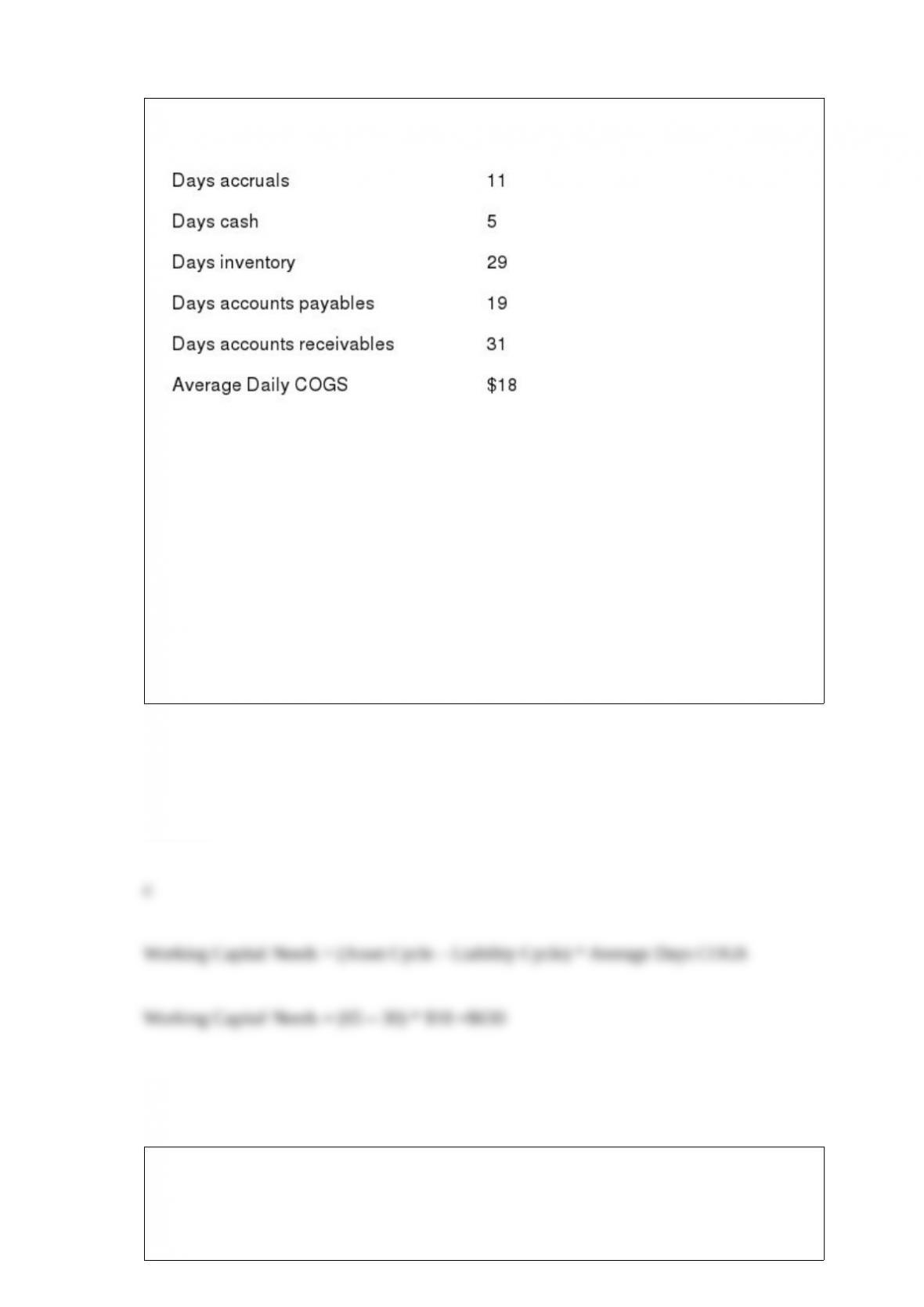
Use the following firm working capital cycle information.
What are the firm’s estimated working capital needs?
a. $90
b. $540
c. $630
d. $1,170
e. $2,034
Answer:
FASB 115 requires historical costs to be used for:
a. trading account securities.

b. available-for-sale securities.
c. retained earnings.
d. held-to-maturity securities.
e. net income.
Answer:
Under FASB 157, the valuation of Level 1 assets is labeled:
a. marking to market.
b. marking to matrix.
c. marking to myth.
d. marking to major.
e. marking to minor.
Answer:
Commercial banks mostly specialize in:
a. mortgages.

b. mutual loans.
c. short-term business credit.
d. savings accounts.
e. share draft accounts.
Answer:
Federal Reserve Reg. ____ requires disclosure of as to why a costumer was denied
credit.
a. AA
b. BB
c. Z
d. C
e. B
Answer:
Which of the following is not a criticism against granting commerce companies
industrial loan company charters?

a. There should be a separation between commerce and banking to protect customers
from potential conflicts of interest.
b. Firms could become so large and powerful that they might dominate business in
many communities.
c. Industrial loan companies are not subject to the same regulations as commercial
banks.
d. All of the above are criticisms against granting commerce companies industrial loan
company charters
e. a. and b. only
Answer:
Banks rarely provide:
a. start-up capital loans.
b. mortgage loans.
c. automobile loans.
d. agricultural loans..
e. commercial loans.
Answer:

Correspondent banking services would include which of the following?
a. Check collection
b. Data processing services
c. Federal funds trading
d. all of the above
e. a. & c. only
Answer:
A security interest in a loan is said to be perfected if the:
a. bank holds the collateral.
b. loan has no protective covenants.
c. borrower is a low credit risk.
d. government guarantees the loan.
e. bank has never lent to the customer before.
Answer:

Which of the following will not affect a bank’s duration estimate for the year?
a. Prepayments on loans that exceed expectations.
b. A 20-year corporate bond that is unexpectedly called in 6 months.
c. Certificates of deposit that are withdrawn early.
d. Holding a 30-year Treasury bond until maturity.
e. All of the above will affect a bank’s estimated duration for the year.
Answer:
Which of the following would be considered a “negative” loan covenant?
a. The firm’s current ratio cannot fall below 2.0
b. All property must be maintained in good condition
c. The firm’s net worth must exceed $10,000,000
d. The firm must carry property insurance on all collateral.
e. Cash dividends cannot exceed 50% of earnings.
Answer:

When you own the underlying security, your spot position is _______.
a. flat.
b. long.
c. short.
d. is also known as your cash position.
e. b. and d.
Answer:
Many banks have changed their business model to a _____________ model.
a. originate-to-keep
b. originate-to-service
c. originate-to-pay
d. originate-to-lead
e. originate-to-distribute
Answer:

A bond has a Macaulay’s duration of 7 years. If rates fall from 7% to 6%, the bonds
price will:
a. increase by approximately 1%.
b. decrease by approximately 1%.
c. increase by approximately 10%.
d. decrease by approximately 10%.
e. Not enough information is given to answer the question.
Answer:
If $1,500 is invested today, the initial investment plus interest will be worth $2,700 in
seven years. What is the annual interest rate on the investment?
a. 6.51%
b. 8.05%.
c. 8.76%.
d. 9.12%.
e. 10.43%
Answer:
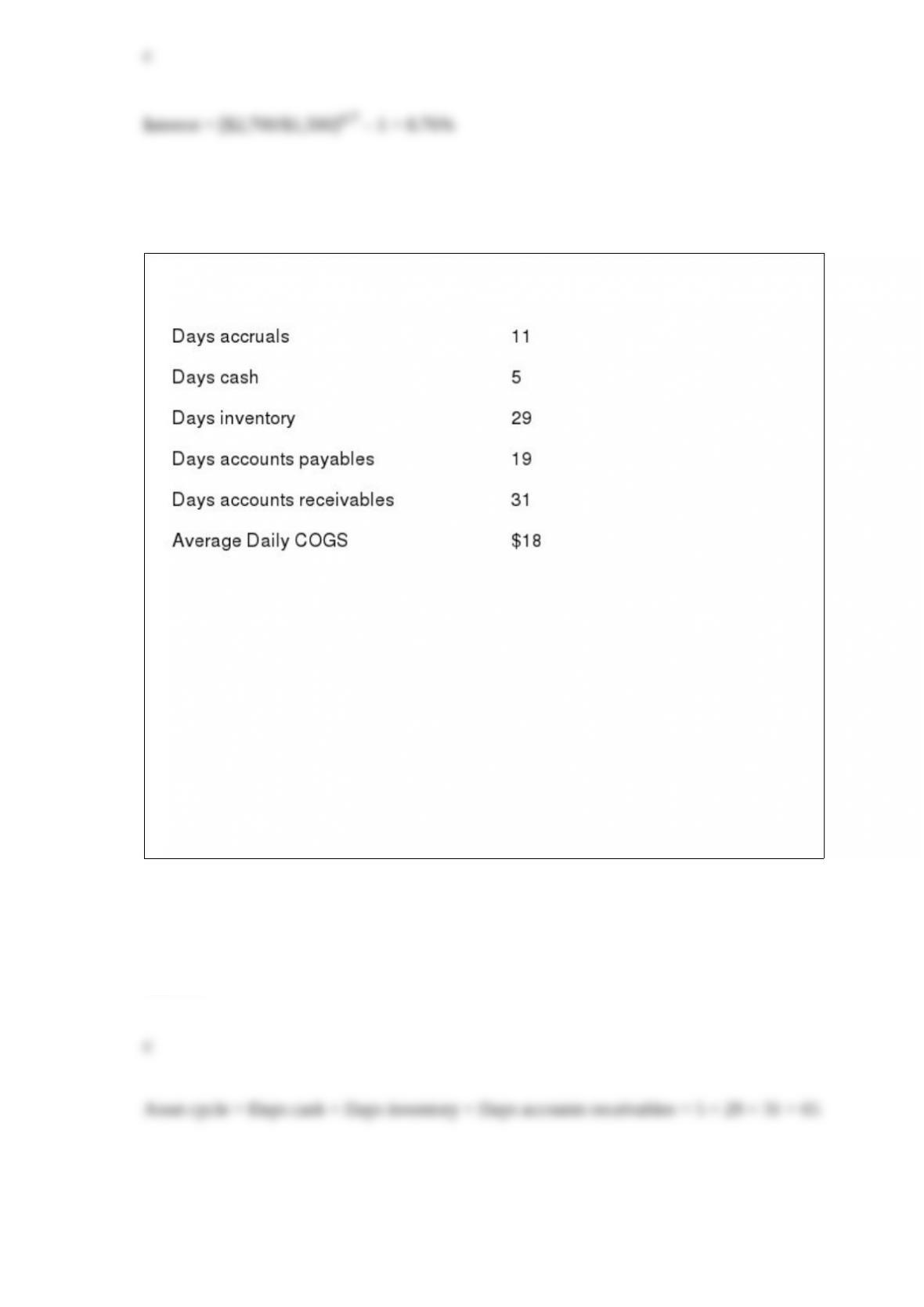
Use the following firm working capital cycle information.
What is the firm’s cash-to-cash asset cycle?
a. 30 days
b. 59 days
c. 65 days
d. 95 days
e. 113 days
Answer:

Which regulation requires out-of-state-banks that acquire local banks to commit to
continued lending in the area and not use the acquired banks simply as deposit
gatherers?
a. Equal Credit Opportunity Act
b. National Bank Act
c. Federal Lending Act
d. Fair Credit Reporting Act
e. Community Reinvestment Act
Answer:
Which of the following are sold at a deep discount to par?
a. Trust CD
b. Zero coupon CD
c. Bump-up CD
d. Federal funds CD
e. Fixed-rate CD
Answer:

Which of the following indicates the potential for deposits leaving a bank?
a. High business activity and growth
b. Deposits that are inelastic to changes in interest rates
c. An aggressive bank loan officer
d. Large deposits held by a single customer
e. Small unused commercial credit lines outstanding
Answer:
Which of the following are lenders prohibited from asking on a credit application?
a. The applicant’s income
b. If the applicant has a telephone
c. If the applicant has declared bankruptcy in the past
d. How long the applicant has been on the job
e. Lenders are not prohibited from asking any of the above
Answer:

What is a macrohedge?
a. It is a hedge of the bank’s aggregate portfolio.
b. It is a hedge using just one type of futures contract.
c. It is the hedge of a specific asset or liability for which the bank is exposed to interest
rate risk.
d. It is a hedge using two or more types of futures contracts.
e. It is a has that has a duration of less than one month.
Answer:
The first type of international office that a bank forms outside its home country that is
exploratory in nature is known as:
a. an Edge Act bank.
b. a head office.
c. a representative office.
d. an agreement corporation.
e. a foreign branch.
Answer:

Securities that are “held-to-maturity” are:
a. trading account securities.
b. recorded on the balance sheet at amortized cost.
c. marked-to-market.
d. a. and b.
e. a. and c.
Answer:
Federal funds:
a. can only be traded by banks.
b. transactions are generally 7-day loans.
c. loans are collateralized.
d. large transactions are denominated in multiples of $1 million.
e. All of the above.
Answer:

A liability sensitive bank decides to reduce risk by marketing 2-year CDs paying 5%
instead of NOW accounts that pay 4%. The bank will benefit if:
a. the 2-year rate in one year is less than 5%.
b. the 1-year rate in one year is less than 6%.
c. the 1-year rate in one year is greater than 6%.
d. the 2-year rate in one year is greater than 6%.
e. Not enough information is given to determine the correct answer.
Answer:
Core deposits consist of all of the following except:
a. demand deposits.
b. NOW accounts.
c. jumbo certificates of deposit.
d. savings accounts.
e. money market demand accounts.
Answer:

When a bank keeps dealer reserves, the reserves are primarily used:
a. to cover charge-offs.
b. to increase bank profits.
c. to increase dealer profits.
d. to reduce taxes.
e. to increase advertising revenues.
Answer:
The two-week period during which a bank must hold sufficient legal reserves is called
the:
a. deposit computation period.
b. deposit maintenance period.
c. vault cash computation period.
d. base computation period.
e. maintenance period.
Answer:

Which of the following is true about a ROTH IRA?
a. Funds contributed are tax-deductible.
b. Funds withdrawn before age 62 are subject to a 10% penalty.
c. Withdrawn proceeds are totally non-taxable.
d. All of the above are true about a ROTH IRA.
e. None of the above are true about a ROTH IRA
Answer:
When selling securities to meet liquidity needs, a bank should consider all of the
following except:
a. brokerage fees.
b. lost interest income.
c. the gains or losses on the securities.
d. the impact on taxes.
e. All of the above should be considered when selling securities to meet liquidity needs.
Answer:

At a minimum, cash flow from operations should cover:
a. interest on long-term debt.
b. dividends plus mandatory principal payments on debt.
c. capital expenditures plus dividends.
d. the change in marketable securities.
e. dividends plus interest.
Answer:
Which of the following statements is/are correct?
a. Higher capital requirements often result in a higher cost of capital for banks.
b. Small banks have greater access to the equity markets than large banks.
c. Higher capital requirements encourage small banks to consolidate into larger banks.
d. All of the above are correct.
e. Only a. and c. are correct.
Answer: