
1) In the 1990s, Congress passed legislation that:
A.will eventually replace the $1 bill with a $1 coin.
B.allows non-bank firms such as Chrysler and IBM to own large commercial banks or
thrifts.
C.replaces the twelve Federal Reserve Banks with a single Central Bank.
D.ends the legal separation of the banking industry and securities firms.
2) since 1975, united states exports and imports have:
a.grown absolutely, but remained a constant proportion of gdp.
b.grown absolutely, but declined as a proportion of gdp.
c.grown both absolutely and as a percentage of gdp.
d.declined both absolutely and as a percentage of gdp.
3) In a full-employment economy a rise in M will cause inflation unless:
A.V rises in proportion to the increase in M.
B.the quantity of goods produced declines proportionately.
C.tax reductions accompany the increase in the money supply.
D.the velocity of money diminishes.
4) if the supply of a product decreases and the demand for that product simultaneously
increases, then equilibrium:
a.price must rise, but equilibrium quantity may rise, fall, or remain unchanged.
b.price must rise and equilibrium quantity must fall.
c.price and equilibrium quantity must both increase.
d.price and equilibrium quantity must both decline.
5) In the United States in 2006, one million BTUs of energy yielded _______ worth of
goods and services (in year 2000 dollars).
A.$14.6
B.$51.3
C.$84.2
D.$114.3

6) The supply curve of loanable funds is upsloping because:
A.businesses find more investments to be profitable at low interest rates than at high
interest rates.
B.households are willing to save more at high interest rates than they are at low interest
rates.
C.government budget deficits vary inversely with the equilibrium interest rate.
D.banks lend more at low interest rates than they do at high interest rates.
7) if real gdp falls from one period to another, we can conclude that:
a.deflation occurred.
b.inflation occurred.
c.nominal gdp fell.
d.none of these necessarily occurred.
8) export subsidies are:
a.maximum limits on the quantity or total value of specific products imported to a
nation.
b.excise taxes or duties placed on imported products.
c.licensing requirements, unreasonable quality standards, and the like designed to
impede imports.
d.government payments to domestic producers to enable them to charge lower prices
and sell more goods in world markets.
9) Assume that the short-run cost and demand data given in the table below confronts a
monopolistic competitor selling a given product and engaged in a given amount of
product promotion. Compare the marginal cost and marginal revenue of each unit of
output and enter these figures in the table.
(a)At what output level and at what price will the firm produce in the short run? What
will be the total profit?
(b)What will happen to demand, price, and profit in the long run? How will the market
adjust to achieve this?
10) Over the past several decades, farm employment has:
A.grown absolutely, but declined as a percentage of total employment.
B.declined both absolutely and as a percentage of total employment.
C.increased both absolutely and as a percentage of total employment.
D.declined absolutely, but increased as a percentage of total employment.
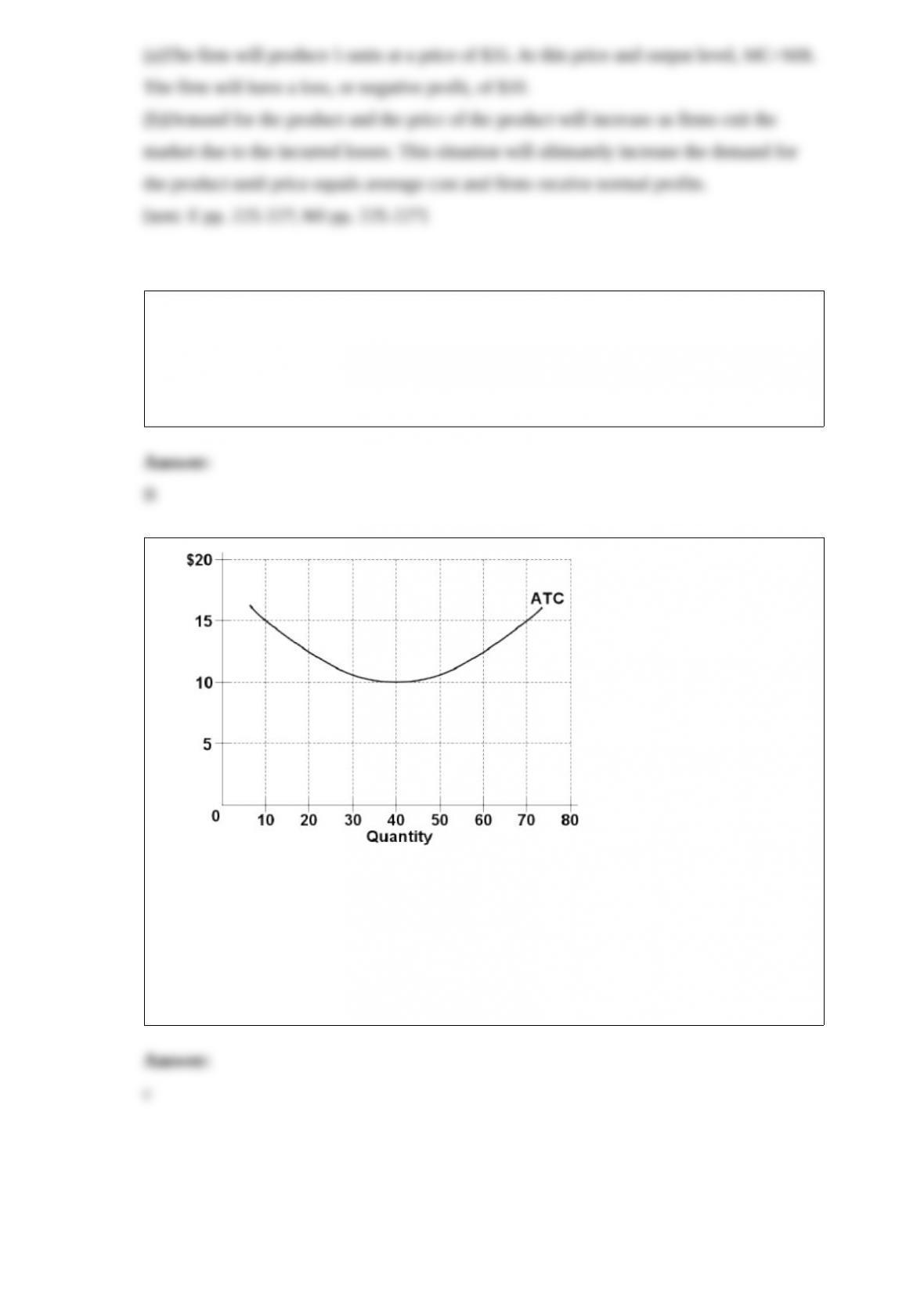
11)
refer to the above diagram showing the average total cost curve for a purely competitive
firm. suppose that average variable cost is $8 at 40 units of output. at that level of
output, total fixed cost:
a.is $2.
b.is $40.
c.is $80.
d.cannot be determined from the information provided.
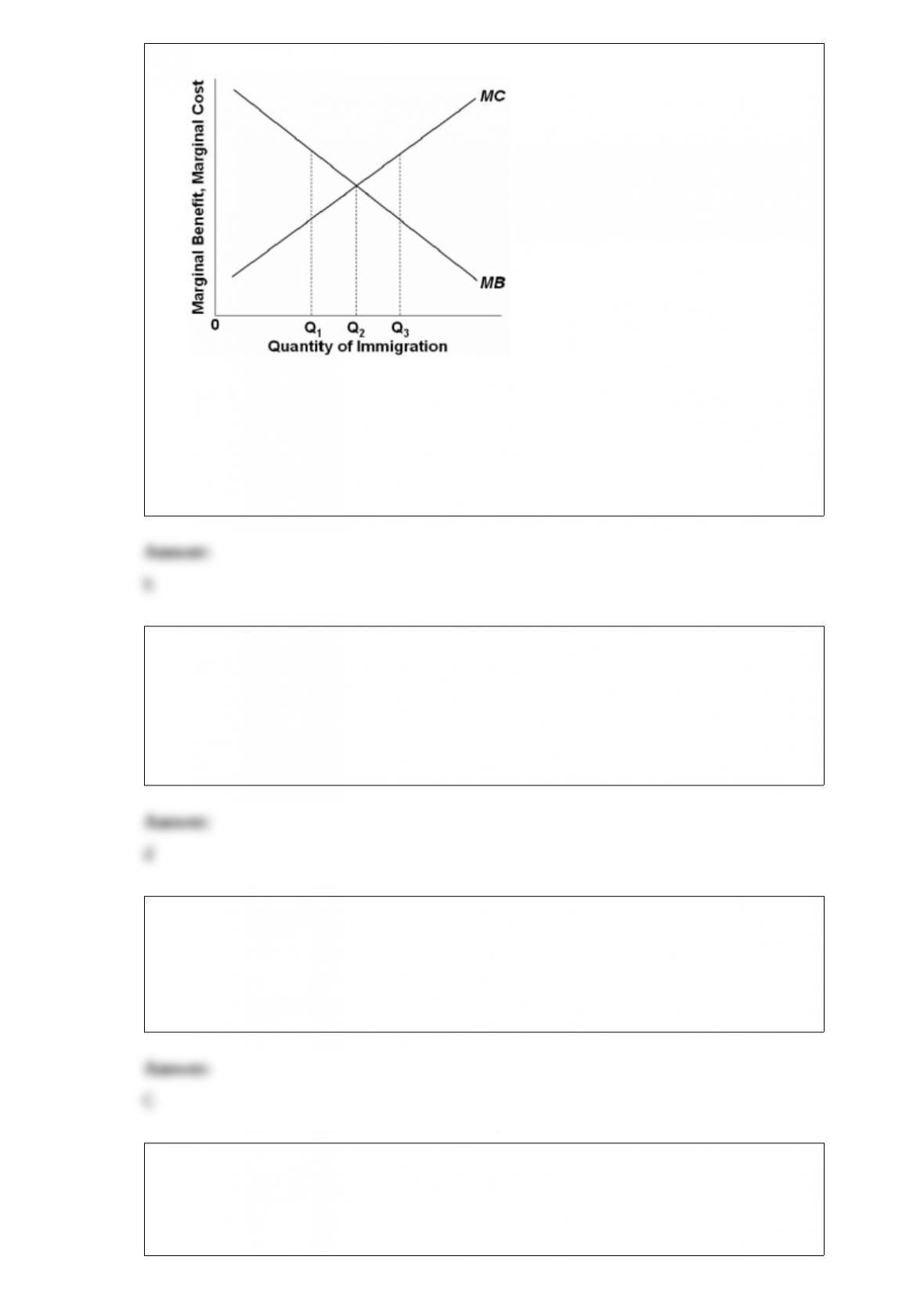
12)
refer to the above figure. an increase in the number of highly motivated and skilled
potential immigrants will:
a.reduce mb and increase mc, lowering the optimal quantity of immigrants.
b.increase mb and reduce mc, raising the optimal quantity of immigrants.
c.increase both mb and mc, and the effect on the optimal quantity is uncertain.
d.reduce both mb and mc, and the effect on the optimal quantity is uncertain.
13) the demand for health care in industrially advanced economies is:
a.highly elastic with respect to both price and income.
b.highly inelastic with respect to both price and income.
c.highly elastic with respect to income, but highly inelastic with respect to price.
d.about unit elasticity with respect to income and relatively inelastic with respect to
price.
14) A vertical merger involves a combining of one or more firms:
A.as the result of one firm purchasing the assets of the other.
B.that are operating in entirely different industries.
C.operating at different stages of the production process in a particular industry.
D.operating at the same stage of the production process.
15) the demand for commodity x is represented by the equation p = 10 – 0.2q and
supply by the equation p = 2 + 0.2q.
refer to the above information. if demand changed from p = 10 – .2q to p = 7 – .3q, the
new equilibrium price is:

a.$2.
b.$4.
c.$6.
d.$7.
16) The U.S. demand for euros is:
A.downsloping because, at lower dollar prices for euros, Americans will want to buy
more European goods and services.
B.downsloping because, at higher dollar prices for euros, Americans will want to buy
more European goods and services.
C.downsloping because the dollar price of euros and the euro price of dollars are
directly related.
D.upsloping because a higher dollar price of euros makes European goods and services
more attractive to Americans.