1)
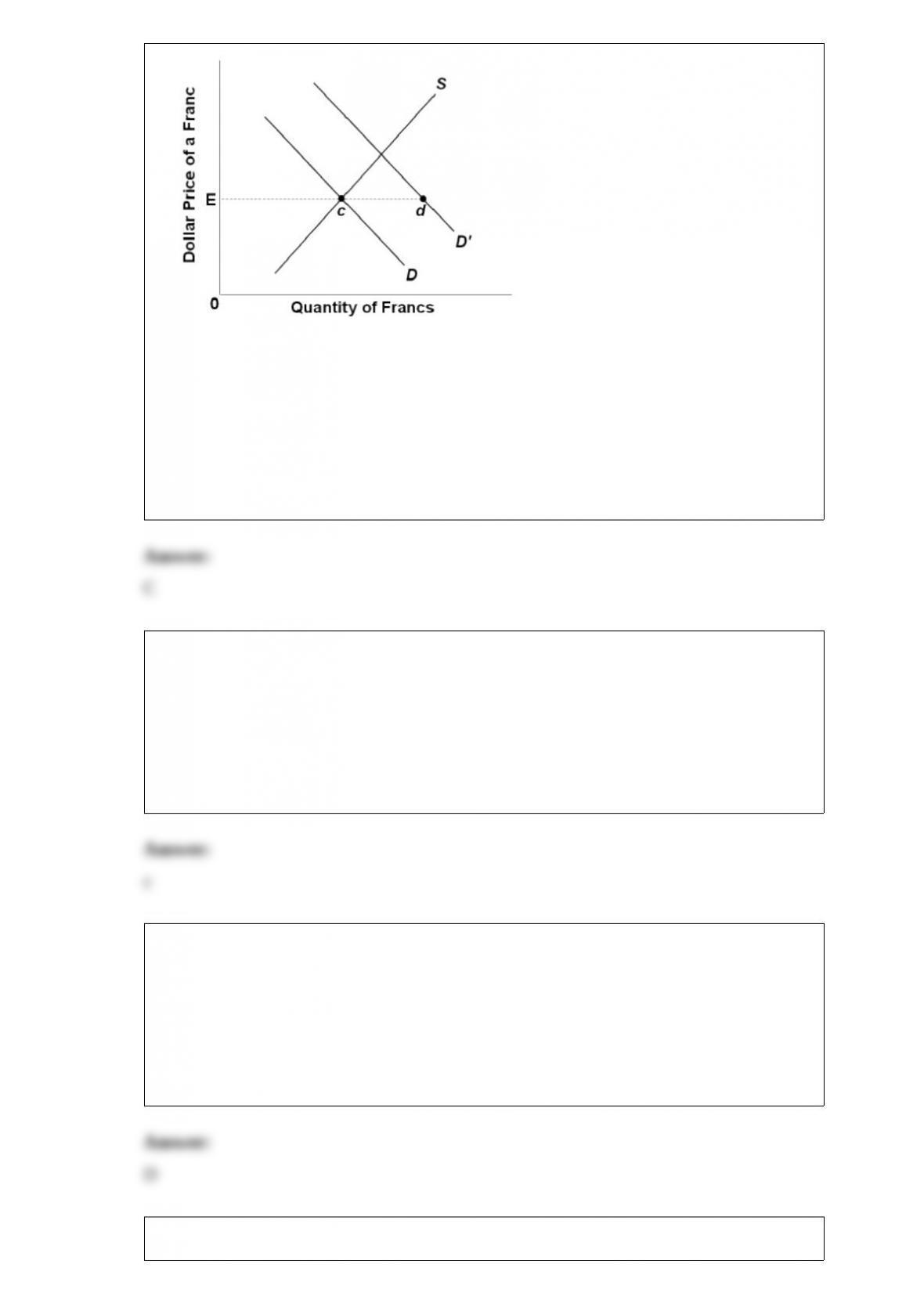
Refer to the above diagram where D and S are the United States’ demand for and supply
of Swiss francs. At the equilibrium exchange rate, E, the United States’ balance of
payments is in equilibrium. Under a system of fixed exchange rates, the shift in demand
from D to D’ will cause:
A.the United States to increase its stocks of international monetary reserves.
B.a Swiss balance of payments deficit.
C.a U.S. balance of payments deficit.
D.a U.S. balance of payments surplus.
2) the short-run supply curve for a purely competitive industry can be found by:
a.multiplying the avc curve of the representative firm by the number of firms in the
industry.
b.adding horizontally the avc curves of all firms.
c.summing horizontally the segments of the mc curves lying above the avc curve for all
firms.
d.adding horizontally the immediate market period supply curves of each firm.
3) The cost of not being able to extract and sell a non-renewable resource in the future
(because it is being extracted in the present) is known by natural resource economists as
the:
A.extraction cost.
B.future cost.
C.conservation cost.
D.user cost.
4) Gigantic Corporation follows a strategy of waiting for rivals to innovate, then
quickly imitating any successful innovations. This behavior is known as:
A.collusion.
B.an entrepreneurial strategy.
C.a fast-second strategy.
D.pricing the demand curve.
5) Overfishing caused which of the following fisheries to collapse by 2004?
A.Maine Red Hake and Atlantic Tuna.
B.Pacific Halibut and Sockeye Salmon.
C.Blue Crab and Dungeness Crab.
D.White Shrimp and Brown Shrimp.
6) Free trade based on comparative advantage is economically beneficial because:
A.it promotes an efficient allocation of world resources.
B.it increases competition.
C.it provides consumers with a wider range of products.
D.of all of these reasons.
7) If a technological advance expands output and requires a smaller investment in
capital goods, this technological advance:
A.is capital-using.
B.must involve nonfinancial investment.
C.is capital-saving.
D.must pertain to the infrastructure.
8) Alex and Ben are both loggers wanting to harvest timber from the same forest. Alex
prefers to harvest and replant at a sustainable rate; Ben wants to harvest as many trees
as possible to maximize short-run profit, and then move on. They face the same
production costs.
Refer to the information above. If no explicit property right is given over the forest
land, then:
A.a property right will be established when trees are cut down and brought to market.
B.there is no property right over the harvested timber.
C.Alex and Ben will likely work out an agreement on harvesting and replanting the
land.
D.that implies that government owns and regulates its use.
9) the unemployment rate of:
a.women greatly exceeds that of men.
b.whites is roughly equal to that of african-americans.
c.white-collar workers exceeds that of blue-collar workers.
d.teenagers is much higher than that of adults.
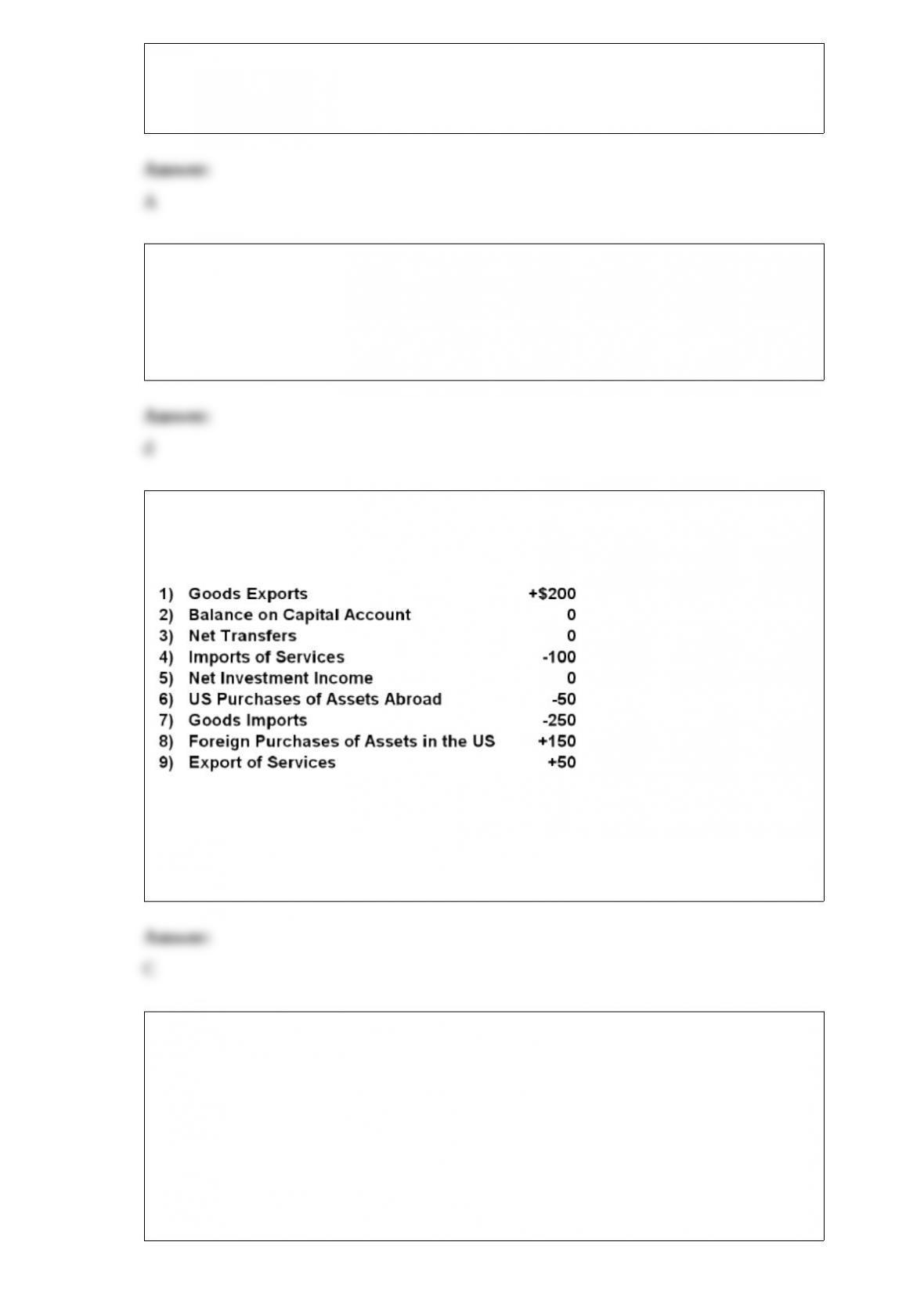
10) The plus items below are “export-type” entries and the minus items are
“import-type” entries in the balance of payments for the hypothetical country of Zippo.
Refer to the above information. Zippo has a:
A.current account surplus.
B.financial account deficit.
C.trade deficit on goods and services.
D.balance of services surplus.
11) which of the following is a true statement?
a.economists who support economic growth say that it is the most practical route to the
higher standards of living that the vast majority of people desire.
b.most economists believe that the recent productivity acceleration implies an end to the
business cycle.
c.most economists believe that increases in real gdp actually produce decreases in
overall economic well-being because of spillover costs.
d.mainstream economists disagree as whether the rate or productivity growth was
higher between 1995 and 2005 than between 1973 and 1995.