
Consumption spending is $5 million, planned investment spending is $8 million,
unplanned investment spending is $2 million, government purchases are $10 million,
and net export spending is $2 million. What is aggregate expenditure?
A) $15 million
B) $23 million
C) $25 million
D) $27 million
A price maker is
A) a person who actively seeks out the best price for a product that he or she wishes to
buy.
B) a firm that has some control over the price of the product it sells.
C) a firm that is able to sell any quantity at the highest possible price.
D) a consumer who participates in an auction where she announces her willingness to
pay for a product.
Letters are used to represent the terms used to answer this question: price (P), quantity
of output (Q), total cost (TC) and average total cost (ATC). Which of the following
equations is equal to a firm’s profit?
A) P – ATC

B) (P Q) – TC
C) (P Q) – (P ATC)
D) P – TC
An increase in the real interest rate results in which of the following?
A) an increase in the demand for loanable funds
B) a decrease in the demand for loanable funds
C) an increase in the quantity of loanable funds supplied
D) Both B and C will occur as a result of an increase in the real interest rate.
If the market price is $40, the average revenue of selling five units is
A) $8.
B) $20.
C) $40.
D) $200.
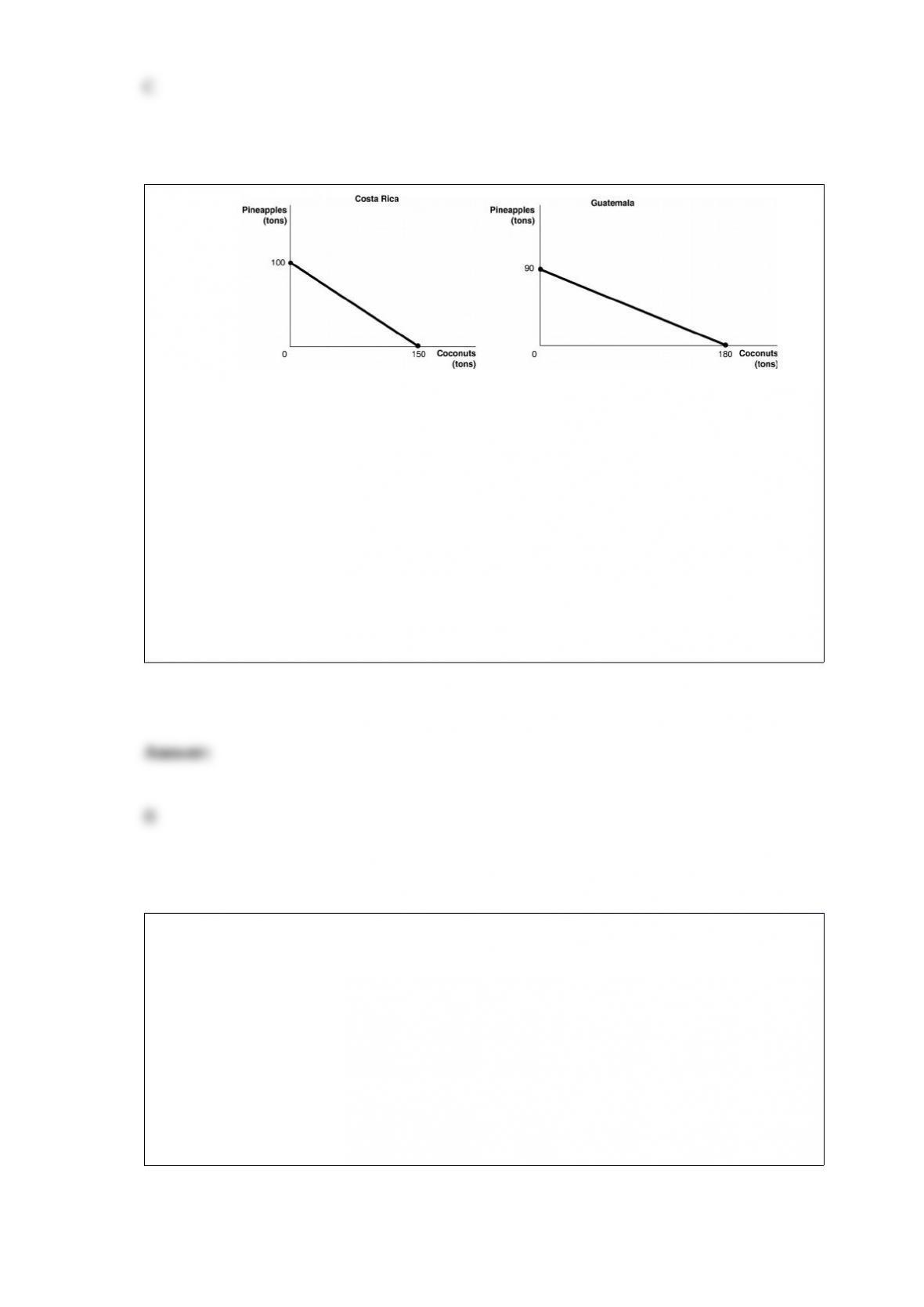
Figure 2-8
Figure 2-8 shows the production possibilities frontiers for Costa Rica and Guatemala.
Each country produces two goods, pineapples and coconuts.
What is the opportunity cost of producing 1 ton of coconuts in Costa Rica?
A) 3/8 of a ton of pineapples
B) 2/3 of a ton of pineapples
C) 1 1/2 tons of pineapples
D) 100 tons of pineapples
________ is a situation in which a good or service is produced at the lowest possible
cost.
A) Allocative efficiency
B) Productive efficiency
C) Equity
D) Optimal marginalism

Consumers who will pay high prices to be among the first to own certain new products
are called
A) savvy consumers.
B) naive consumers.
C) gullible.
D) early adopters.
Wendell can sell five motor homes per week at a price of $22,000. If he lowers the price
of motor homes to $20,000 per week he will sell six motor homes. What is the marginal
revenue of the sixth motor home?
A) $10,000
B) $12,000
C) $20,000
D) $22,000
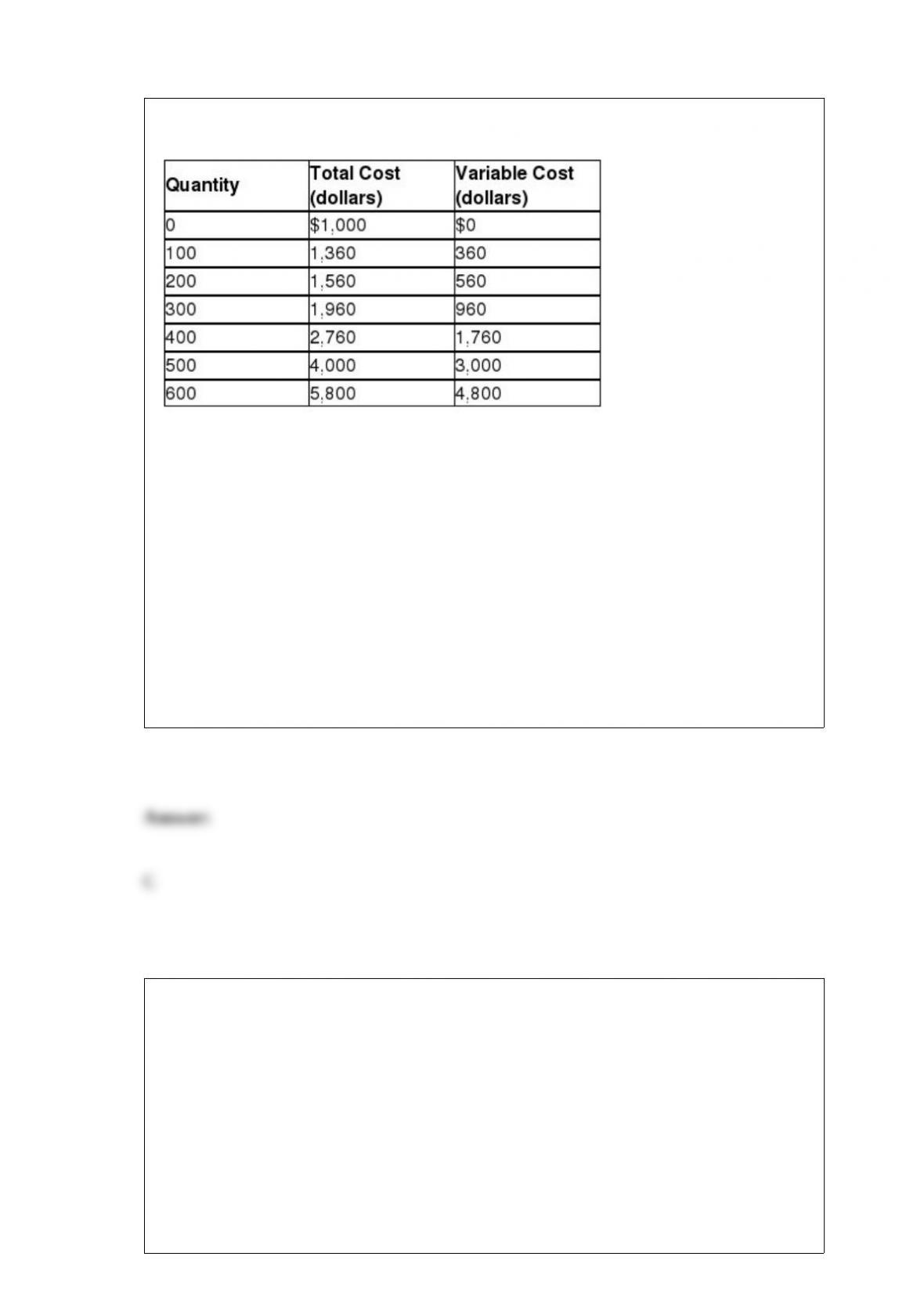
Table 12-1
Table 12-1 shows the short-run cost data of a perfectly competitive firm that produces
plastic camera cases. Assume that output can only be increased in batches of 100 units.
If the market price of each camera case is $8 and the firm maximizes profit, what is the
amount of the firm’s profit or loss?
A) $0 (it breaks even)
B) loss of $1,000
C) profit of $440
D) loss of $440
Although the pegged exchange rate between the yuan and the dollar has undervalued
the yuan, China has been reluctant to abandon the peg for fear that abandoning the peg
would
A) increase exports and increase the current account deficit.
B) reduce capital inflows.
C) reduce exports and reduce economic growth.
D) increase Chinese holdings of dollars.

Article Summary. In 2012, Colorado and Washington legalized marijuana for
recreational use, and one of the major selling points in each state’s pro-marijuana
campaign was the possibility of generating millions of dollars in tax revenue from
sales which could be used for funding general education. The Colorado legislature
was weighing a proposal to tax marijuana at 30 percent, of which 15 percent would
be a sales tax on consumers and 15 percent an excise tax on growers. Washington
has set a tax rate of 44 percent on consumers and 25 percent each for growers and
retailers. Since the legalization of marijuana is relatively new, projecting the
economic impact of its sale is difficult, leading to many questions as to the
quantities that will be produced and sold and what actual tax revenues will be
generated.
Source: Elizabeth Dwoskin, “Colorado and Washington Try to Figure Out How to
Tax Marijuana,” Bloomberg Businessweek, April 26, 2013.
Colorado is weighing a proposal to tax marijuana at 30 percent, of which 15 percent
would be a sales tax on consumers and 15 percent would be an excise tax on growers.
Does this necessarily mean that each group will bear half the burden of the tax?
A) Yes, since the taxes are divided equally between consumers and producers, each will
bear half the burden.
B) Yes, despite the even split of the 30 percent tax, consumers and producers always
bear equal burdens of a tax.
C) No, the burden of a tax is always 100 percent on the consumer.
D) No, the burden of the tax will depend on the elasticity of demand and supply.
Figure 16-1
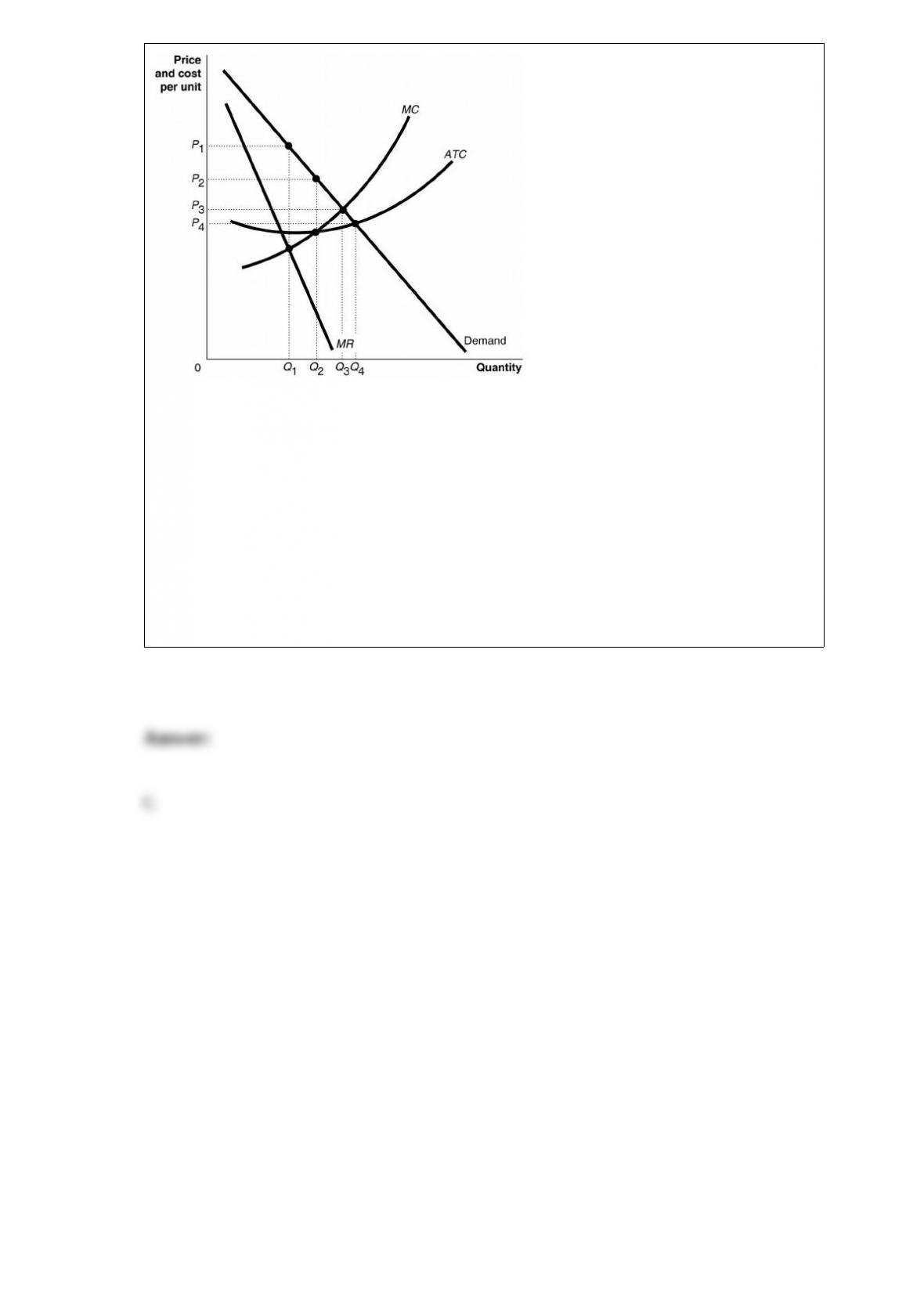
With perfect price discrimination, the firm will produce and sell
A) Q1 units.
B) Q2 units.
C) Q3 units.
D) Q4 units.
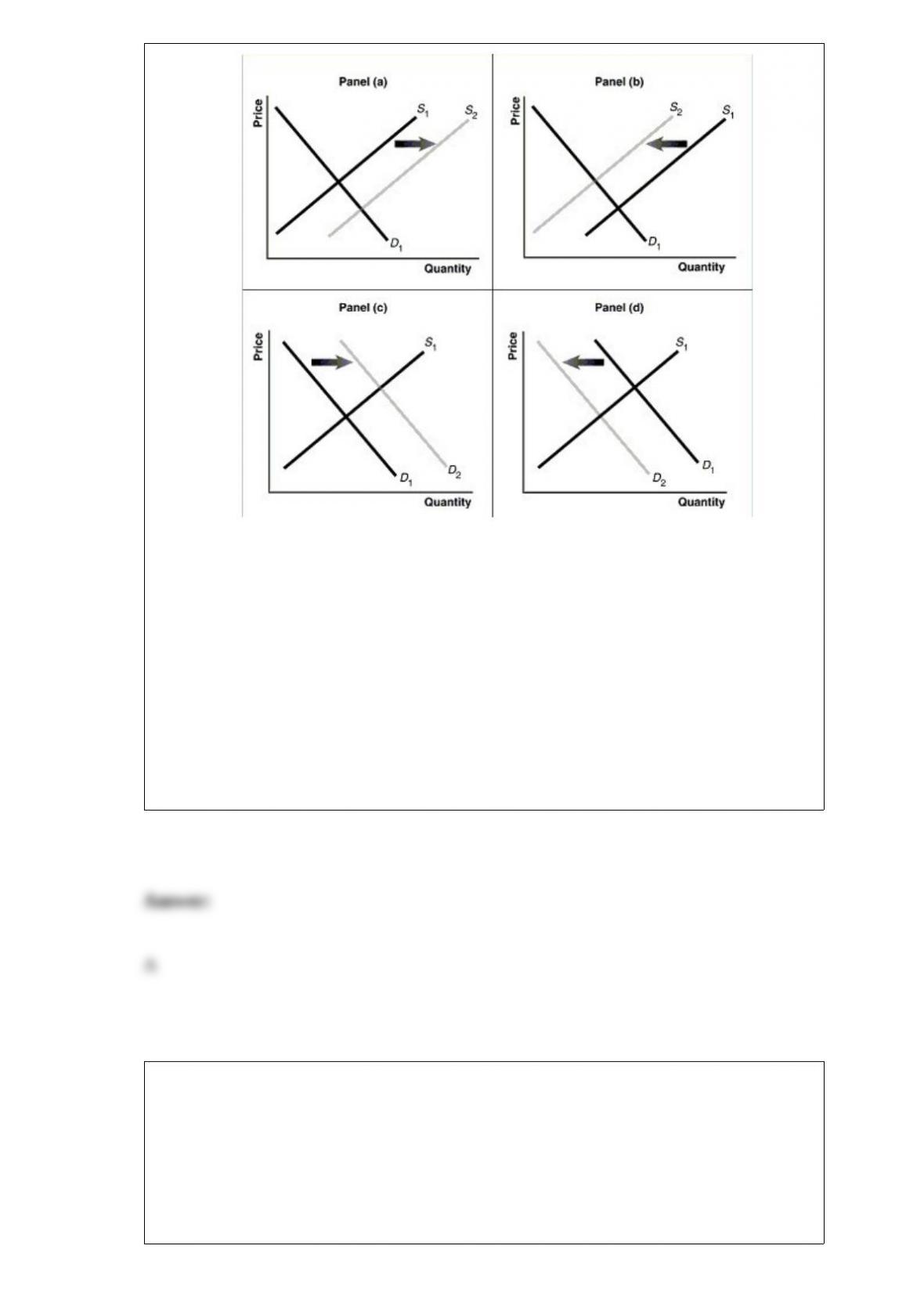
Figure 3-7
Assume that the graphs in this figure represent the demand and supply curves for laptop
computers. Which panel best describes what happens in this market when the price of
computer hard drives falls?
A) Panel (a)
B) Panel (b)
C) Panel (c)
D) Panel (d)
Which of the following arguments could be made as evidence that the market for
produce sold at a farmers’ market is perfectly competitive?
A) The U.S. Department of Agriculture has established standards for the labeling of
organic produce sold at farmers’ markets.
B) Sales of organically grown food have increased at a rate of 20 percent per year.

C) As more farmers began selling their products at farmers’ markets, the increase in
supply has driven down prices to the point where they just cover the cost of production.
D) The profits earned by farmers who sell their products at farmers’ markets have
continued to grow, despite the increasing number of farmers entering this market.
Personnel economics is
A) the study of the factors that determine wage rates.
B) the study of how workers are affected by tax law changes.
C) the application of economic analyses to human resource issues.
D) the application of economic analysis to the hiring decision.
Laura’s Pizza Place incurs $800,000 per year in explicit costs and $100,000 in implicit
costs. The restaurant earns $1.3 million in revenues. Based on this information, what is
accounting profit for Laura’s Pizza Place?
A) $200,000
B) $400,000
C) $500,000
D) $900,000
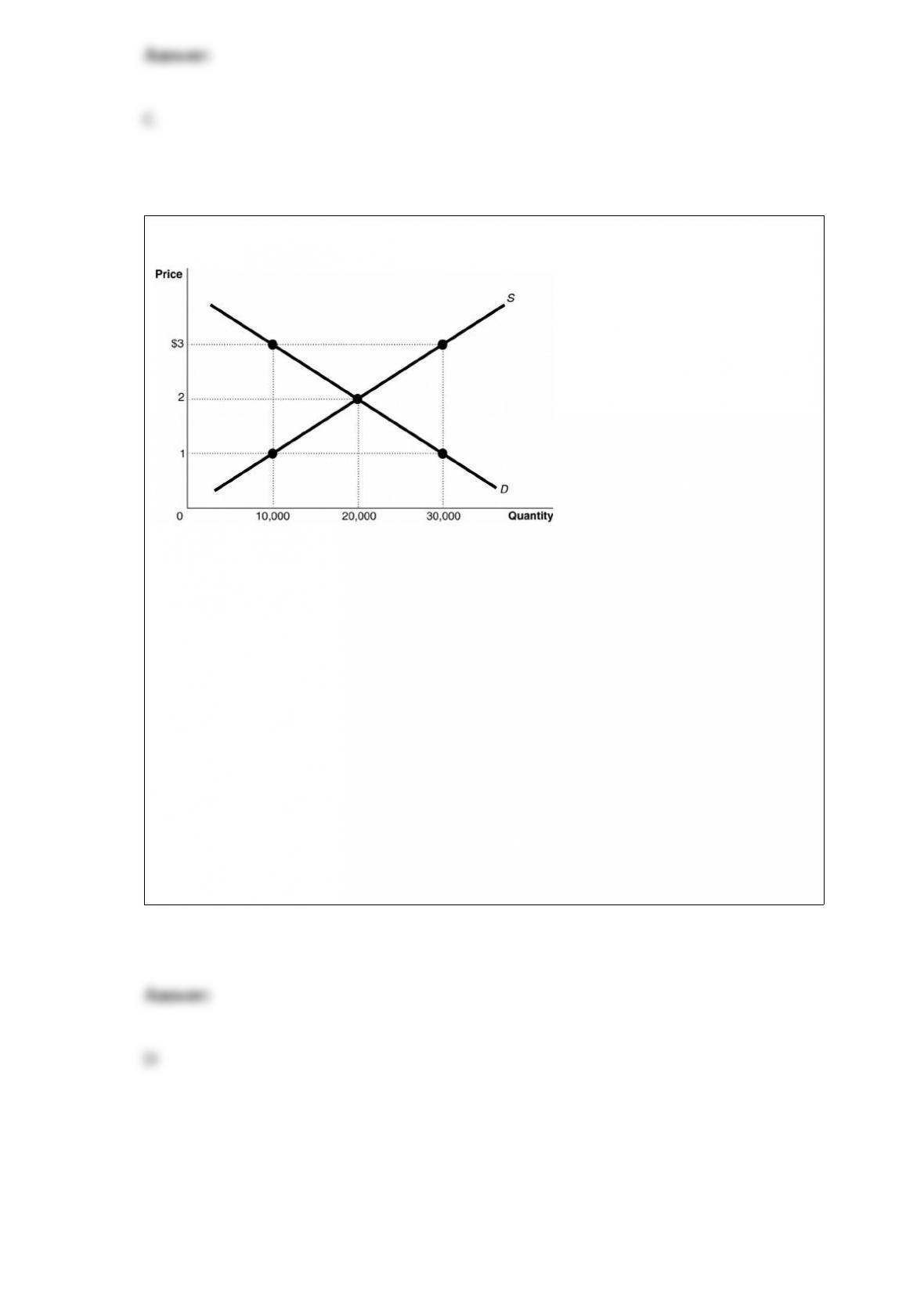
Figure 4-4
The figure above represents the market for iced tea. Assume that this is a competitive
market. If the price of iced tea is $3, what changes in the market would result in an
economically efficient output?
A) The price would decrease, the quantity supplied would increase, and the quantity
demanded would decrease.
B) The quantity supplied would decrease, the quantity demanded would increase and
the equilibrium price would decrease.
C) The price would decrease, the demand would increase and the supply would
decrease.
D) The price would decrease, quantity demanded would increase and quantity supplied
would decrease.