Cross-subsidization implies that a loss from one product’s sales will be made up by the
profit from another product’s sales.
a. True
b. False
In the second quarter of 1995, the following values were observed: real GDP = 4,359.3
billion; GDP Deflator = 325.1; and M1 = 989.5. What is the value of velocity?
a. 32.51
b. 24.31
c. 14.32
d. 2.31
There exist only two causes of monopoly: barriers to entry and government restrictions.
a. True
b. False
In the United States, the wage rates for high school graduates are growing faster than
the wage rates for college graduates.
a. True
b. False
Under the theory of perfect competition, firms and buyers know the availability and
prices associated with all products in the market.
a. True
b. False
Figure 13-1
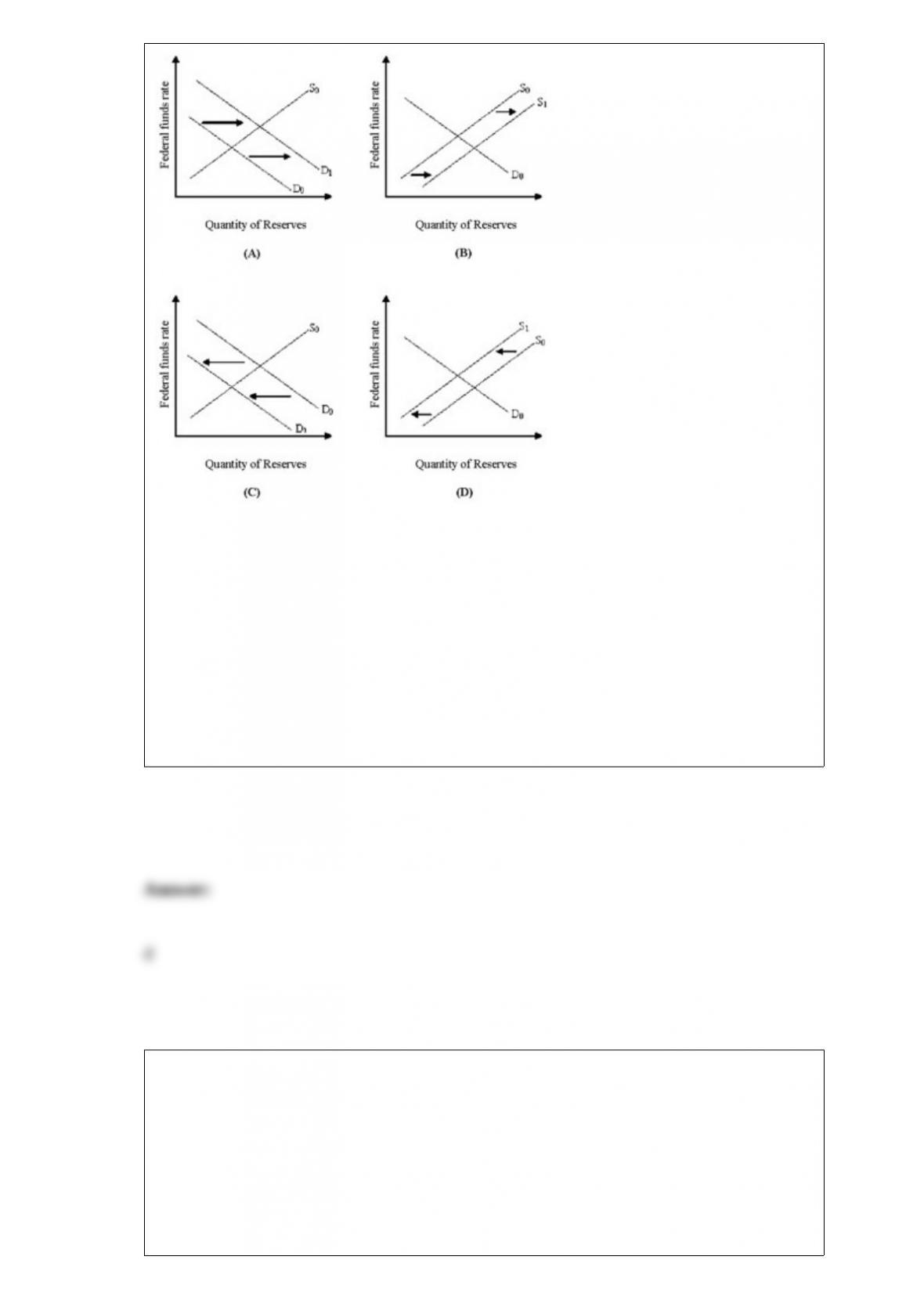
In Figure 13-1, which panel shows the effect of a Fed open market sale on the interest
rate?
a. Panel (A)
b. Panel (B)
c. Panel (C)
d. Panel (D)
A market structure in which only one firm has survived because of its economies of
scale is called a
a. natural monopoly.
b. planned monopoly.
c. structural monopoly.
d. free monopoly.
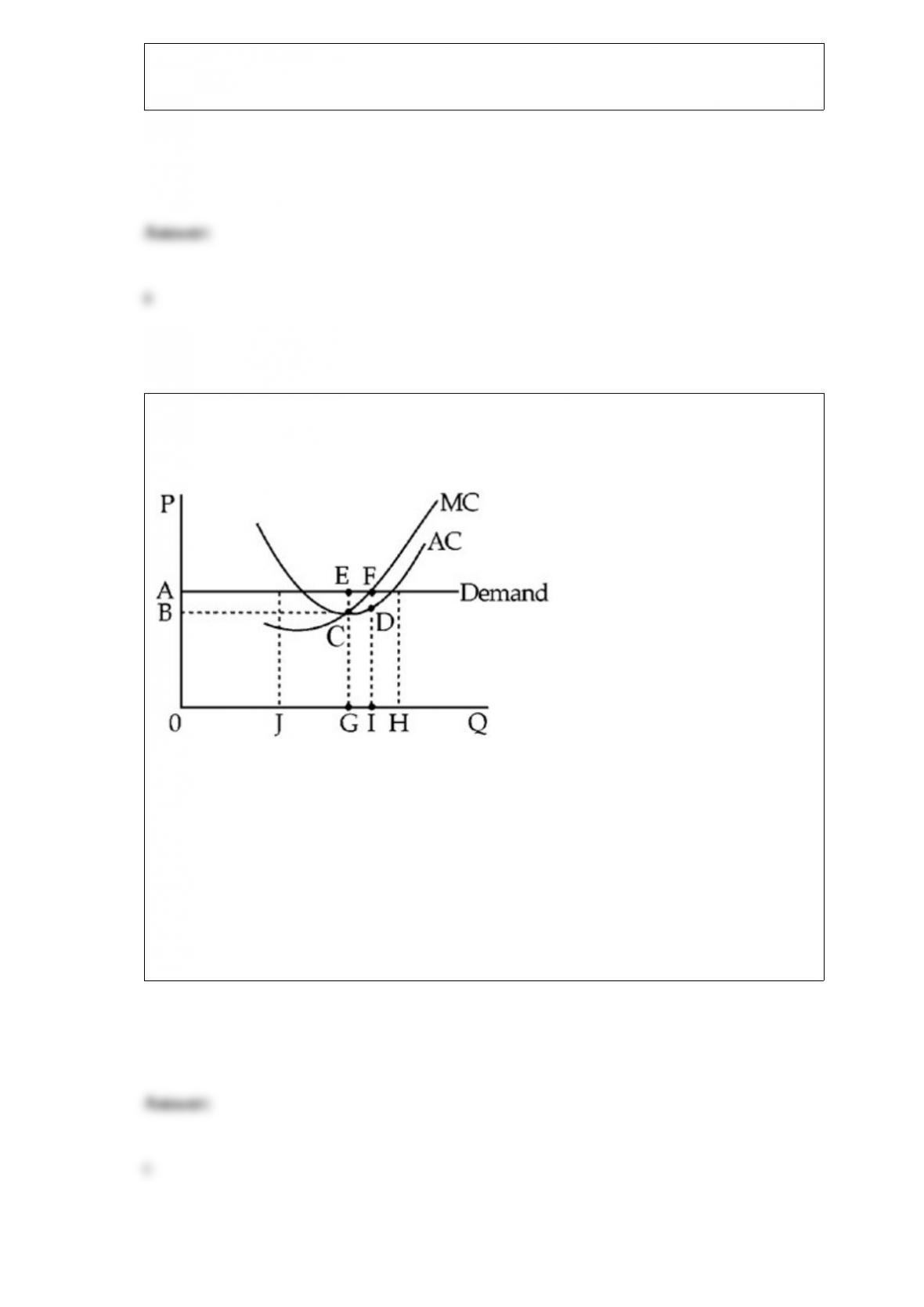
Figure 10-3
In Figure 10-3, the perfectly competitive firm is realizing a
a. loss equal to ABCE.
b. profit equal to ABCE.
c. profit equal to ABDF.
d. loss equal to ABDF.
Full employment is defined by all economists as precisely 5 percent of the labor force.
a. True
b. False
A corporation has legal status like an individual citizen.
a. True
b. False
If nations erect tariffs and quotas to restrict trade, what is likely to happen to predicted
values of currencies drawn from the purchasing power parity theory?
a. They will be understated for tariffs and overstated for quotas.
b. They will be overstated for tariffs and understated for quotas.
c. They will be the correct values.
d. They will be incorrect.
An increase in AD will trigger less inflation under which of the following conditions?
a. AD is relatively steep.
b. AD is relatively flat.
c. AS is relatively steep.
d. AS is relatively flat.
The general shape of the aggregate supply curve is
a. downward sloping.
b. upward sloping.
c. vertical.
d. horizontal.
Which of the following is an income number?
a. M1
b. M2
c. GDP
d. cash
A deficit will burden future generations
a. because the obligation to pay it off must be faced sooner or later.
b. if it produces higher interest rates when the economy is near full employment.
c. because future generations will have to pay taxes to fund the interest payments to
Americans who hold the debt.
d. All of the above are correct.
Fractional reserve banking takes its name from the fact that banks
a. hold only a fraction of their reserves at the bank itself.
b. keep only a fraction of their total deposits on reserve.

c. lend only a fraction of their total reserves to customers.
d. reserve only a fraction of their activity for lending.
Since the U.S. economy expanded rapidly from 1992 to 2000, it must be true that
a. fiscal contraction overwhelmed monetary expansion.
b. monetary expansion overwhelmed fiscal contraction.
c. monetary expansion exactly offset fiscal contraction.
d. monetary contraction overwhelmed fiscal expansion.
Total profit = Total revenue − Total cost (including opportunity cost).
Total profit defined in this way is called
a. accounting profit.
b. economic profit.
c. absolute profit.
d. relative profit.
When policy makers choose between tax policy and spending policy to affect the level
of aggregate demand, they tend to choose on the basis of
a. how large a public sector they want.
b. how much they want to change aggregate demand.
c. how much they want to change aggregate supply.
d. which has the larger multiplier.
Most supply-side initiatives have the effect of reducing inequality.
a. True
b. False
Unions often have the power to push wages above competitive levels.
a. True
b. False
In the short run,
a. all of the firm’s input quantities, including plant size, become adjustable.
b. firms are not constrained by past decisions.
c. firms have relatively little opportunity to change production processes.
d. all of the firm’s current commitments come to an end.
Until the 1980s, most of the national debt was
a. owned by foreigners.
b. acquired either during wars, especially World War II, or during recessions.
c. owned by banks.
d. financed by printing money.
The most widely used approach for the analysis of oligopoly behavior is
a. game theory.
b. role playing.
c. strategic engineering.
d. input-output analysis.
The aim of antitrust policy is to
a. provide adequate incentives for inventors and entrepreneurs.
b. prevent firms from acquiring or exercising undue market power.
c. prevent firms from becoming very large.
d. regulate the prices charged by oligopolies.
An increase in the price level in Japan relative to the price level in the United States
would
a. increase U.S. net exports and increase aggregate demand.
b. increase U.S. net exports and increase aggregate supply.
c. reduce U.S. net exports and reduce aggregate demand.
d. reduce U.S. net exports and increase aggregate demand.
The hallmark of Clintonomics was first to reduce the budget deficit.
a. True
b. False
Because business firms often finance new investments with borrowed money, a key
determinant of investment spending is
a. tax rates.
b. the price level.
c. the rate of inflation.
d. the real interest rate.
Marginal profit is the profit
a. earned by a firm that is about to go out of business.
b. calculated directly from the total cost curve.
c. that is added by a one-unit increase in total output.
d. earned for each dollar of cost increase.
In order for a central planner to achieve the invisible-hand type efficiency of a free
market, the planner would
a. need masses of statistics.
b. be required to makes enormous calculations.
c. need to be able to measure a consumer’s marginal utility in order to equate MU with
MC.
d. All of the above would be required.

The reason firms often choose sales maximization as a goal is because
a. that is where profits are maximized.
b. it is impossible to maximize profits.
c. firms are managed and owned by different groups of people with different goals.
d. owners believe setting price/output to maximize profits is unfair to consumers.
The equation of exchange can be written as
a. Velocity Nominal GDP = Price Index
b. Real GDP Price Index = Money supply
c. Money supply Price Index = Real GDP
d. Money supply Velocity = Nominal GDP
Getting more output from a given amount of inputs is usually the result of increases in
a. the labor force.
b. technology.
c. the capital stock.
d. investment.
The government prefers a market-based approach to reduce firms’ emissions of a toxic
gas but wants to make certain that no more than 1,000 cubic yards of the gas are ever
emitted in a single day. The most efficient policy under these circumstances is likely to
be a system of
a. per-unit taxes on emissions of the gas.
b. per-unit taxes on the goods produced by firms that emit the gas.
c. subsidies to firms that agree not to emit the gas.
d. sales of permits to emit specified quantities of the gas on specified days.
Distinguish between demand and quantity demanded. Do the same for supply and
quantity supplied.
Draw a long-run average cost curve that first exhibits increasing returns to scale
(economies of scale), then constant returns to scale, and finally decreasing returns to
scale (diseconomies of scale). Label each region.
Would a profit-maximizing firm sell at a price where demand is inelastic? Explain.
The sales manager of a retail outlet suggests that the best way to increase customers is
to have a sale. If a 10 percent price cut doesn’t bring in enough customers, then he’ll cut
prices 20 percent. Increased cash flow should take care of profits. Do you agree?
Explain.
The interest rate is the opportunity cost of transferring spending power between time
periods. However, the market mechanism may fail to provide adequately for future
economic growth. List the reasons why a market might fail.
Would a corporation seeking to raise capital sell its new shares on the stock market? If
not, why not?
Why are the prices of some regulated industries often higher than they would be if there
were no regulation?
Why do polluting firms overproduce? Use a completely and correctly labeled graph to
illustrate your answer.
Suppose a monopolist can charge different prices to different customers, such as doctors
charging different prices depending on whether the patient is insured. How will profits
and marginal revenue of such a price-discriminating monopolist compare to profits and
MR of an ordinary monopolist who must charge all patients the same fee?
Is peak pricing economically efficient? Explain. Give an example to illustrate your
answer.
Explain why monetary policy is needed specifically with regard to the existence of
excess reserves. Compare and contrast the effectiveness of monetary policy during the
Great Depression and the Great Recession?
Describe an asset price bubble and give examples. Explain why it is extremely difficult
if not impossible for the Federal Reserve to prevent such bubbles.
Explain why on average the profit levels for invention and entrepreneurship are
generally so low.
What is meant by the concept of a “coordination failure” in macroeconomics?
Why is it inefficient for an economy to be inside the production possibilities frontier?
Explain the expression “time is more valuable than money.” Explain in words and use a
diagram to illustrate the implications of this for a person’s labor supply curve.
What are the main determinants of demand elasticity? Explain their importance.
Explain why taxes on pollutants reduce pollution while subsidies to firms cutting their
pollutants actually increase pollution.