
The figure below shows the demand curve for a product that can be sold only in
whole-number amounts.
At a price of $15 per unit, what would be the total consumer surplus in this market each
day?
A. $0
B. $6
C. $15
D. $75
The construction of the interstate highway system in the United States is an example of
a government policy to promote economic growth by:
A. increasing human capital.
B. increasing physical capital.
C. improving technology.
D. improving the social and legal environment.
Taking a limousine to a five star restaurant in New York is a:
A. necessity to Donald Trump but a luxury to Joe Average.
B. necessity to both Joe Average and Donald Trump.
C. want to both Joe Average and Donald Trump.
D. want to Donald Trump and a luxury to Joe Average.
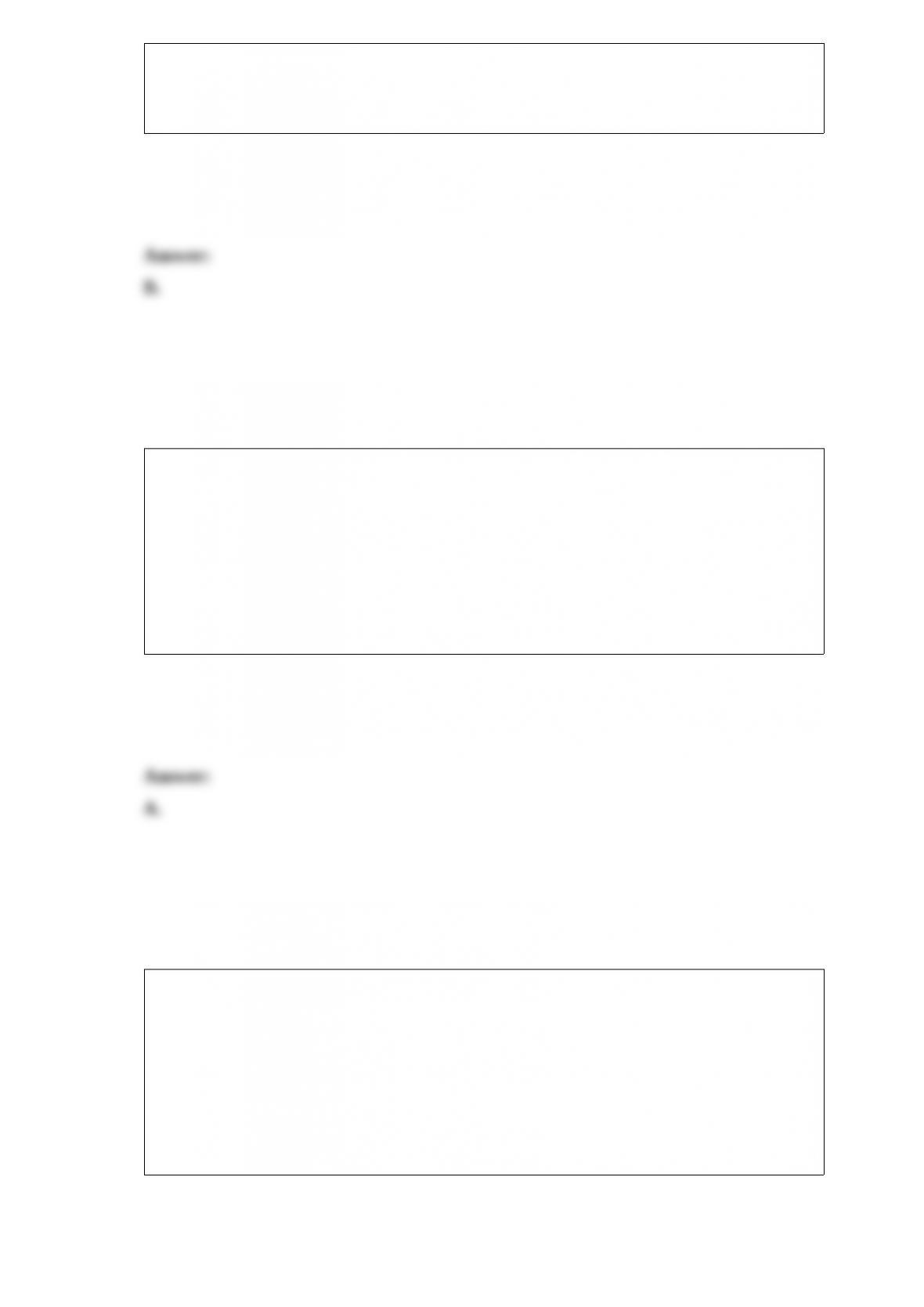
Refer to the figure below. Suppose the economy is in a short-run equilibrium at output
Y3 and inflation rate π2. The economy is currently experiencing ______, and the correct
fiscal policy response to this situation, to return the economy to potential GDP, is to
______.
A. a recessionary gap; increase government spending
B. an expansionary gap; decrease government spending
C. a recessionary gap; increase taxes
D. an expansionary gap; decrease taxes
To close a recessionary gap, the Fed ______ interest rates which ______ planned
aggregate spending and ______ short-run equilibrium output.
A. reduces; increases; increases

B. raises; decreases; increases
C. raises; decreases; decreases
D. reduces; increases; decreases
One problem with using monetary policy to address “bubbles” in asset markets is that:
A. the Federal Reserve is better than financial-market professionals at identifying
bubbles.
B. monetary policy is not a very good tool for addressing the problem of
inappropriately high asset prices.
C. reducing the real interest rate to deal with the bubble could lead to inflation.
D. the Federal Reserve is not interested in stabilizing output.
The self-correcting tendency of the economy means that falling inflation eventually
eliminates:
A. expansionary gaps.
B. recessionary gaps.
C. exogenous spending.
D. unemployment.
The duration of a recession is measured from:
A. peak to trough.
B. trough to peak.
C. peak to peak.
D. trough to trough.
If all taxpayers pay the same percentage of their income in taxes, the tax is termed a(n):
A. proportional tax.
B. progressive tax.
C. head tax.
D. excise tax.

A period in which the economy is growing at a rate significantly above normal is called
a(n):
A. depression.
B. expansion.
C. peak.
D. recession.
Heterogeneity and the dynamic nature of labor markets are the principal causes of
______ unemployment.
A. cyclical
B. chronic
C. structural
D. frictional

The principle of diminishing returns to capital states that if the amount of labor and
other inputs employed is held constant, then the greater the amount of capital in use the:
A. less is produced.
B. less production is wasted.
C. the more an additional unit of capital adds to production.
D. the less an additional unit of capital adds to production.
The slowdown in the growth of real wages in the United States since 1973 is consistent
with a concurrent:
A. slowdown in productivity gains.
B. slowdown in the growth of the working age population.
C. slowdown in immigration into the country.
D. speedup in the rate of inflation.

You paid $35 for a ticket (which is non-refundable) to see SPAM, a local rock band, in
concert on Saturday. Assume that $35 is the most you would have been willing to pay
for a ticket. Your boss called, and she is looking for someone to cover a shift on
Saturday at the same time as the concert. You would have to work 4 hours and she
would pay you $11/hr. The psychic cost to you of working is $2/hr. Should you go to
the concert instead of working Saturday?
A. Yes, the benefit of going to the concert is more than the cost.
B. No, the benefit of going to the concert is less than the cost.
C. Yes, the benefit of going to the concert is equal to the cost.
D. No, because there are no benefits of going to the concert.
Suppose that all workers value a safe job $2,000 per year more than a risky job. The
cost to firms of providing a safe job is $700 per year for each worker. Firms currently
pay workers $35,000 per year, without any effort to improve safety. If new firms began
to offer workers $34,000 per year and safe jobs, then
A. no workers would apply for jobs at the new firms.
B. only low-quality workers would apply for jobs at the new firms.
C. only injury-prone workers would apply for jobs at the new firms.
D. all workers would apply for jobs at the new firms.
GDP equals the value added by producers of:
A. intermediate goods and services only.
B. final goods and services only.
C. intermediate goods and services, as well as final goods and services.
D. intermediate and final goods only.
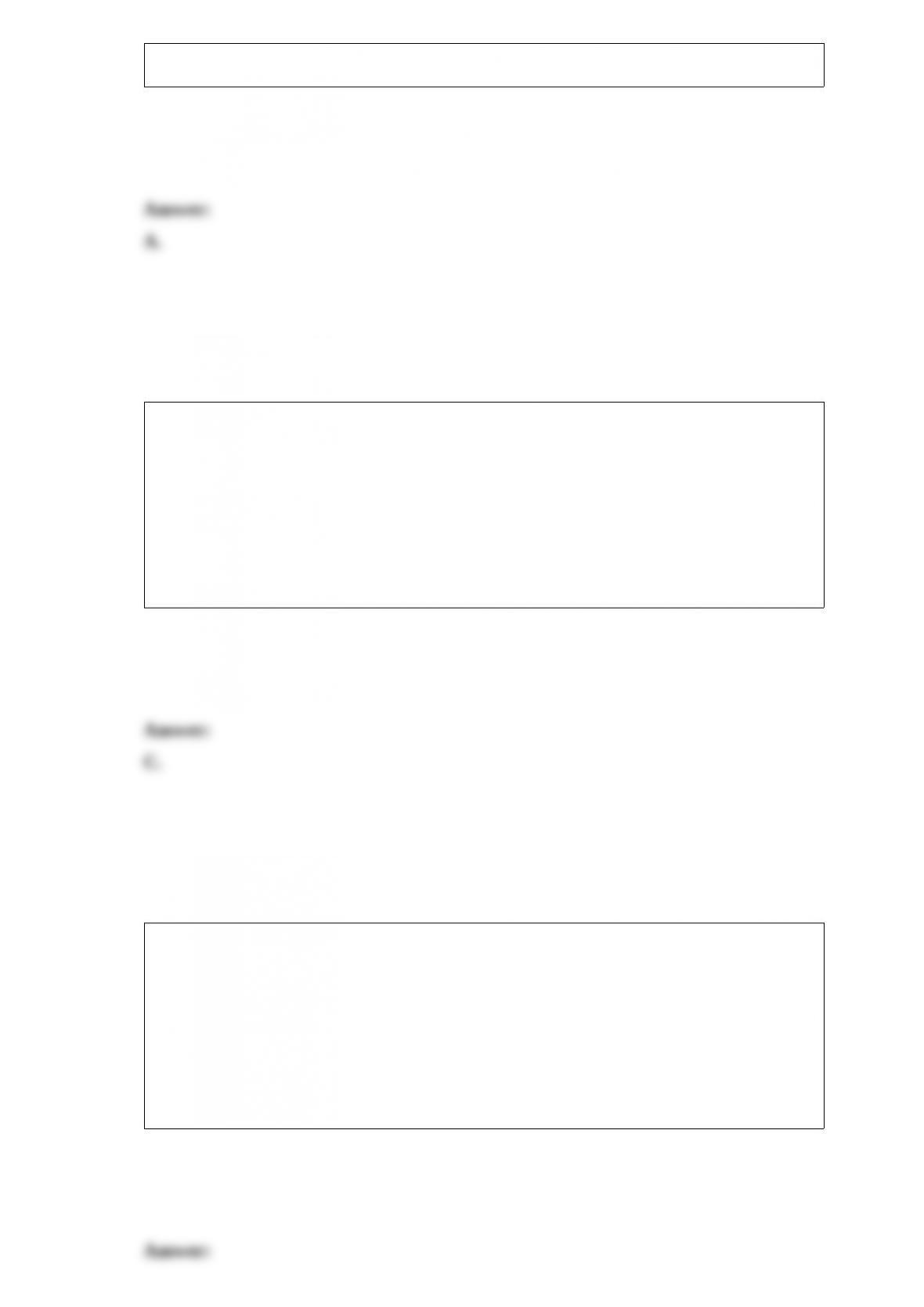
Suppose Matt and Gabe must both choose between two jobs, a safe job that pays $250
per week and a risky job that pays $300 per week. The value of safety to each is $75 per
week. Having more income than the other is worth $75 per week to each, and having
less income than the other means a $75-per-week reduction in satisfaction. Having the
same income as the other means no change in satisfaction. The payoff matrix below
summarizes this situation.
If Gabe and Matt choose their jobs at the same time, then you can predict that:
A. the equilibrium outcome of this game will not be efficient.
B. the equilibrium outcome of this game will be efficient.
C. there will not be an equilibrium of this game.
D. there will be more than one equilibrium of this game.
A reduction in workers’ marginal productivity would result in:
A. an increase in labor demand.
B. an increase in equilibrium employment level.
C. a reduction in the equilibrium wage rate.
D. a decrease in labor supply.
A country’s trade balance equals:
A. the value of tariffs less the number of quotas.
B. the number of quotas less the value of tariffs.
C. the value of exports minus the value of imports.
D. the value of imports minus the value of exports.
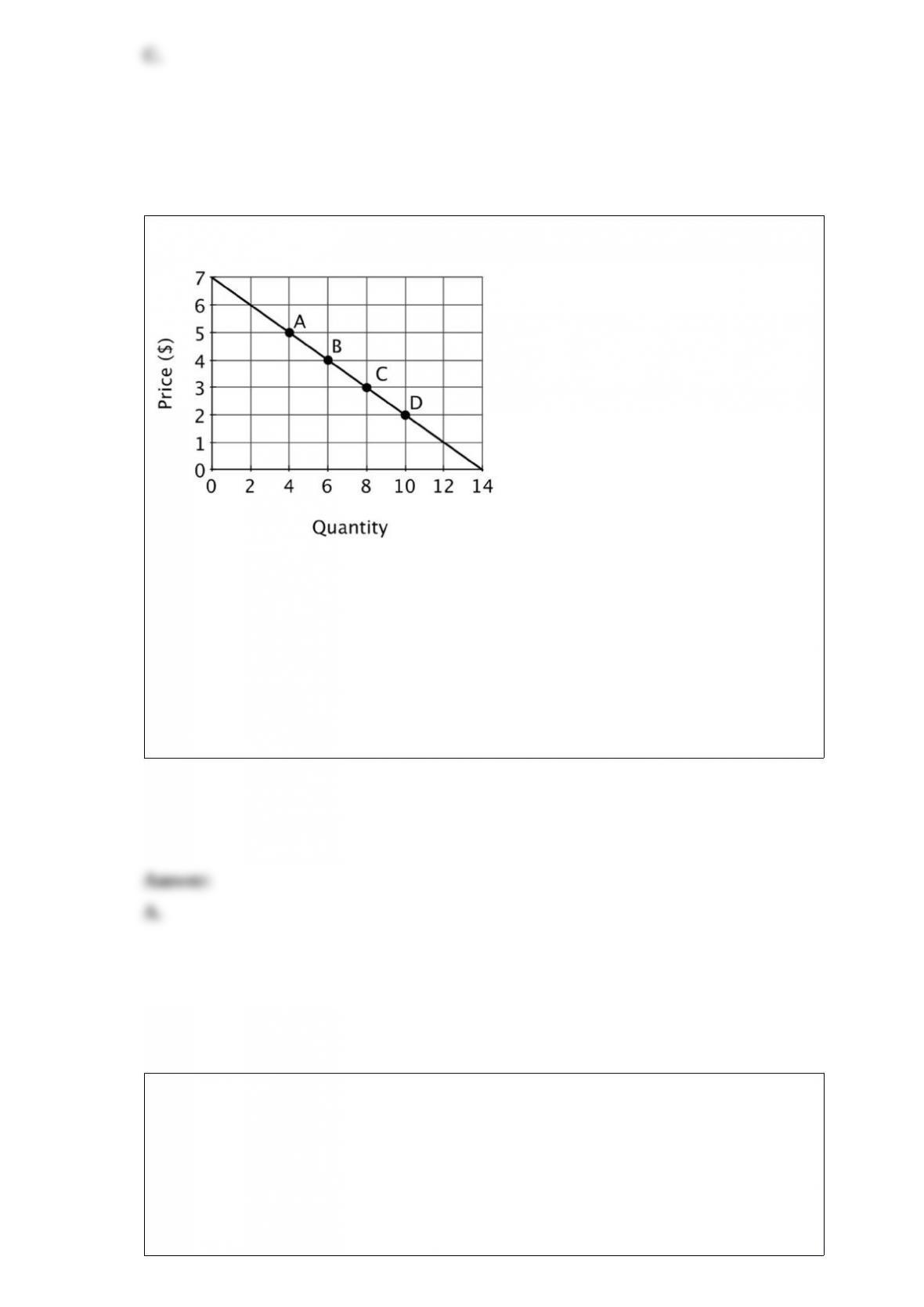
The following graph depicts demand.
The price elasticity of demand at point A is:
A. 5/2.
B. 5/8.
C. 2/5.
D. 8/5.
A dominant strategy exists if:
A. a player has a strategy that yields the highest payoff regardless of the other player’s
choice.
B. both players have the highest payoff when they make the same choice.
C. both players make the same choice.
D. one strategy yields the highest possible payoff.
When the supply of a good decreases, consumers will eventually:
A. decrease their demand.
B. increase their preferences for the good.
C. decrease their quantity demanded.
D. increase their quantity demanded.
Imposing a minimum wage above the equilibrium wage:
A. makes all workers better off.
B. lowers labor costs.
C. increases the size of the total wage bill.
D. makes some workers worse off.
A credible threat is:
A. possible to carry out.
B. legally enforceable.
C. in the threatener’s interest to carry out.
D. not in the threatener’s interest to carry out.
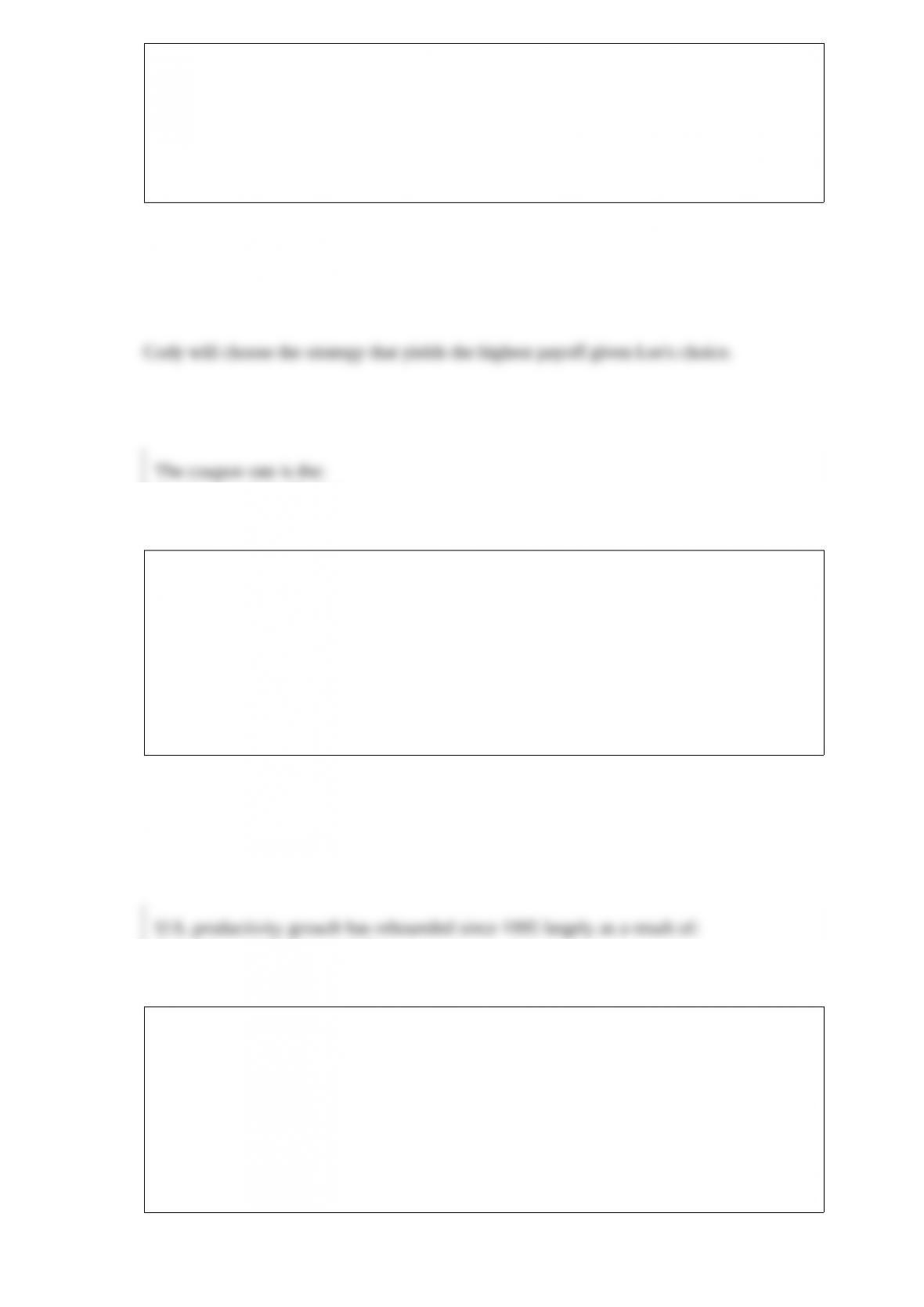
Lee and Cody are playing a game in which Lee has the first move at A in the decision
tree shown below. Once Lee has chosen either aggression or cooperation, Cody, who
can see what Lee has chosen, must choose either aggression or cooperation at B or C.
Both players know the payoffs at the end of each branch.
If Lee chooses aggression, Cody will respond with ______, and if Lee chooses
cooperation, Cody will respond with ______.
A. aggression; cooperation
B. aggression; aggression
C. cooperation; aggression
D. cooperation; cooperation
The coupon rate is the:
A. amount originally lent.
B. regular payment of interest to a bondholder.
C. interest rate promised when a bond is issued.
D. maximum interest rate that can be paid on a bond.
U.S. productivity growth has rebounded since 1995 largely as a result of:
A. increases in human capital.
B. discoveries of new natural resources.
C. increased political stability.
D. advances in information and communication technology.
Arguing that economic growth will eventually stop because we will run out of natural
resources:
A. must be correct because scarcity exists.
B. will only be correct if growth takes the form of newer, more efficient goods and
services.
C. ignores the power of markets to recognize shortages and induce changes in behavior.
D. is supported today by the fact that richer countries have fewer natural resources.
The opportunity cost of an activity includes the value of:
A. all of the alternatives that must be forgone.
B. the next-best alternative that must be foregone.
C. the least-best alternative that must be foregone.
D. the chosen activity minus the value of the next-best alternative.

The consumer price index for the current year measures the cost of a standard basket in
the ______ year relative to the cost of the same basket in the ______ year.
A. current; base
B. current; current
C. base; index
D. base; current