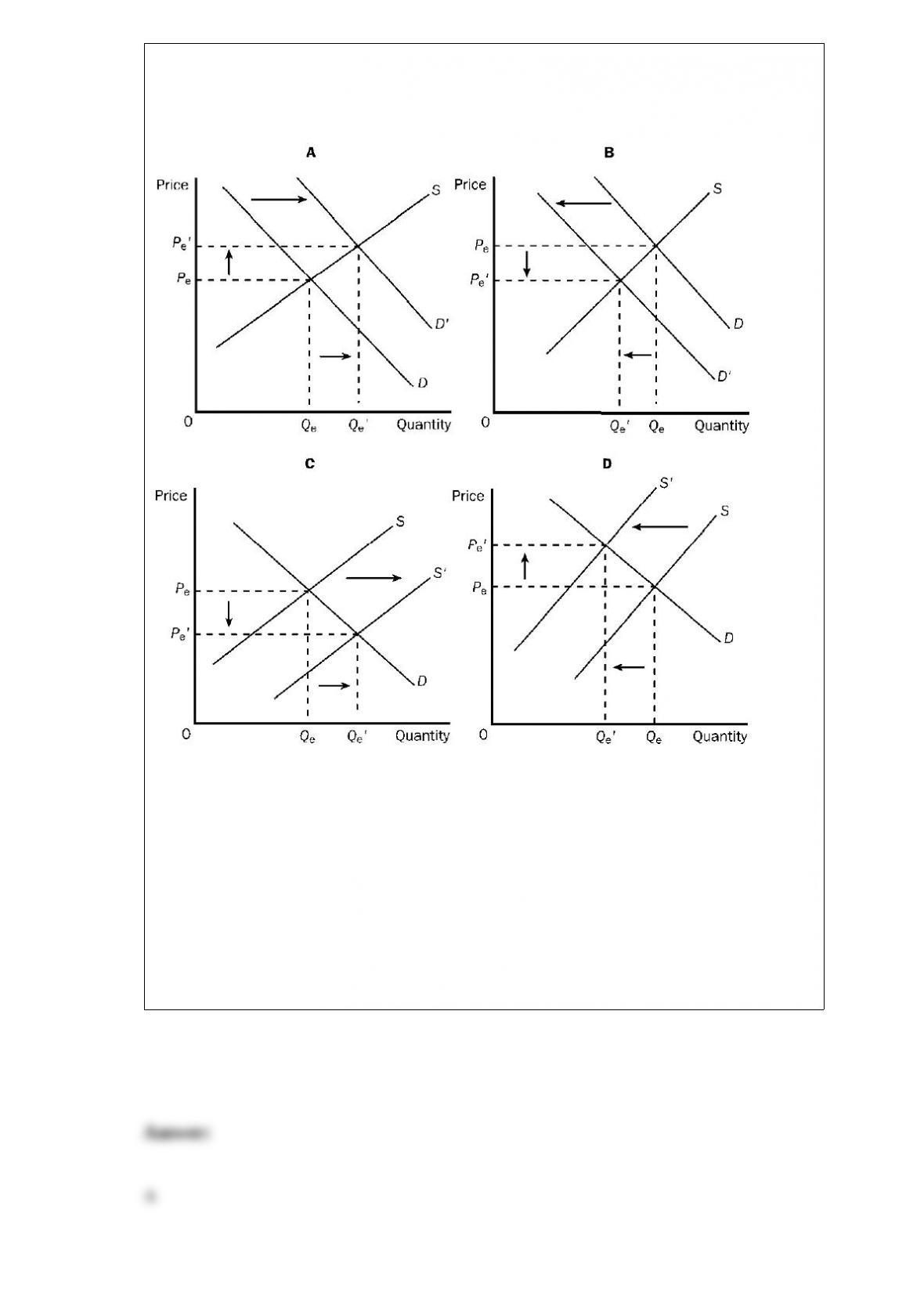
Figure 3-22
Refer to Figure 3-22. Suppose the events depicted in graphs A and C were illustrated
together on a single graph. A definitive result of the two events would be
a. an increase in the equilibrium quantity.
b. an increase in the equilibrium price.
c. an instance in which the law of demand fails to hold.
d. All of the above are correct.

The sale of government securities by the Fed will cause
a. a decrease in both the monetary base and the money supply.
b. an increase in both the monetary base and the money supply.
c. an increase in the monetary base but no change in the money supply.
d. a decrease in the monetary base but no change in the money supply.
Economists use the term ceteris paribus to indicate that
a. supply and demand are in balance.
b. other things are assumed to be constant.
c. the analysis is true for the individual but not for the economy as a whole.
d. their conclusions are based on normative economics rather than positive economic
analysis.
Which of the following correctly states the relationship between GDP and GNP for the
U.S.?
a. GDP equals GNP minus the net income of foreigners.
b. GDP equals GNP plus the net income of foreigners.
c. GDP equals GNP minus indirect business taxes.

d. GDP equals GNP.
When the price of gasoline increases substantially, many consumers will
a. turn to fuel saving alternatives like hybrid vehicles.
b. drive less.
c. take public transportation.
d. all of the above are true.
The Patient Protection and Affordable Care Act will require
a. health insurers to provide coverage to applicants regardless of prior health conditions.
b. all Americans to purchase an approved health insurance policy or pay a tax-penalty
for failing to do so.
c. employers with more than 50 full-time employees to either provide approved health
insurance for their employees or pay a fine for the failure to do so.
d. all of the above.

Which of the following provides the clearest statement of the Ricardian equivalence
theorem?
a. Both an increase in government expenditures and a reduction in taxes will provide a
substantial stimulus for aggregate demand.
b. When additional debt is used to finance a tax cut, the lower taxes and higher interest
rates will exert an equivalent impact on aggregate demand.
c. The finance of government spending with additional debt is essentially the same
thing as finance with higher taxes because the larger debt implies higher taxes in the
future.
d. A 10 percent reduction in tax rates will reduce tax revenues by 10 percent.
Given the current tax rate structure and promised benefit levels, persons that are
currently 40 years old or younger can expect to earn approximately what real rate of
return on their Social Security contributions?
a. 0 percent
b. 2 percent
c. 10 to 12 percent
d. 15 to 20 percent
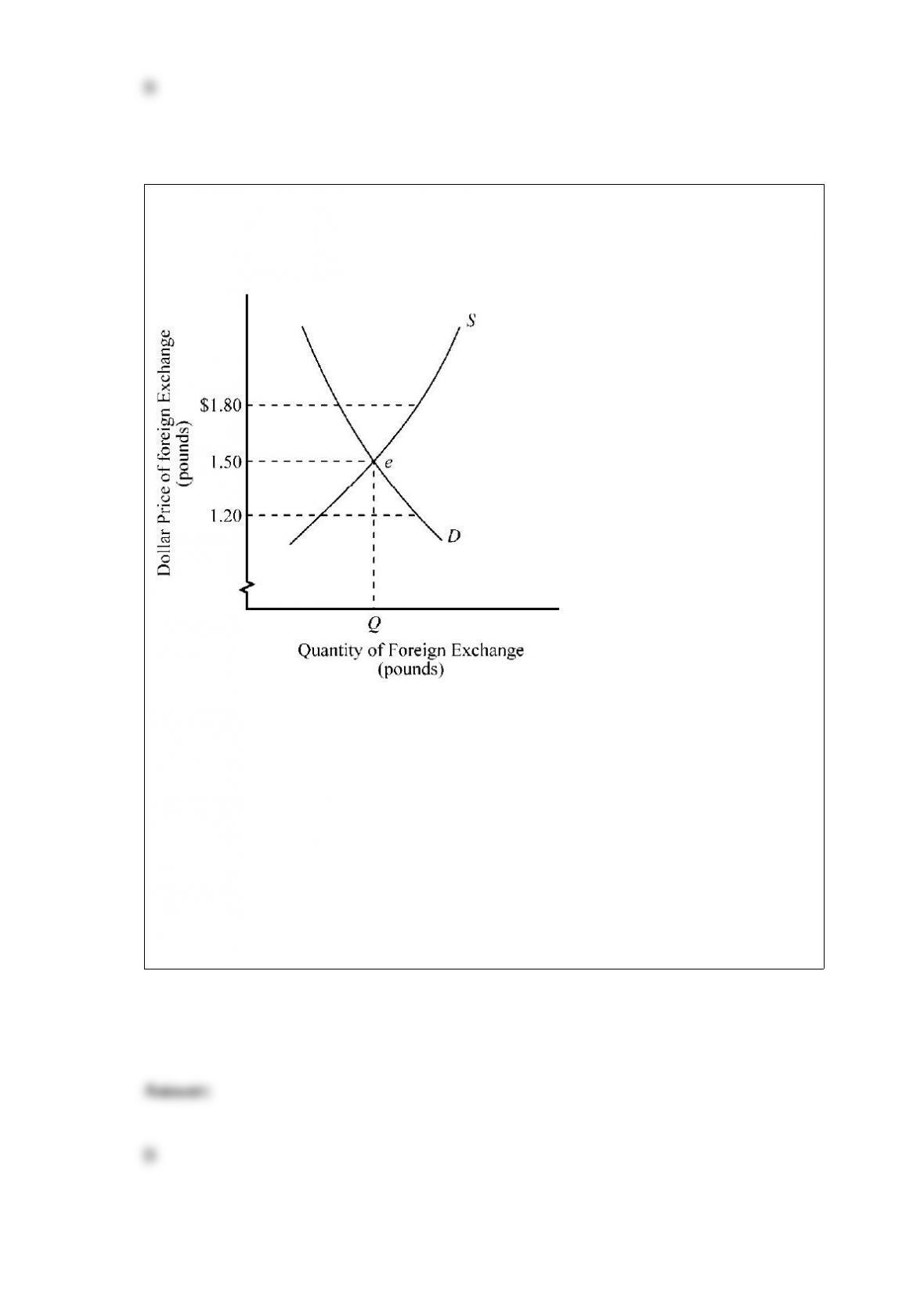
Use the figure below to answer the following question(s).
Figure 18-1
Figure 18-1 illustrates supply and demand for U.S. dollars and British pounds in the
foreign exchange market. If the dollar price of pounds is $1.20, which of the following
is true?
a. There is an excess supply of pounds, and the dollar price of pounds will rise.
b. There is an excess demand for pounds, and the dollar price of pounds will rise.
c. There is an excess supply of pounds, and the dollar price of pounds will fall.
d. There is an excess demand for pounds, and the dollar price of pounds will fall.

A general mismatch between the skills of unemployed workers and the skills needed by
employers with job openings results in
a. frictional unemployment.
b. structural unemployment.
c. cyclical unemployment.
d. a higher labor force participation rate.
Redistribution through the public sector tends to lower economic prosperity because
a. it weakens the link between productive activity and the reward derived from it.
b. it encourages resources to flow into wasteful rent-seeking activities.
c. the higher tax rates required to finance redistribution result in resources being
devoted toward tax avoidance activities.
d. all of the above are true.
When economists use the term ceteris paribus, they are indicating that
a. the relationship between two economic variables cannot be determined.
b. the analysis is true for the individual but not for the economy as a whole.
c. all other variables except the ones specified are assumed to be constant.

d. their conclusions are based on normative economics rather than positive economic
analysis.
The privately held government debt is that portion of the national debt that
a. must be paid off at some point in the future.
b. is owed to domestic and foreign investors.
c. cannot be refinanced by issuing new debt.
d. is owned by agencies of the federal government.
Use the figure to answer the following question(s).
Figure 12-1
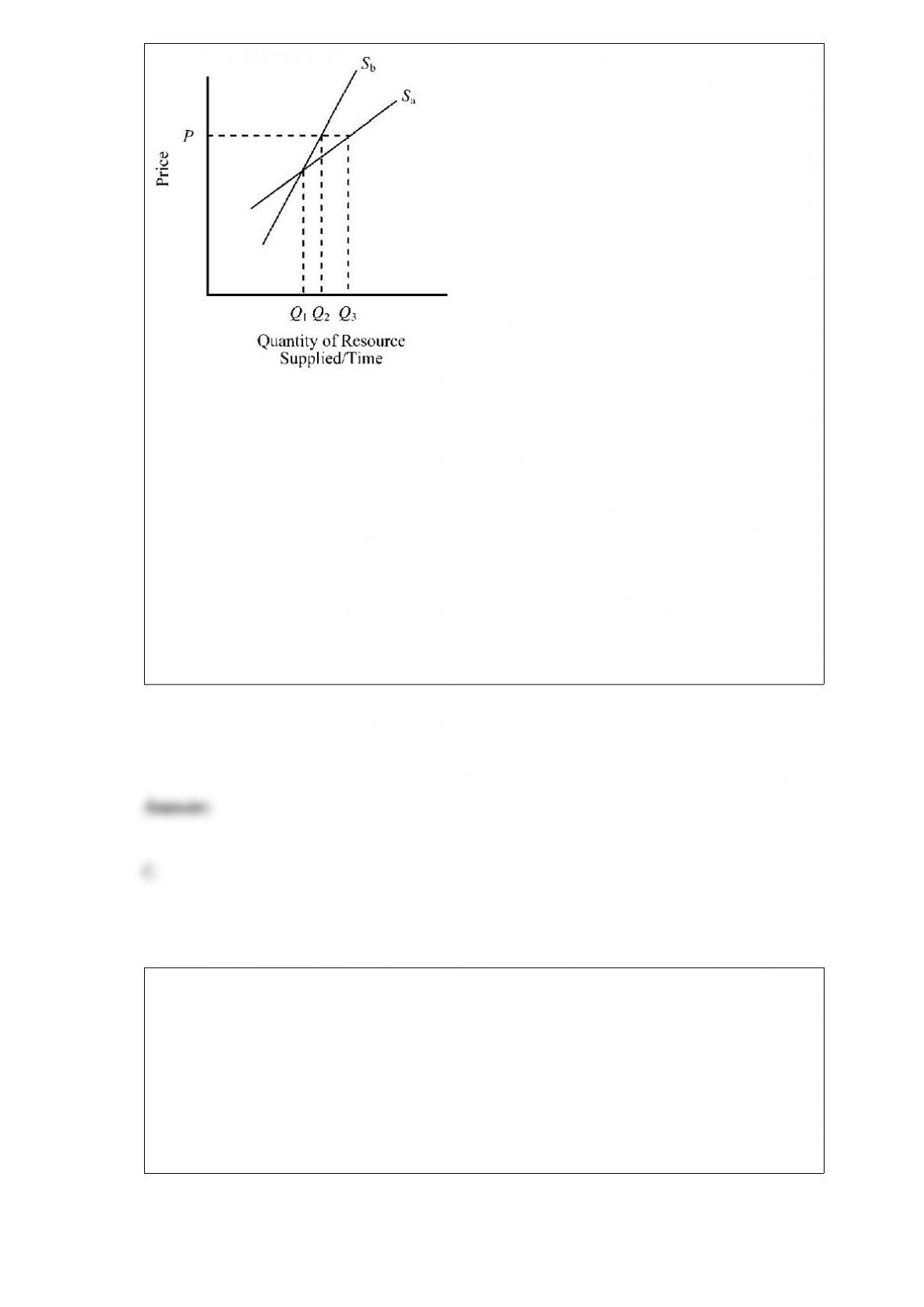
If one short-run supply curve in Figure 12-1 was for truck drivers and the other was for
nuclear physicists (also short-run), which one would probably be the supply curve for
physicists?
a. Q2
b. Q3
c. Sb
d. Sa
If the marginal productivity of labor was the sole determinant of household income in
the U.S., then
a. no households would be poor according to the official government definition of
poverty.
b. no households would be poor according to a relative definition of poverty.
c. the distribution of income would be unequal.
d. every household would have sufficient income to meet biological needs.

During 1959 through 2010, the percent of poor families headed by an elderly person
a. rose.
b. steadily declined.
c. remained virtually unchanged.
d. steadily increased until 1980 when it began to decline.
When economists say the supply of a product has decreased, they mean that
a. the supply curve has shifted to the left.
b. the product price has decreased, and as a consequence, suppliers are producing less
of the product.
c. producers are now willing to sell more of this product at each possible price.
d. the supply curve has shifted to the right.
Which of the following contributed to the weak recovery from the 2008-2009
recession?
a. The restrictive monetary policy followed by the Fed.
b. Government spending was increased by only a small amount.
c. The temporary nature of the tax rebates and spending increases created uncertainty
and exerted only a weak impact on aggregate demand.
d. The budget deficits were too small to exert much impact on aggregate demand,
output, and employment.
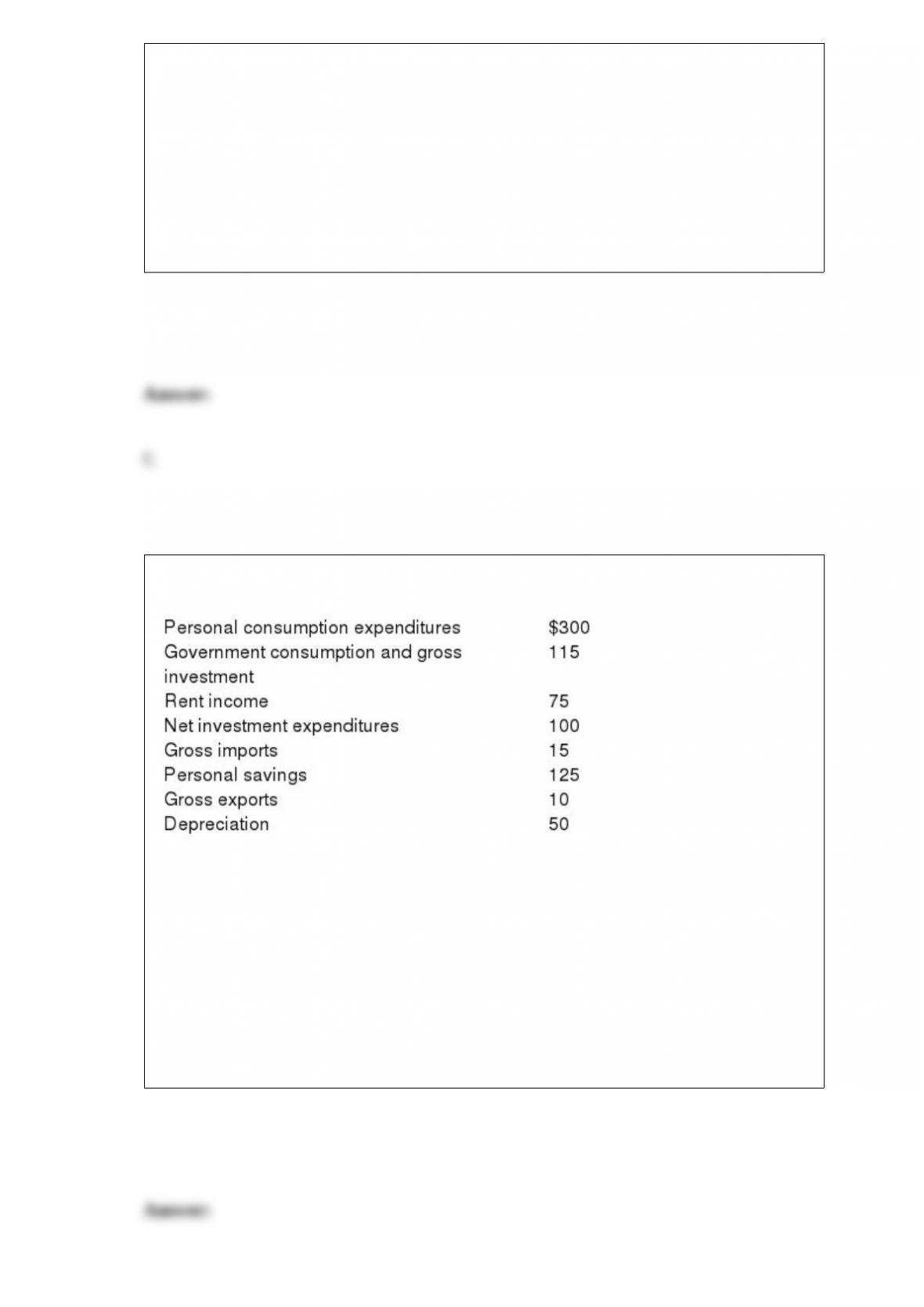
Use the table below to choose the correct answer.
Gross domestic product equals
a. $550.
b. $510.
c. $595.
d. $610.

Economic growth will
a. reduce the future real GDP of an economy.
b. expand the production possibilities of an economy.
c. increase an economy’s nominal income, but not its real income.
d. increase real output, but the real income level of the country will decline.
A regressive tax
a. taxes individuals with higher incomes at a higher rate than individuals with lower
incomes.
b. takes a similar percentage of income at all income levels.
c. takes a higher percentage of the income of those with lower incomes than for those
with higher incomes.
d. taxes savings at a higher rate than consumption.
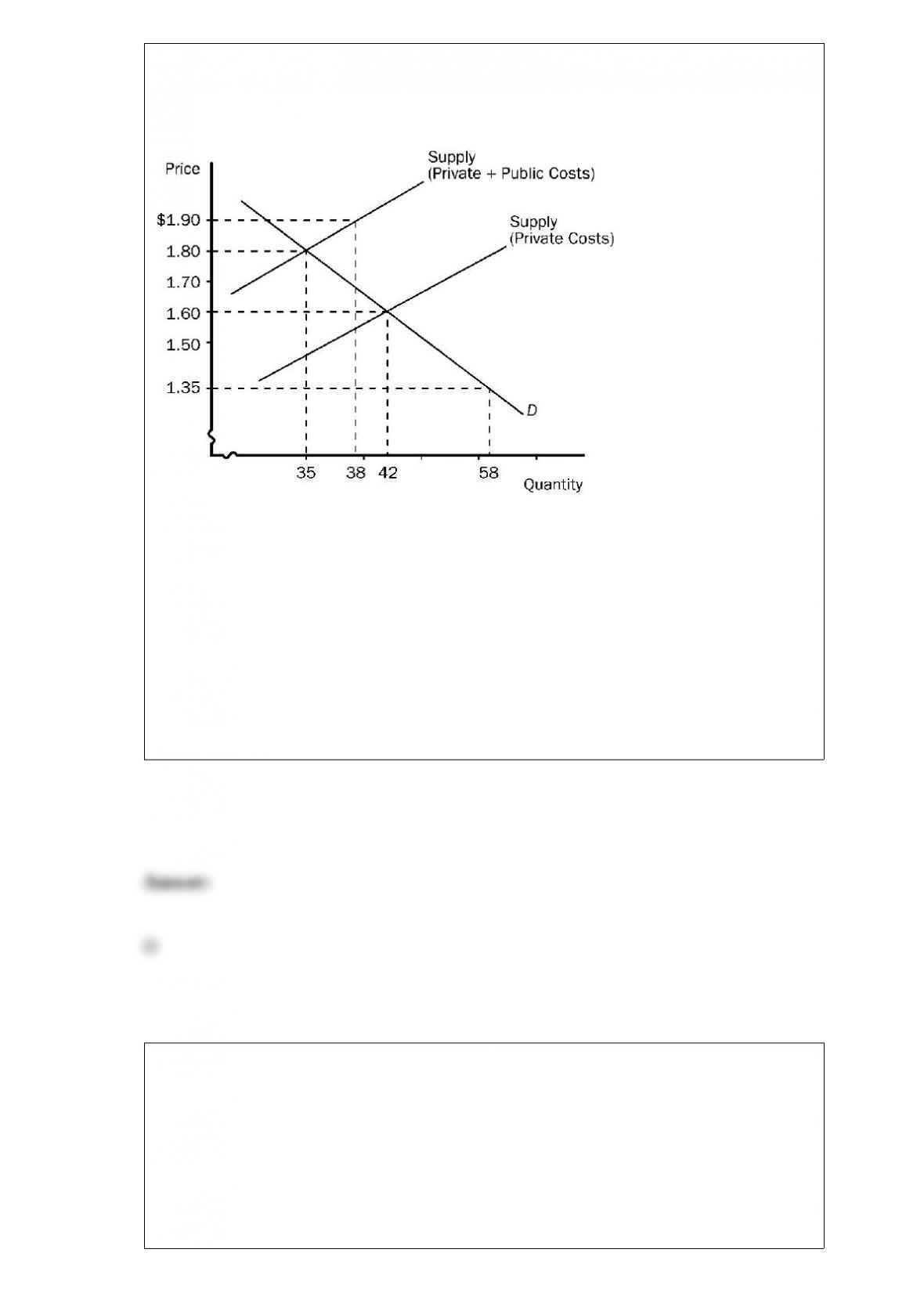
Figure 5-4
Refer to Figure 5-4. If the government uses a pollution tax, how much of a tax must be
imposed on each unit of production?
a. $1.90
b. $1.80
c. $1.60
d. $0.30
Which of the following conditions is most essential if a firm is going to earn long-run
economic profits?
a. an inelastic market demand for the product
b. a small number of firms, even though competitors are free to enter the industry
c. a differentiated product
d. restrictions that limit the entry of potential competitors into the industry
“The operator of the tunnel that links Britain and France, Eurotunnel, said that
commercial and tourist traffic using its car and coach shuttle service had fallen sharply
in 2004, leading to a drop in operating revenues of 4%. Eurotunnel’s chief executive,
Jean-Louis Raymond, blamed cut-throat competition from budget airlines.” (news story,
January 2005)
Which of the following provides an example of an externality?
a. a paper pulp mill releasing pollution into the atmosphere
b. persons driving during a busy rush hour

c. a drunk driver operating a car on a public highway
d. all of the above
Economies of scale imply that within some range a firm can increase the size of
operation and
a. total cost will decrease.
b. fixed cost will decrease.
c. average total cost will decrease.
d. average total cost will increase.
e. average variable cost will decrease.
At the most basic level, the distinguishing characteristic of government that makes it
different from private firms is
a. the difference in incentive structure motivating economic activity.
b. its ability to direct resources in a manner that is more economically efficient.
c. its ability to produce goods and services that people value.
d. its ability to use coercive force against people to modify their behavior or force them
to pay for a good or service whether they benefit from it or not.

Income mobility studies suggest that poverty
a. cannot be alleviated by privately sponsored anti-poverty programs.
b. cannot be alleviated by government sponsored anti-poverty programs.
c. is a long-term problem for a relatively large number of families.
d. is not a long-term problem for most families.
The equation of exchange states that
a. money supply multiplied by real output equals velocity.
b. velocity multiplied by money supply equals real output times the price level.
c. money supply divided by velocity equals nominal GDP.
d. money supply divided by velocity equals real GDP.
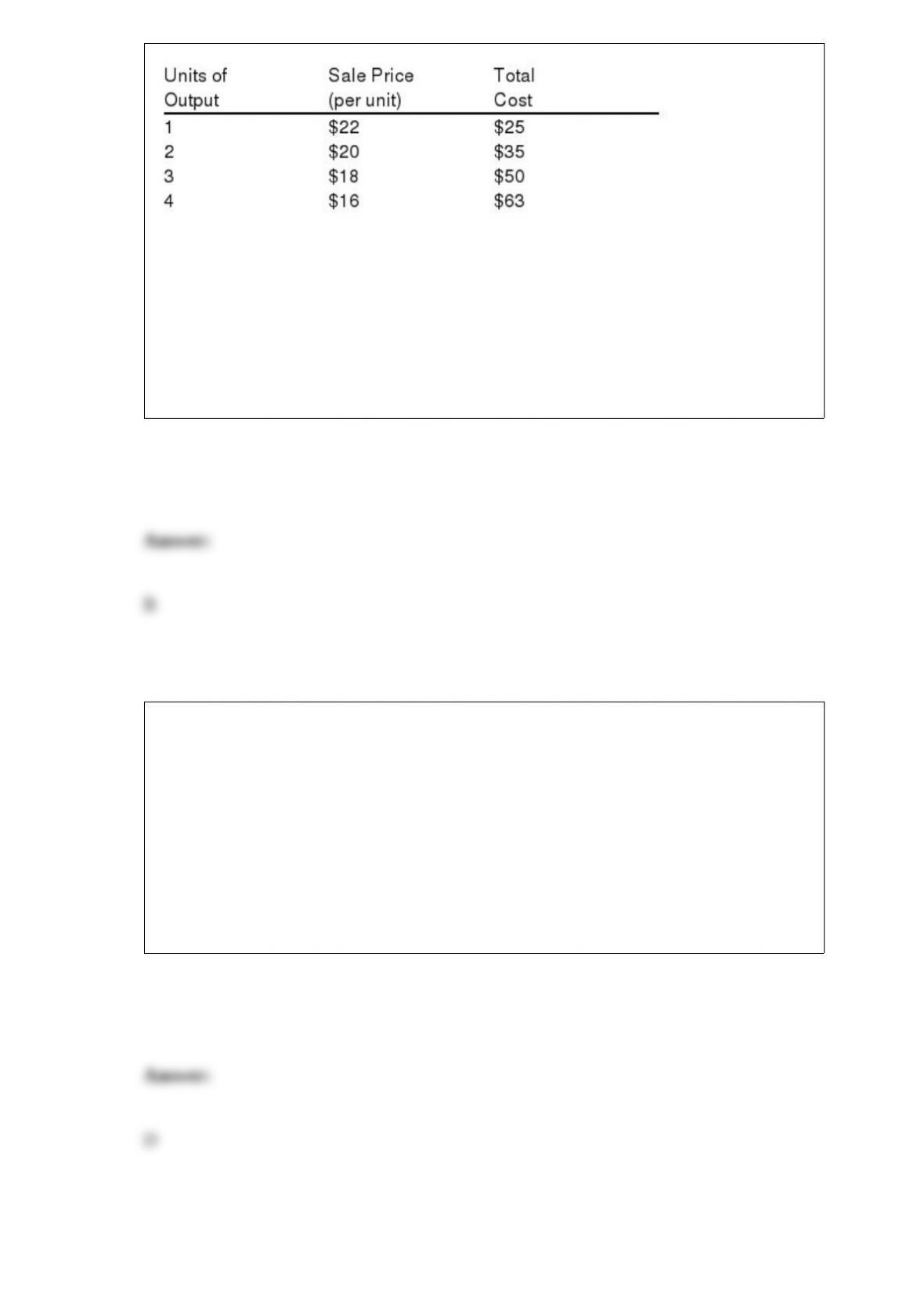
Given the following price and output schedule, how many units should this
price-searcher firm produce in order to maximize profits?
a. 1
b. 2
c. 3
d. 4
When an economy experiences long-run economic growth, a larger output can be
achieved
a. only if there is a reduction in the natural rate of unemployment.
b. only if the economy’s actual unemployment is less than the natural rate.
c. if prices increase.
d. even though unemployment remains at its natural rate.

Other things constant, an increase in resource prices will
a. increase aggregate demand.
b. decrease aggregate demand.
c. decrease short-run aggregate supply.
d. increase short-run aggregate supply.