
A trade policy is a government policy
a. directed toward the goal of improving the tradeoff between equity and efficiency.
b. that directly influences the quantity of goods and services that a country imports or
exports.
c. intended to exploit the tradeoff between inflation and unemployment by altering the
budget deficit.
d. concerning employment laws.
Buskin’s Corporation has issued 2 million shares of stock. Its earnings were $10
million, of which it retained $6 million. What was the dividend per share?
a. $2.
b. $3.
c. $5
d. None of the above is correct.
Figure 8-14
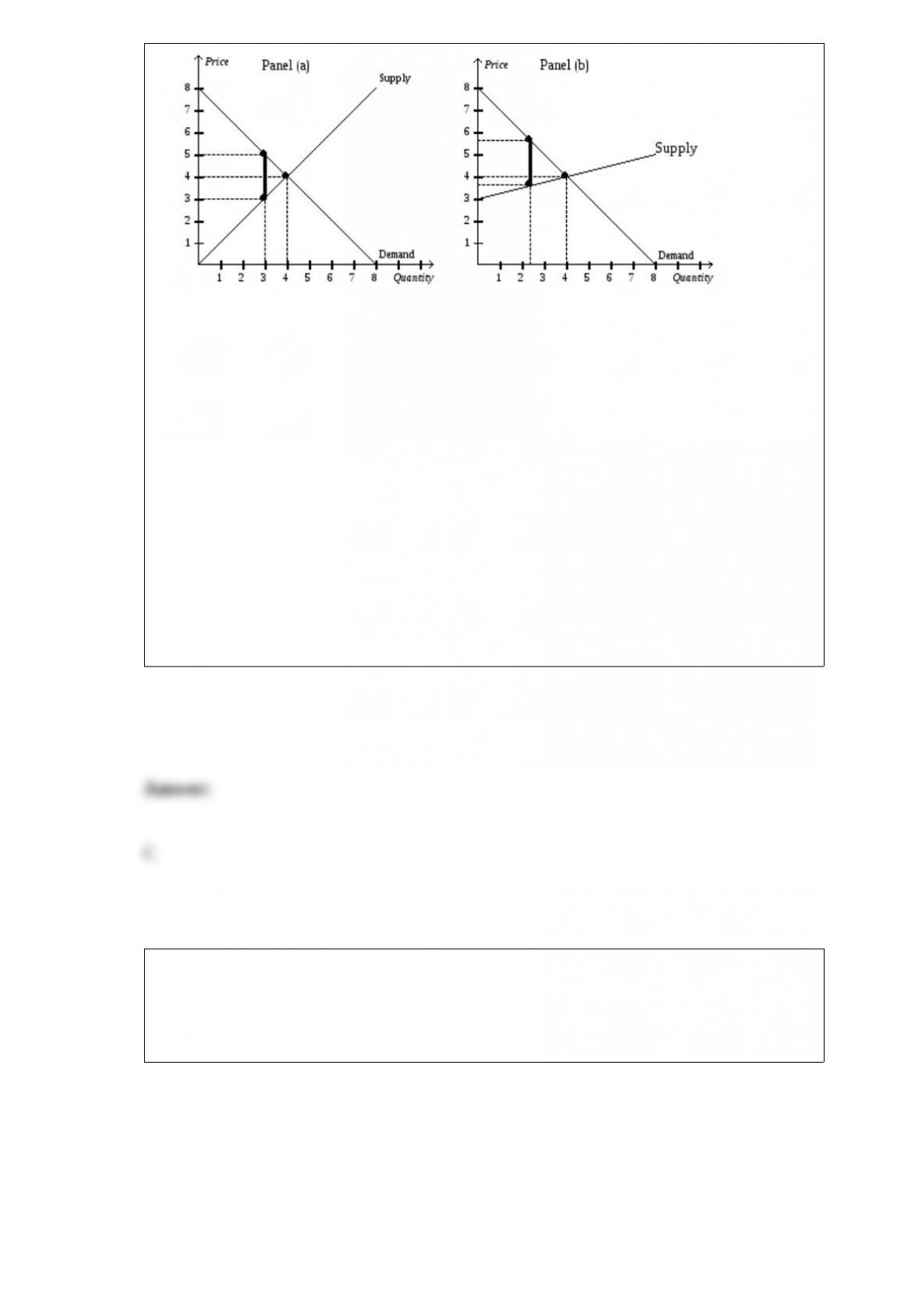
Refer to Figure 8-14. Panel (a) and Panel (b) each illustrate a $2 tax placed on a
market. In comparison to Panel (b), Panel (a) illustrates which of the following
statements?
a. When demand is relatively inelastic, the deadweight loss of a tax is smaller than
when demand is relatively elastic.
b. When demand is relatively elastic, the deadweight loss of a tax is larger than when
demand is relatively inelastic.
c. When supply is relatively inelastic, the deadweight loss of a tax is smaller than when
supply is relatively elastic.
d. When supply is relatively elastic, the deadweight loss of a tax is larger than when
supply is relatively inelastic.
Figure 8-4
The vertical distance between points A and B represents a tax in the market.
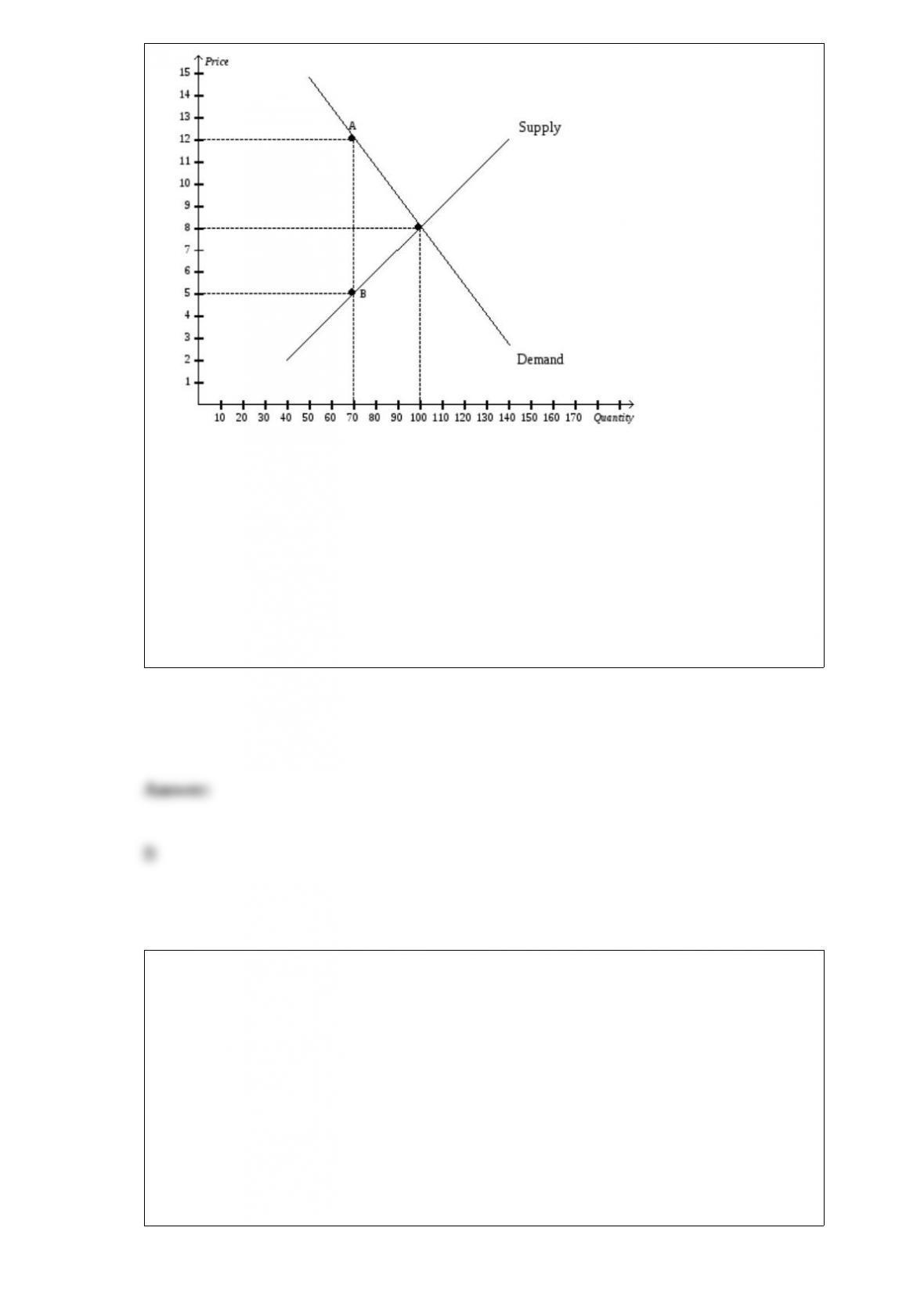
Refer to Figure 8-4. The amount of the tax on each unit of the good is
a. $5.
b. $7.
c. $8.
d. $12.
It costs a company $50,000 to produce 5000 beach towels. The company’s cost will be
$50,009 if it produces an additional beach towel. If the company produces 5,000 beach
towels then
a. its average cost is greater than its marginal cost.
b. its average cost and its marginal cost are equal.
c. its average cost is less than its marginal cost.
d. there is insufficient information to compute average and marginal costs.

Sir Isaac Newton’s development of the theory of gravity after observing an apple fall
from a tree is an example of
a. a controlled experiment that lead to the formulation of a scientific theory.
b. being in the right place at the right time.
c. an idea whose time had come.
d. the interplay between observation and theory in science.
Catherine, a citizen of Spain, decides to purchase bonds issued by Chile instead of ones
issued by the United States even though the Chilean bonds have a higher risk of default.
An economic reason for her decision might be that
a. she dislikes U.S. foreign policy.
b. the Chilean bonds pay a higher rate of interest.
c. the U.S. government is more stable than the Chilean government.
d. None of the above provide an economic reason for buying the riskier bond.

Which of the following shifts the long-run aggregate supply curve to the right?
a. both an increase in the capital stock and technological improvements
b. an increase in the capital stock but not technological improvements
c. an increase in the capital stock but not technological improvements
d. neither an increase in the capital stock nor an technological improvements
An Italian company builds and operates a pasta factory in the United States. This is an
example of Italian
a. foreign direct investment that increases Italian net capital outflow.
b. foreign direct investment that decreases Italian net capital outflow.
c. foreign portfolio investment that increases Italian net capital outflow.
d. foreign portfolio investment that decreases Italian net capital outflow.

Suppose a fall in stock prices makes people feel poorer. The decrease in wealth would
induce people to
a. decrease consumption, shown as a movement to the left along a given
aggregate-demand curve.
b. increase consumption, shown as a movement to the right along a given
aggregate-demand curve.
c. decrease consumption, shown by shifting the aggregate-demand curve to the left.
d. increase consumption, shown by shifting the aggregate-demand curve to the right.
Suppose ice cream cones costs $3. Molly holds $60. What is the real value of the
money she holds?
a. $60. If the price of ice cream cones rises, to maintain the real value of her money
holdings she need to hold more dollars.
b. $60. If the price of ice cream cones rises, to maintain the real value of her money
holdings she need to hold fewer dollars.
c. 20 ice cream cones. If the price of ice cream cones rises, to maintain the real value of
her money holdings she needs to hold more dollars.
d. 20 ice cream cones. If the price of ice cream cones rises, to maintain the real value of
her money holdings she needs to hold fewer dollars.
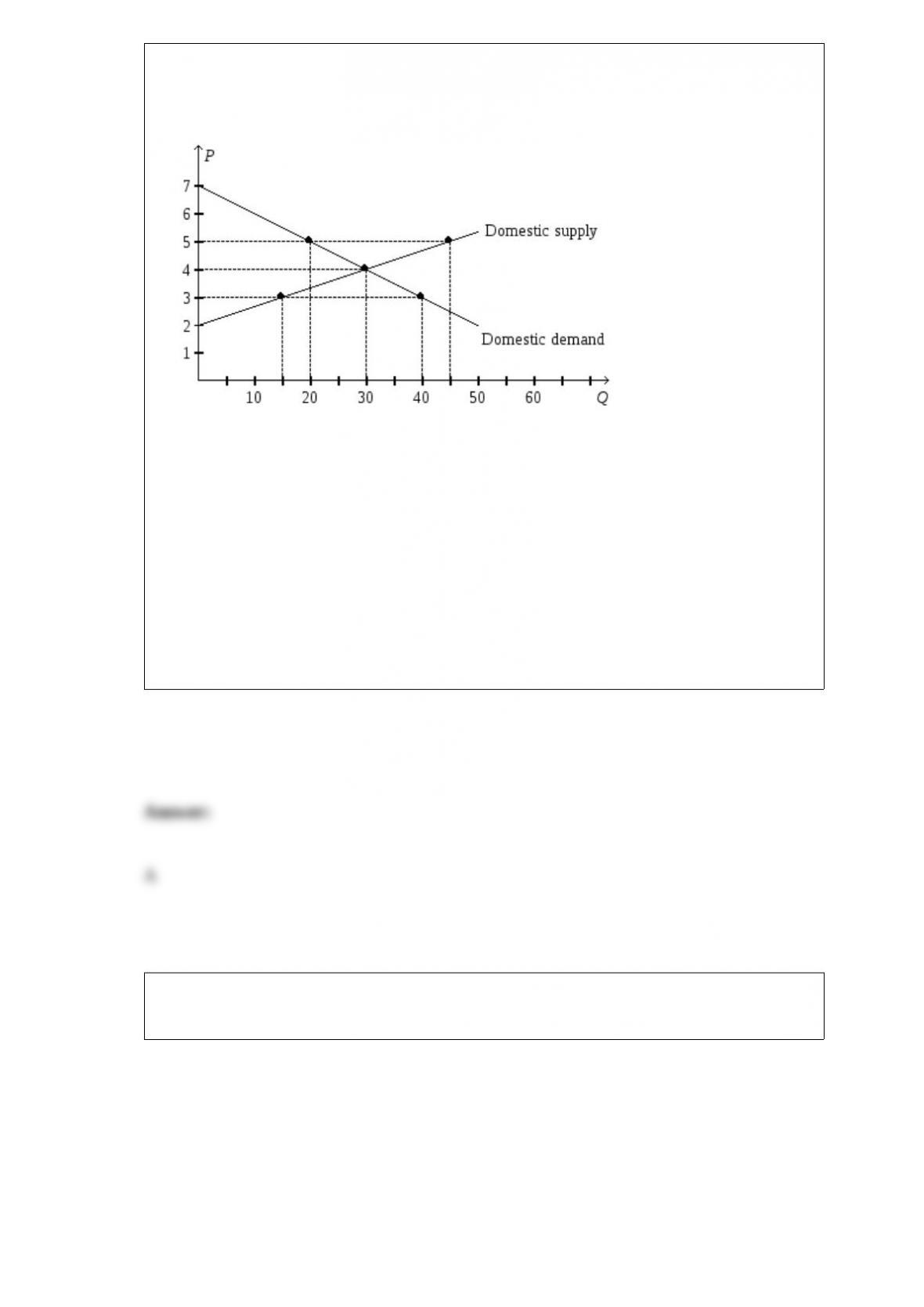
Figure 9-18. On the diagram below, Q represents the quantity of peaches and P
represents the price of peaches. The domestic country is Isoland.
Refer to Figure 9-18. If Isoland allows international trade and if the world price of
peaches is $5, then
a. Isoland has a comparative advantage, relative to other countries, in producing
peaches.
b. Isoland will import peaches.
c. consumer surplus with trade exceeds consumer surplus without trade.
d. All of the above are correct.
Figure 5-1
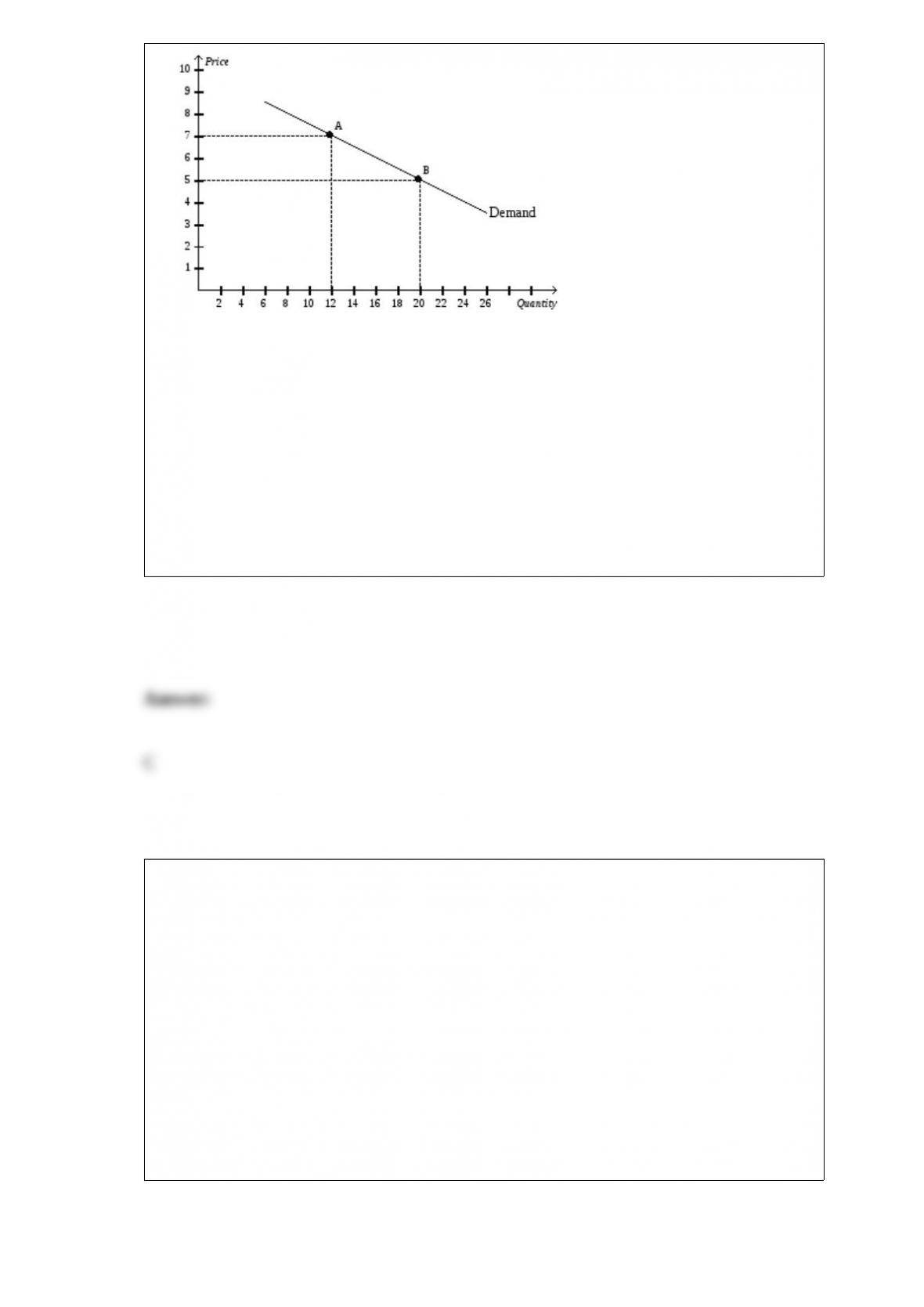
Refer to Figure 5-1. Between point A and point B, price elasticity of demand is equal
to
a. 0.33.
b. 0.67.
c. 1.5
d. 2.67.
Suppose that the money supply increases. In the short run this decreases unemployment
according to
a. both the short-run Phillips curve and the aggregate demand and aggregate supply
model.
b. neither the short-run Phillips curve nor the aggregate demand and aggregate supply
model.
c. the short-run Phillips curve, but not the aggregate demand and supply model.
d. the aggregate demand and aggregate supply model, but not the short-run Phillips
curve.

Suppose the economy is in long-run equilibrium. If there is a sharp decline in the stock
market combined with a significant increase in immigration of skilled workers, then in
the short run,
a. real GDP will rise and the price level might rise, fall, or stay the same. In the
long-run, real GDP will rise and the price level might rise, fall, or stay the same.
b. the price level will fall, and real GDP might rise, fall, or stay the same. In the
long-run, real GDP and the price level will be unaffected.
c. the price level will rise, and real GDP might rise, fall, or stay the same. In the long
run, real GDP will rise and the price level will fall.
d. the price level will fall, and real GDP might rise, fall, or stay the same. In the long
run, real GDP will rise and the price level will fall.
Suppose an economy produces two goods, food and machines. This economy always
operates on its production possibilities frontier. Last year, it produced 1000 units of
food and 47 machines. This year, it is producing 1050 units of food and 52 machines.
Which of the following events could not explain the increase in output?
a. a reduction in unemployment
b. an increase in available labor
c. an improvement in technology
d. Any of these events could explain the increase in output.

Which of the following bond buyers did not buy the bond that best met his or her
objective?
a. Jackie wanted a bond with a high interest rate and was willing to take a lot of risk.
She purchased a junk bond.
b. Andrew wanted a bond that would allow him to legally avoid paying federal income
taxes. He purchased a municipal bond.
c. Suzy wanted to purchase a bond whose seller was unlikely to default. She purchased
a bond that Standards and Poor’s rated a low credit risk.
d. Cecilia held long-term bonds rather than short-term bonds to avoid risk.
Ralph is a plumber. Which of the following are included in his physical capital?
a. the knowledge he learned on the job, and the tools he uses
b. the knowledge he learned on the job, but not the tools he uses
c. the tools he uses, but not the knowledge he learned on the job
d. neither the knowledge he learned on the job nor the tools he uses

An increase in the MPC
a. increases the multiplier, so that changes in government expenditures have a larger
effect on aggregate demand.
b. increases the multiplier, so that changes in government expenditures have a smaller
effect on aggregate demand.
c. decreases the multiplier, so that changes in government expenditures have a larger
effect on aggregate demand.
d. decreases the multiplier, so that changes in government expenditures have a smaller
effect on aggregate demand.
Demand is elastic if the price elasticity of demand is
a. less than 1.
b. equal to 1.
c. equal to 0.
d. greater than 1.
Incomes of U.S. households in the 1970s and 1980s
a. grew rapidly, due to the widespread success of labor unions in pushing up wages
during those decades.
b. grew rapidly, due to several increases in the minimum wage during those decades.
c. grew rapidly, due to government policies that discouraged the importation of foreign
products during those decades.
d. grew slowly, due to slow growth of the output of goods and services per hour of U.S.
workers’ time during those decades.
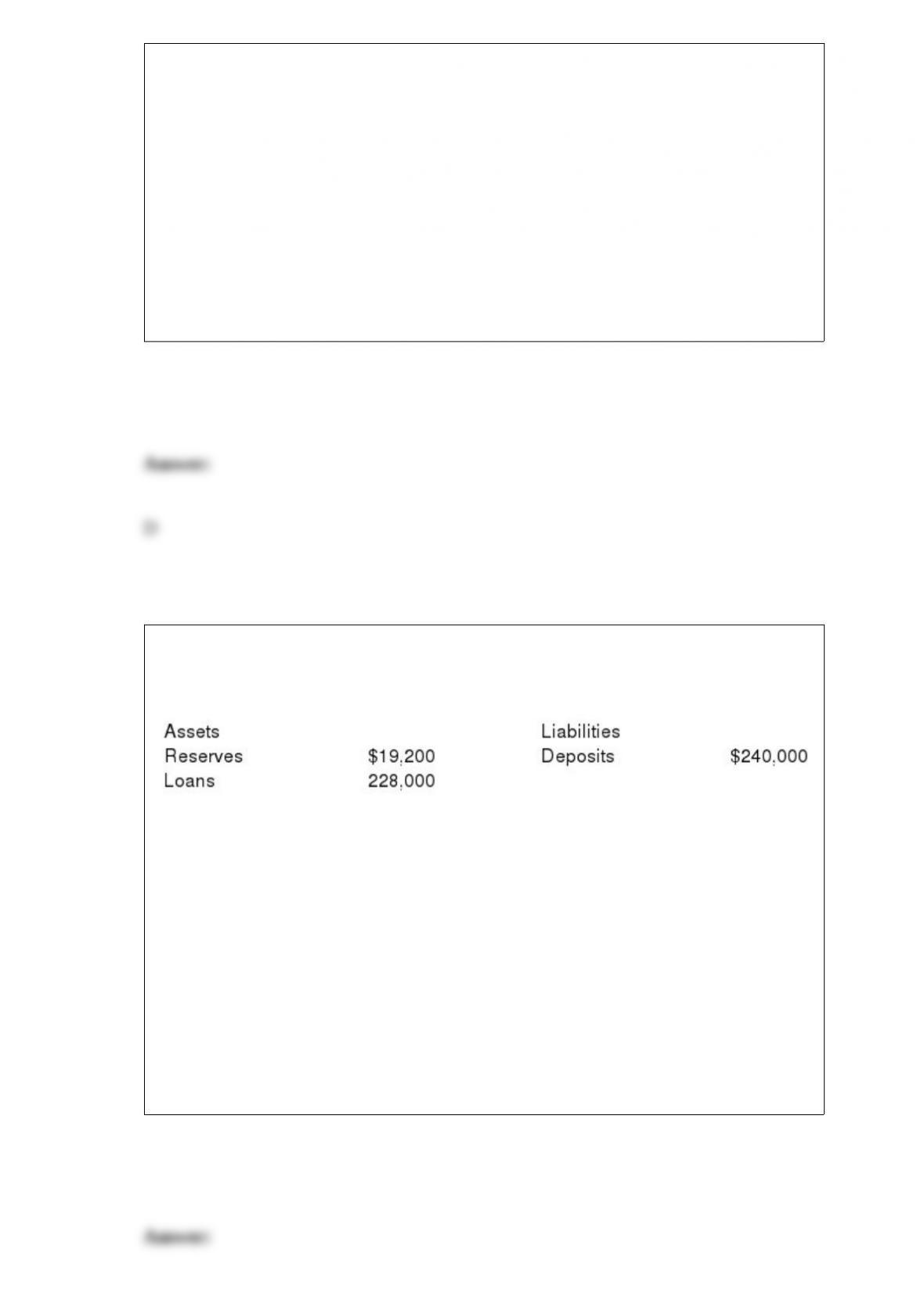
Table 16-6.
Bank of Springfield
Refer to Table 16-6. Assume the Fed’s reserve requirement is 6 percent and that the
Bank of Springfield makes new loans so as to make its new reserve ratio 6 percent.
From then on, no bank holds any excess reserves. Assume also that people hold only
deposits and no currency. Then by what amount does the economy’s money supply
increase?
a. $50,200
b. $60,000
c. $72,000
d. $106,000

Productivity is defined as the quantity of
a. labor required to produce a nation’s GDP.
b. labor required to produce one unit of goods and services.
c. goods and services produced from each unit of labor input.
d. goods and services produced per unit of time.
When economists make
a. positive statements, they are speaking not as policy advisers but as scientists.
b. positive statements, they are speaking not as scientists but as forecasters.
c. normative statements, they are speaking not as policy advisers but as scientists.
d. normative statements, they are speaking not as policy advisers but as model-builders.
Which of the following correctly ranks the three countries, from highest to lowest, for
percentage of high-school age children in school?
a. United Kingdom, Mali, Mexico.
b. Mexico, Mali, United Kingdom.
c. United Kingdom, Mexico, Mali.
d. Mali, Mexico, United Kingdom.
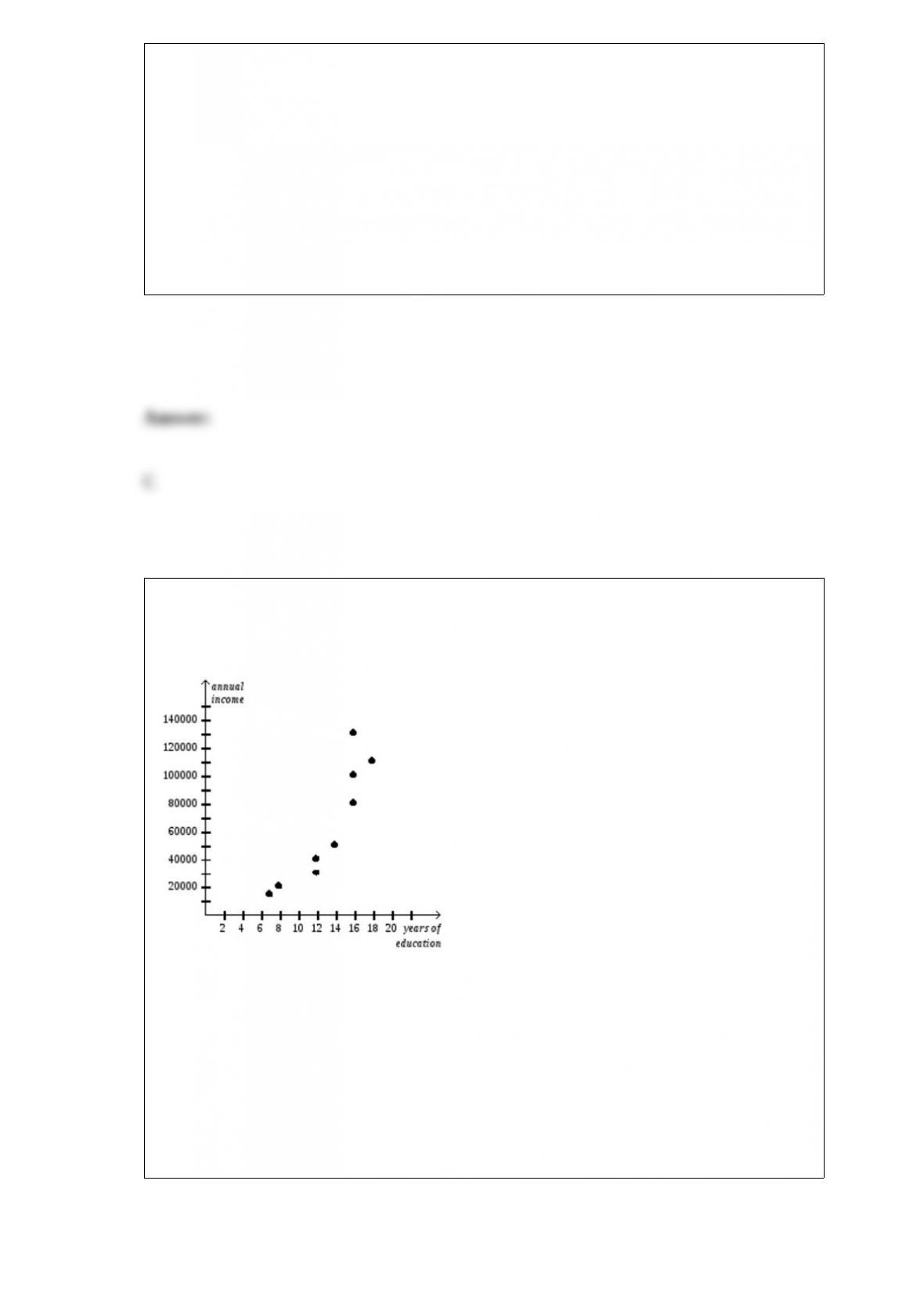
Figure 2-17
Relationship Between Years of Education and Annual Income
Refer to Figure 2-17. The graph above is a
a. bar graph
b. scatterplot
c. pie chart
d. time series analysis

The benefit that government receives from a tax is measured by
a. the change in the equilibrium quantity of the good.
b. the change in the equilibrium price of the good.
c. tax revenue.
d. total surplus.
When demand is inelastic, the price elasticity of demand is
a. less than 1, and price and total revenue will move in the same direction.
b. less than 1, and price and total revenue will move in opposite directions.
c. greater than 1, and price and total revenue will move in the same direction.
d. greater than 1, and price and total revenue will move in opposite directions.
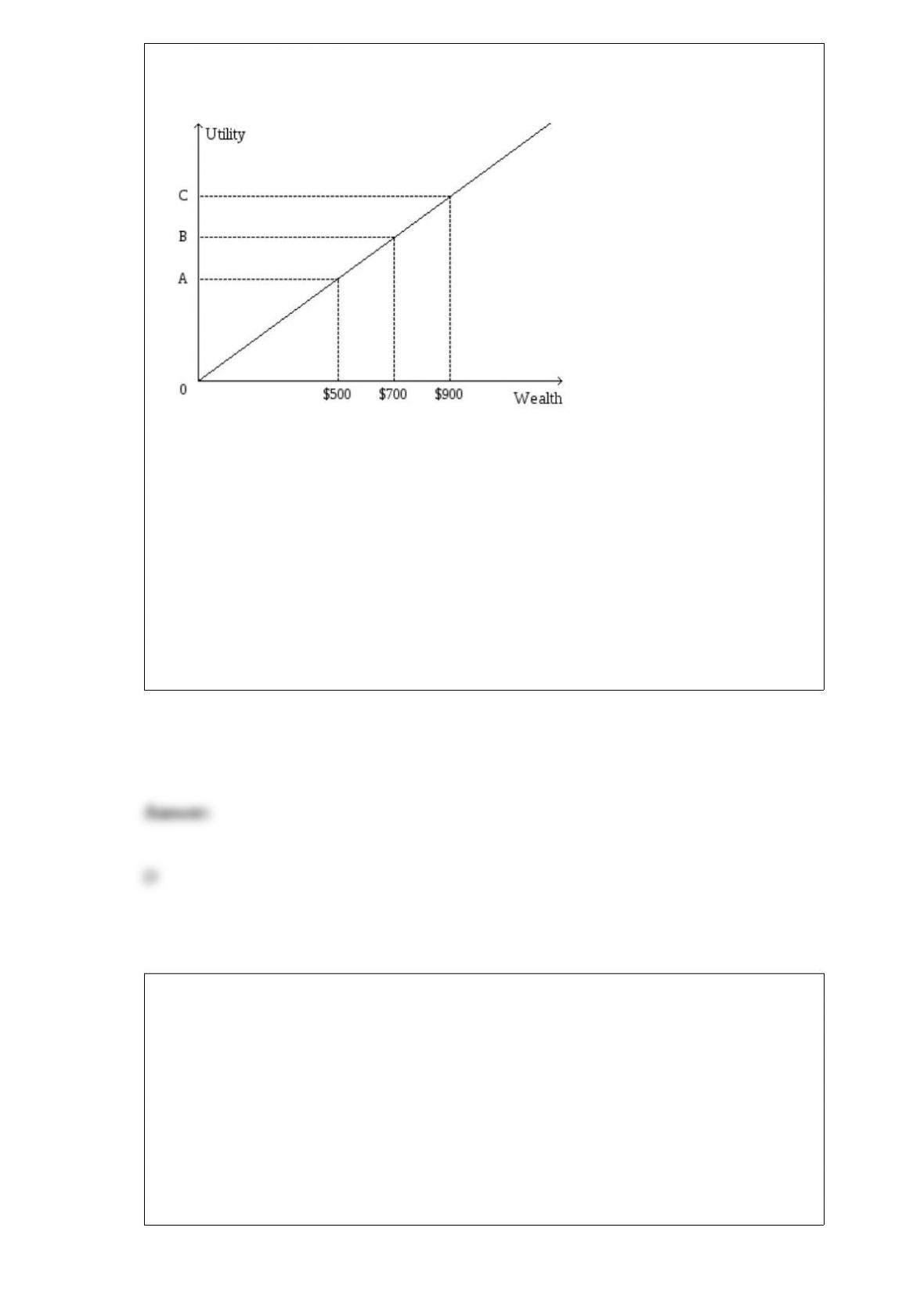
Figure 14-3. The figure shows a utility function for Rob.
Refer to Figure 14-3. From the appearance of Rob’s utility function, we know that
a. if Rob owns a house, then he definitely would buy fire insurance provided the cost of
the insurance were reasonable.
b. Rob would voluntarily exchange a portfolio of stocks with a high average return and
a high level of risk for a portfolio with a low average return and a low level of risk.
c. Rob is risk averse.
d. Rob is not risk averse.
During recessions investment
a. falls by a larger percentage than GDP.
b. falls by about the same percentage as GDP.
c. falls by a smaller percentage than GDP.
d. falls but the percentage change is sometimes much larger and sometimes much
smaller.

Economists use the word equality to describe a situation in which
a. each member of society has the same income.
b. each member of society has access to abundant quantities of goods and services,
regardless of his or her income.
c. society is getting the maximum benefits from its scarce resources.
d. society’s resources are used efficiently.
The producer price index measures the cost of a basket of goods and services
a. typically produced in the economy.
b. produced for a typical consumer.
c. sold by producers.
d. bought by firms.

Which of the following shifts aggregate demand right?
a. both a decrease in the price level and the implementation of an investment tax credit
b. a decrease in the price level but not the implementation of an investment tax credit
c. the implementation of an investment tax credit but not a decrease in the price level
d. neither a decrease in the price level nor the implementation of an investment tax
credit
Consumer surplus
a. is closely related to the supply curve for a product.
b. is represented by a rectangle on a supply-demand graph when the demand curve is a
straight, downward-sloping line.
c. is measured using the demand curve for a product.
d. does not reflect economic well-being in most markets.
Measuring unemployment is the job of the Bureau of Labor Statistics.

The multiplier is computed as MPC / (1 – MPC).
A price ceiling set above the equilibrium price causes quantity demanded to exceed
quantity supplied.
How does the study of economics depend upon the phenomenon of scarcity?

Journey Motorcycles produced 100 motorcycles using 50 workers who each worked 8
hours a day. Journey’s productivity was 12.5.
There are three factors that help explain the slope of the aggregate demand curve.
Which two are less important? Why are they less important?
The destruction of manufacturing jobs and workers leaving their jobs to find better ones
both contribute to frictional unemployment.

Using income tax revenue to fund the welfare system illustrates the conflict between
efficiency and equality.
A reduction in the marginal tax-rate includes a substitution effect that tends to increase
saving.
U.S. real GDP is substantially higher today than it was 60 years ago. What does this tell
us, and what does it not tell us, about the well-being of U.S. residents?

NAFTA is an example of a multilateral approach to achieving free trade.
Adults who were not working but who had jobs from which they were temporarily
absent are included in the Bureau of Labor Statistics’ “employed” category.
When consumer spending is broken down into the major categories of goods and
services, the largest single category is spending on transportation.

If the United Kingdom imports tea cups from other countries, then U.K. producers of
tea cups are better off, and U.K. consumers of tea cups are worse off, as a result of
trade.
Tax cuts affect only aggregate demand not aggregate supply.
If the demand for movies increases at the same time as the movie industry adopts
labor-saving technology for producing movies, the equilibrium price for movies will
increase, but the effect on the equilibrium quantity of movies is ambiguous.
Someone who is without work but is not looking for work is included in the Bureau of
Labor Statistics’ “unemployed” category.