1) Supply-side economist Arthur Laffer has argued that:
A.there is no empirically proven relationship between tax rates and incentives.
B.large reductions in personal and corporate income taxes will increase aggregate
supply much more than aggregate demand.
C.the only way to eliminate inflation is to increase taxes to induce a recession severe
enough to eliminate inflationary expectations.
D.large cuts in income taxes will increase aggregate demand more than aggregate
supply.
2) refer to the above diagram. the equation that shows the relationship between y and x
is:
a.y = 50 + 1/4 x
b.x = 1/4y
c.y = .4x
d.y = 1/4 x – 50
3)
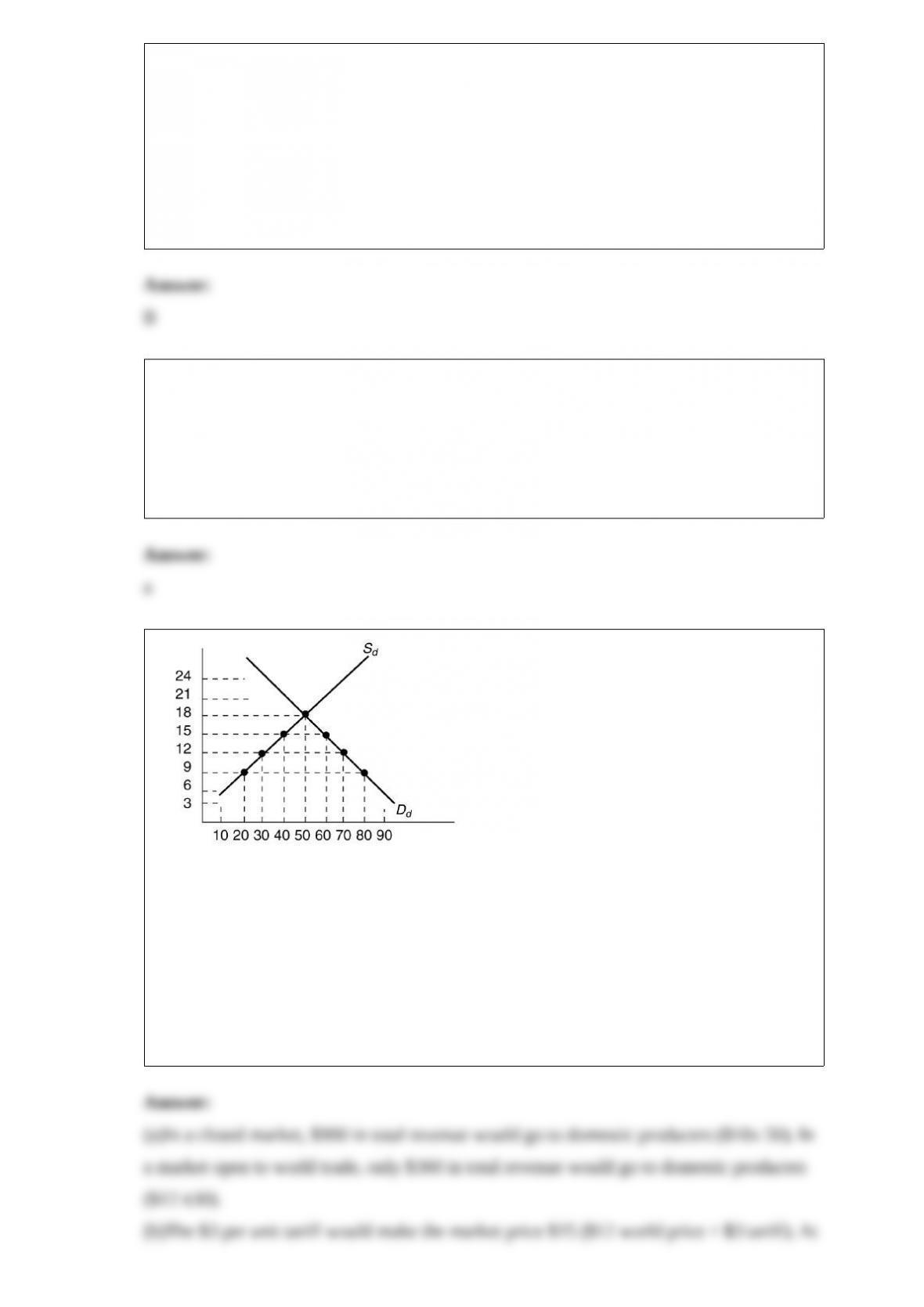
The next three questions refer to the below graph, where Sd and Dd are the domestic
supply and demand for a product. The world price of the product is $12.
(a)How much total revenue would go to domestic producers if the market were closed
to international trade compared to a market open to international trade? Explain.
(b)If the economy is open to trade, but a $3 per unit tariff were applied, what would be
the total revenue going to domestic producers, foreign producers (after-tax revenue),
and to the government? Explain.
(c)What would be the difference in revenue with a tariff of $3 per unit versus a quota of
20 units?
4)
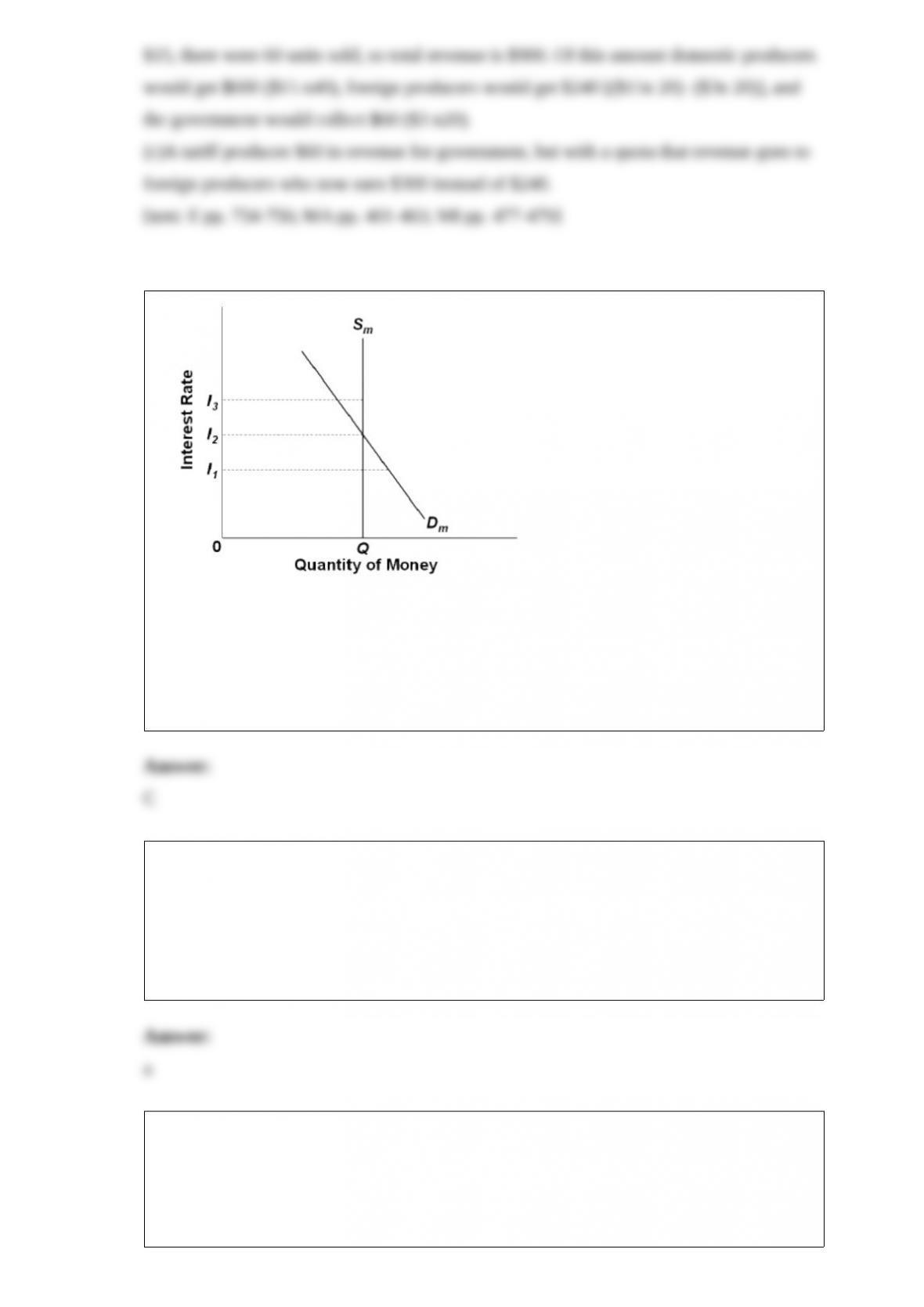
Refer to the above diagram of the market for money. The downward slope of the money
demand curve Dm is best explained in terms of the:
A.transactions demand for money.
B.direct or positive relationship between bond prices and interest rates.
C.asset demand for money.
D.wealth or real-balances effect.
5) refer to the above diagram. if this industry is comprised of only one seller, the
profit-maximizing price and quantity will be:
a.p3 and q3
b.p1 and q1
c.p2 and q2
d.indeterminate on the basis of the information given
6) suppose that corn prices rise significantly. if farmers expect the price of corn to
continue rising relative to other crops, then we would expect:
a.the supply of ethanol, a corn-based product, to increase.
b.consumer demand for wheat to fall.
c.the supply to increase as farmers plant more corn.
d.the supply to fall as farmers plant more of other crops.
7) the annual growth of u.s. labor productivity:
a.was greater between 1973 and 1995 than between 1995 and 2007.
b.was greater between 1995 and 2007 than between 1973 and 1995.
c.was negative in the late 1990s.
d.averaged nearly 5 percent in the 1990s.
8) Overfishing caused which of the following fisheries to collapse by 2004?
A.Maine Red Hake and Atlantic Tuna.
B.Pacific Halibut and Sockeye Salmon.
C.Blue Crab and Dungeness Crab.
D.White Shrimp and Brown Shrimp.
9)
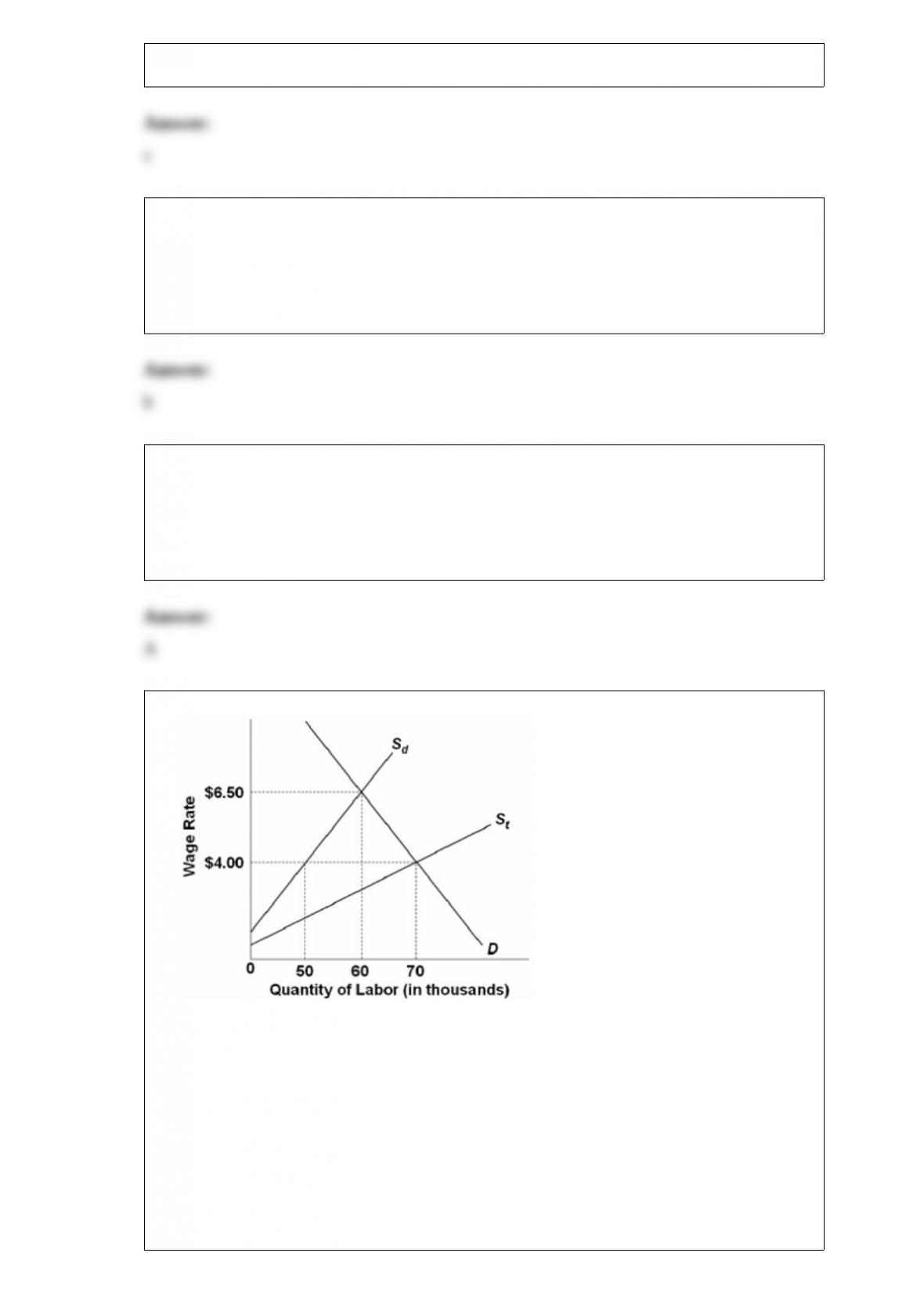
assumptions: 1) employers in this market are willing and able to ignore minimum wage
laws; 2) sd represents the supply of domestically-born (and legal immigrant) workers;
3) st represents the total supply of workers in this labor market (sd plus illegal
immigrants); and 4) unless otherwise stated, illegal immigration is not effectively
blocked by the government.
refer to the above figure. how many illegal immigrant workers will be hired at
equilibrium?
a.20,000
b.50,000
c.60,000
d.70,000
10) A lump-sum tax means that:
A.the tax only applies to one time period.
B.the same amount of tax revenue is collected at each level of GDP.
C.tax revenues vary directly with GDP.
D.tax revenues vary inversely with GDP.
11) The immediate-short-run aggregate supply curve represents circumstances where:
A.both input and output prices are fixed.
B.both input and output prices are flexible.
C.input prices are fixed, but output prices are flexible.
D.input prices are flexible, but output prices are fixed.
12) the four factors of production are:
a.land, labor, capital, and money
b.land, labor, capital, and entrepreneurial ability
c.labor, capital, technology, and entrepreneurial ability
d.labor, capital, entrepreneurial ability, and money
13)

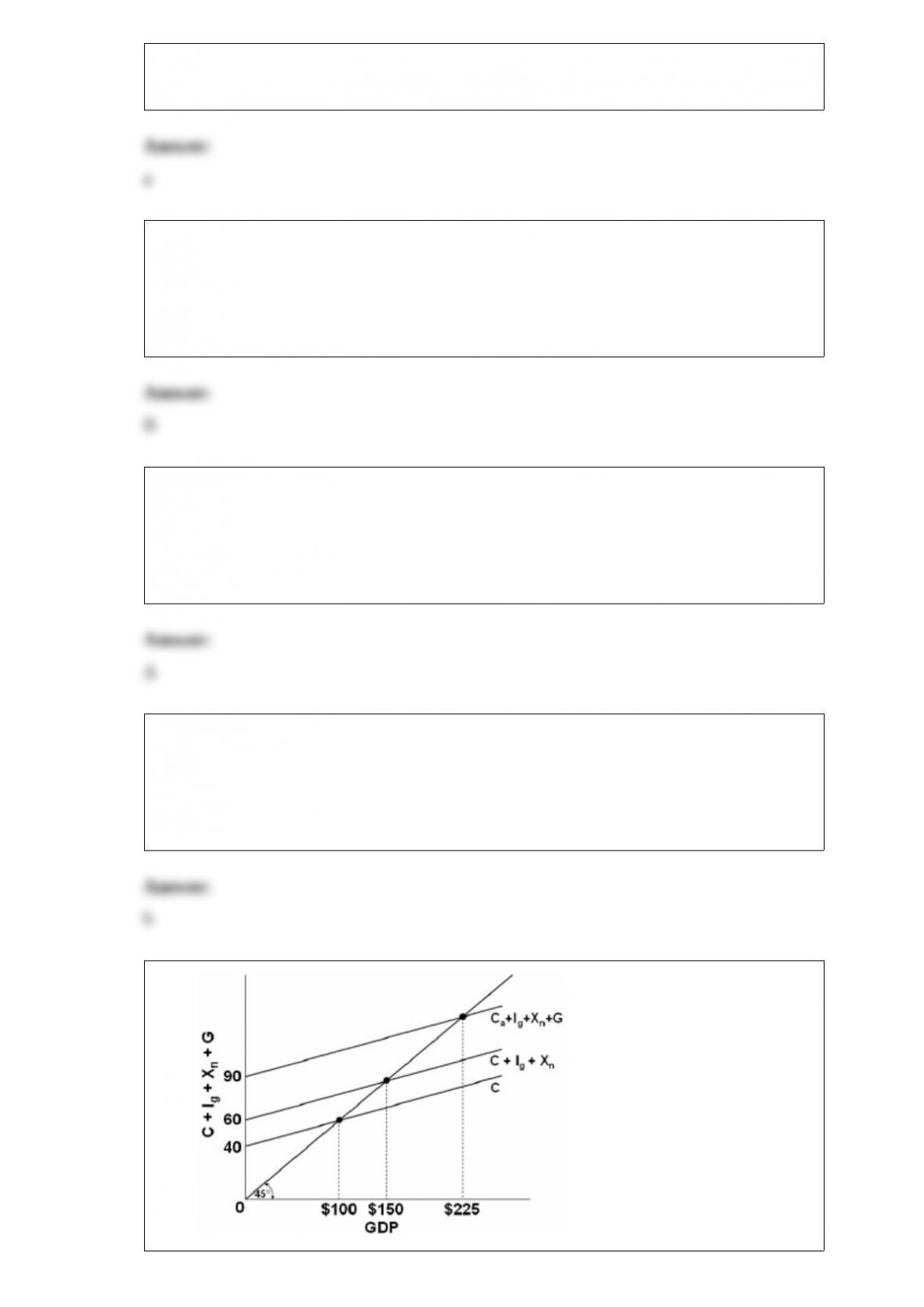
Refer to the above diagram. The impact of the public sector on the equilibrium GDP:
A.is expansionary.
B.is contractionary.
C.is neutral.
D.cannot be determined from the information given.
14) If a lump-sum tax of $40 billion is imposed and the MPC is 0.6, the saving schedule
will shift:
A.downward by $24 billion.
B.upward by $24 billion.
C.downward by $16 billion.
D.upward by $16 billion.
15) what is the difference between national income and personal income?
a.personal taxes.
b.national income includes income earned both at in the united states and abroad, while
personal income only includes that income earned within the borders of the united
states.
c.national income represents before-tax income, while personal income measures how
much is available for spending after all taxes have been subtracted.
d. national income represents income earned by american-owned resources, while
personal income measures received income, whether earned or unearned.
16) price elasticity of supply is:
a.positive in the short run but negative in the long run.
b.greater in the long run than in the short run.
c.greater in the short run than in the long run.
d.independent of time.