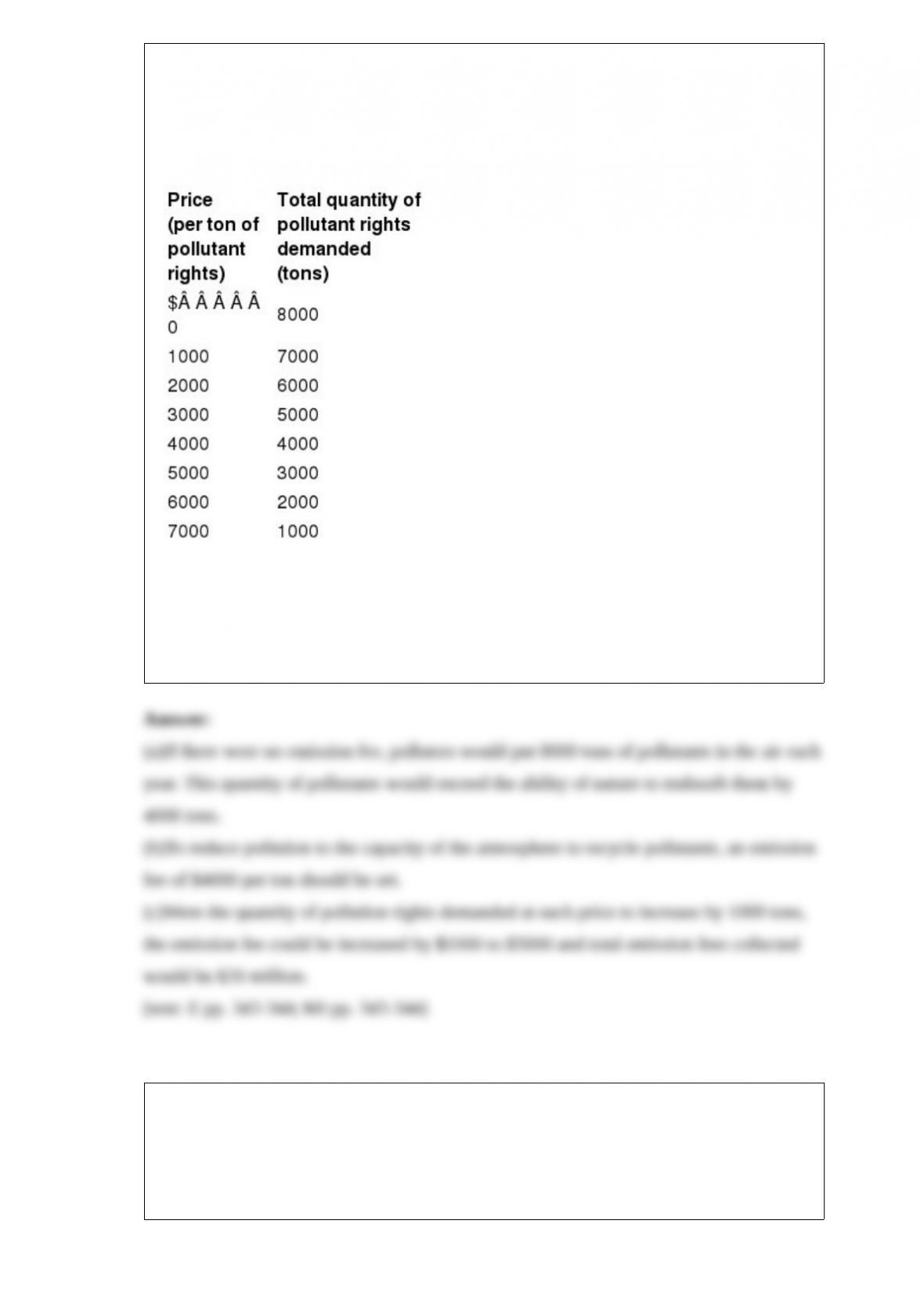
1) Assume the atmosphere of an urban area is able to reabsorb 4000 tons of pollutants
per year. The schedule below shows the price polluters would be willing to pay for the
right to dispose of 1 ton of pollutants per year and the total quantity of pollutants they
would wish to dispose of at each price.
(a)If there were no emission fee, how many tons of pollutants would there be and how
much greater would this amount be than the capacity for reabsorption?
(b)What pollution fee should the urban authorities charge to solve the problem?
(c)What would happen in this market for pollution rights if quantity demanded
increased by 1000 tons at each price?
2) For the past 150 years, the:
A.supply and demand for productive resources have grown at the same rate.
B.supply of productive resources has grown faster than the demand for those resources.
C.demand for productive resources has grown faster than the supply of those resources.
D.supply of productive resources has increased, while the demand has fallen.
3) if a monopolist’s marginal revenue is $3.00 and its marginal cost is $4.50, it will
increase its profits by:
a.reducing output and raising price.
b.reducing both output and price.
c.increasing both price and output.
d.raising price while keeping output unchanged.
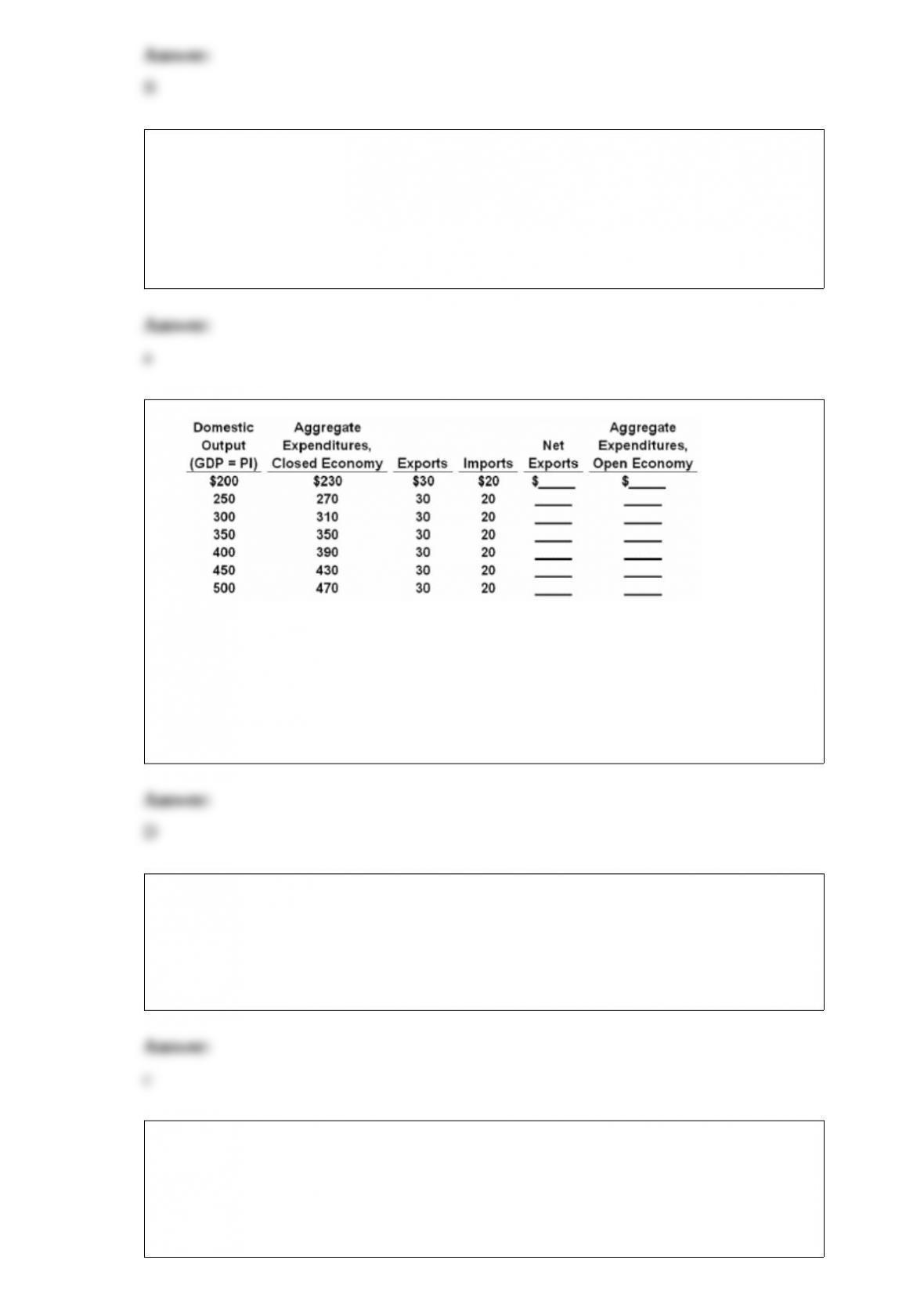
4)
If the above economy was closed to international trade, the equilibrium GDP and the
multiplier would be:
A.$300 and 5.
B.$350 and 4.
C.$400 and 4.
D.$350 and 5.
5) the lines on a topographical map are analogous to a(n):
a.series of demand curves.
b.series of supply curves.
c.indifference map.
d.series of budget constraints.
6) when a consumer shifts purchases from product x to product y the marginal utility of:
a.x falls and the marginal utility of y rises.
b.x rises and the marginal utility of y falls.
c.both x and y rises.
d.both x and y falls.
7) The government of a DVC may purposely cause inflation because:
A.a rapid rate of inflation attracts private foreign capital into a DVC.
B.there is conclusive evidence that inflation discourages people from having large
families.
C.this will strengthen the nation’s position in international markets.
D.inflation works like taxation in that it may release resources from consumption so
that they can be invested.
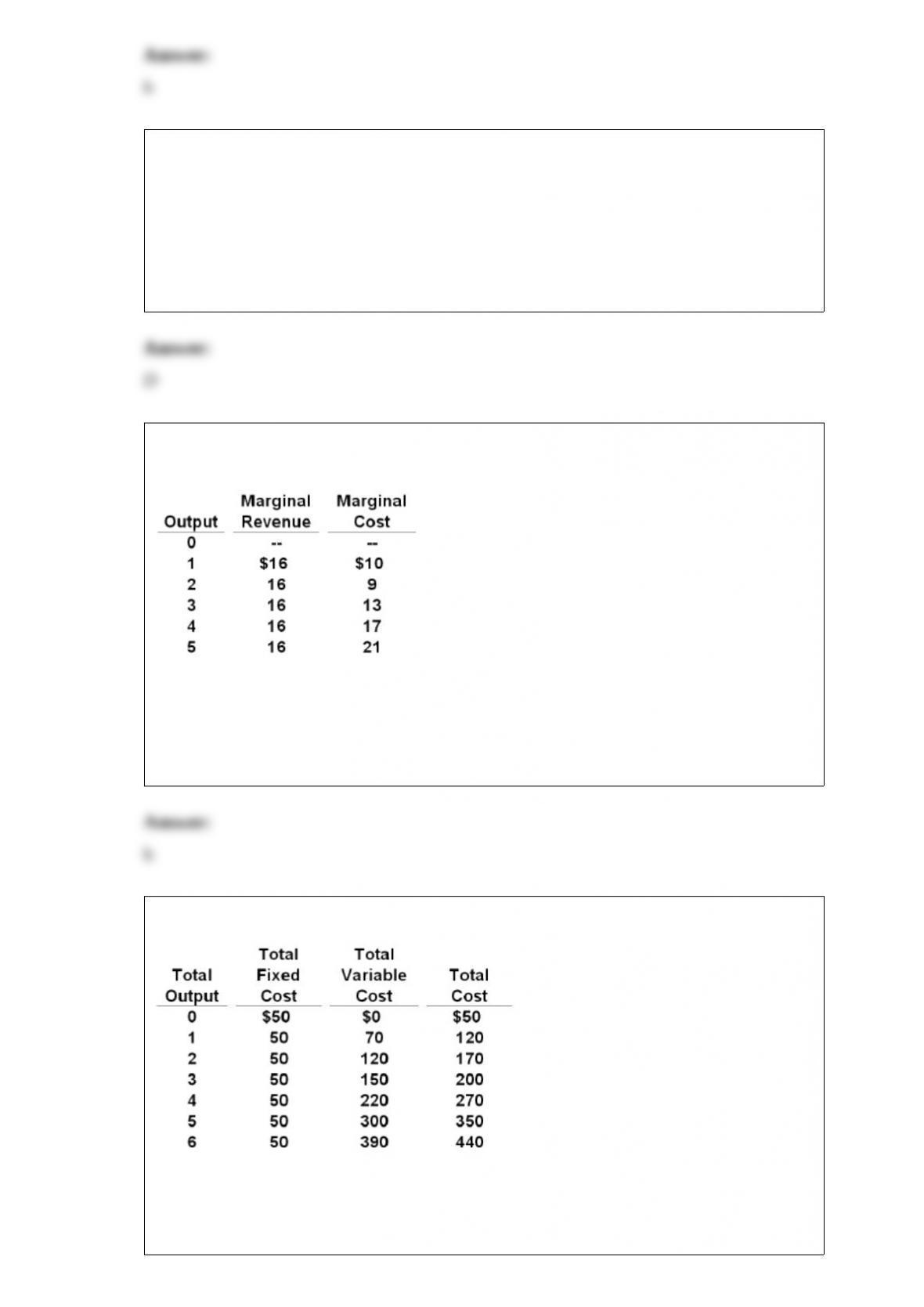
8) the following data confronting a firm:
refer to the above data. at the profit-maximizing output the firm’s total cost is:
a.$48.
b.$32.
c.$80.
d.$64.
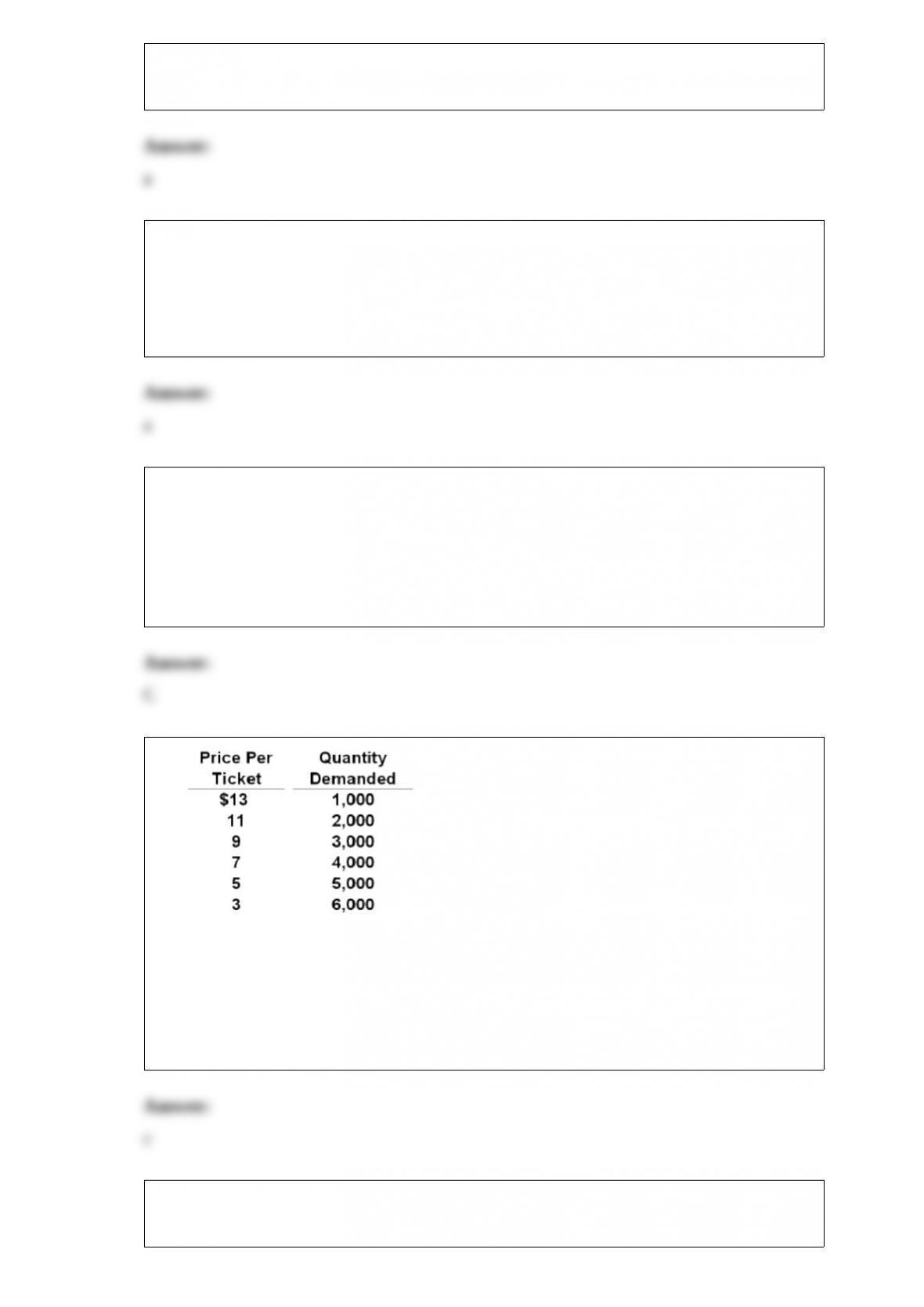
9) the following cost data for a purely competitive seller:
refer to the above data. at 5 units of output average fixed cost, average variable cost,
and average total cost are:
a.$10, $60, and $70 respectively.
b.$50, $40, and $90 respectively.
c.$10, $70, and $80 respectively.
d.$5, $25, and $30 respectively.
10) which of the following best defines disposable income?
a.income received by households less personal taxes
b.the before-tax income received by households
c.all income earned by resource suppliers for their current contributions to production
d.the market value of the annual output net of consumption of fixed capital
11) Which of the following is not a DVC policy that might increase DVC economic
growth?
A.privatizing state industries
B.controlling population growth
C.restricting direct foreign investment from abroad
D.building human capital
12)
refer to the above information and assume the stadium capacity is 5,000. if the
mudhens’ management wanted a full house for the game, it would:
a.set price so as to maximize its total revenue.
b.encourage scalpers to sell their tickets for more than $7.
c.set ticket prices at $5.
d.set ticket prices at $9.
13) (Consider This) Violin strings made from sheep intestines were first called “catgut”
because:

A.at the time it was thought to be extremely unlucky to kill sheep.
B.the inventor wanted to establish a legally protected brand name.
C.the inventor wanted to preserve his trade secret.
D.the inventor thought that “catgut” would sound less offensive to buyers than ‘sheep
intestines.”