
Wage and price controls and income policies are techniques advocated to
a. shift the Phillips curve to the left.
b. shift the aggregate supply curve to the left.
c. shift the 45-degree line to the left.
d. shift the production possibilities curve to the left.
e. control inflation by increasing the rate of unemployment.
The average number of times per year a dollar is used to make transactions for final
goods and services is called the
a. price level.
b. quantity theory of money.
c. interest rate.
d. nominal GDP.
e. velocity of circulation.
The Sarbanes”Oxley Act of 2002 was designed to increase

a. investor confidence.
b. government ownership.
c. the number of firms.
d. executive salaries.
e. income equality.
Some elements of a negative income tax have been incorporated into the U.S. federal
tax code in the form of
a. reduced inheritance and estate taxes.
b. unemployment compensation programs.
c. capital gains taxes.
d. the Earned Income Tax Credit.
e. the Aid to Families with Dependent Children program.
Reducing bank reserves would be an appropriate measure
a. during a recession.

b. to balance the government budget.
c. to contain strong inflationary pressures.
d. to promote an increased level of business borrowing.
e. to increase the M1 money supply.
Malthus believed that maintaining or improving humanity’s standard of living would be
possible only with
a. technological change.
b. war, famine, or the universal adoption of birth control measures.
c. the introduction of widespread public assistance programs.
d. an expansion of the Corn Laws limiting imports.
e. an accumulation of capital.
This short-run equilibrium price
a. is also the long-run equilibrium price.
b. is not profitable for the monopolistic competitor.

c. requires the firm to advertise to avoid continuing to lose money.
d. equals marginal cost.
e. will not be sustained because there is an incentive for entry.
The relationship between household spending and disposable income is known as the
a. investment function.
b. multiplier.
c. gross domestic product.
d. consumption function.
e. saving function.
The following table shows the costs to society of allowing certain levels of air pollution
as well as the costs of pollution control. What is the optimal level of air pollution in
terms of both the costs of pollution and the costs of control?

a. 0
b. 100
c. 200
d. 300
e. 400
The horizontal axis shows
a. the money supply.
b. total real output.
c. the unemployment rate.
d. the price level.
e. wage rates.

A major factor leading to demand-side inflation is
a. the existence of unions and firms with considerable market power.
b. the presence of considerable slack in the economy.
c. increases in spending when resources are fully employed.
d. significant increases in the prices of important materials (for example, crude oil) in
the short run.
e. rapid growth of an economy’s potential output.
The downward-sloping demand curve of the monopolistic competitor
a. becomes horizontal in the long run.
b. results from the absence of any competition.
c. reflects product differentiation.
d. ensures the firm produces at minimum average cost in the long run.
e. indicates collusion among the members of the product group.
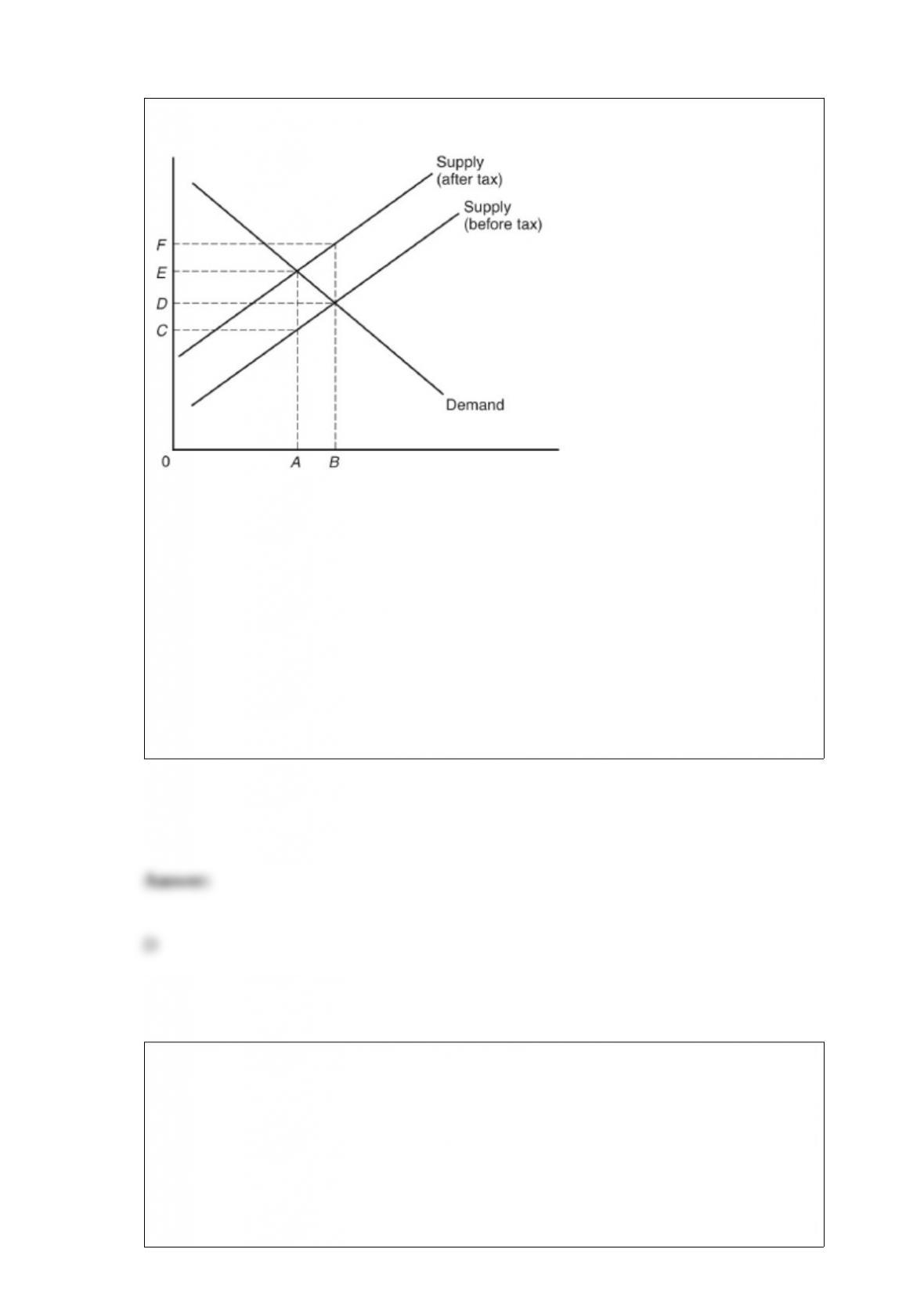
The following questions are based on the following diagram:
The amount of tax shifted onto the seller is best illustrated by
a. AB.
b. DE.
c. CE.
d. DC.
e. CF.
The economic rationale behind effluent fees is
a. to eliminate all pollution.
b. to create external diseconomies.
c. to expand the role of regulatory agencies.

d. unsound because the private market system is not given the freedom to eliminate the
pollution problem.
e. to bring the private cost of waste disposal closer to the social cost.
As compared to earlier years, the rate of growth of labor productivity in the United
States from the 1970s through the mid-1990s
a. increased dramatically.
b. increased slightly.
c. slowed considerably.
d. increased in the 1970s and declined in the late 1980s.
e. remained constant.
A perfectly competitive firm’s marginal cost curve above the minimum value of average
variable cost is equivalent to the
a. industry demand curve.
b. long-run average cost curve.
c. firm’s production function.

d. production possibilities curve.
e. firm’s supply curve.
In the early 1900s, managers generally refused to grant wage increases to garment
workers because
a. they were already paying all that their firms could afford and still remain solvent.
b. they could get all the workers they wanted at the wages they were paying.
c. most workers were unskilled and covered by the minimum wage law.
d. workers were compensated in other ways, such as with free housing and medical
care.
e. garment workers were already among the highest-paid skilled labor.
Profits as a reward to risk and uncertainty is a theory closely associated with
a. Karl Marx.
b. Henry George.
c. Frank Knight.
d. Thomas Malthus.

e. Joseph Schumpeter.
A market demand curve shows
a. what price will prevail in the marketplace.
b. how much of a commodity will be purchased in a given period of time at various
prices.
c. the rate at which consumption of a commodity will increase as income goes up.
d. the minimum price consumers will have to pay to get a certain quantity.
e. that as price goes up, consumers will spend more money on a commodity.
The following questions are based on the following information: The country has a
fractional-reserve banking system, required reserves are 12.5 percent of demand
deposits, each bank initially has reserves exactly equal to the required amount, each
wants to maintain this equality, and no person withdraws cash from the banking system.
Suppose $10,000 in newly printed currency is deposited in a checking account in bank
A. Bank A now has
a. excess reserves of $10,000.
b. required reserves up by $10,000.

c. net worth up by $10,000.
d. demand deposits up by $10,000.
e. added $10,000 to the money supply.
In 1961, major electrical equipment manufacturers were convicted of illegal practices
undertaken during the 1950s, consisting primarily of
a. tying contracts.
b. collusive agreements.
c. horizontal mergers.
d. vertical mergers.
e. conglomerate mergers.
The table above shows the net effect of an open market operation undertaken by the
Fed. Use it to answer the following question.
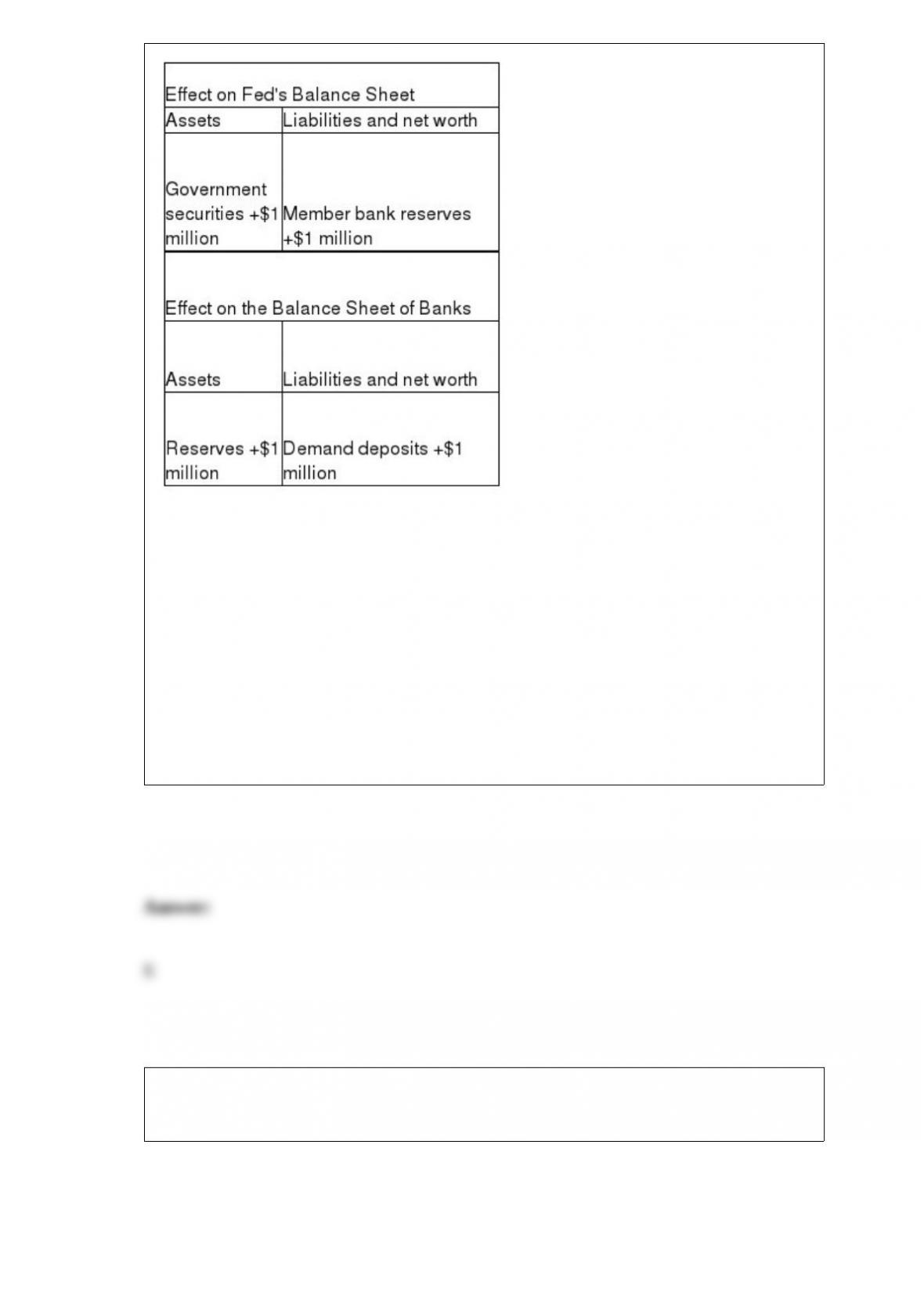
The Fed has
a. increased bank reserves, thereby decreasing the supply of money.
b. sold government securities, thereby decreasing the supply of money.
c. sold government securities, thereby increasing the supply of money.
d. increased the national debt.
e. purchased government securities, thereby increasing the supply of money.
The following questions are based on the following diagram, in which existing
aggregate supply and demand curves are AS0 and AD0, respectively:
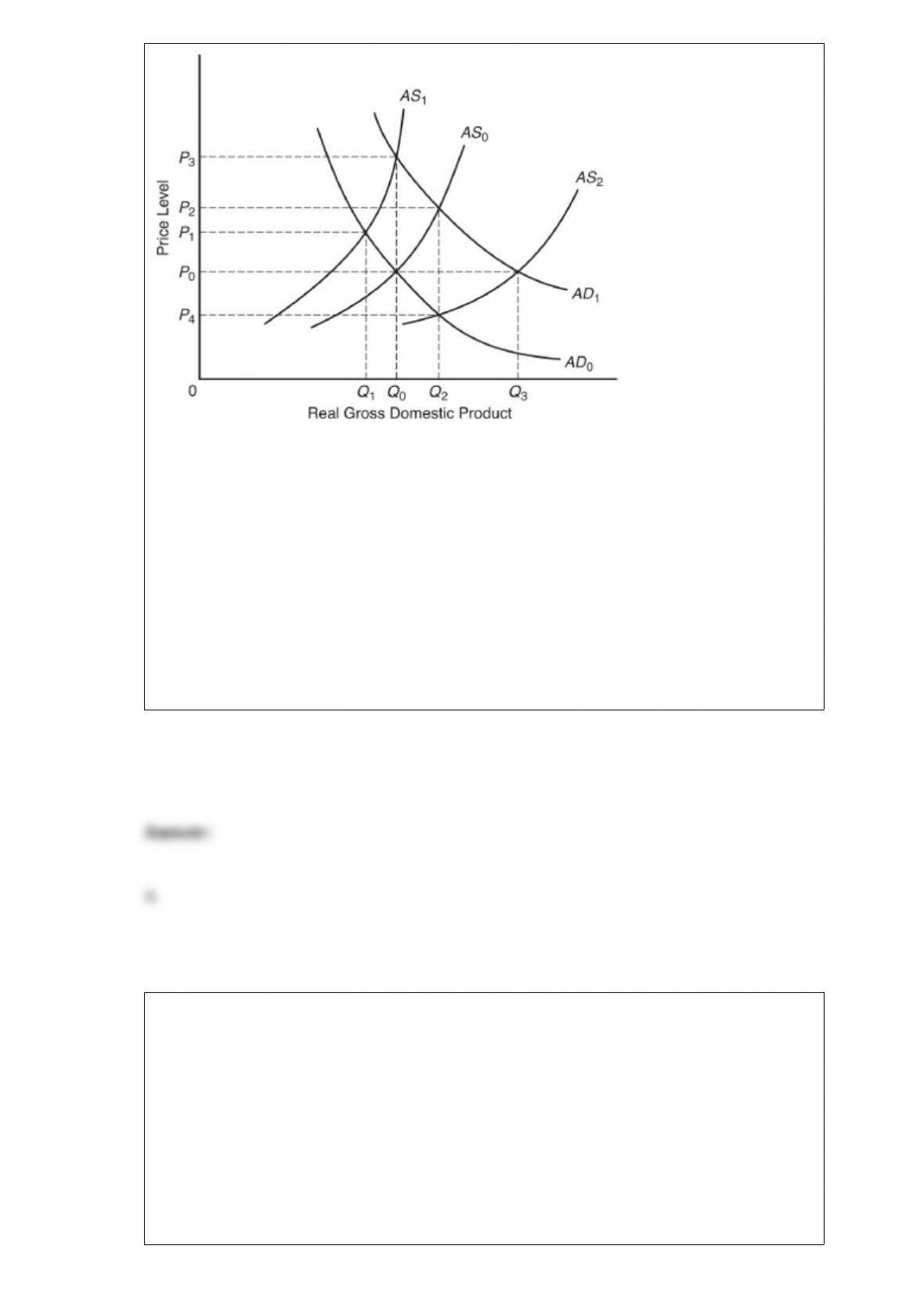
Under these conditions, unemployment will
a. rise as real output declines.
b. fall as real output rises.
c. remain unchanged as real output declines.
d. fall as price levels rise.
e. rise as price levels decline.
Given our experience with the gold standard and the Bretton Woods agreement, most
economists today would probably agree that
a. both floating and fixed exchange rate systems are less desirable than the gold
standard.
b. floating exchange rate systems offer a definite advantage over fixed exchange rate
systems.
c. fixed exchange rate systems offer a decided advantage over floating exchange rate

systems.
d. neither floating nor fixed exchange rate systems can operate effectively in today’s
world market.
e. fixed and floating exchange rate systems should be employed simultaneously to have
a beneficial impact.
In the United States, the compulsory hospitalization insurance plan for people over 65
is known as
a. Supplemental Security.
b. the Family Assistance Plan.
c. Blue Cross.
d. Medicare.
e. the Federal Security Life Insurance Copay (FSLIC) program.
All of the following fit the narrow definition of money EXCEPT
a. savings accounts.
b. demand deposit accounts.

c. coins.
d. currency.
e. NOW accounts.
According to the Social Security Administration, the cost of a minimal nutritionally
sound food plan is multiplied by what number to arrive at an income level used as the
criteria for establishing the poverty line?
a. 2
b. 3
c. 4
d. 5
e. 6
Liberals
a. argue that the role of the government should be minimized and carefully
circumscribed.
b. feel that economic and political freedom is undermined by reliance on the
government.

c. are skeptical about the government’s ability to solve economic and social problems.
d. assert that the government can and should overcome the limitations of the price
system by regulating private activity.
e. view the price system as an efficient noncoercive method of allocation.
The total increase in the money supply that can be achieved from a given amount of
excess reserves can be found by
a. adding the excess reserve ratio to the amount of excess reserves.
b. multiplying the excess reserve ratio by the amount of excess reserves.
c. subtracting the required reserve ratio from the excess reserve ratio.
d. dividing the amount of excess reserves by the required reserve ratio.
e. adding the required reserve ratio to the excess reserve ratio and multiplying the
reciprocal of the result by the amount of required reserves.
The process of computing an asset’s worth is called
a. computing an asset’s rate of return.
b. appropriation.

c. calibration.
d. investment.
e. capitalization.