
By the 2000s, investment banks had become significant participants in the secondary
market for mortgages.
The multiplier effect following an increase in expenditure is generated by induced
increases in consumption expenditure as income rises.
The income effect of a price change refers to the change in the quantity demanded of a
good that results from a change in the price of a substitute product.
The producer price index tracks the prices firms receive for goods and services at all
stages of production.

In market economies, income distribution is always going to be completely equitable.
Inflation targeting has been adopted by the central banks of several countries including
the European Central Bank.
An increase in real GDP
A) increases the buying and selling of goods and increases the demand for money as a
medium of exchange.
B) increases the buying and selling of goods and decreases the demand for money as a
medium of exchange.
C) decreases the buying and selling of goods and increases the demand for money as a
medium of exchange.
D) decreases the buying and selling of goods and decreases the demand for money as a
medium of exchange.

According to the quantity theory of money, if the money supply grows at 6%, real GDP
grows at 2%, and the velocity of money is constant, then the inflation rate will be
A) 8%.
B) 6%.
C) 4%.
D) 2%.
In economics, the total amount received for selling a good or service is referred to as
A) revenue.
B) profit.
C) capital gains.
D) factor payments.
Knowledge capital is nonrival in the sense that
A) two people can use the same knowledge to develop and produce a product.
B) firms do not compete to be the first to develop new technologies.
C) no single company can be excluded from the benefits of new technologies.
D) firms can benefit from the research and development of rival firms without paying
for that benefit.
Zane’s Vanes is a service that restores old weather vanes. Zane has just spent $125
purchasing a 1920s era weather vane which he expects to restore and sell for $500 once
the work is completed. After having spent $125, Zane realizes that he will need to spend
an additional $200 on materials to complete the restoration. Alternatively, he can sell
the weather vane without restoring it for $200. What is his marginal cost to complete
the restoration?
A) $75
B) $125
C) $200
D) $300
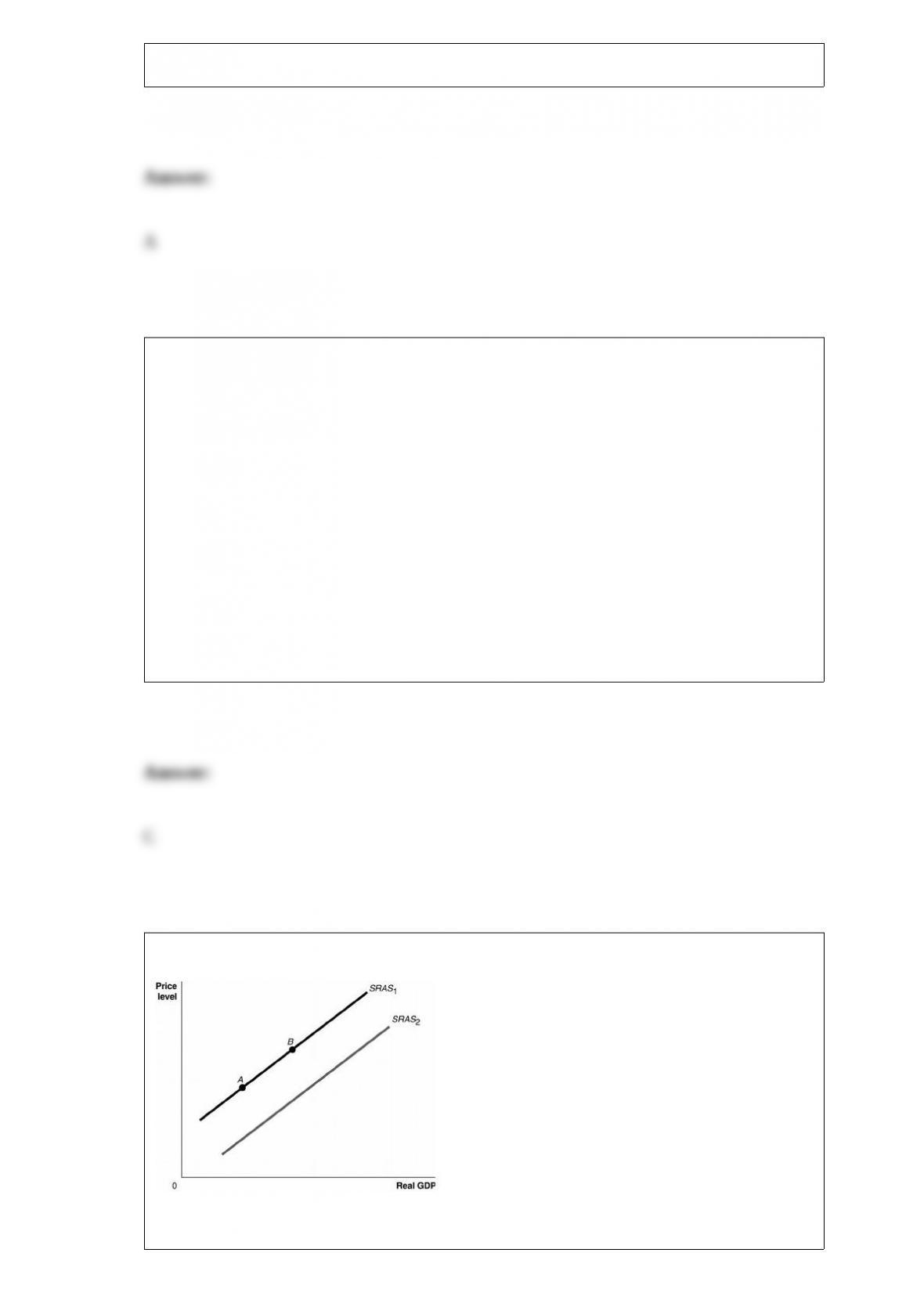
Figure 13-2
Refer to Figure 13-2. Ceteris paribus, a decrease in the capital stock would be
represented by a movement from

A) SRAS1 to SRAS2.
B) SRAS2 to SRAS1.
C) point A to point B.
D) point B to point A.
How does a decrease in government spending affect the aggregate expenditure line?
A) It shifts the aggregate expenditure line upward.
B) It shifts the aggregate expenditure line downward.
C) It increases the slope of the aggregate expenditure line.
D) It decreases the slope of the aggregate expenditure line.
If the Fed is using policy to combat inflation, what is likely to happen in the foreign
exchange market and to the foreign exchange value of the dollar?
A) The demand for the dollar will increase and the foreign exchange value of the dollar
will rise.
B) The demand for the dollar will decrease and the foreign exchange value of the dollar
will rise.
C) The demand for the dollar will increase and the foreign exchange value of the dollar

will fall.
D) The demand for the dollar will decrease and the foreign exchange value of the dollar
will fall.
If tablet computers are considered substitutes for e-readers, the decline in the price of
e-readers would, all else equal,
A) increase the demand for tablet computers.
B) decrease the demand for tablet computers.
C) increase the quantity of tablet computers demanded.
D) decrease the quantity of tablet computers demanded.
An economy can improve its standard of living by
A) organizing production so that the quantity of goods produced per hour will decrease.
B) reducing the amount of human capital workers have.
C) increasing the amount of capital available per hour worked.
D) all of the above

The Sarbanes-Oxley Act of 2002 was passed in response to what event?
A) a series of accounting scandals
B) unexpected increases in dividend payments to stockholders at various corporations
C) volatility in NASDAQ indexes
D) historically low bond prices
Which of the following is not an argument against inflation targeting?
A) Inflation targeting reduces the flexibility of the Fed to pursue other policy goals.
B) Inflation targeting assumes that the Fed can accurately forecast future inflation rates.
C) Inflation targeting makes monetary policy ineffective because the targets are
publicly announced.
D) Inflation targeting holds the Fed accountable for an inflation goal, but may make it
less likely the Fed will achieve other goals.
Economists assume that rational people

A) never use all available information as they act to achieve their goals.
B) undertake activities that benefit others and hurt themselves.
C) only weigh the benefits and costs of the most desirable alternative actions.
D) respond to economic incentives.
When the price of a financial asset ________ its interest rate will ________.
A) rises; rise
B) falls; fall
C) falls; rise
D) rises; remain the same
How will the purchase of $100 million of government securities by the Federal Reserve
change bank reserves and total checking account deposits in the banking system as a
whole? Assume that banks do not hold any excess reserves, that households and firms
do not change the amount of currency they hold, and that the required reserve ratio is 20
percent.
Describe the three types of unemployment.
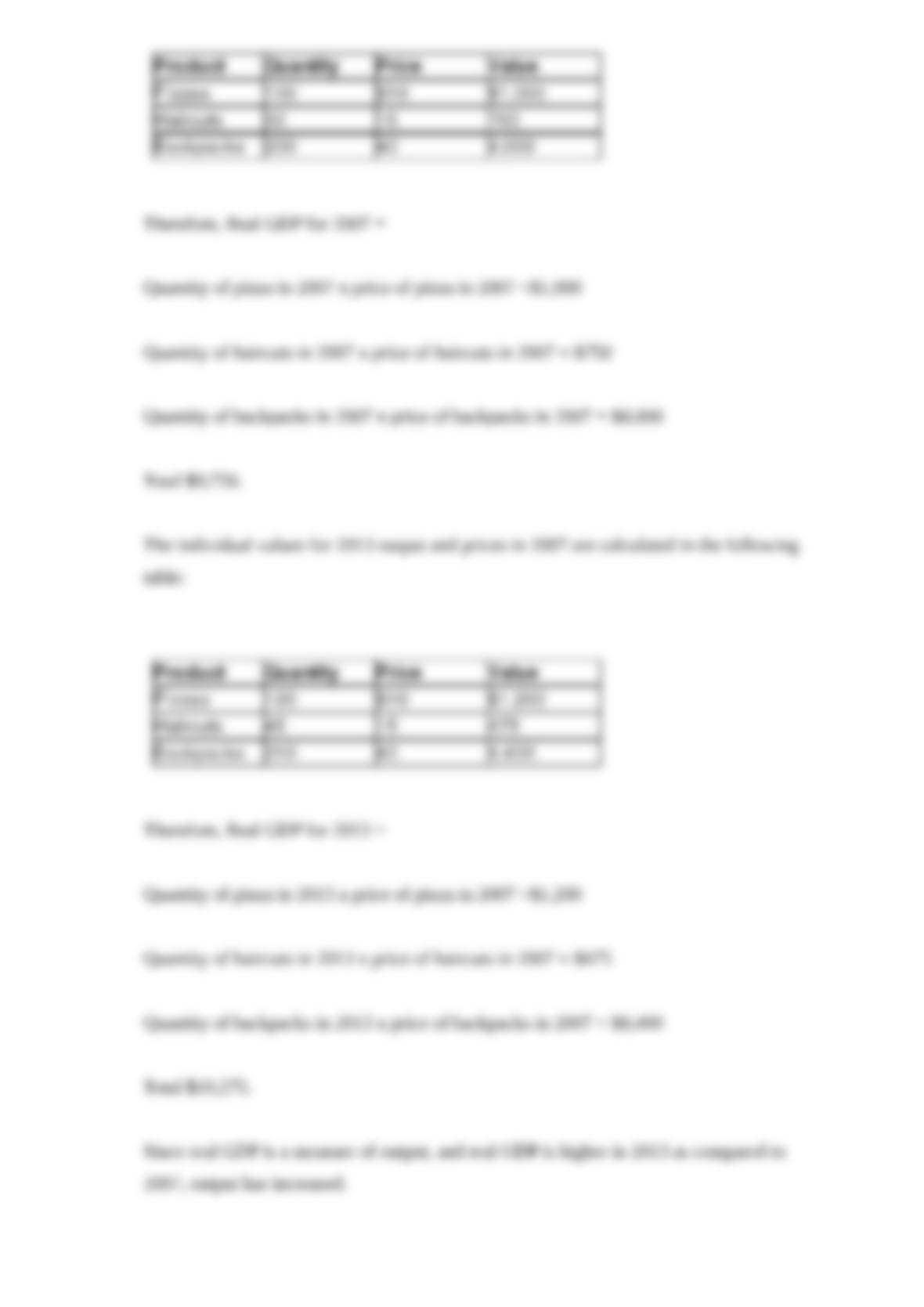
Table 8-23
2007 2013
Refer to Table 8-23. Suppose that a very simple economy produces three goods: pizzas,
haircuts, and backpacks. Suppose the quantities produced and their corresponding
prices for 2007 and 2013 are shown in the table above. Use the information to compute
real GDP in the year 2007 and 2013. Assume that 2007 is the base year. Is output higher
in 2013 or 2007? Why?
How is economic profit found?
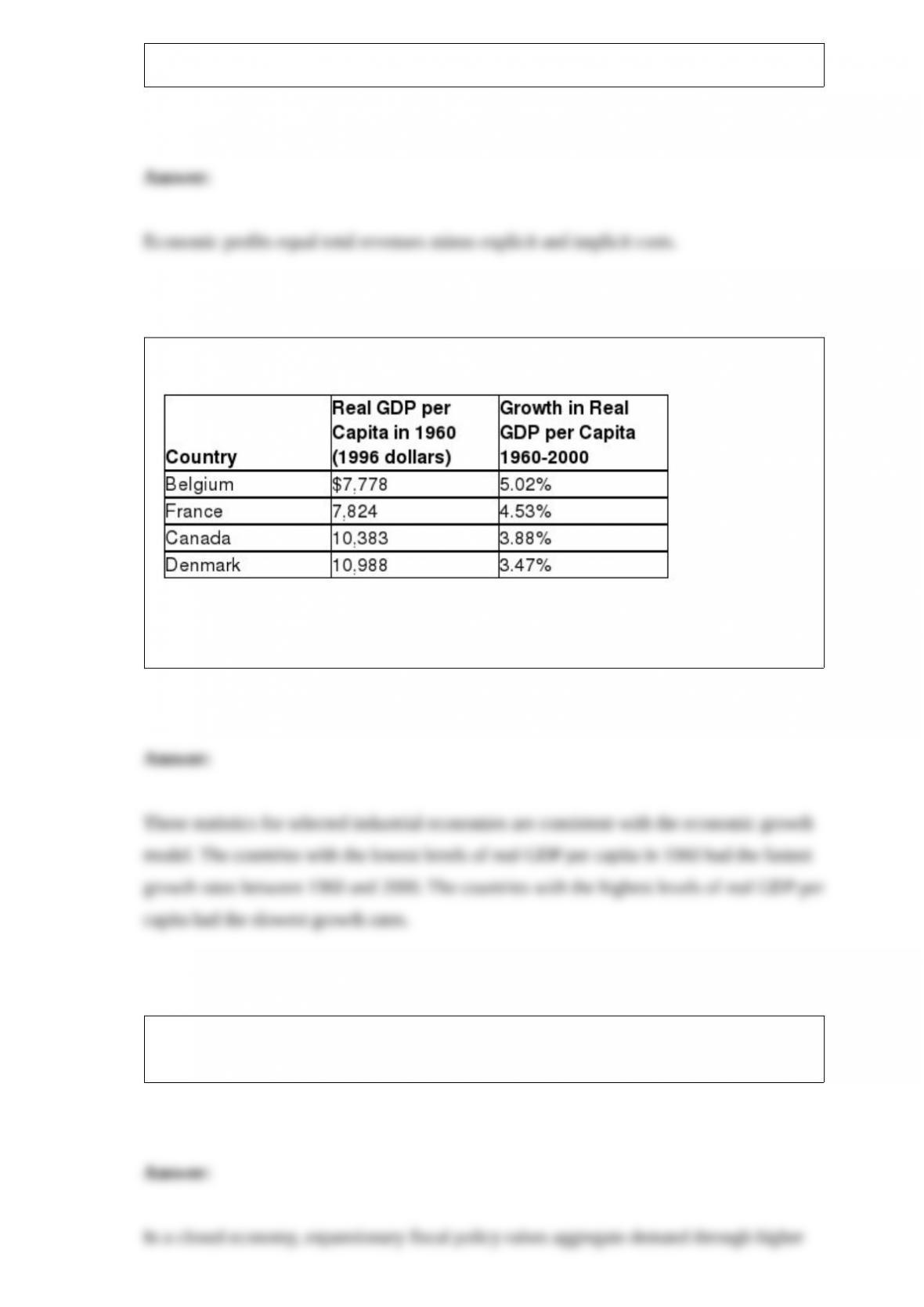
Table 11-5
Refer to Table 11-5. Consider the statistics in the table above in describing the
industrialized countries.Are these consistent with the economic growth model? Briefly
explain.
How is the impact of expansionary fiscal policy different in an open economy than in a
closed economy?
Beginning in 2008, The Federal Reserve and the U.S. Treasury Department responded
to the financial crisis by intervening in financial markets in unprecedented ways.
Briefly summarize the actions of the Fed and Treasury.
Scott is a manager at a pool cleaning business. He has hired 10 workers to clean pools
for him and is considering what type of payment scheme he should set up for his
workers. He can pay each of his workers $10 per hour to clean pools, or he can pay his
workers $20 for each pool a worker cleans. (It takes 2 hours, on average, for an
employee to clean a pool thoroughly.) If Scott wants to maximize the number of pools
his workers clean in one day, which payment scheme should he use? Explain.
Describe the differences (in sign and relative magnitude) between the government
purchases multiplier and the tax multiplier.