An imperfectly competitive firm is one that:
A. has at least some influence over the market price.
B. charges any price it wants.
C. seeks to maximize revenue.
D. faces a perfectly inelastic demand curve.
Among the most important indicators used by the NBER Business Cycle Dating
Committee to determine the beginning of the 2007-2009 recession were all of the
following except:
A. industrial production.
B. total sales in manufacturing, wholesale trade, and retail trade.
C. the consumer price index.
D. nonfarm employment.
When Brady is driving he throws his cigarette butts out the window, reasoning that
other people will clean up the litter on the side of the road. By throwing his cigarette
butts out the window, Brady is:
A. helping to achieve the socially optimal level of litter.
B. creating a positive externality for himself.
C. imposing an external cost on others.
D. treating his private property as common property.
In the short run, a profit-maximizing firm will not shut down if its total revenue is:
A. positive.
B. greater than or equal to its total cost.
C. greater than or equal to its fixed cost.
D. greater than or equal to its variable cost.
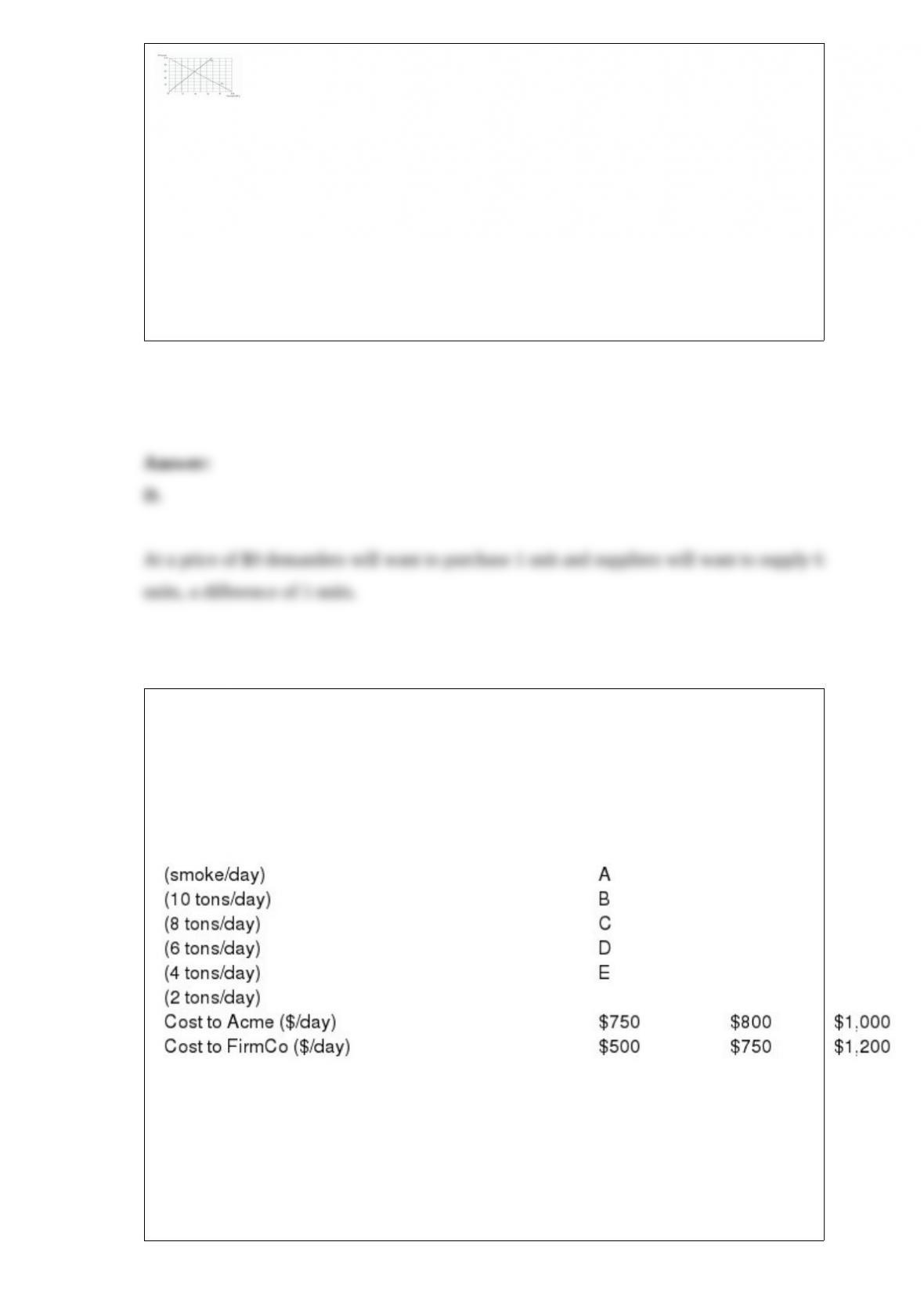
Refer to the figure above. At a price of $9, the market will experience ______________
in the amount of __________ units.
A. excess demand; 5 units
B. excess supply; 6 units
C. equilibrium; 4 units
D. excess supply; 5 units
Two firms, Acme and FirmCo, have access to five production processes, each of which
has a different cost and gives off a different amount of pollution. The daily costs of the
processes and the corresponding number of tons of smoke emitted are shown in the
table below.
process
If pollution is unregulated, the two firms will produce using process ______, and a total
of ______ tons of smoke will be emitted each day.
A. C; 12
B. D; 4
C. B; 16
D. A; 20
If a monopolist’s marginal revenue is $25 and its marginal cost is $19, then the
monopolist should:
A. raise its price.
B. increase its output.
C. leave its output and price unchanged.
D. decrease its output.
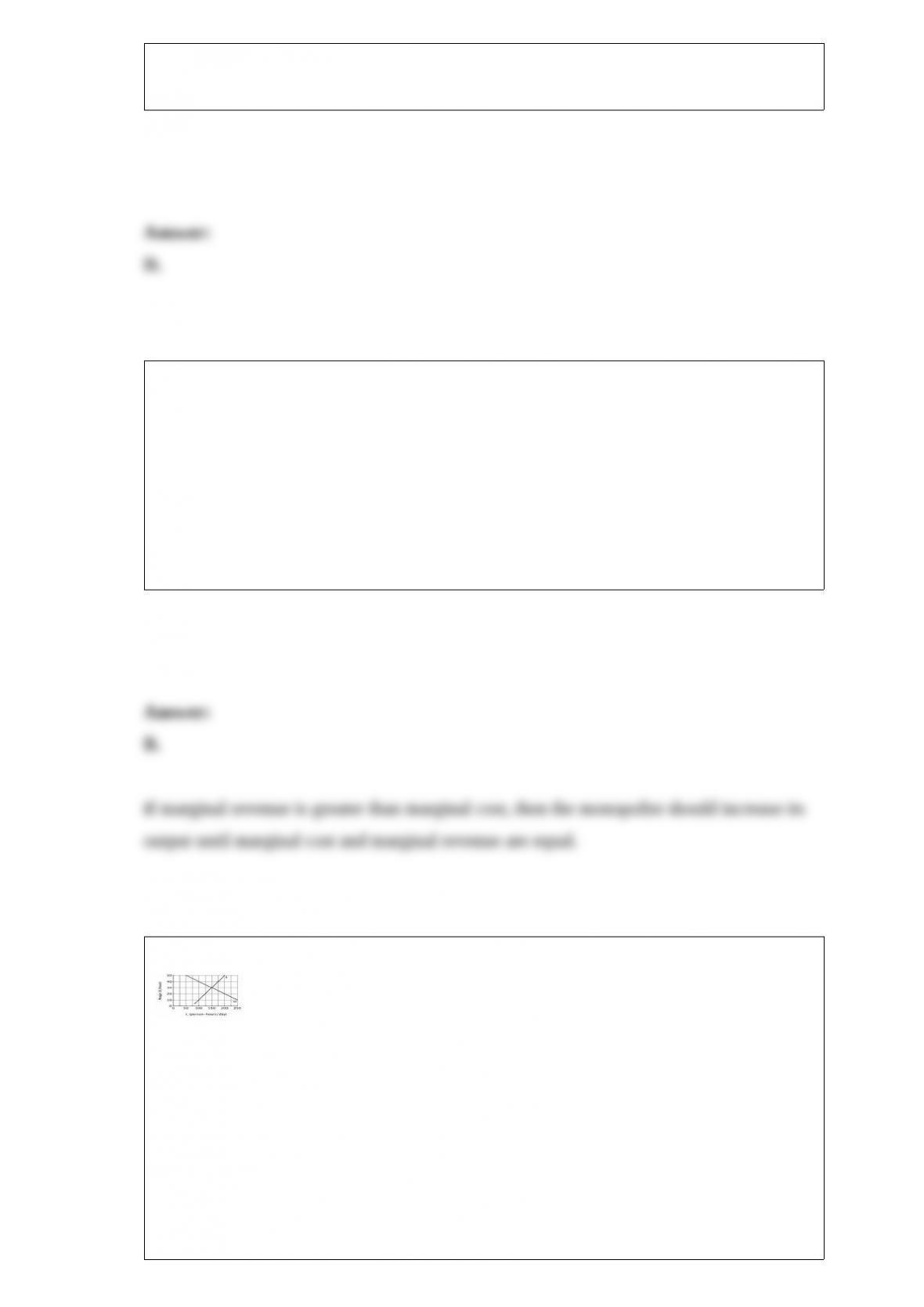
Assume that this graph illustrates a perfectly competitive labor market.
Equilibrium in this labor market is at a wage of ______ per hour and an employment
level of ______ person-hours per day.
A. $30; 100
B. $30; 150
C. $20; 200
D. $20; 125
Consider a monopolist who charges a single price to all of its customers. If this
monopolist starts price discriminating, its output will ______ and its profit will ______.
A. fall; rise
B. fall; fall
C. rise; fall
D. rise; rise
In an open economy, the domestic real interest rate is determined by:
A. domestic saving, domestic investment, and net capital inflows.
B. domestic investment.
C. domestic saving and domestic investment.
D. domestic saving and net capital inflows.
Real GDP per person equals average labor productivity:
A. times one minus the unemployment rate.
B. minus the share of population employed.
C. times the labor force participation rate.
D. times the share of population employed.
The tit-for-tat strategy only works for a prisoner’s dilemma that:
A. has only one Nash equilibrium.
B. is played only one time.
C. does not have a Nash equilibrium.
D. is repeated.

According to Okun’s law, when cyclical unemployment increases by one percentage
point, the recessionary gap ______ by ______ percent of potential output.
A. widens; one
B. widens; two
C. closes; one
D. closes; two
In the market for saving, the price is the:
A. relative price.
B. real interest rate.
C. nominal interest rate.
D. inflation rate.
Your economics professor has announced that he or she will assign final grades as
follows: the top 20 percent of students will get an A, the bottom 20 percent of students
will get an F, and everyone else will get a C. This grading scheme generates a positional

externality because:
A. society as whole will be better off when people are educated.
B. students will study hard no matter how the professor assigns final grades.
C. each student’s final grade depends on his or her relative standing.
D. studying requires both time and effort.
Which of the following does not describe a characteristic of short-term economic
fluctuations?
A. Expansions and recessions are felt in only a few sectors of the economy.
B. Expansions and recessions are irregular in length and severity.
C. The unemployment rate rises during recessions.
D. Durable-goods industries are more sensitive to short-term fluctuations than service
and non-durable industries.
The phrase ‘smart for one, but dumb for all” refers to the idea that the individual pursuit
of self-interest:
A. only leads to an efficient outcome when everyone is well-informed.
B. always leads to an efficient outcome.
C. never leads to an efficient outcome.
D. doesn’t always lead to an efficient outcome.
According to the Incentive Principle, people will be less likely to smoke if the
government:
A. increases taxes on smoking-cessation devices such as nicotine patches.
B. increases taxes on cigarettes, effectively raising the price.
C. subsidizes hospitals treating lung disease.
D. invests more money in cancer research.
You expect a share of EconNews.Com to sell for $65 a year from now. If you are

willing to pay $65.74 for one share of the stock today, and you require a return of 8%,
what dividend payment must you expect to receive from the stock?
A. $4.46
B. $5.20
C. $6.00
D. $9.25
The Great Recession was the result of:
A. two negative demand shocks.
B. a negative demand shock and a negative inflation shock.
C. two positive inflation shocks.
D. a negative demand shock and a positive inflation shock.
The monopolist will maximize profits at the output level for which:
A. price equals marginal cost.
B. price equals average total cost.
C. marginal revenue equals average total cost.
D. marginal revenue equals marginal cost.
Which of the following is an example of cyclical unemployment?
A. Dora lost her job when the textile factory closed. She does not have skills to work in
another industry and has been unemployed for over a year.
B. Marsha was laid off from her job with the airline because the recession reduced
demand for airline travel. She expects to get her job back when the economy picks up.
C. George is an unskilled worker who mows lawns in the summer, but is unemployed
the rest of the year.
D. Jim had a job as an engineer, but quit when his wife was transferred to another state.
He looked for a month before finding a new job that he liked.
Refer to the figure below.
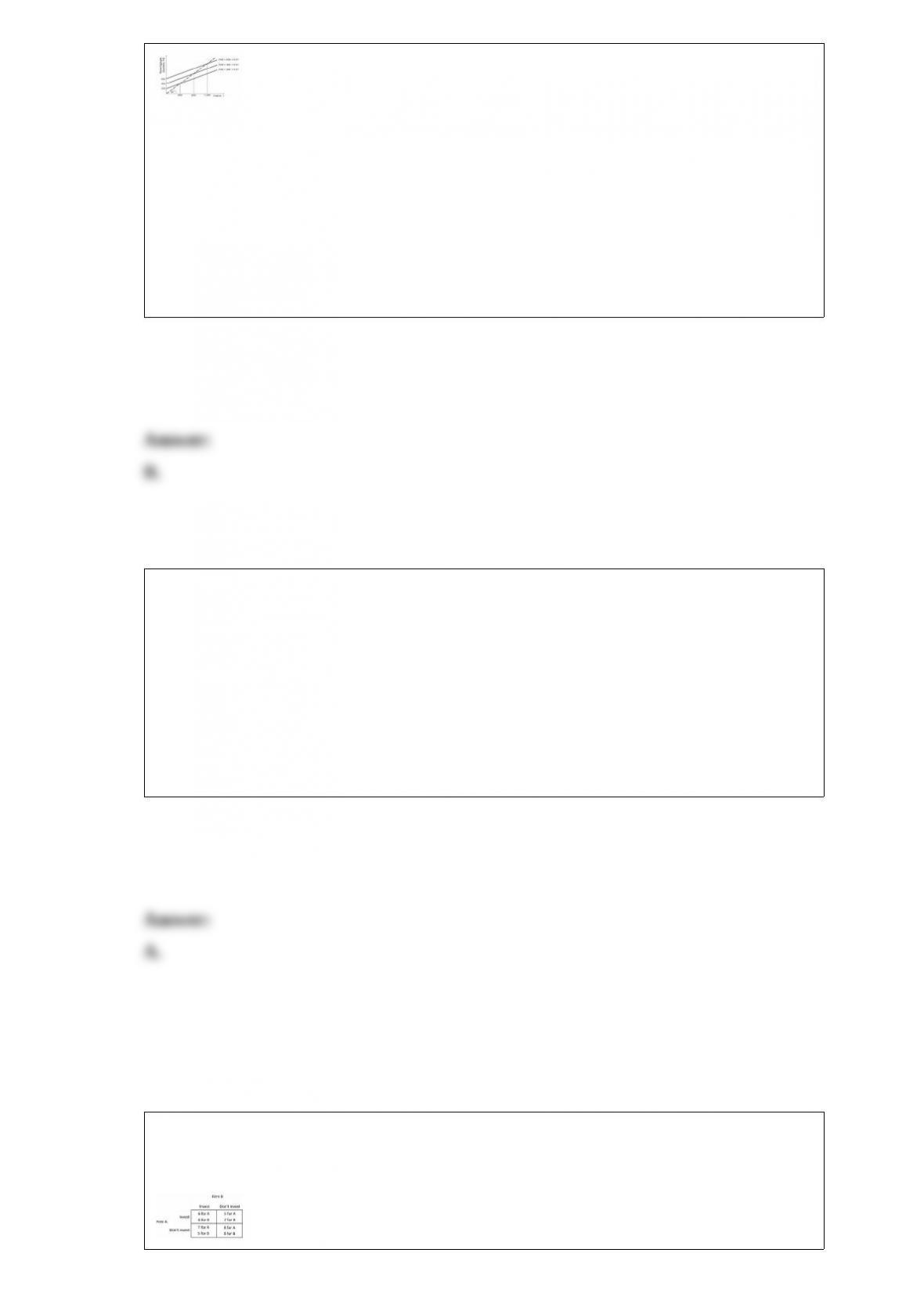
Based on the figure, if autonomous spending falls from 400 to 200, then the new
short-run equilibrium output will equal:
A. 1,200.
B. 400.
C. 600.
D. 800.
When a bank makes a loan by crediting the borrower’s checking account balance with
an amount equal to the loan:
A. money is created.
B. the bank gains new reserves.
C. the bank immediately loses reserves.
D. the Fed has made an open-market purchase.
Suppose Firm A and Firm B are considering whether to invest in a new production
technology. For each firm, the payoff to investing (given in thousands of dollars per
day) depends upon whether the other firm invests, as shown in the payoff matrix below.
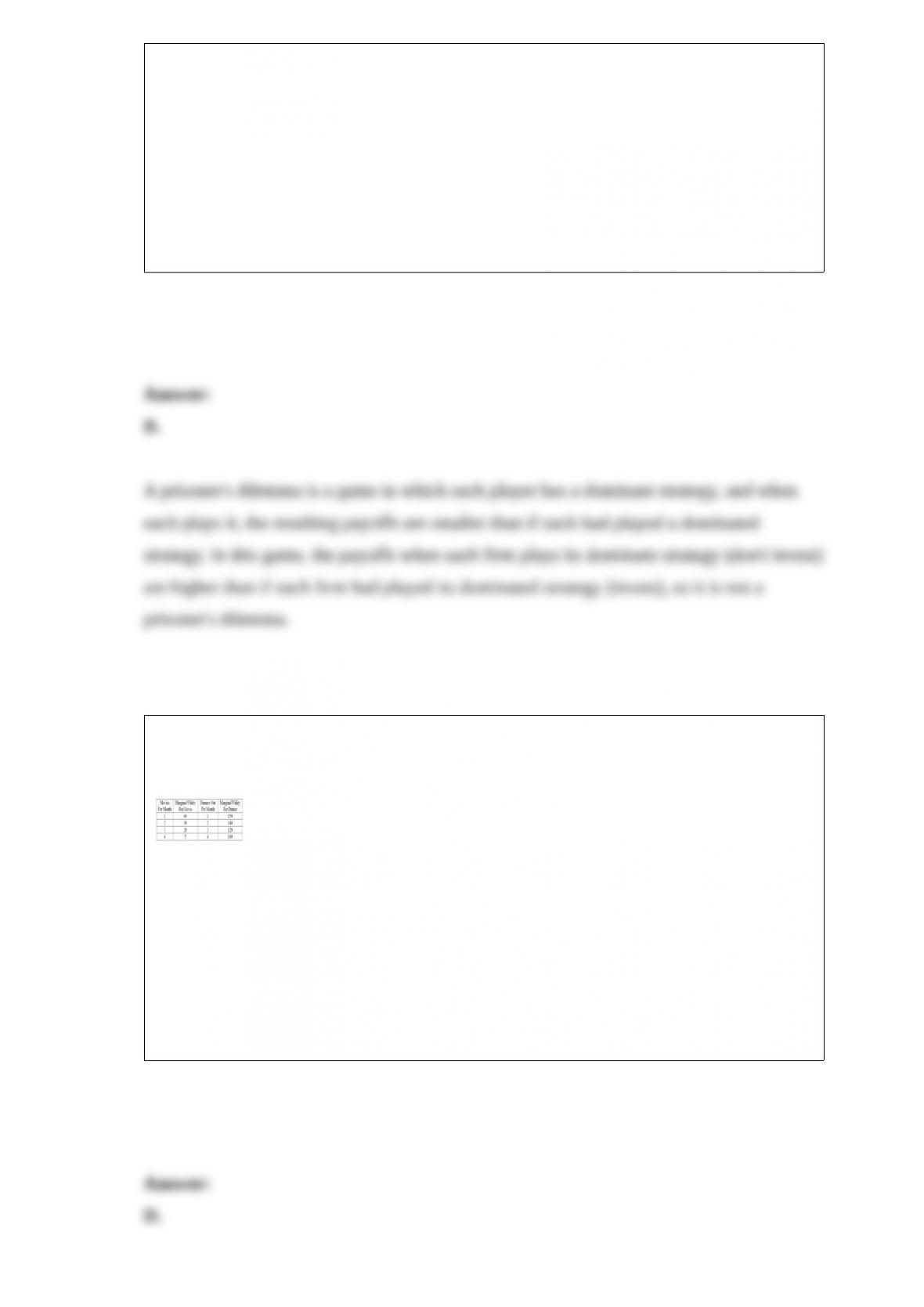
Is this game a prisoner’s dilemma?
A. Yes.
B. No.
C. It cannot be determined.
D. Only when both Firm A and Firm B invest.
Taylor’s marginal utility from watching movies and from eating out (in utils) is shown
below. Taylor spends exactly $100 every month on these two forms of entertainment,
and the price of each movie is $10 and the price of each dinner is $20.
Taylor’s optimal combination of movies and eating out is:
A. 3 movies and 3 dinners.
B. 4 movies and 3 dinners.
C. 3 movies and 4 dinners.
D. 2 movies and 4 dinners.

Fred purchases a bond, newly issued by the Big Time Corporation, for $10,000. The
bond pays $400 to its holder at the end of the first, second, and third years and pays
$10,400 upon its maturity at the end of four years. The principal amount of this bond is
___, the coupon rate is ____, and the term of this bond is _____.
A. $400; 40%; four years
B. $10,000; 4%; four years
C. $10,000; $400; 4%
D. $10,400; 4%; four years
In the long run, total spending affects ______, and output is determined by _______.
A. inputs and productivity; prices
B. inputs and productivity; total spending
C. prices; inputs and productivity
D. prices; meeting demand at preset prices
Two companies, Dirty Inc. and Filthy Inc., each of which has access to 5 different
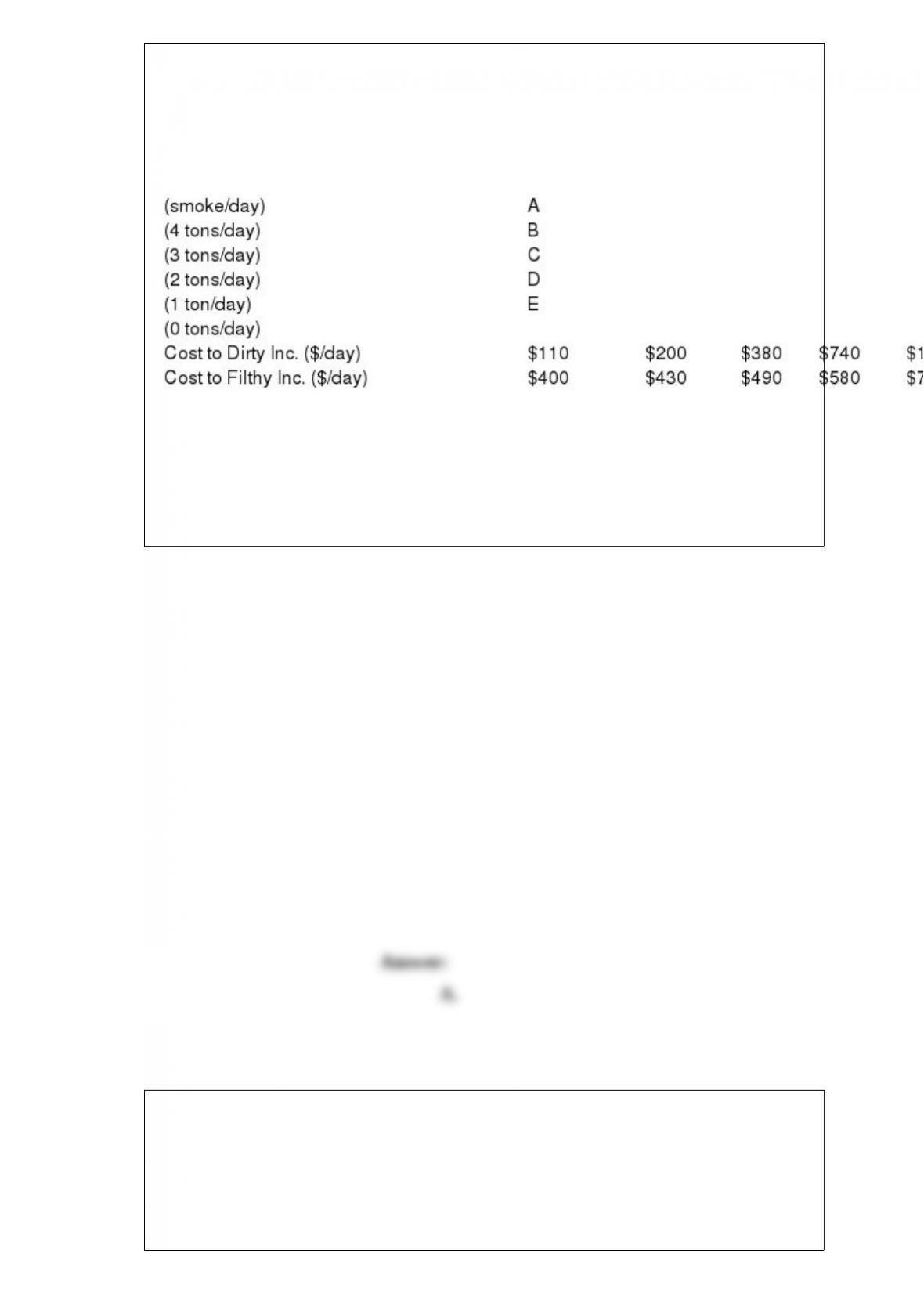
production processes, each of which has a different cost and produces a different
amount of pollution. The daily costs of the processes and the number of tons of smoke
emitted are shown in the table below.
process
Suppose pollution is initially unregulated. If the City Council requires each firm to
reduce emissions by 50 percent, then the total cost to society of this policy will be
______ per day.
A. $360
B. $380
C. $490
D. $870
One family earned an income of $28,000 in 1990. Over the next five years, their
income increased by 15%, while the CPI increased by 12%. After five years, this
family’s nominal income ______, and their real income ______.
A. decreased; also decreased
B. decreased; increased

C. increased; did not change
D. increased; also increased
Suppose someone offers Max the following gamble: with probability 0.50 he will win
$10 and with probability 0.50 he will lose $8. The expected value of this gamble is:
A. $5
B. $2
C. $1
D. $0
Features of the labor market that are likely to cause structural unemployment include all
of the following except:
A. labor unions.
B. minimum wage laws.
C. unemployment compensation.
D. differences in the skills and experience of workers.

From the point of view of a particular country, capital inflows are:
A. purchases of domestic goods or services by foreigners.
B. purchases of domestic assets by foreigners.
C. purchases of foreign goods or services by domestic households or firms.
D. purchases of foreign assets by domestic households or firms.
Which of the following describes a surplus-enhancing transaction?
A. The Federal government taxes the wealthy to pay for programs to help the poor.
B. A firm lays off 25 workers in order to cut costs.
C. A person pays $10.00 to buy a scoop of ice cream at a baseball game.
D. Your state government imposes a higher minimum wage than the one set by federal
law.
Which of the following is NOT an example of the hurdle method of price
discrimination?
A. A coupon for $10 off any purchase of $50 or higher.
B. A mail-in rebate on a printer.
C. An early-bird discount for people order dinner before 5 p.m.
D. A lower price on strawberries when they are in season.