If prices rise on average in the U.S. economy, the purchasing power of a dollar declines.
A decrease in population shifts the production possibility frontier outwards over time.
A monopolist’s demand curve is the same as the marginal revenue curve for the product.
One example of human capital is the amount of skills that you have.
If planned aggregate expenditure is less than real GDP, some firms will experience
unplanned increases in inventories.
Potential GDP is estimated to grow at a rate of 3.2% in the United States. Actual GDP
in the U.S.
A) always grows at a slower rate than potential GDP.
B) always grows at a faster rate than potential GDP.
C) always grows at the same rate as potential GDP.
D) is the same as potential GDP if all firms in the economy were working at capacity.
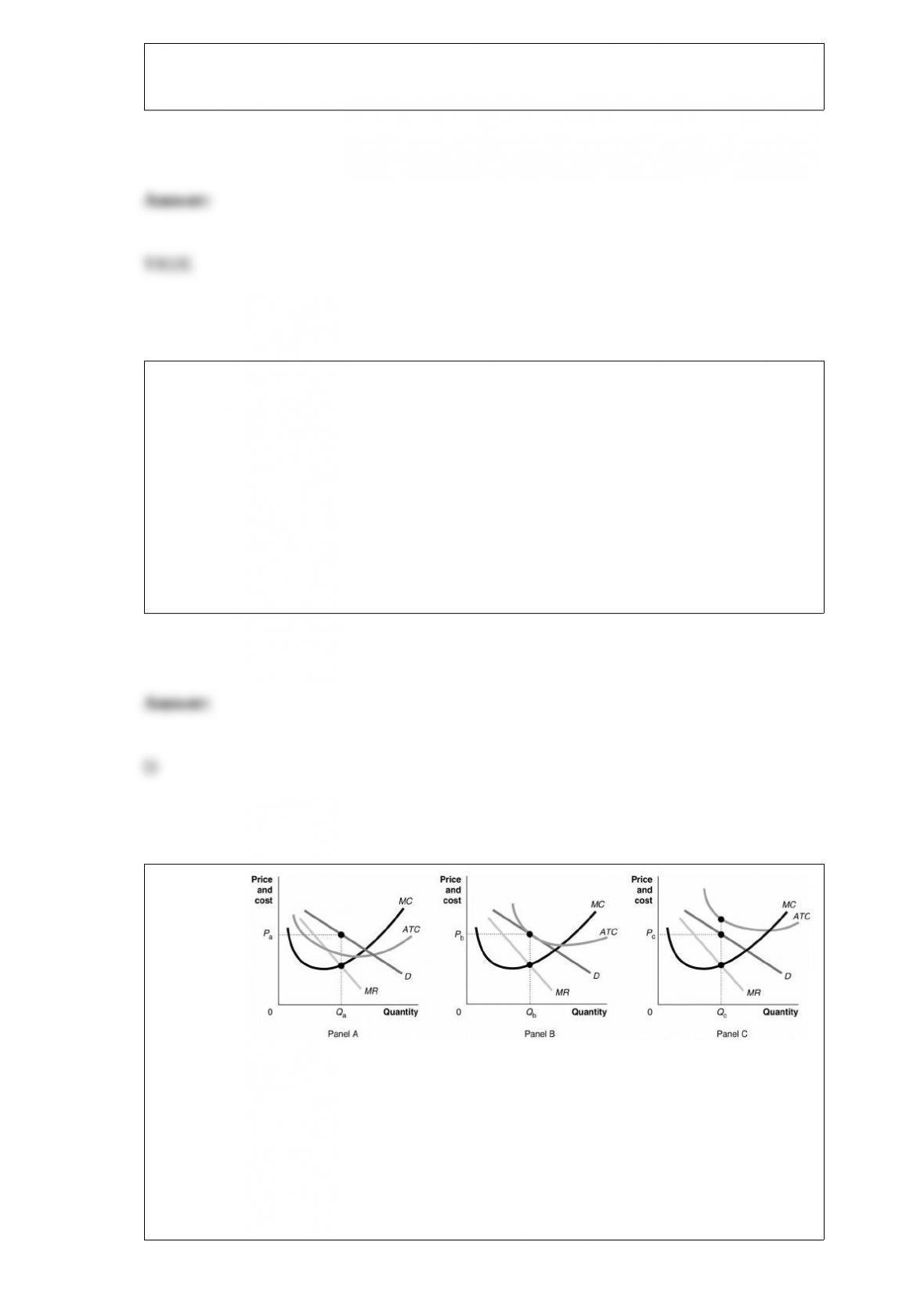
Figure 13-9
Which of the graphs in the figure depicts a monopolistically competitive firm that is
minimizing its losses?
A) Panel A
B) Panel B
C) Panel C
D) Panel A and Panel C
The restriction that a consumer’s total expenditure on goods and services purchased
cannot exceed the income available is referred to as
A) maximizing behavior.
B) economizing behavior.
C) the price constraint.
D) the budget constraint.
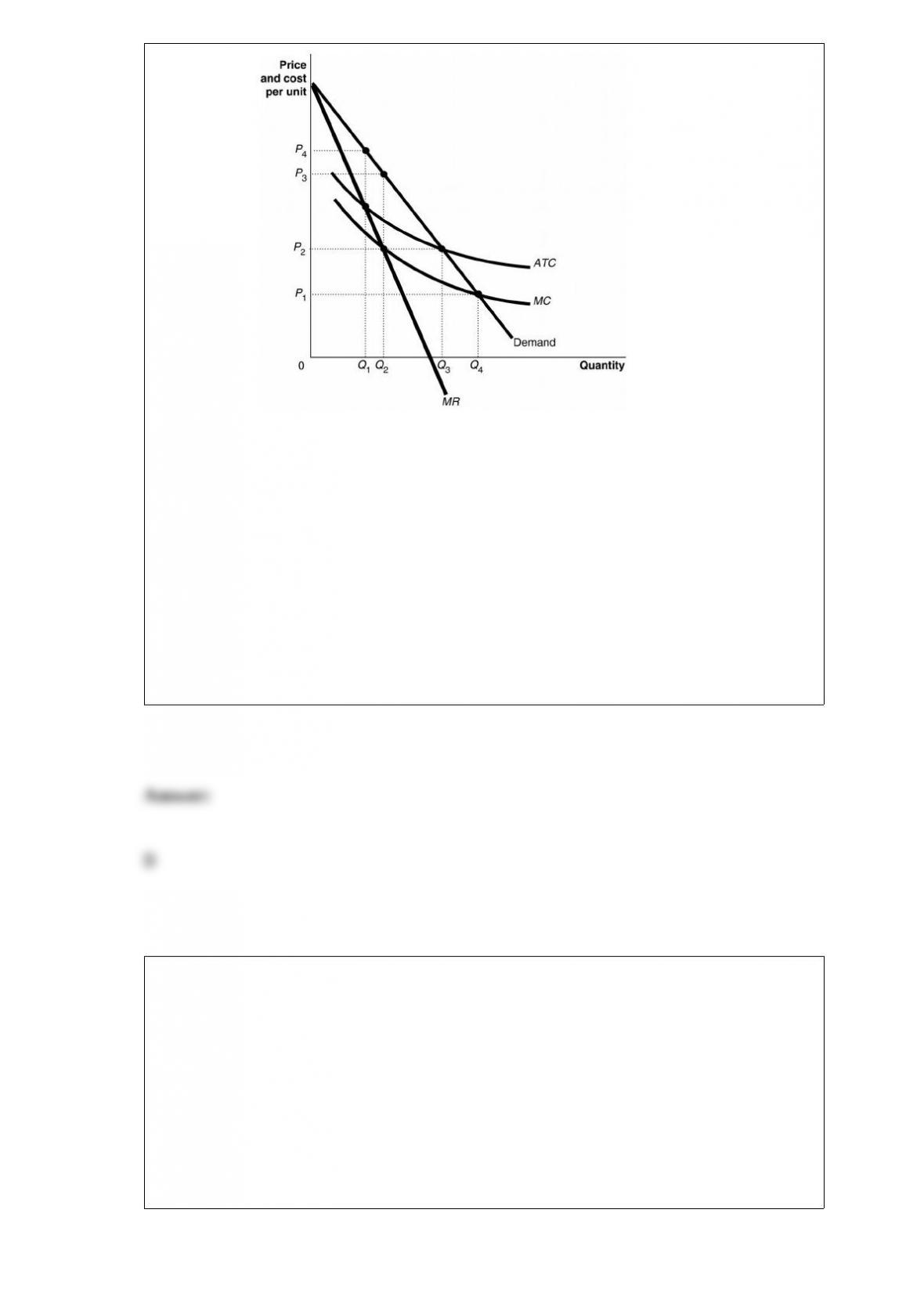
Figure 15-15 Figure 15-15 shows the
cost and demand curves for the Erickson Power Company.
The firm would maximize profit by producing
A) Q1 units.
B) Q2 units.
C) Q3units.
D) Q4units.
When production in an economy grows more quickly than the population in that
economy, which of the following must be occurring?
A) Real GDP is falling.
B) Incomes are growing at a slower rate than the population.
C) Real GDP per capita is rising.
D) Living standards are falling.

You’re traveling in Ireland and are thinking about buying a new digital camera. You’ve
decided you’d be willing to pay $125 for a new camera, but cameras in Ireland are all
priced in euros. If the exchange rate is 0.85 euros per dollar, what’s the highest price in
euros you’d be willing to pay for a camera?
A) 105 euros
B) 106.25 euros
C) 110.15 euros
D) 147 euros
One result of the public choice model is that most economists believe that
A) when market failure occurs, government intervention will always lead to a more
efficient outcome.
B) government intervention will always result in a reduction in economic efficiency in
regulated markets.
C) policymakers may have incentives to intervene in the economy in ways that do not
promote economic efficiency.
D) the voting paradox will prevent voters from selecting the best person for public
office.
In 1960, out-of-pocket spending on health care in the United States was
A) 2.2 percent.
B) 6 percent.
C) 48 percent.
D) 64 percent.
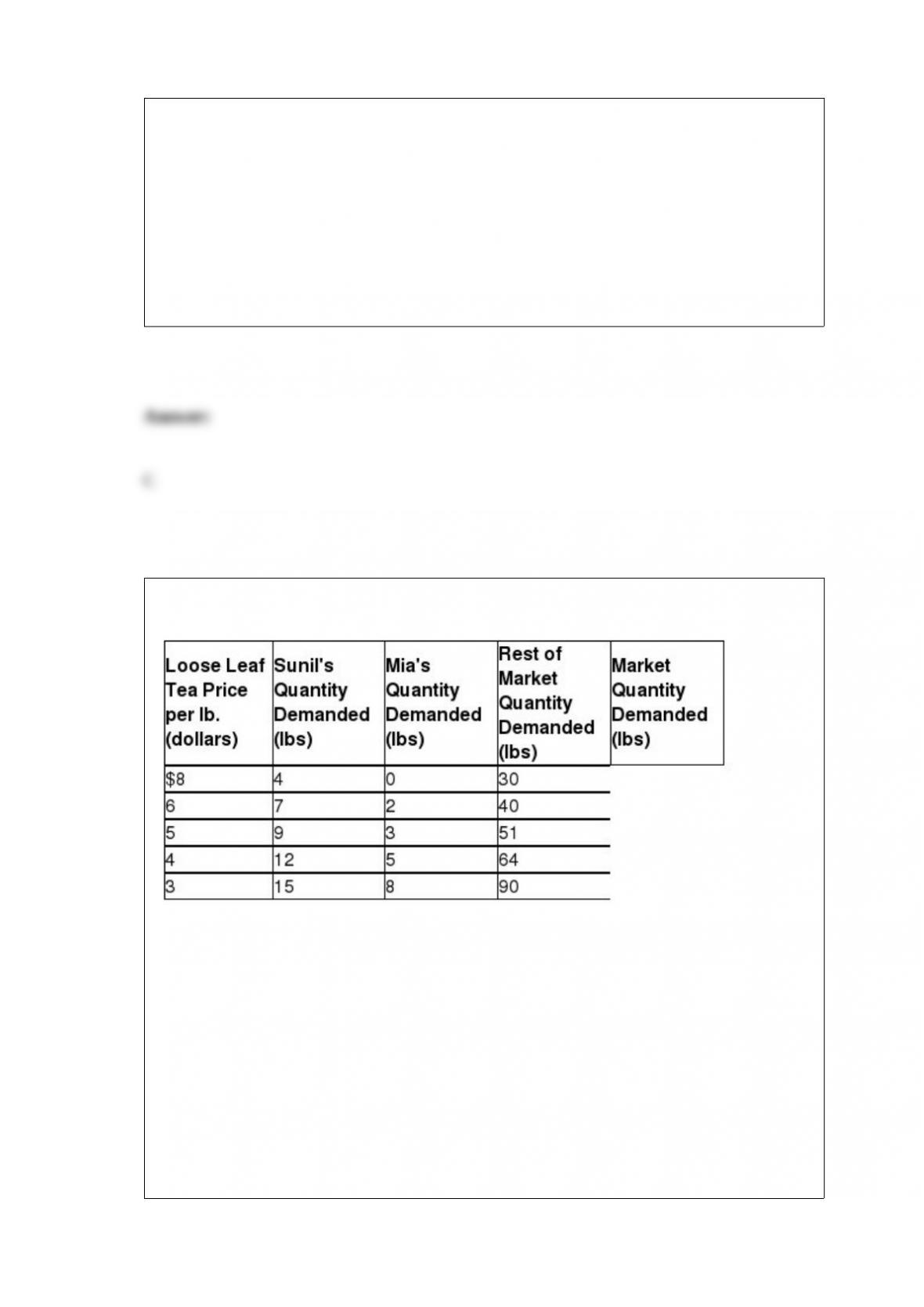
Table 3-1
The table above shows the demand schedules for loose-leaf tea of two individuals
(Sunil and Mia) and the rest of the market. At a price of $5, the quantity demanded in
the market would be
A) 51 lbs.
B) 63 lbs.
C) 76 lbs
D) 146 lbs.

Using cross-sectional data from the two Housing Assistance Supply Experiment
(HASE) sites–Brown County, Wisconsin, and St. Joseph County, Indiana, John
Mulford of Rand Research estimates that the long-run “permanent” income elasticity of
housing expenditures to be 0.45 for owners. Using this information, what is likely to
happen to housing expenditures if the government increases income transfers to
recipients in HASE sites?
A) Housing expenditures will increase significantly.
B) Housing expenditures in HASE sites significantly will fall as recipients moved out
of these areas to higher-income areas.
C) Housing expenditures will increase, but not significantly.
D) Housing expenditures will decrease by a small amount.
Using the money demand and money supply model, an open market purchase of
Treasury securities by the Federal Reserve would cause the equilibrium interest rate to
A) increase.
B) decrease.
C) not change.
D) increase if the economy is in a recession.

In a production possibilities frontier model, a point ________ the frontier is
productively inefficient.
A) along
B) inside
C) outside
D) at either intercept of
From 1990-2012, productivity growth in the United States was ________ the growth
rates of other high-income countries.
A) greater than
B) less than
C) equal to
D) greater than for the first 15 years, then less than
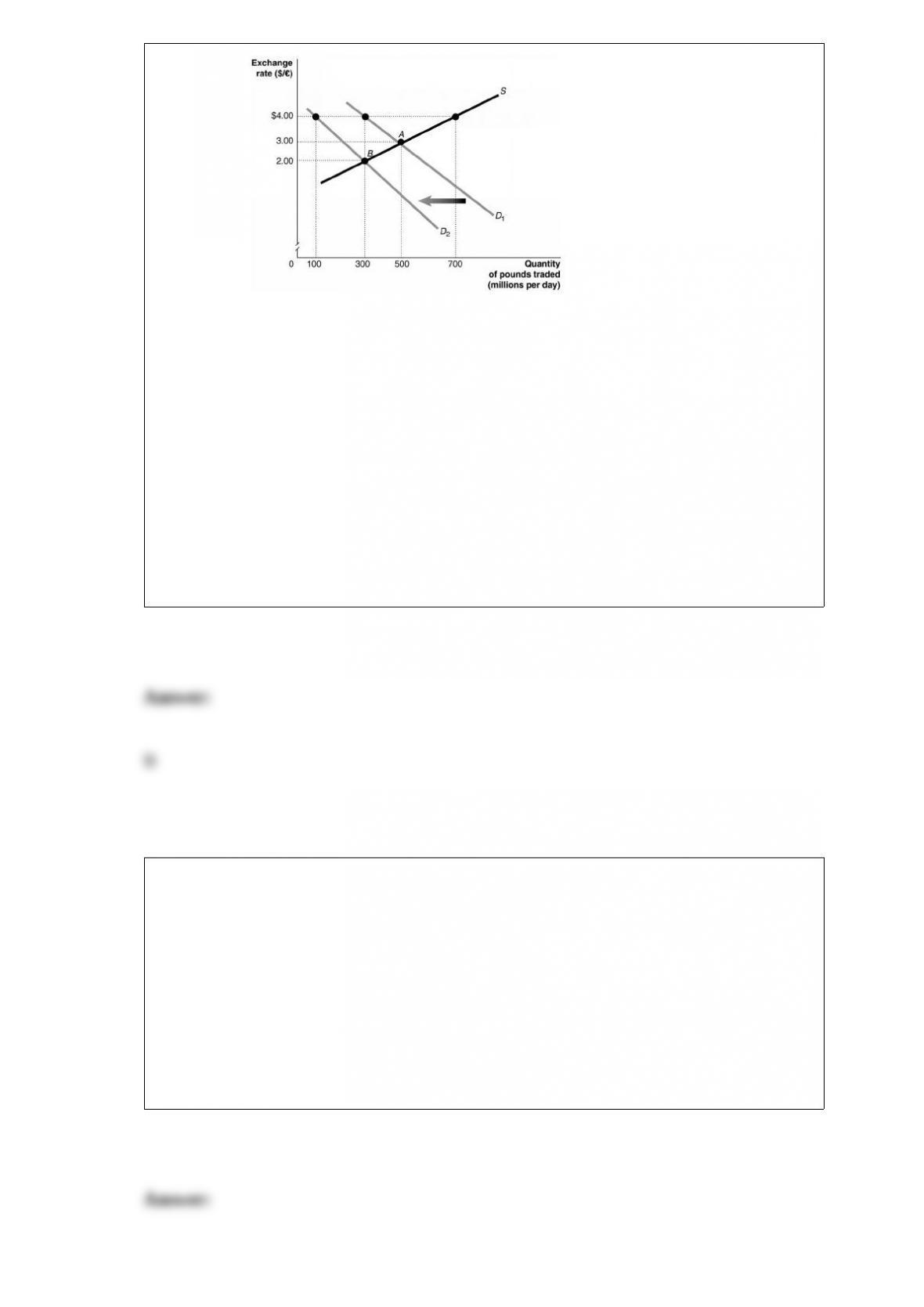
Figure 19-4
The equilibrium exchange rate is at A, $3/pound. Suppose the British government pegs
its currency at $4/pound. At the pegged exchange rate,
A) there is a shortage of pounds equal to 600 million.
B) there is a surplus of pounds equal to 400 million.
C) there is a shortage of pounds equal to 400 million.
D) there is a surplus of pounds equal to 600 million.
E) there is a shortage of pounds equal to 200 million.
As a consumer consumes more and more of a product in a particular time period,
eventually marginal utility
A) rises.
B) is constant.
C) declines.
D) fluctuates.
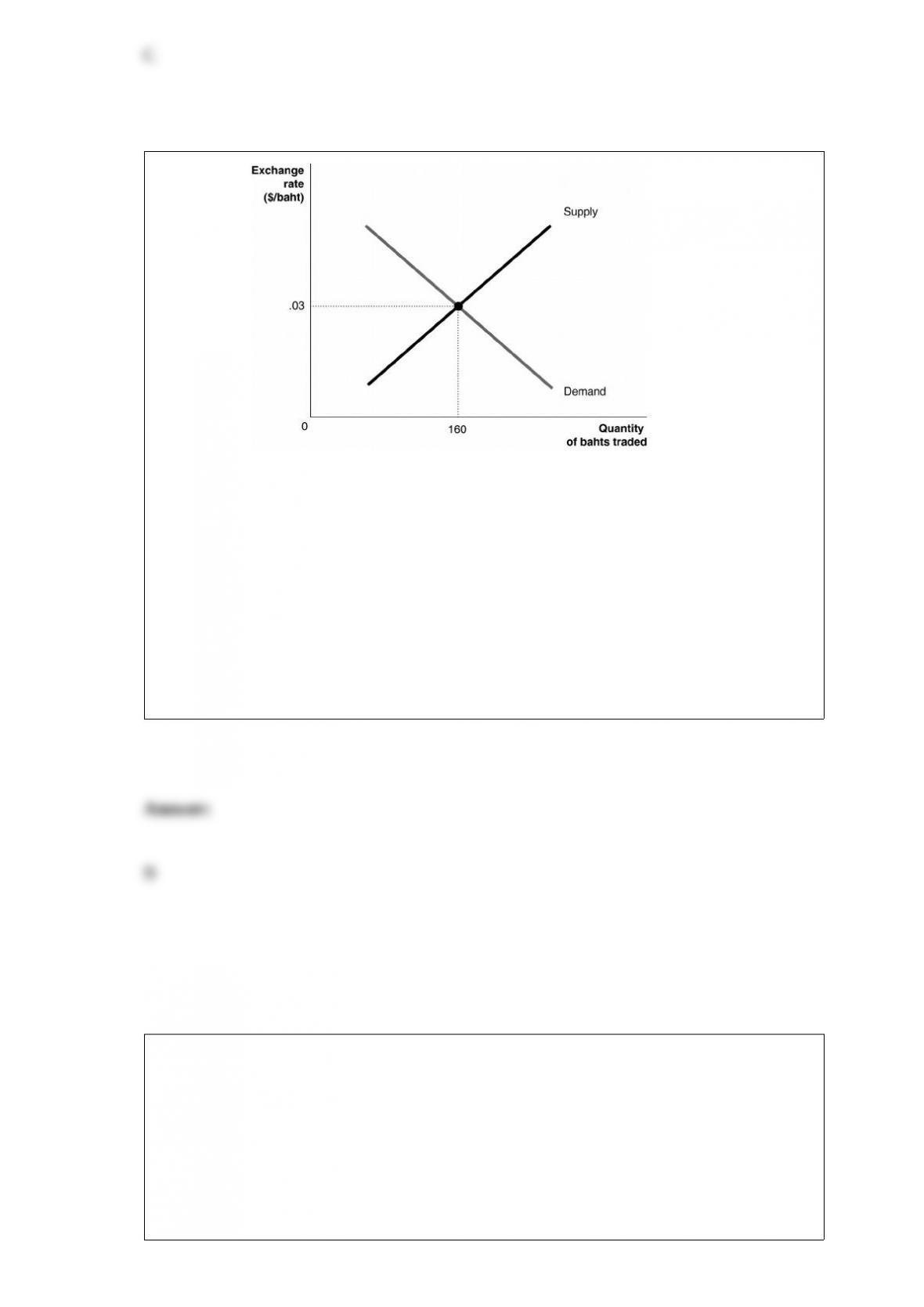
Figure 19-3
If the Thai government pegs its currency to the dollar at a value above $.03/baht, we
would say the currency is
A) undervalued.
B) overvalued.
C) parity valued.
D) equilibrium valued.
Which industry has the highest four-firm concentration ratio?
A) discount department stores
B) college bookstores
C) retail gasoline stations

D) cigarettes
Suppose a decrease in the supply of paper results in an increase in revenue. This
indicates that
A) the demand for paper is inelastic.
B) the demand for paper is elastic.
C) the supply of paper is inelastic.
D) the supply of paper is elastic.
Which of the following is not one of the three sources of technological change?
A) additional amounts of existing capital
B) better machinery and equipment
C) increases in human capital
D) better means of organizing and managing production
Money cannot serve as a medium of exchange unless it also serves as a store of value.
Is this statement true or false? Explain.
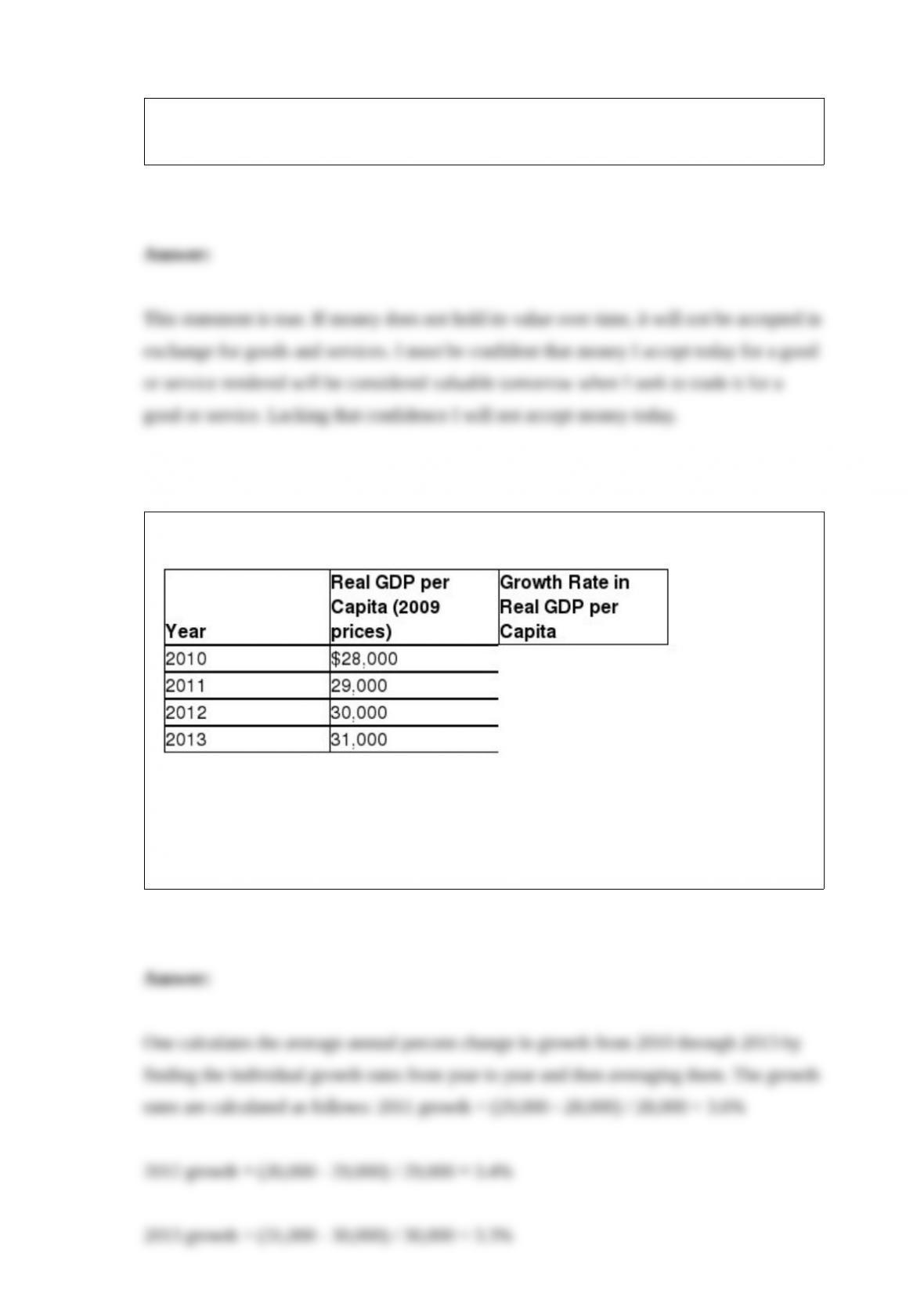
Table 11-3
Use the table above to calculate the annual growth rate in GDP. Also calculate the total
percentage change in the growth from 2010 through 2013. Explain the difference
between the average annual growth rate in real per capita GDP from 2010 through 2013
and the total percentage change in growth from 2010 and 2013.
Provide two examples of a government barrier to entry?
Explain how advances in technology are critical to sustaining economic growth, even if
capital per hour worked is consistently increasing. Provide a graph of a per-worker
production function to support your answer.
What happens to national saving when the government runs a budget surplus? What
happens to national saving when the government runs a budget deficit?
What is meant by the “law of one price”? In discussing the law of demand, Hubbard
and O’Brien claim there has been no evidence of an exception to the law (that is, no
evidence of an upward-sloping demand curve). Are there exceptions to the law of one
price?
How can a partnership raise funds needed for firm expansion?
Table 20-21
Source: Energy Information Administration
The table above reports the consumer price index and the average U.S. retail price for
unleaded regular gasoline for four different periods since 1976. Note that the gasoline
prices are in cents per gallon.
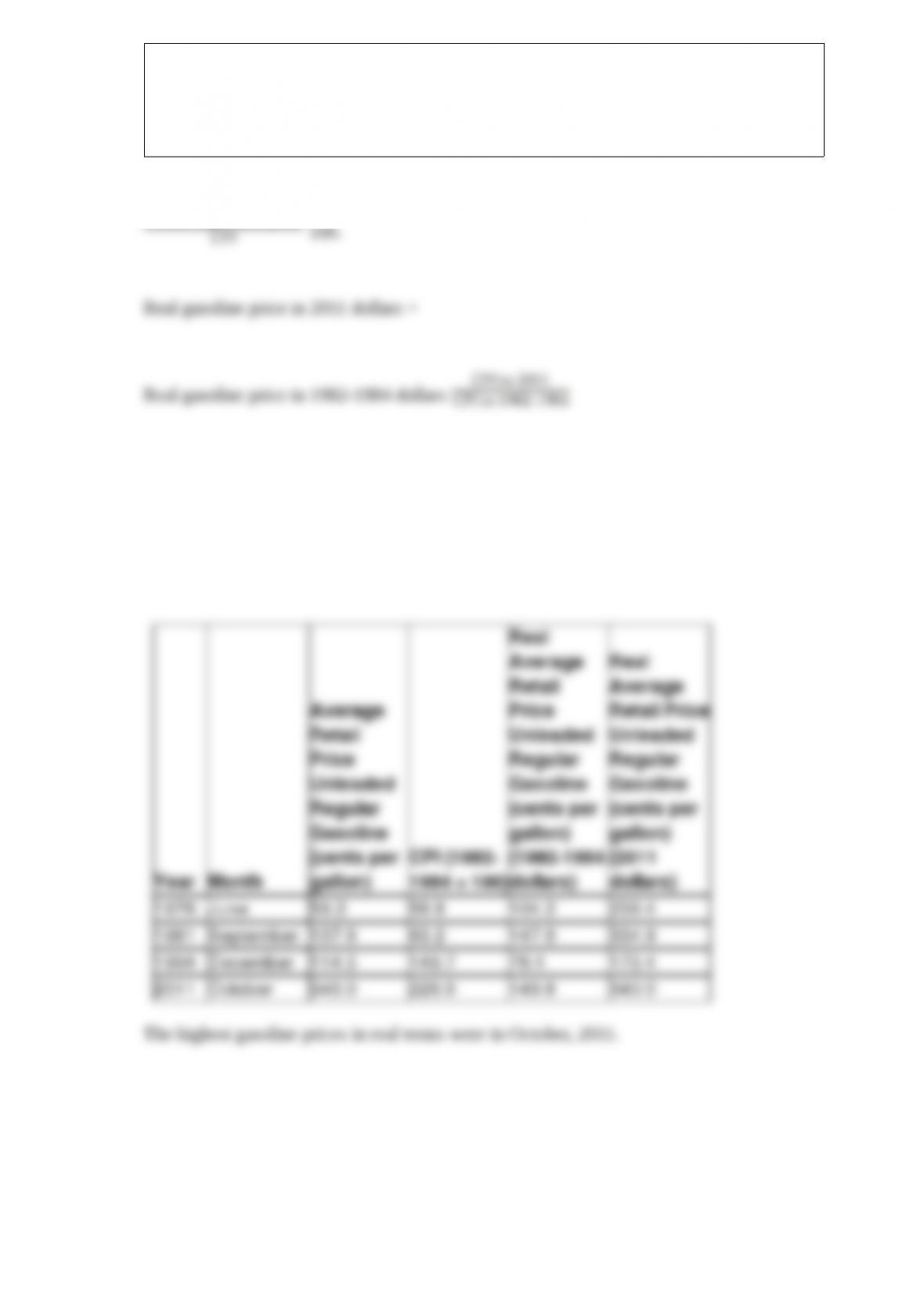
Calculate the real average retail price of unleaded regular gasoline in 1982-1984
dollars. In which period were gasoline prices the highest in real terms? Also, calculate
the real average retail price of unleaded regular gasoline in 2011 dollars.