
Which of the following is a normative economic statement?
a. If we doubled the size of welfare payments, we would reduce the number of
homeless persons.
b. Companies should be concerned with more than just their profits.
c. An increase in spending on airport security will reduce the number of hijackings.
d. If social security were to be privatized, workers would earn a higher rate of return on
their retirement contributions.
Your grandfather tells you that he earned $.50 per hour at his job when he was a boy in
1929.
a. Given that the CPI was 17.1 in 1929 and 184.0 in 2003, how much would you have
to make in 2003 to have the same real hourly wage?
b. You made $5.50 an hour working during 2003. Were you better off than your
grandfather in terms of purchasing power? Explain.
c. Your grandfather also tells you that a soda cost $.05 in 1929, and you know a soda
cost $.55 in 2003. You decide to use the price of a soda as the price index. How much
would the 2003 “soda equivalent” of $.50 per hour in 1929 be?
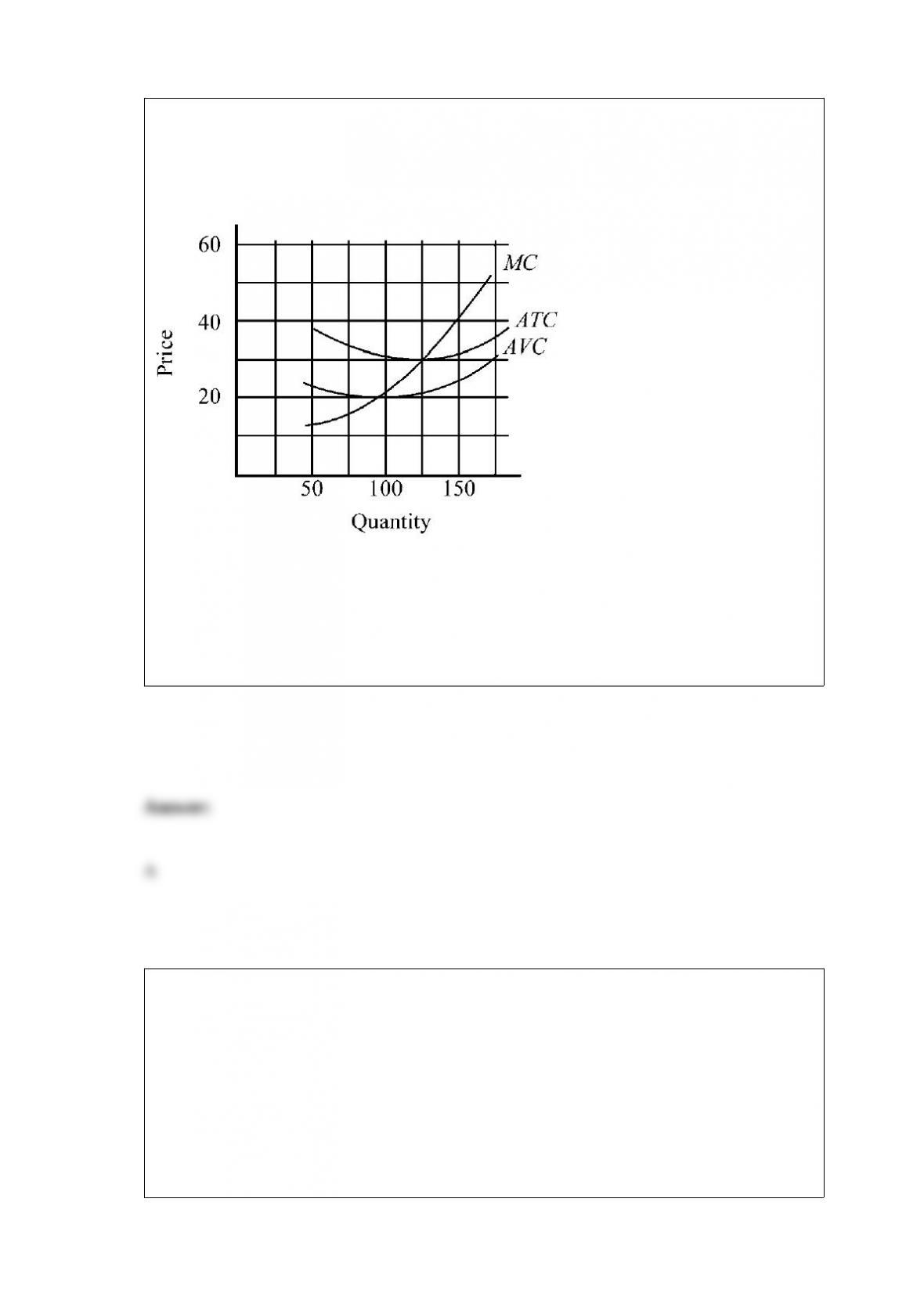
Use the figure to answer the following question(s).
Figure 9-3
For Figure 9-3, if the market price is $30, indicate the firm’s profit-maximizing output
and maximum profit.
a. profit-maximizing output, 125; maximum profit, zero
b. profit-maximizing output, 125; maximum profit, between $1,000 and $1,250
c. profit-maximizing output, 150; maximum profit, $1,500
d. profit-maximizing output, 150; maximum profit, between $1,250 and $1,500
A tax imposed on the sellers of a good will
a. raise the price paid by buyers and lower the equilibrium quantity.
b. raise the price paid by buyers and raise the equilibrium quantity.
c. raise the net price received by sellers and raise the equilibrium quantity.
d. raise the net price received by sellers and lower the equilibrium quantity.

Which one of the following would be recorded as a credit in the U.S. balance of
payments accounts?
a. the purchase of an European-made car by an American
b. the purchase of insurance from Lloyd’s of London by an American business firm
c. the purchase of an American-made computer by an European business
d. the purchase of Japanese bonds by an American investor
Assuming that firms maximize profits, how will the price and output policy of an
unregulated monopolist compare with ideal market efficiency?
a. The output of the monopolist will be too large and its price too high.
b. The output of the monopolist will be too large and its price too low.
c. The output of the monopolist will be too small and its price too high.
d. The output of the monopolist will be too small and its price too low.

An economic contraction caused by a shift in aggregate demand causes prices to
a. rise in the short run, and rise even more in the long run.
b. rise in the short run, and fall back to their original level in the long run.
c. fall in the short run, and fall even more in the long run.
d. fall in the short run, and rise back to their original level in the long run.
The distinguishing characteristics of business cycles are
a. periods of inflation followed by periods of deflation.
b. high rates of economic growth coupled with high rates of unemployment.
c. a constant rate of economic growth coupled with ups and downs in the general level
of prices.
d. periods of growth in real output followed by periods of decline.
Suppose that the consumer price index of a country was 160 at year-end 2007 and 168
at the end of 2008. What was the country’s inflation rate during 2008?
a. 5 percent
b. 8 percent
c. 60 percent

d. 68 percent
The size of a country’s “economic pie” is thought of as the total dollar value of all goods
and services produced during some period of time. The economic pie
a. is a fixed total waiting to be divided up among people.
b. determines how much wealth an individual can obtain.
c. is variable, not fixed, across time periods.
d. depends solely upon the natural resources of a country.
The marginal product of labor is the
a. value marginal product of labor multiplied by the price of the good produced.
b. total output of labor divided by the quantity of labor used.
c. additional output resulting from employing one additional unit of labor.
d. same as the marginal revenue product of labor in price-taker markets.

An economist would argue that global warming is
a. unquestionably a human-generated problem that should be stopped immediately at all
costs.
b. simply fear mongering, for there is no scientific evidence that the average
temperature on earth is changing.
c. likely to cause massive starvation as temperatures on earth rise, reducing agricultural
productivity.
d. a serious issue that may best be addressed primarily by making changes as problems
occur in the future.
Capital is a term economists use to refer to
a. man-made resources used to produce other goods and services.
b. resources that are available in nature such as mineral deposits.
c. money that is used to consume goods and services, to distinguish it from money that
is saved.
d. the value of the best alternative to an action.

Which of the following is a driving force underlying economic growth?
a. trade restrictions that protect domestic businesses from competition with foreign
producers
b. regulations that require businesses to obtain permission from the government before
starting a new business
c. tax increases that expand the revenues of the government
d. entrepreneurial discovery and production of improved products
An increase in the tariff on foreign-produced automobiles would most likely help
a. the domestic producers of automobiles.
b. steel producers that sell most of their output to foreign producers of automobiles.
c. workers in the foreign automobile industry.
d. consumers looking for alternatives to domestic automobiles.
The private sector cost of tax revenues is equal to the
a. tax revenue collected by government from individuals in the economy.

b. income that could have been earned by government employees if they had worked in
the private sector.
c. difference between government expenditures and tax revenues.
d. tax revenue plus the cost of tax compliance and the excess burden of taxation.
“The Great Depression was caused by the 1929 stock market crash.” Which of the
following is an indication that this statement is false?
a. The stock market had regained most of its losses from the October 1929 crash by
April 1930.
b. The recessionary conditions actually began in the mid-1920s before the stock market
crash.
c. The Great Depression was a result of government failure to intervene in market
activity.
d. Economic theory indicates that a reduction in stock prices would reduce the
consumer price index and thereby stimulate output and employment.
In the short run, a profit-maximizing price taker will expand output as long as the
market price exceeds
a. average variable cost.

b. marginal cost.
c. average total cost.
d. average fixed cost.
Special-interest programs are highly attractive to vote-seeking politicians because
a. these programs are highly efficient, and therefore, they tend to enhance the general
welfare of the populace.
b. members of special interest groups favoring these programs are less likely to vote
than the taxpayers who pay for them.
c. low-income recipients are the primary beneficiaries of special-interest programs.
d. members of special interest groups favoring these programs feel strongly about them
while most other voters are rationally uninformed about them.
Which of the following would tend to increase the wage of coal miners?
a. new environmental laws that make it more costly for firms to use coal in their
production process
b. an increase in the price of oil, a substitute for coal
c. a decrease in the demand for coal
d. an increase in the supply of coal miners

To the extent that current profits are directly related to future profits, a high
price/earnings ratio would indicate that stocks are
a. inexpensive.
b. expensive.
c. going to increase in value in the future.
d. most likely to fall in value if interest rates decline.
Which of the following countries have instituted liberal reforms and substantially
improved their economic freedom rating since 1990?
a. Japan and Italy
b. Nigeria and Pakistan
c. Sierra Leone and Zimbabwe
d. Estonia and Hungary

In a world where capital moves rapidly across national boundaries, if a larger budget
deficit leads to higher real interest rates,
a. there will be an inflow of foreign capital, which will cause the dollar to appreciate
and net exports to decline.
b. there will be an outflow of foreign capital, which will cause the dollar to depreciate
and net exports to increase.
c. there will be an inflow of foreign capital, which will cause the dollar to depreciate
and net exports to increase.
d. there will be an outflow of foreign capital, which will cause the dollar to appreciate
and net exports to decline.
If a decrease in the price of good Y causes the demand for good Z to decrease, this
indicates that
a. Y and Z are complements.
b. Y and Z are substitutes.
c. Y and Z are unrelated.
d. the demand for Y is elastic, but the demand for Z is inelastic.

Over time, people have come to rely more on market-produced goods and less on goods
that they produce for themselves. For example, busy people with high incomes, rather
than cleaning their own houses, hire people to clean their houses. By itself, this change
has
a. caused GDP to fall.
b. not caused any change in GDP.
c. caused GDP to rise.
d. probably changed GDP, but in an uncertain direction; the direction of the change
depends on the difference in the quality of the cleaning that has resulted.
According to economic theory, it is often rational for a politician to support special
interest groups at the expense of unorganized, widely dispersed groups (for example,
taxpayers or consumers)
a. only when the gains that accrue to the special interest group exceed the costs imposed
on other voters.
b. when nonspecial-interest voters are unconcerned or uninformed about the issue, and
campaign funds are readily available from the special interest group.
c. only if the government action is socially efficient.
d. only if the government action will reduce the monopoly power of business or labor
and, thereby, lead to an improvement in the general welfare of consumers.

An unanticipated increase in the money supply will lead to
a. a decline in interest rates, an increase in investment, and an increase in aggregate
demand.
b. a decline in interest rates, a decrease in investment, and an increase in aggregate
demand.
c. a decline in interest rates, an increase in investment, and a decline in aggregate
demand.
d. an increase in interest rates, an increase in investment, and an increase in aggregate
demand.
e. a decline in interest rates, a decline in investment, and a decline in aggregate demand.
Which of the following is a partially valid economic argument for restricting free trade?
a. Restrictions on foreign trade will increase employment and permanently reduce
unemployment.
b. Infant industries may need temporary protection to develop and gain productive
efficiency.
c. A nation needs to protect its national defense; hence, it should restrict some products
that threaten an industry considered vital to its defense.
d. Both b and c are correct.
Which of the following will most likely accompany an unanticipated reduction in
aggregate demand?
a. an increase in the general price level
b. an increase in unemployment

c. an increase in real GDP
d. an increase in resource prices
The most effective fiscal stimulus will
a. create jobs, even if the employment is on unproductive projects.
b. substantially change the composition of aggregate demand.
c. encourage interest groups to lobby more intensely and make larger political
contributions.
d. direct the economy to full employment and direct resources toward economically
productive projects.
In 1980, the price of a gallon of gasoline was $1.25. The Consumer Price Index was
82.4 in 1980 compared to 215.3 in 2008 (1983 1984 = 100). Measured in 2008 dollars,
the price of gasoline in 1980 was
a. $0.56.
b. $1.25.
c. $2.37.
d. $3.27.

The economic way of thinking stresses that
a. changes in personal costs and benefits generally fail to exert much impact on
behavior.
b. incentives matter–individuals respond in predictable ways to changes in personal
costs and benefits.
c. if one individual gains from an economic activity, then someone else must lose and in
the same proportion.
d. if a good is provided by the government, its production will not consume valuable
scarce resources.
Adam Smith believed that if people were free to pursue their own interests,
a. public interest would be served quite well.
b. less would be produced than if altruism were the guiding principle.
c. they would generally apply their talents to unproductive activities that would
generate little value to society.
d. they would have little incentive to undertake productive activities.

High income countries with larger governments as a share of GDP have generally
a. grown less rapidly than their counterparts with smaller governments.
b. experienced less deadweight losses resulting from taxes and/or government
borrowing.
c. seen the government decrease in size as real GDP rises.
d. been able to be more economically efficient.
The period of declining growth in real GDP between the peak of the business cycle and
the trough is called the
a. contractionary phase.
b. boom.
c. expansionary phase.
d. stationary phase.