
Suppliers will be willing to supply a product only if
A) the price received is less than the additional cost of producing the product.
B) the price received is at least equal to the additional cost of producing the product.
C) the price is higher than the average cost of producing the product.
D) the price received is at least double the additional cost of producing the product.
The size of the underground economy would tend to increase if the government of a
country
A) decreased government regulations on businesses.
B) increased income tax rates.
C) legalized prostitution.
D) legalized marijuana.
A key difficulty facing insurance companies is that people know more about their health
than do insurance companies, and that those people who are seriously ill are the most
likely to want to obtain health insurance. What is this phenomenon called?
A) moral hazard
B) economic irrationality
C) asymmetric information

D) adverse selection
In 2013, Smileytown consumed 12,000 gallons of mouthwash. In 2014, mouthwash
consumption rose to 17,000 gallons. Calculate the percentage change in mouthwash
consumption.
A) 17.2%
B) 29.4%
C) 41.7%
D) 70.6%
Which of the following is included in gross domestic product for an economy in a given
year?
A) the value of intermediate goods produced in that year
B) the value of used goods sold in that year
C) the value of final goods produced in that year
D) All of the above would be included in gross domestic product for an economy in a
given year.

If the purchasing power of a dollar is less than the purchasing power of the euro,
purchasing power parity would predict that
A) in the short run, exchange rates will move to equalize the purchasing power of the
dollar and the euro.
B) in the long run, exchange rates will move to equalize the purchasing power of the
dollar and the euro.
C) in the long run, interest rates will move to equalize the purchasing power of the
dollar and the euro.
D) in the short run, interest rates will move to equalize the purchasing power of the
dollar and the euro.
Which of the following is an examples of spending on factors of production in the
circular flow model?
A) Orson buys a package of beef jerky at a convenience store.
B) Bernadette gets a manicure and pedicure before attending her parents’ anniversary
party.
C) Landon pays $100 for a season pass to a water park.
D) The “Suds Bucket” car wash buys new squeegees for all its employees.

Table 7-6 Production and
Consumption Production
Without Trade With Trade
Estonia and Morocco can produce both swords and belts. Table 7-6 shows the
production and consumption quantities without trade, and the production numbers with
trade. Which country has an absolute advantage in producing belts?
A) Estonia
B) Morocco
C) both countries
D) neither country
If diminishing marginal returns have already set in for Golden Lark Woodworks, and
the marginal product of the 6th carpenter is 8 chairs, then the marginal product of the
7th carpenter is
A) negative.
B) less than 8 chairs.
C) more than 8 chairs.
D) zero.

If New Yorkers decrease their purchases of French champagne, assuming all else
remains constant, this will ________ of the United States.
A) increase the balance of trade
B) decrease net exports
C) decrease the current account balance
D) increase the trade deficit
E) increase the balance of payments
Which of the following would increase the balance on the current account?
A) an increase in foreign direct investment
B) an increase in the amount of aid money the government sends abroad
C) an increase in imports
D) an increase in the balance of trade
The antitrust law that prohibits price discrimination on grounds that it reduces
competition is
A) the Clayton Act.
B) the Federal Trade Commission Act.
C) the Robinson-Patman Act.
D) the Sherman Act.
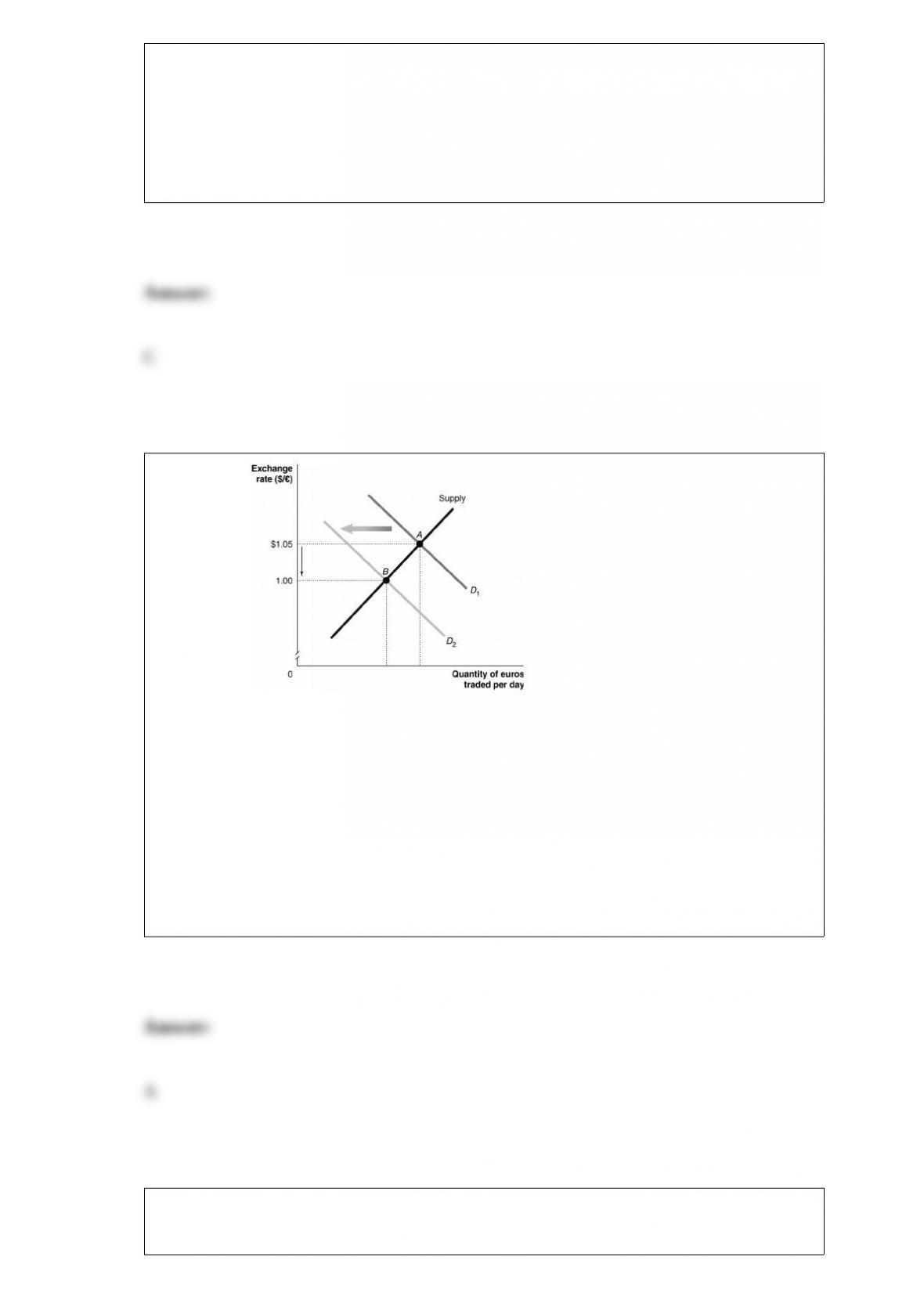
Figure 30-1
Which of the following would cause the change depicted in the figure above?
A) U.S. productivity rises relative to European productivity.
B) Europeans decrease their preferences for U.S. goods relative to European goods.
C) The European Union increases its quotas on French wine.
D) an increase in the price level of U.S. goods relative to European goods
A virtuous cycle occurs

A) when lobbyists petition members of Congress to grant a public franchise; the
lobbyist then raise money for those Congress members who granted the franchise.
B) when monopoly profits are used to create new products for additional monopoly
profits.
C) when a firm can attract enough buyers initially to increase a product’s usefulness to
attract even more buyers.
D) when a firm’s sales volume reaches a level where the firm can take advantage of
economies of scale; thereby reducing the price of the product to further boost its sales.
A change in the price of a good has two effects on the quantity consumed. What are
these effects?
A) the income effect and the substitution effect
B) the utility effect and the budget effect
C) the total utility effect and marginal utility effect
D) the consumption effect and expenditure effect
If the slope of the per-worker production function is 1/2 in a given range, how will a
$10,000 increase in capital per hour worked affect real GDP per hour worked in the
same given range?
A) Real GDP per hour worked will increase by $5,000.
B) Real GDP per hour worked will increase by $20,000.

C) Real GDP per hour worked will increase by $10,000.
D) Real GDP per hour worked will decrease by $20,000.
The total value to society of having garbage removed is greater than the value of
baseball games. Why, then, are baseball players paid more than garbage collectors?
A) Although the total value of garbage removal is greater than the total value of
baseball, wages are determined by average values.
B) Garbage removal results in significant external benefits that are not captured in the
price paid for garbage removal. As a result, wages of garbage collectors do not reflect
their social benefits.
C) There is greater competition in the garbage collection industry than there is in Major
League Baseball.
D) Wages do not depend on total values but marginal values. The marginal revenue
product of baseball players exceeds the marginal revenue product of garbage collectors.