
One difficulty of computing the value of GDP is that there are no market prices for
a. exports and imports.
b. business investments.
c. government goods and services.
d. resource values.
Which of the following is characteristic of a firm that is a competitive price searcher?
a. The firm faces an upward-sloping demand curve.
b. The firm faces an inelastic demand curve.
c. The firm faces a horizontal demand curve.
d. The firm produces a differentiated product.
Other things constant, which of the following will most likely cause the dollar to
appreciate on the exchange rate market?
a. higher interest rates in the United States
b. a relatively low rate of inflation in the United States
c. high rates of income growth in Europe
d. all of the above

Means-tested income transfers refer to
a. the average amount of the annual governmental transfers.
b. transfers that are limited to families with an income below a certain cutoff point.
c. income transfers that are specifically paid for by the top 1 percent (wealthiest) of tax
payers.
d. none of the above.
If an investment project costing $2,800 was expected to yield $1,000 (to be received at
year end) for each of the next three years, a profit-maximizing entrepreneur would
a. definitely undertake the project.
b. never undertake the project.
c. undertake the project if the interest rate was low enough.
d. undertake the project if the interest rate exceeded 12 percent.
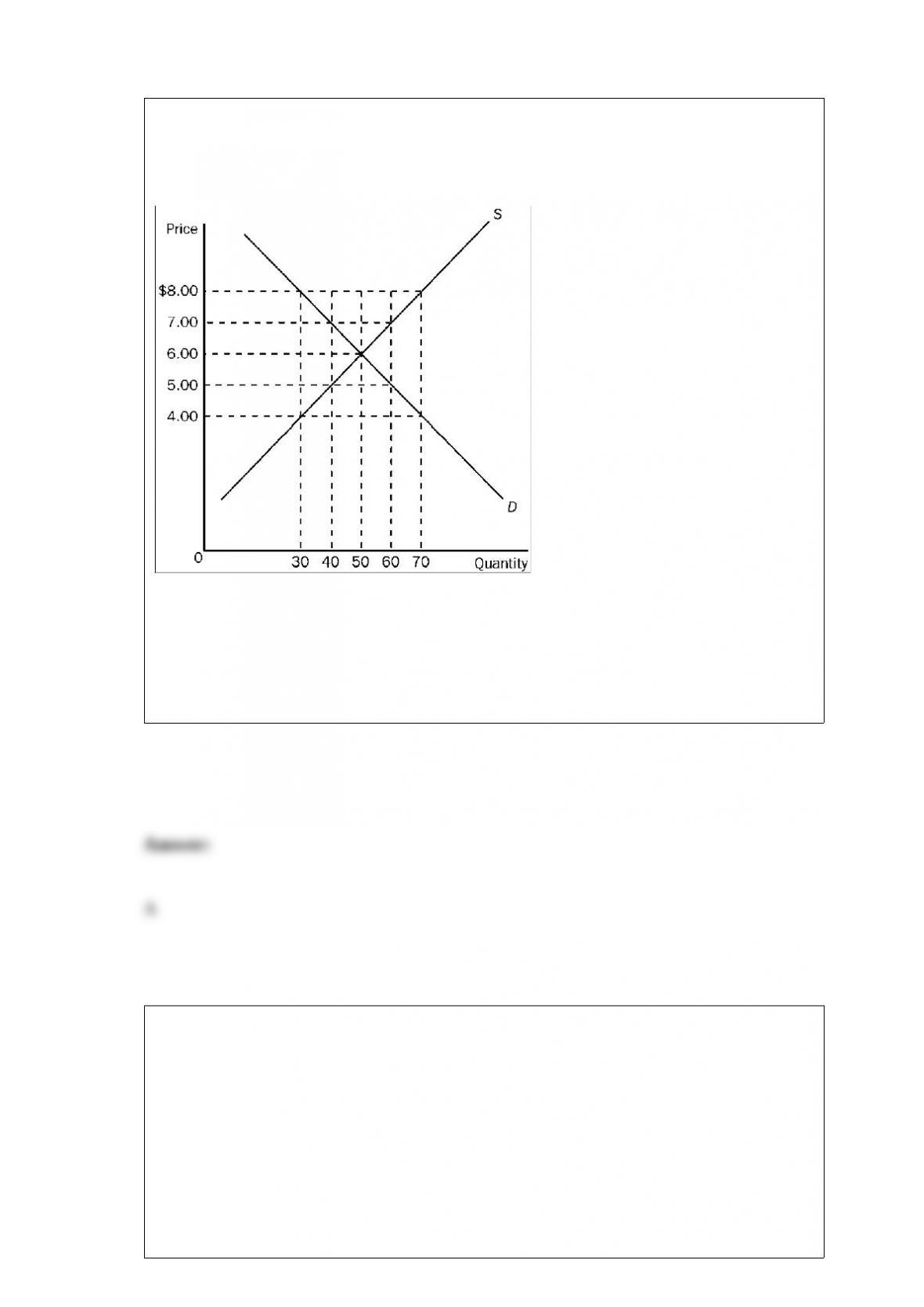
Figure 4-17
Refer to Figure 4-17. Which of the following price controls would cause a shortage of
10 units of the good?
a. a price ceiling of $5.50
b. a price floor of $5.50
c. a price ceiling of $6.50
d. a price floor of $6.50
If a household has $40,000 in taxable income and its tax liability is $4,000, the
household’s average tax rate is
a. 10 percent.
b. 25 percent.
c. 40 percent.
d. 50 percent
In the short run, a price searcher wishing to maximize profits or minimize losses should
produce the output that
a. equates marginal cost with marginal revenue.
b. equates marginal cost with price.
c. corresponds to the lowest point on the average variable cost curve.
d. corresponds to the lowest point on the average total cost curve.
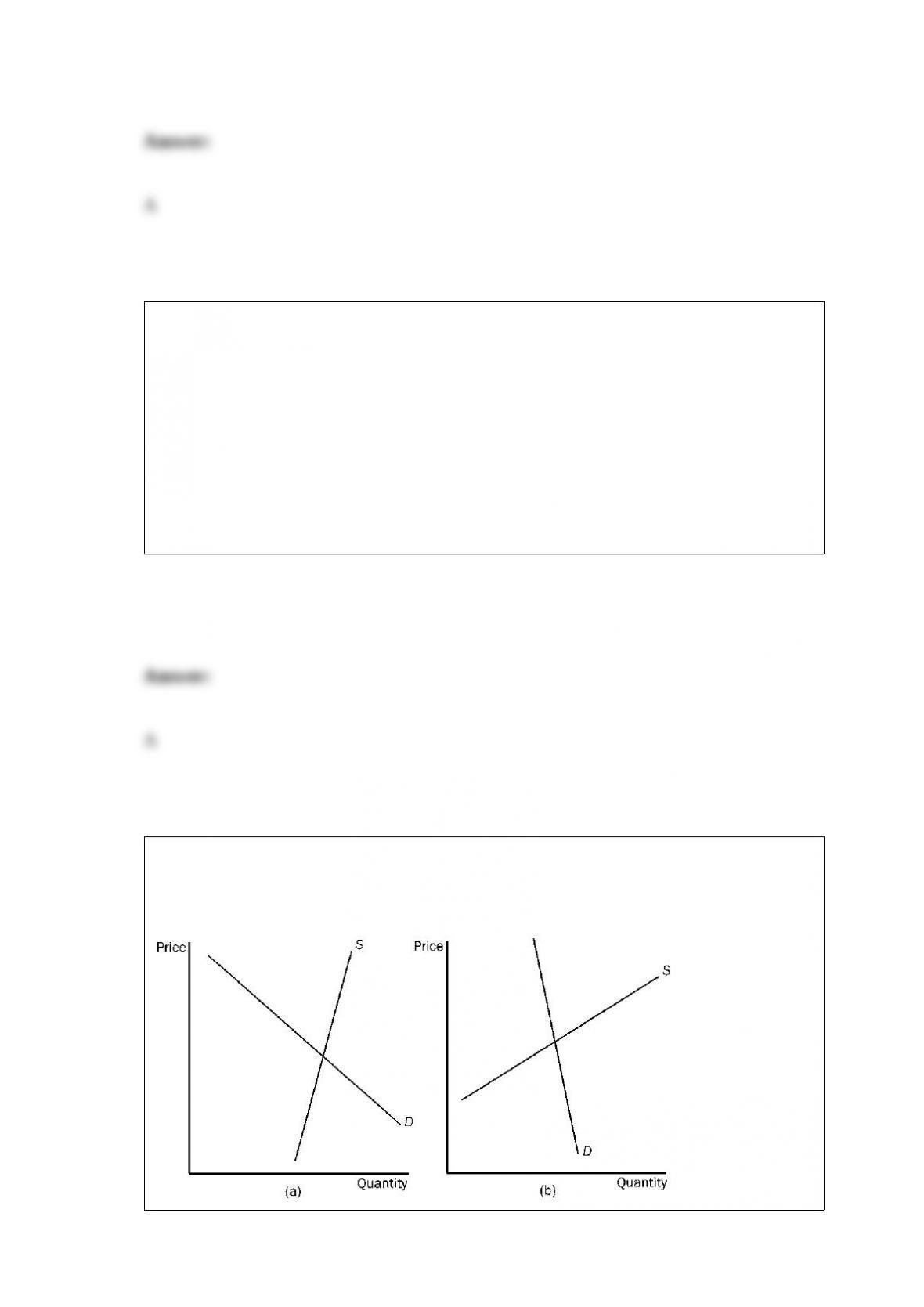
Figure 4-23
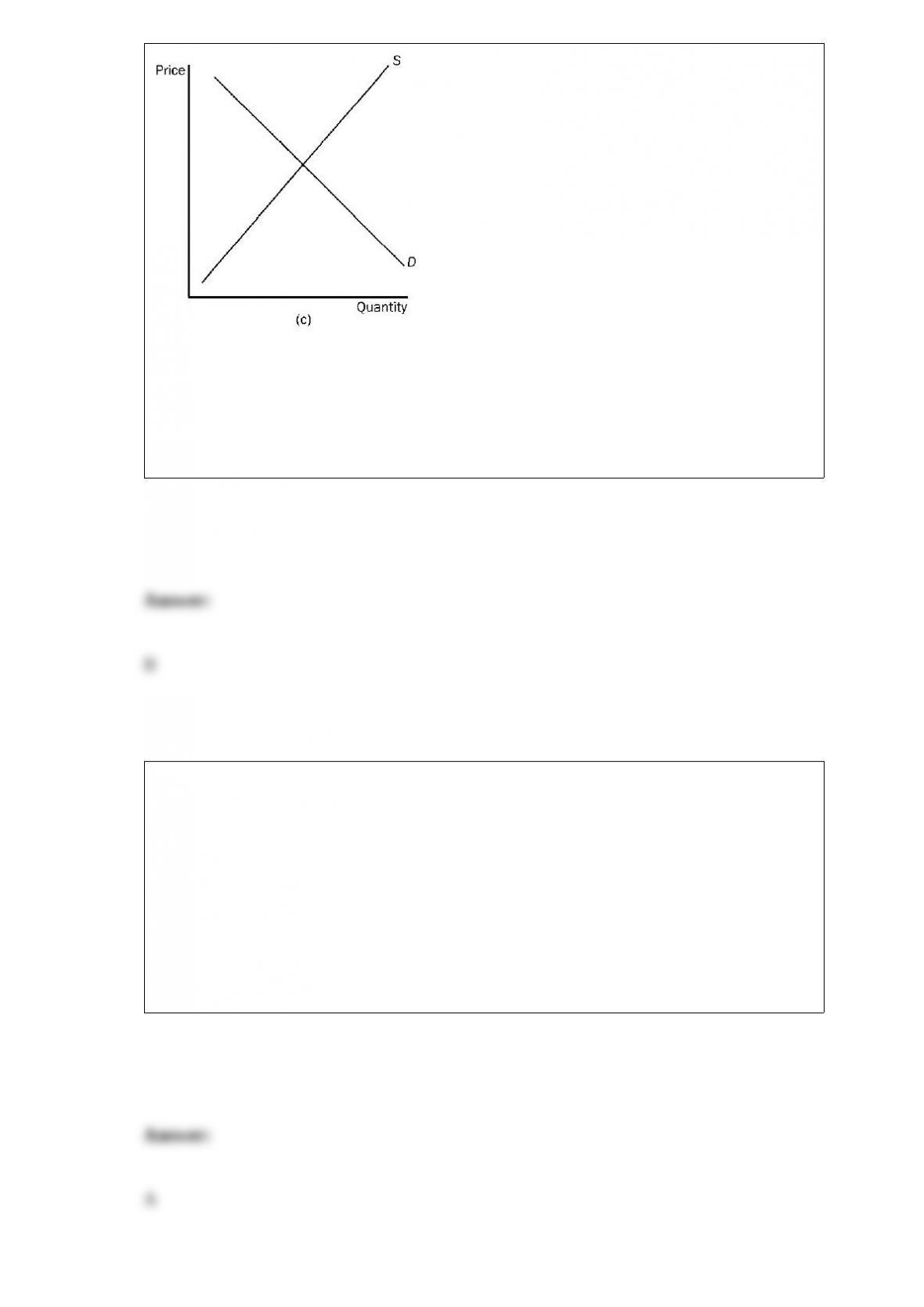
Refer to Figure 4-23. In which market will the majority of the tax burden fall on the
buyer?
a. market (a)
b. market (b)
c. market (c)
d. All of the above are correct.
For the past several decades, the percentage of national income in the United States
allocated to physical capital (rents, interest, profit) has been approximately
a. 20 percent.
b. 40 percent.
c. 60 percent.
d. 80 percent.

The intersection of a firm’s marginal revenue and marginal cost curves determines the
level of output at which
a. total revenue is equal to variable cost.
b. total revenue is equal to fixed cost.
c. total revenue is equal to total cost.
d. profit is maximized.
An analysis of countries experiencing rapid inflation indicates that inflation is generally
a. caused by strong labor unions that push wages up rapidly.
b. caused by rapid growth in the money supply.
c. the result of restrictive macroeconomic policy, which pushes up interest rates.
d. the result of bad weather conditions that reduce the supply of agriculture products.
Use the figure below to answer the following question(s).
Figure 10-1
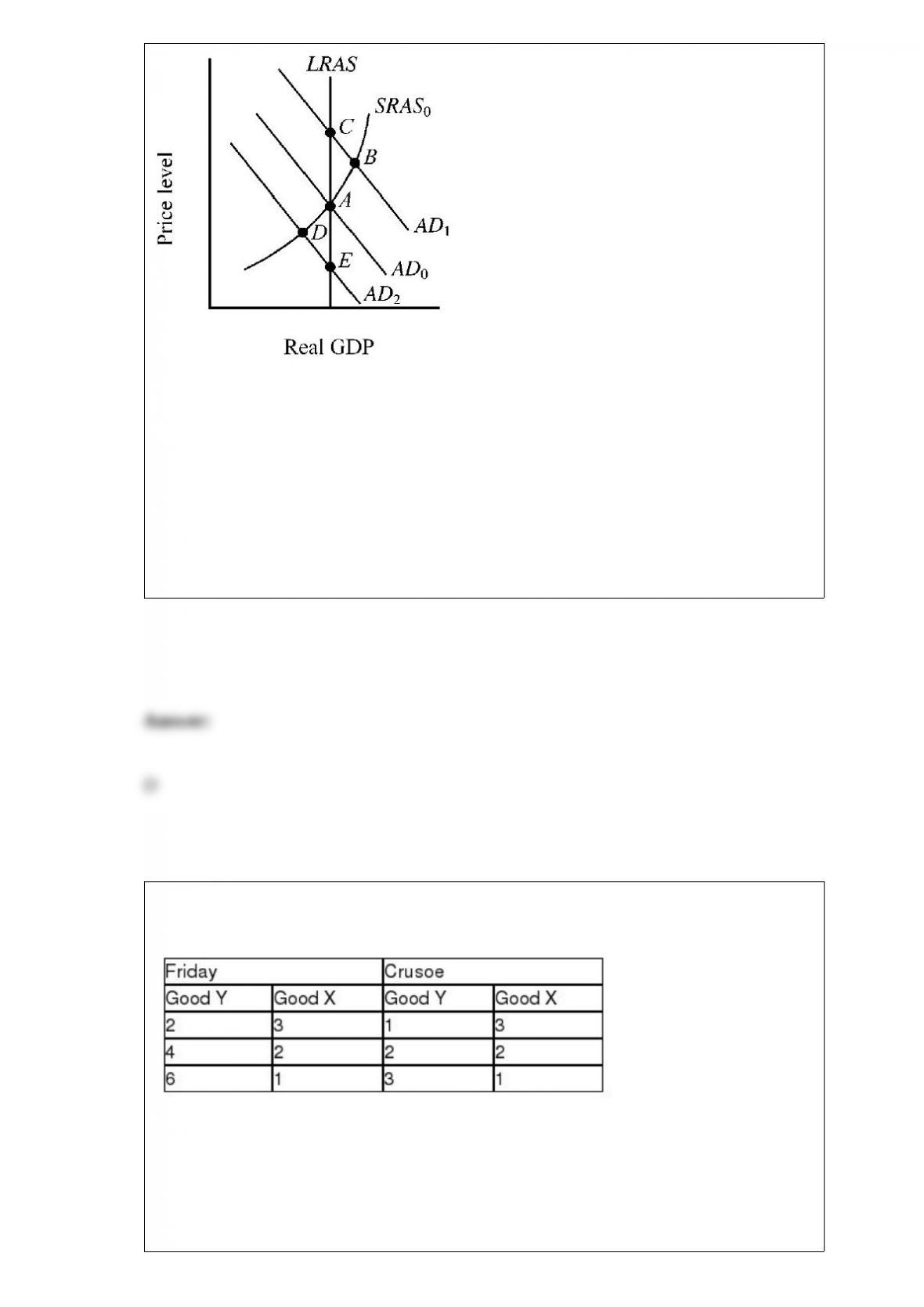
At which point in Figure 10-1 is the economy experiencing an economic recession?
a. A
b. B
c. C
d. D
Use the table below to choose the correct answer. The table outlines the production
possibilities of Robinson Crusoe and Joe Friday.
If Crusoe and Friday want to maximize their consumption possibilities,
a. Crusoe should specialize in producing good X and Friday in producing good Y, but
no trade should be allowed.

b. Crusoe should specialize in producing good X and Friday in producing good Y; trade
should occur to maximize joint consumption.
c. Crusoe should specialize in producing good Y and Friday in producing good X; trade
should occur to maximize joint consumption.
d. both individuals should strive for self-sufficiency, which always maximizes output.
Other things constant, how will a decrease in the wages of teenagers affect the market
for fast food hamburgers?
a. The supply of fast food hamburgers will increase, leading to an increase in the price
of hamburgers.
b. The supply of fast food hamburgers will increase, leading to a reduction in the price
of hamburgers.
c. The supply of fast food hamburgers will decrease, leading to an increase in the price
of hamburgers.
d. The supply of fast food hamburgers will decrease, leading to a reduction in the price
of hamburgers.
Which of the following would most likely cause a firm’s cost curve to shift downward?
a. an increase in resource prices
b. an increase in government regulations

c. a decrease in taxes
d. an increase in demand for the firm’s product
The concept of “proved reserves” refers to the amount of a resource that can be
produced
a. in one year’s time.
b. in the next ten years.
c. before it runs out.
d. at current prices and technology.
Which of the following has resulted from the North American Free Trade Agreement
(NAFTA)?
a. trade between the United States and Mexico increased.
b. trade between the United States and Canada increased.
c. the joint output of the United States, Mexico, and Canada has increased.
d. all of the above are correct.

Economic theory indicates that the behavior of
a. government employees differs from the behavior of employees in the private sector
because government employees generally disregard their own personal self-interest
when making decisions.
b. elected public officials differs from the behavior of all other individuals in society
because they are not influenced by private interests.
c. individuals when they make decisions about who to vote for is very different from the
behavior of these same individuals when they make other types of choices.
d. voters, government employees, and public officials is best understood by applying
the same basic principle we use to predict the behavior of people in the private
sector–that incentives matter.
Which is more likely to stimulate aggregate demand in a timely manner?
a. a tax cut, because households will increase their consumption by the full amount of
their tax reduction
b. a tax cut, because disbursement can take place quickly while spending increases are
generally spread out over several years
c. a spending increase, because disbursement can take place quickly while a tax cut will
be spread out over several years
d. a spending increase, because it can be easily reversed once the economy has
recovered

Which of the following will tend to increase the ability of a union to increase the wages
of its members?
a. Almost all of the firms in the industry are unionized.
b. Foreign competition for the product produced by the union labor is intense.
c. There is a reduction in the demand for union labor.
d. The demand for the product produced by the union labor is highly elastic.
Under the current structure of Medicare, the movement of the baby boom generation
into the retirement phase of life will
a. increase the demand for medical services and the share of those services financed by
third parties.
b. push both healthcare prices and expenditures upward.
c. cause Medicare expenditures to increase and necessitate the need for higher taxes to
finance the program.
d. do all of the above.

Which of the following will increase economic freedom?
a. freedom to enter and compete in markets
b. high tariff rates
c. high taxes
d. rapid and unpredictable inflation
Monetarists reject using discretionary monetary policy as an effective stabilization tool
because
a. it would require the money supply to grow at a rate equal to the economy’s long-run
rate of economic growth.
b. they do not believe that changes in the money stock affect output or prices.
c. they believe that there are lengthy and variable time lags between when a change in
monetary policy is instituted and when the change exerts its primary impact on output
and prices.
d. they believe monetary policy can stimulate aggregate demand, but it cannot control
inflation.
In economics, transaction costs refer to the
a. time, effort, and other resources needed to search out and negotiate an exchange.

b. dollar cost or price of the item traded.
c. cost an economy suffers when it allows specialization according to comparative
advantage.
d. amount by which the price of an item increases due to the presence of a middleman.
In 2008-2009, which of the following weakened the demand stimulus effects of
expansionary fiscal policy?
a. the unwillingness of the federal government to run budget deficits
b. the heavy indebtedness of American households
c. a high level of household spending on big-ticket items such as houses and cars, which
do not promote economic growth
d. the continuation of the high saving rates on the part of Americans
Which of the following states had the highest incidence of union membership as a
percent of all wage and salary workers in 2012?
a. New York
b. Arkansas

c. North Carolina
d. California
Suppose that a price-discriminating firm divides its market into two segments. If the
firm sells its product for a price of $22 in the market segment where demand is
relatively less elastic, the price in the market segment whose customers’ demand is
more elastic will be
a. $22.
b. greater than $22.
c. less than $22.
d. $22 plus average fixed costs
Economic theory suggests that the standard of living of American workers would fall if
the
a. knowledge and skills of workers improved, reducing the need for workers.
b. United States had more natural resources.
c. United States turned to more automated methods of production.
d. productivity of American workers declined.

Specialization in production is beneficial because
a. it allows everyone to have a job that they like.
b. it permits people to expand production and achieve rates of output that would
otherwise be unattainable.
c. it allows everyone to be self-sufficient.
d. it eliminates the need for the division of labor.
If a firm’s average total costs fall as it produces a larger output,
a. average variable cost must also decline as output expands.
b. marginal cost must also decline as output expands.
c. average fixed cost must be less than average variable costs.
d. marginal cost must be less than average total cost.

The agreement of the United States, Canada, and Mexico to eliminate tariffs on the
shipment of most products among the three countries is called the
a. General Agreement on Tariffs and Trade.
b. Uruguay Round.
c. North American Free Trade Agreement.
d. Tariff Reduction Act of 1993.
An increase in the expected future price of a good will cause the current demand for the
good to
a. decrease, which is a shift to the left of the demand curve.
b. decrease, which is a shift to the right of the demand curve.
c. increase, which is a shift to the left of the demand curve.
d. increase, which is a shift to the right of the demand curve.