Which of the following statements is INCORRECT?
A) A firm’s total economic cost is at least as large as the firm’s total accounting cost.
B) A firm’s total economic cost includes both explicit cost and implicit cost of the firm.
C) A firm’s implicit cost is the opportunity cost of non-purchased inputs.
D) A firm’s total accounting cost is at least as large as the firm’s implicit cost.
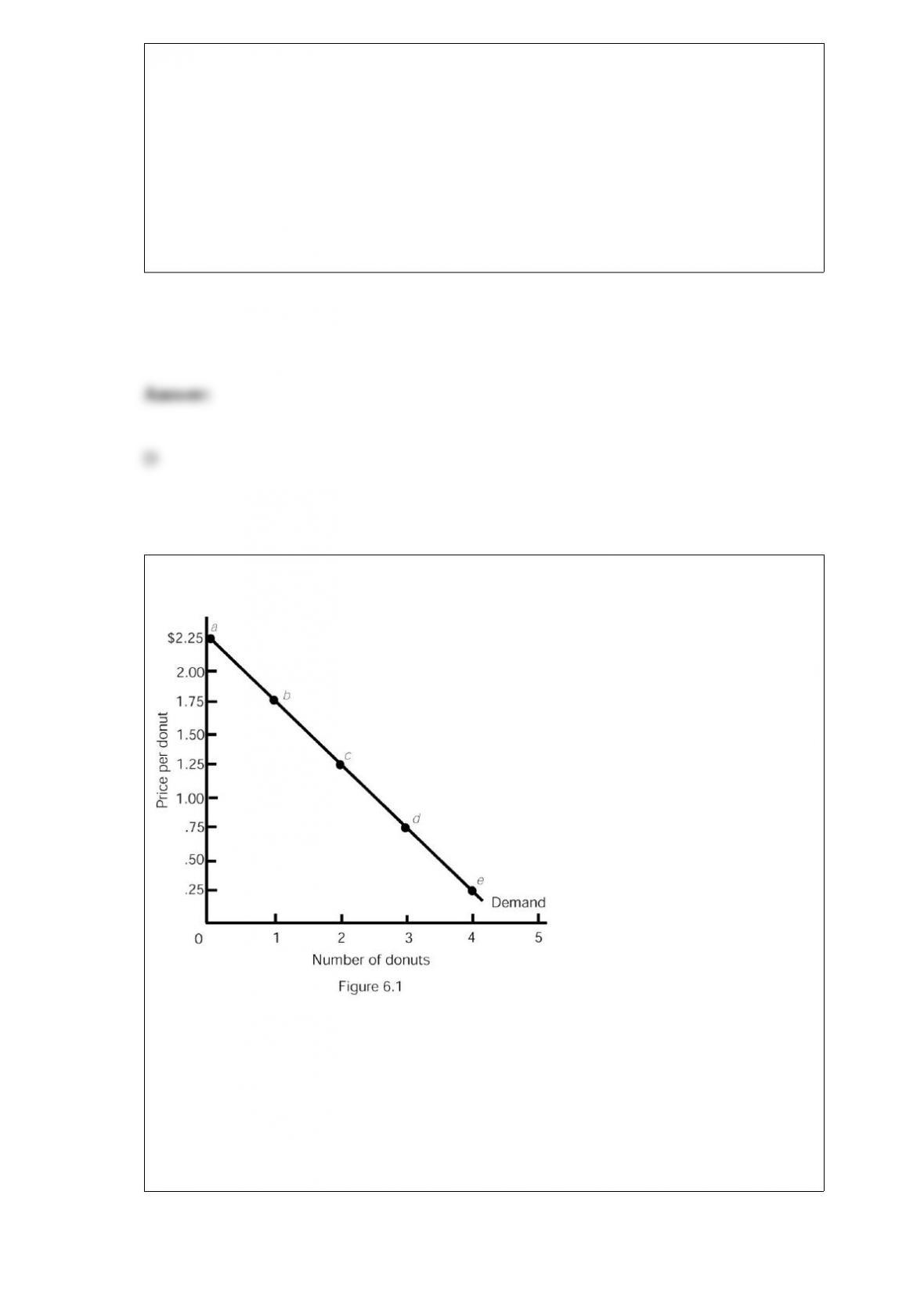
Refer to Figure 6.1. If the price of a donut is $ .75, consumer surplus is:
A) $1.75.
B) $1.50.
C) $ .75.
D) $ .50.
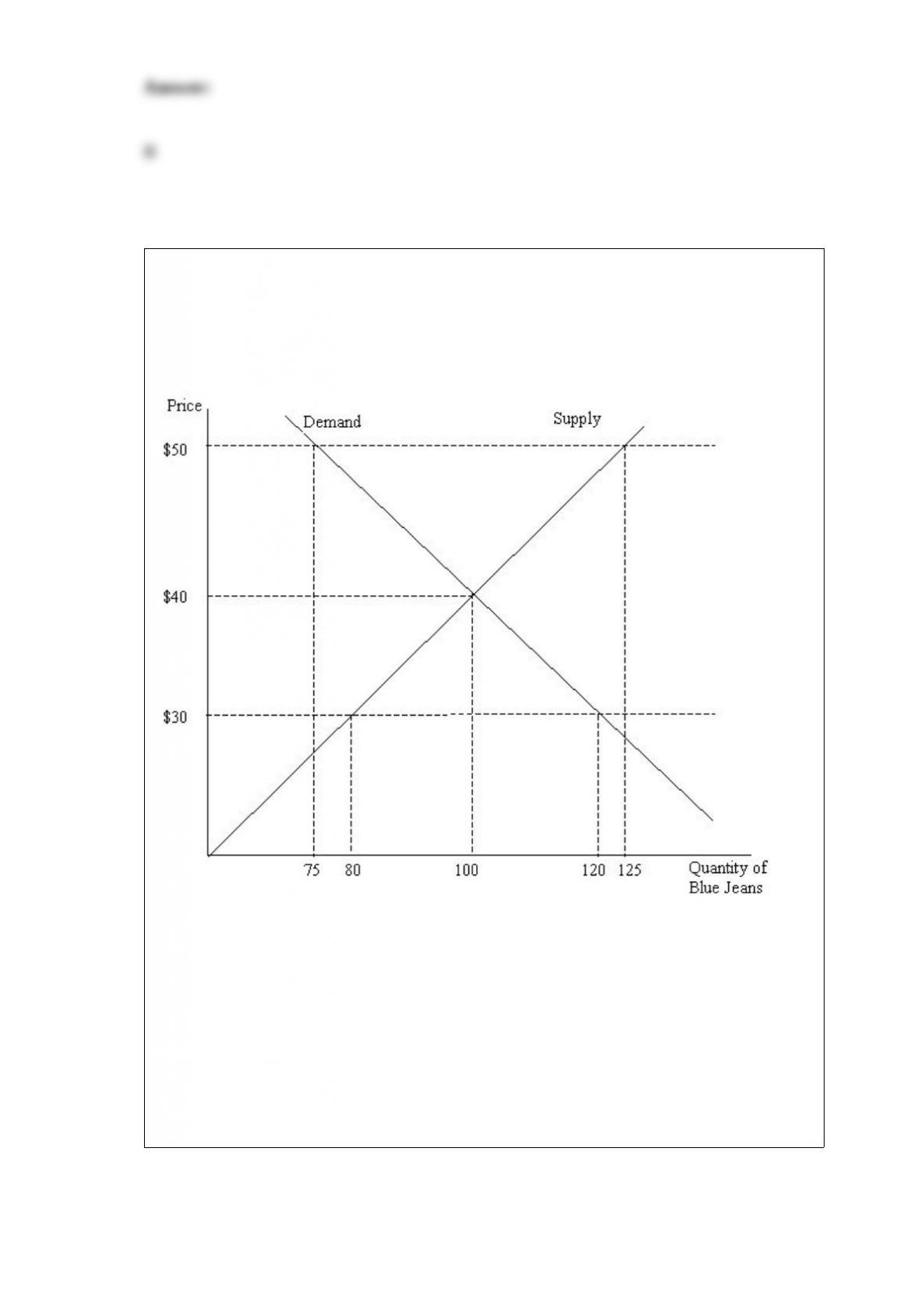
Figure 4.3 illustrates the supply and demand for blue jeans. If the actual price of blue
jeans is $50, we would expect the price of blue jeans to ________, the quantity
demanded of blue jeans to ________, and the quantity supplied of blue jeans to
________.
Figure 4.3
A) increase; increase; increase
B) increase; decrease; increase
C) decrease; increase; decrease
D) decrease; decrease; increase
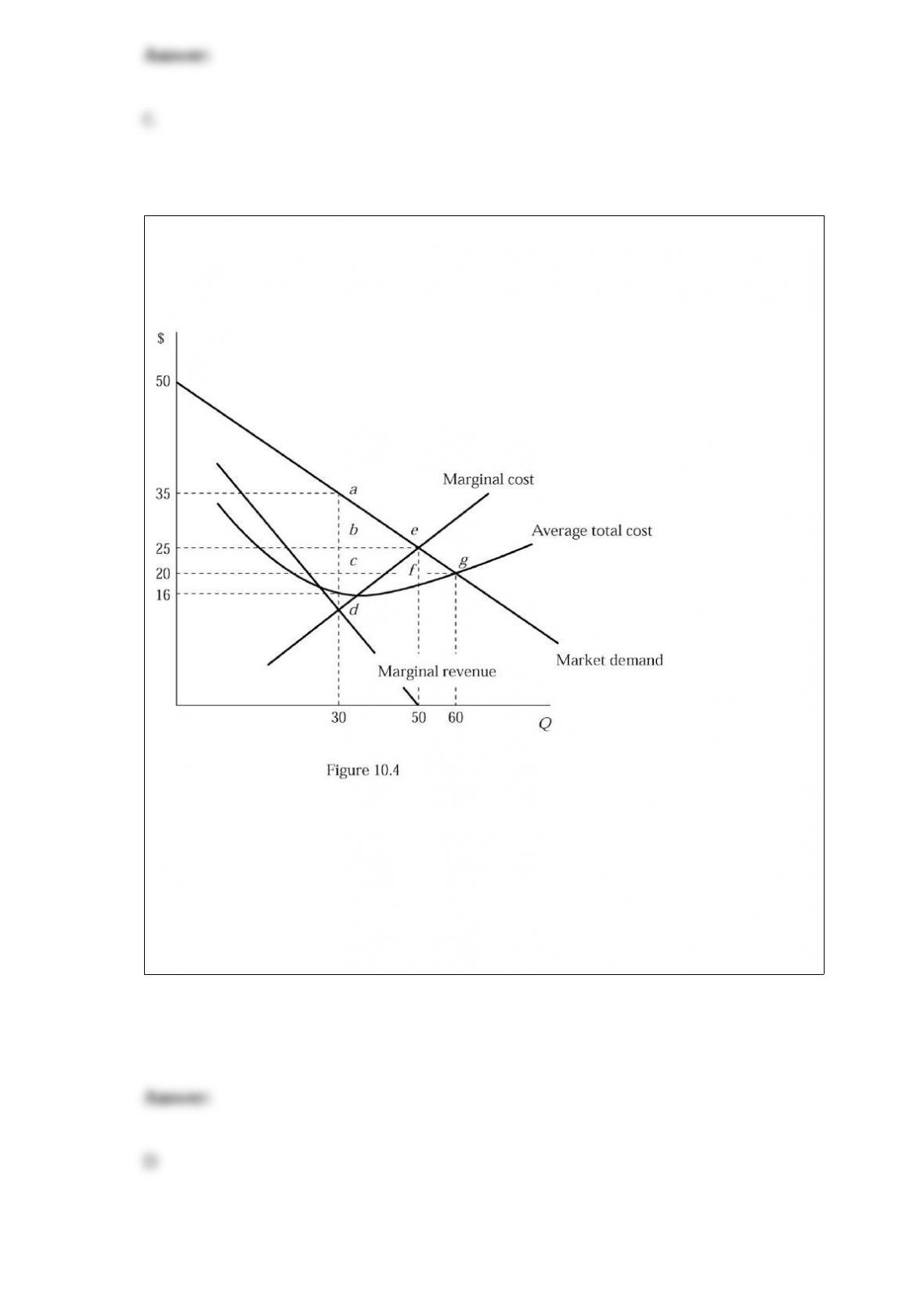
Suppose that Figure 10.4 shows an industry’s market demand, its marginal revenue, and
the production costs of a representative firm. If the industry was perfectly competitive,
a representative firm’s profit would be:
A) $1,250.
B) $450.
C) $250.
D) There is not sufficient information.
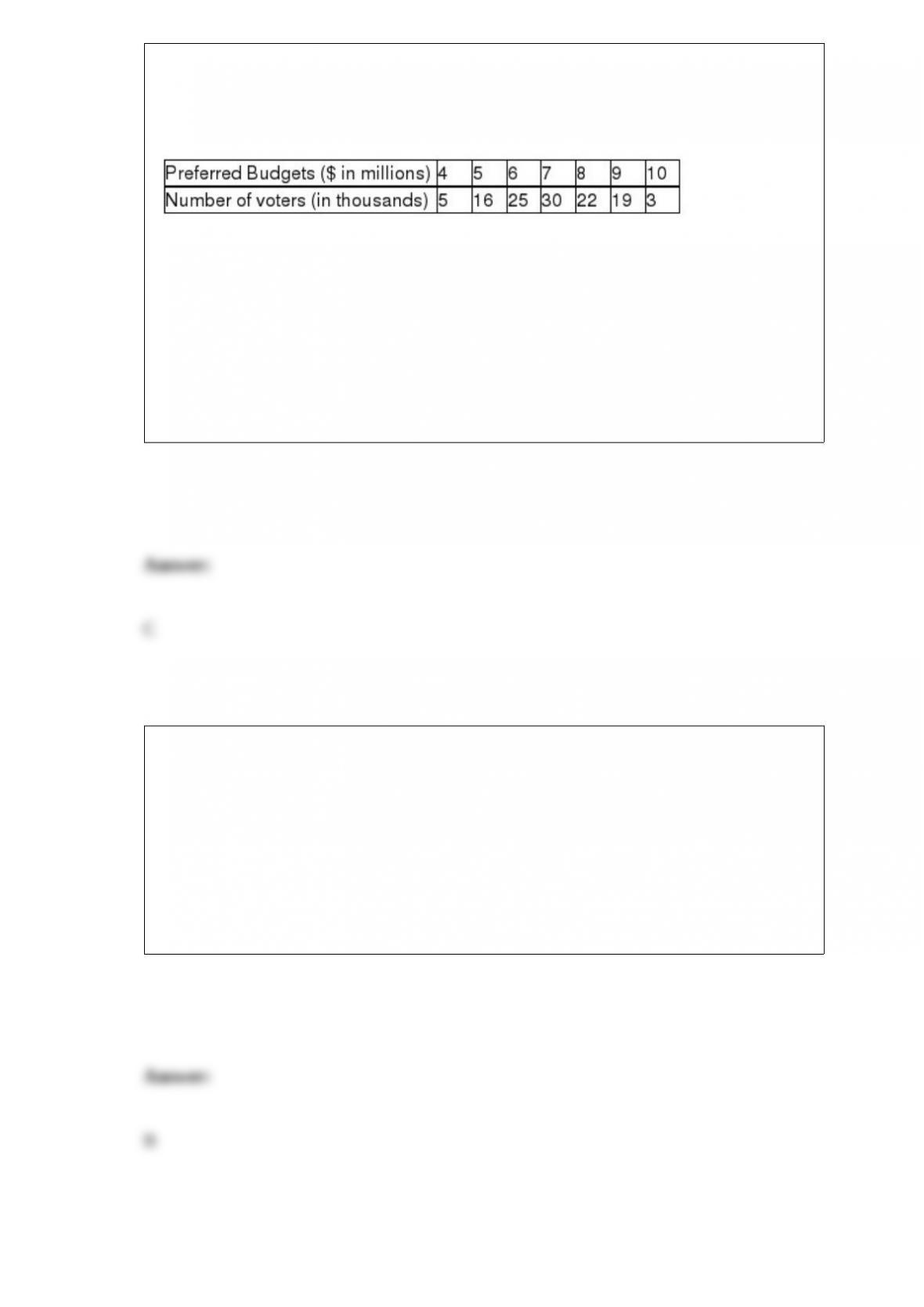
Table 15.3 shows the preferred budget for a new performance center and the number of
voters in a community who prefer that budget. If Dawn proposed $6 million while Terry
proposed $9 million, Dawn will get ________ thousand votes while Terry gets
________ thousand votes.
Table 15.3
A) 46; 44
B) 46; 74
C) 76; 44
D) The outcome cannot be predicted.
The demand for a product of a monopolistically competitive firm is:
A) price inelastic.
B) price elastic.
C) unit elastic.
D) undefined.

If a variable is 100 and then increases to 150, then using the initial value approach its
percentage growth is:
A) -50 percent.
B) 15 percent.
C) 40 percent.
D) 50 percent.
Which of the following statements is INCORRECT?
A) A consumer’s budget line includes all the combinations of goods that exhaust the
consumer’s budget.
B) The slope of the budget line equals the market tradeoff between two goods.
C) The slope of the budget line is the opportunity cost to a consumer of one good in
terms of another good.
D) The budget line represents what the consumer wants to do.
Refer to Table 7.8. Jessy spends no more than $75 per month on movies and meals out.
Movies cost $8 each and a meal out costs $15. If Jessy eats out three times per month,
what is her marginal utility per dollar spent?
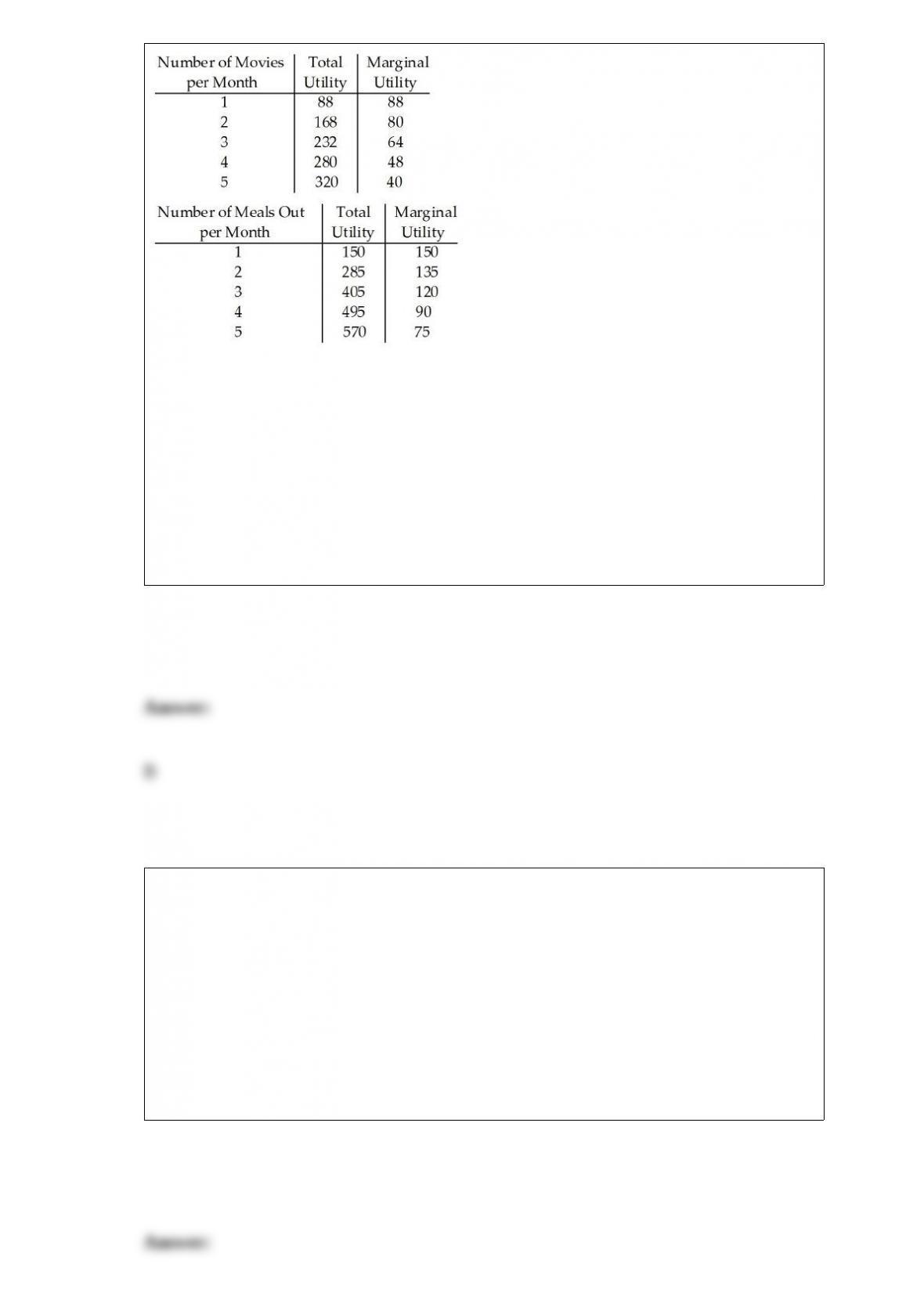
Table 7.8
A) 120
B) 8
C) 15
D) 9
Becky demands more raisins as her income increases. From this, we can conclude that,
for Becky:
A) raisins are an inferior good.
B) raisins are a complementary good.
C) raisins are a normal good.
D) raisins are a substitute good.
The current income you would sacrifice to start your own lawn-cutting business is part
of the:
A) opportunity cost of invested funds.
B) opportunity cost of starting a business.
C) cost of doing business.
D) present value of your initial investment.
Suppose prices increase by 4% per year. What nominal percentage return on your
savings account would you require to get a 1% real return?
A) 0%
B) 2%
C) 5%
D) 7%
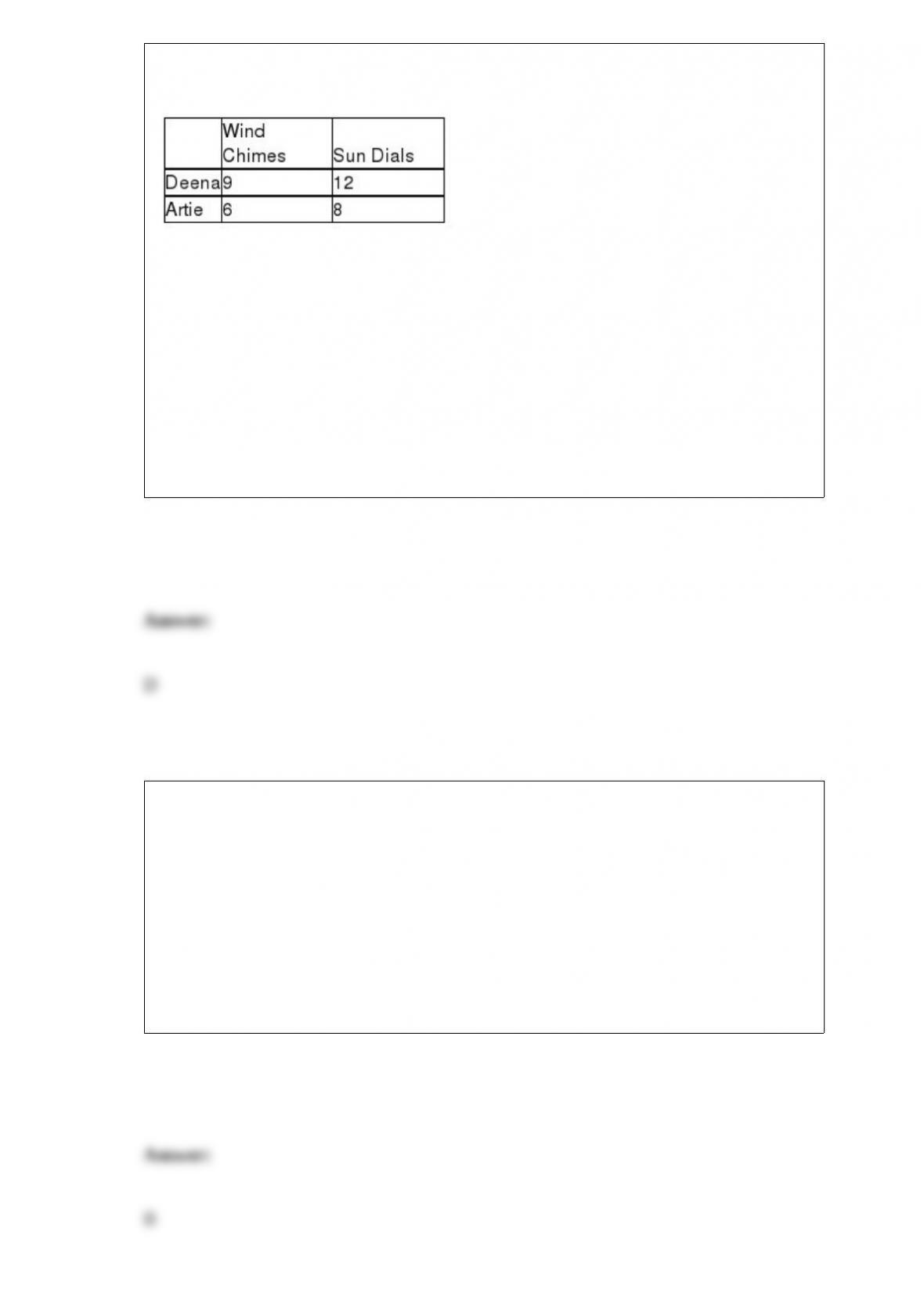
Consider two individuals, Artie and Deena, who produce wind chimes and sun dials.
Artie’s and Deena’s weekly productivity are shown in Table 3.4.
Table 3.4
Which of the following is true?
A) Artie has a comparative advantage in producing wind chimes but not sun dials.
B) Artie has a comparative advantage in producing sun dials but not wind chimes.
C) Artie has a comparative advantage in producing both goods.
D) Artie does not have a comparative advantage in producing either good.
Monopolistically competitive firms achieve the degree of market power they command
through:
A) size.
B) product differentiation.
C) collusion.
D) barriers to entry.

Suppose that there is only one seller in the computer industry. If the demand curve that
the only seller in the industry faces is a straight-line, downward sloping curve, at which
point would the seller’s total revenue be maximized?
A) at the highest point on the demand curve, where price is the highest
B) at a point high on the demand curve, where elasticity is elastic
C) at the midpoint of the demand curve, where elasticity is unitary
D) at a point low on the demand curve, but not at the very bottom
Suppose that the government sets a maximum price for milk at $5 a gallon and the
equilibrium price of a gallon is $3. How much quantity traded will this maximum price
lead to?
A) the equilibrium quantity
B) below the equilibrium quantity
C) above the equilibrium quantity
D) There is not sufficient information.
If a firm is producing where marginal revenue is greater than marginal cost:
A) the revenue gained by producing one more unit of output exceeds the additional cost
incurred by doing so.
B) the revenue gained by producing one more unit of output equals the additional cost
incurred by doing so.
C) the revenue gained by producing one more unit of output is less than the additional
cost incurred by doing so.
D) the firm is already maximizing profits because revenue is being increased by more
than costs.
The main rationale for anti-dumping policies is to prevent:
A) predatory pricing.
B) economies of scale.
C) free-trade.
D) comparative disadvantage.
Each fall the government subsidizes flu shots because:
A) flu shots given to some prevent the spread of disease to others.
B) people are unwilling to pay for something that will cause them pain.
C) flu shots are a public good.
D) there is excess supply of flu vaccine and the government must get rid of the surplus.
The opportunity cost of something is:
A) a measure of the scarcity of the good.
B) what you sacrifice to get the good.
C) the price you pay for the good.
D) what you are willing to pay for the good.
Consider Figure 12.3. If David’s payoff in the bottom rectangle were 40 instead of 70,
the outcome of the game would be that:
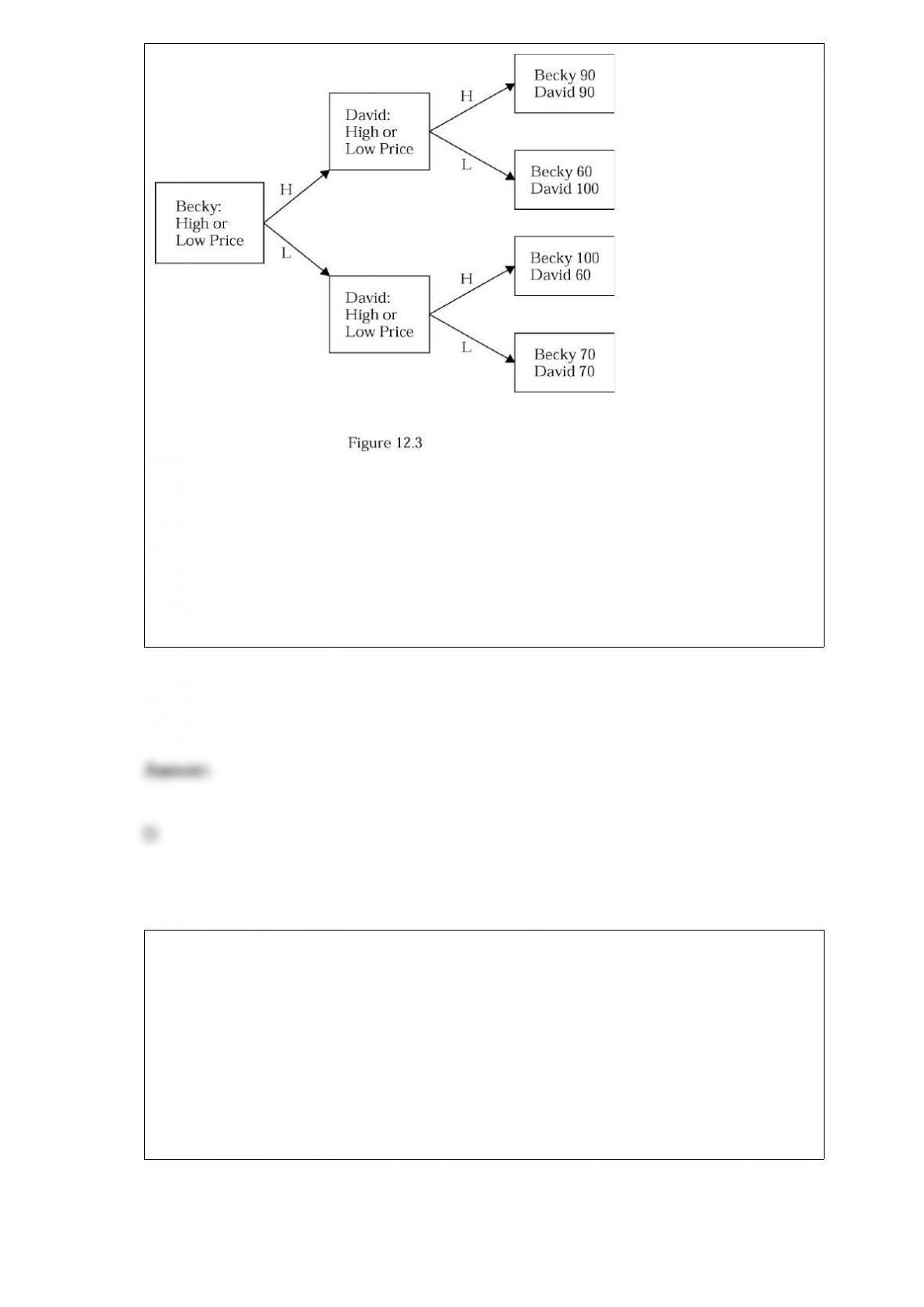
A) both choose a high price.
B) both choose a low price.
C) Becky chooses a high price and David chooses a low price.
D) David chooses a high price and Becky chooses a low price.
The Dominican Republic-Central American Free Trade Association includes:
A) the U.S.
B) Honduras.
C) Costa Rica.
D) all of the above.
You are responsible for purchasing 25 used cars for your company. Star Brand cars
costs $7,500 and Diamond Brand cars cost $6,000. Based on experience, you believe
that 20% of Star Brand cars are lemons (low quality) while 40% of Diamond Brand cars
are lemons (low quality). You are willing to pay $5,000 for a known lemon and $12,000
for a known plum. Which brand do you purchase?
A) Star
B) Diamond
C) indifferent between brands
D) don’t buy either brand
Refer to Figure 7.2. Assume that Ashley faces budget line AB with her $60 income.
Then the opportunity cost to her of a hamburger is:
Figure 7.2
A) one book.
B) one half of a book.
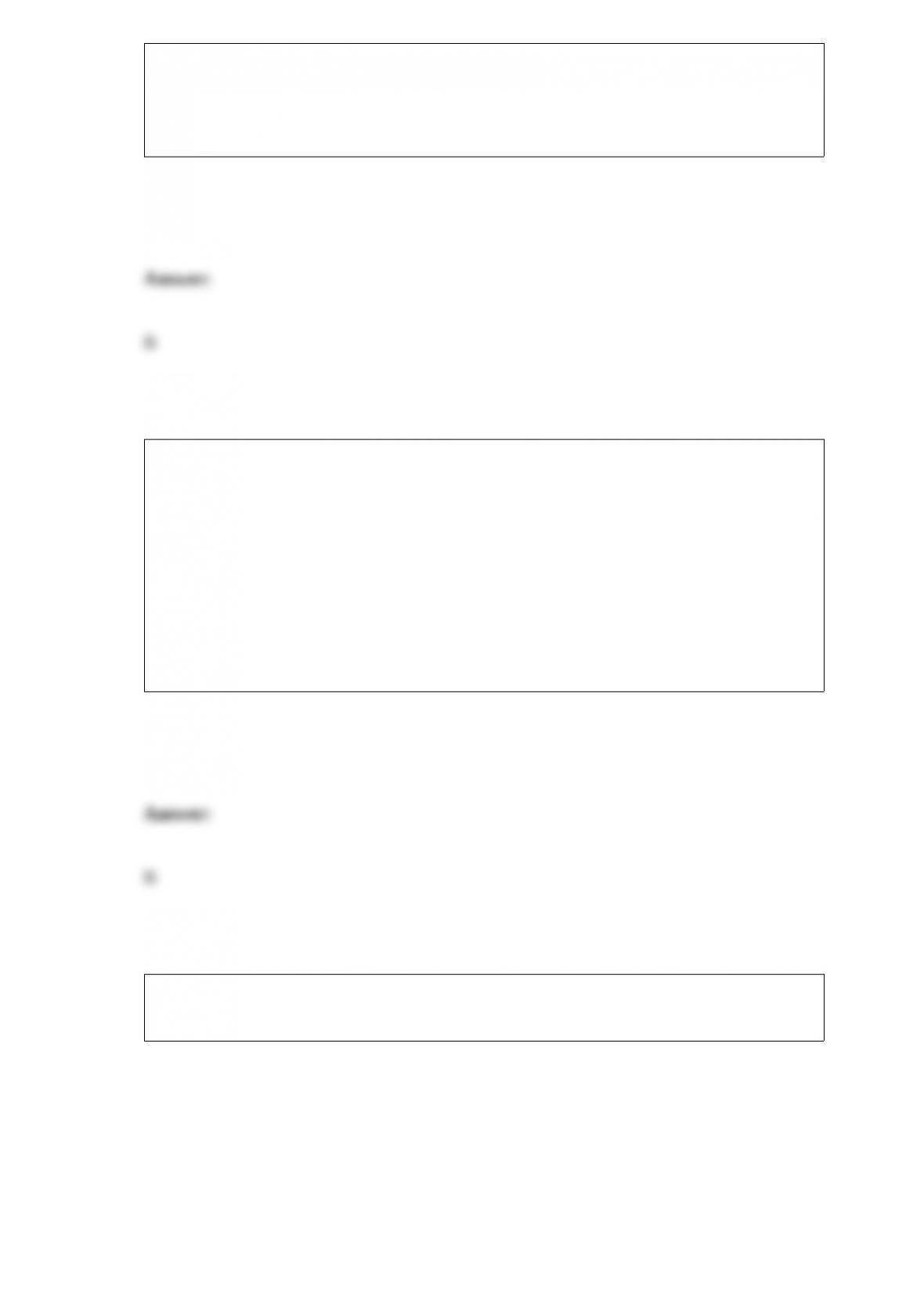
C) one third of a book.
D) one fourth of a book.
If the cost of driving during specific times of the day increases, people will drive less
during those times. This supports the basic economic notion that:
A) supply equals demand.
B) people respond to incentives.
C) marginal returns will diminish.
D) people are irrational.
Figure 4.6 illustrates a set of supply and demand curves for a product. When the
economy moves from point B to point C, there has been:
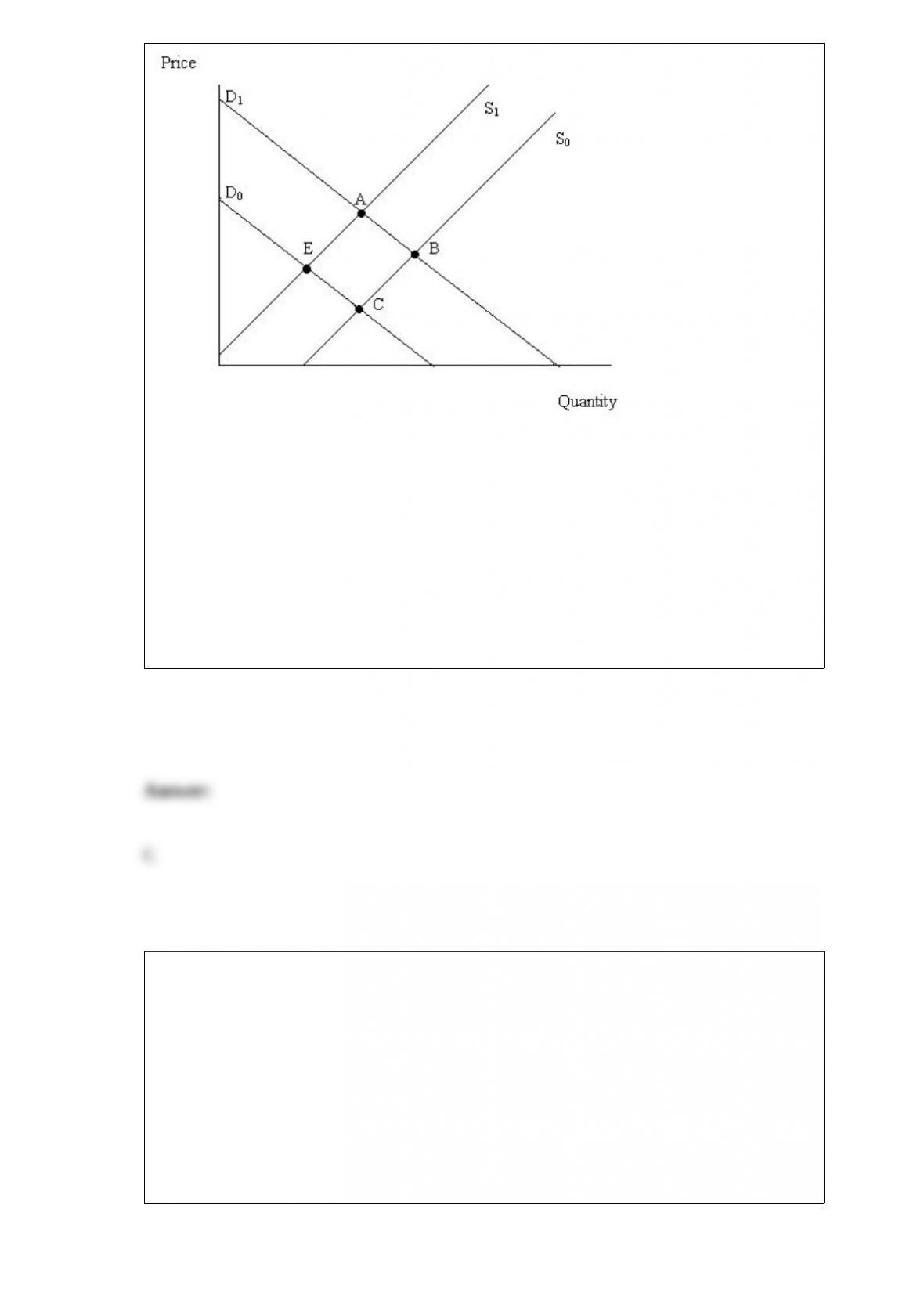
Figure 4.6
A) a decrease in supply and a decrease in demand.
B) a decrease in supply and a decrease in quantity demanded.
C) a decrease in quantity supplied and a decrease in demand.
D) a decrease in quantity supplied and a decrease in quantity demanded.
Which of the following is NOT a characteristic of a monopolistically competitive
market?
A) There are many firms.
B) Firms sell differentiated products.
C) Firms have control over price.
D) There are substantial barriers to entry.
Profit-maximizing firms want to maximize the difference between:
A) total revenue and marginal cost.
B) total revenue and total cost.
C) marginal revenue and marginal cost.
D) marginal revenue and average cost.
The relationship between the price of a good and the quantity that a single consumer is
willing to buy during a particular time period is shown by the:
A) market supply curve.
B) individual supply curve.
C) market demand curve.
D) individual demand curve.

In which of the following markets is a person’s time and effort exchanged for money?
A) consumer market
B) capital market
C) labor market
D) goods market
Suppose that in a month the price of movie rentals increases from $2 to $2.20. At the
same time, the quantity of movie rentals supplied increases from 100 to 110. The price
elasticity of supply for movie rentals (calculated using the initial value formula) is:
A) 0.02.
B) 0.2.
C) 1.
D) 50.
Refer to Figure 18.4. With a tariff or quota, what is the equilibrium quantity of gloves in
Duckland?
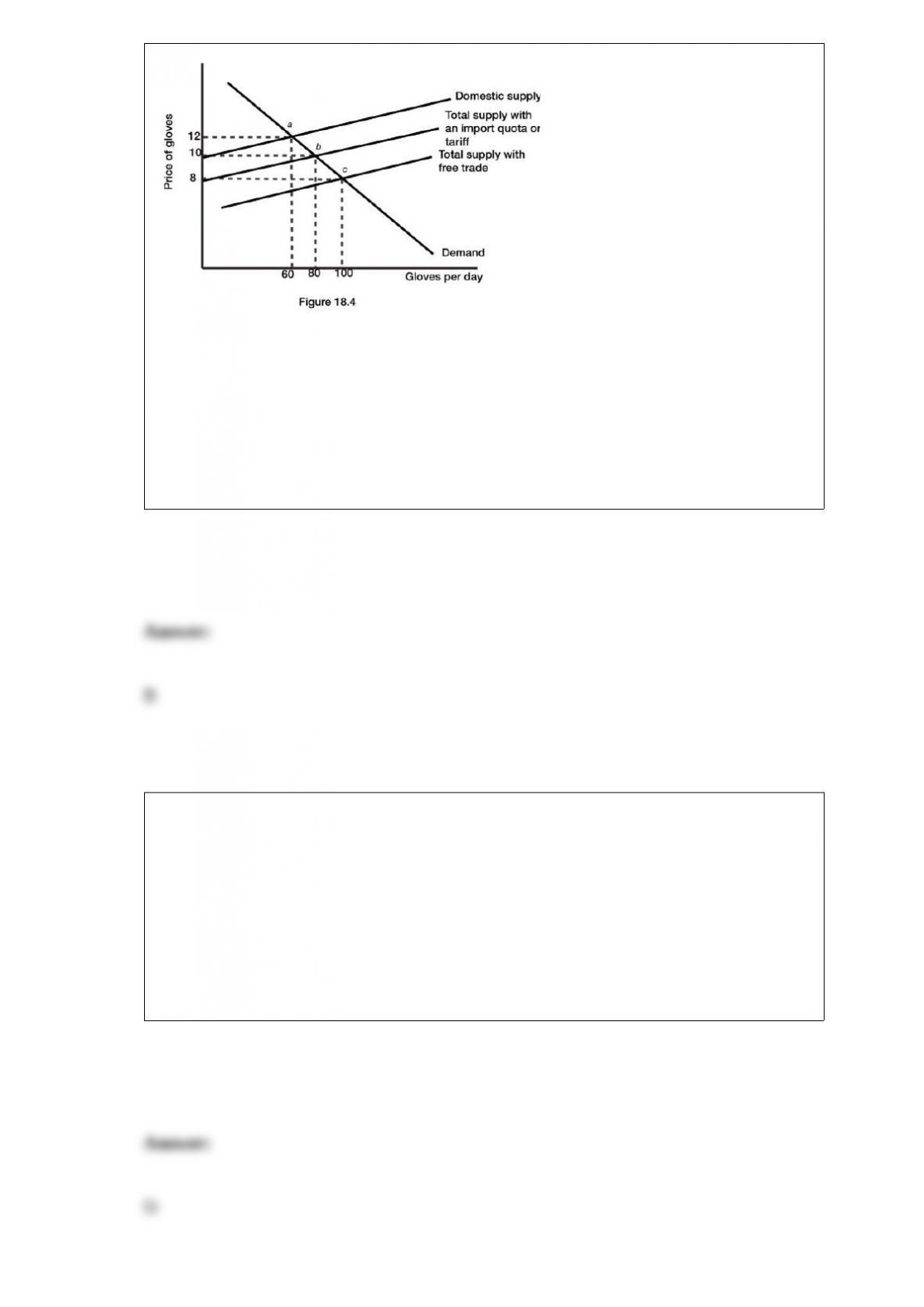
A) 100
B) 80
C) 60
D) 40
A single firm selling its output in a contestable market will:
A) establish a monopoly.
B) be able to maintain high prices indefinitely.
C) be able to earn high economic profits indefinitely.
D) be threatened constantly by the entry of new firms.
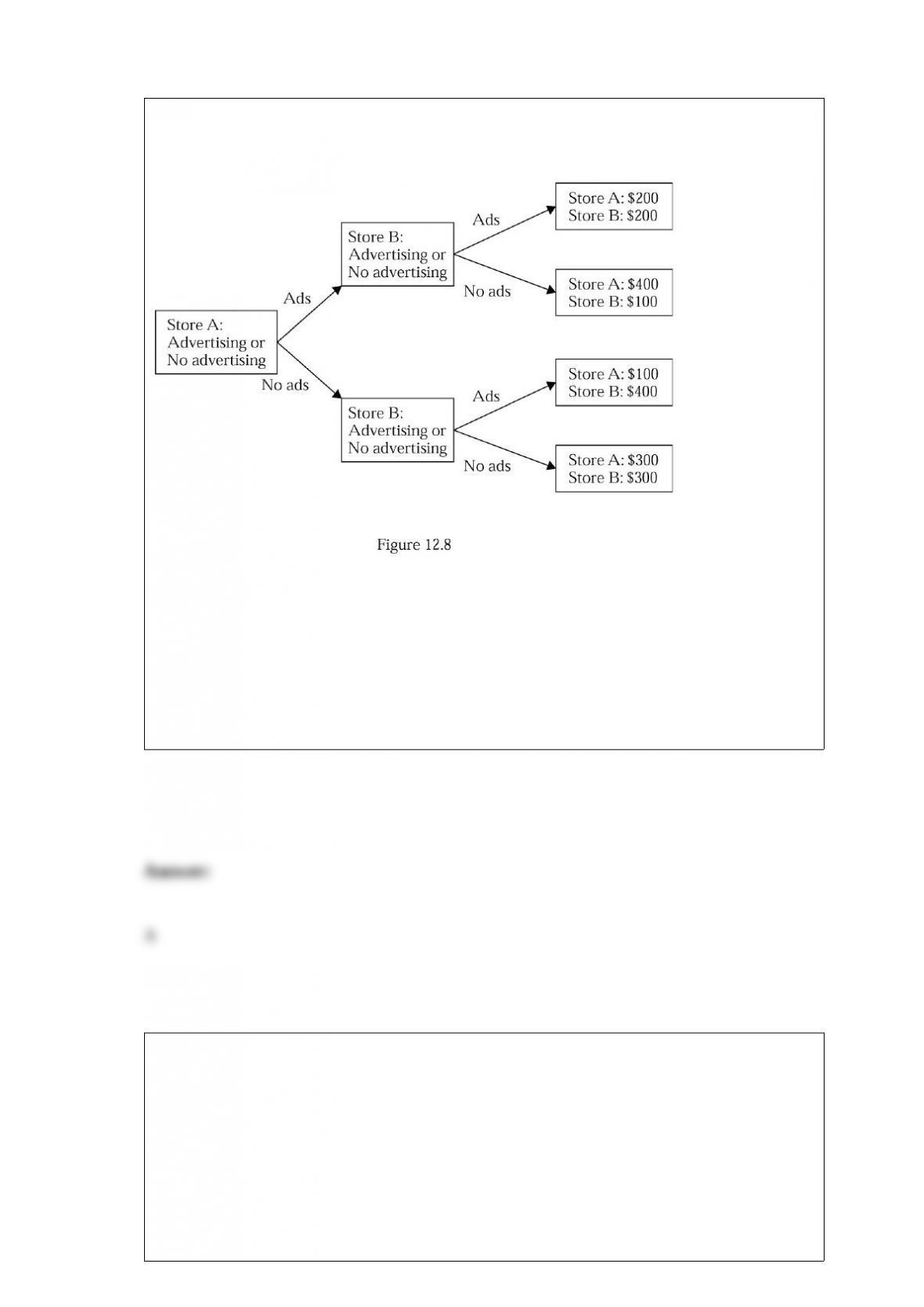
Consider the game tree in Figure 12.8. If Store A and Store B make advertising decision
independently:
A) both stores choose to advertise.
B) both stores choose not to advertise.
C) only Store A chooses to advertise.
D) only Store B chooses to advertise.
Why would a bumper crop be bad news for farmers?
A) Their crop has an inelastic demand and the resulting drop in price reduces their total
revenue.
B) Their crop has an elastic demand and the resulting drop in price reduces their total
revenue.
C) Their crop has an inelastic demand and the resulting drop in price raises their total
revenue.
D) Their crop has an elastic demand and the resulting drop in price raises their total
revenue.