
Protectionism is the use of ________ to protect domestic firms from foreign
competition.
A) military force
B) trade barriers
C) cheap labor
D) dumping
When the U.S. government places a tariff on a product, such as the tariff on tires
imported from China, the quantity of the product imported will generally ________ and
the price paid by consumers for the product will generally ________.
A) increase; increase
B) increase; decrease
C) decrease; increase
D) decrease; decrease
Figure 15-12
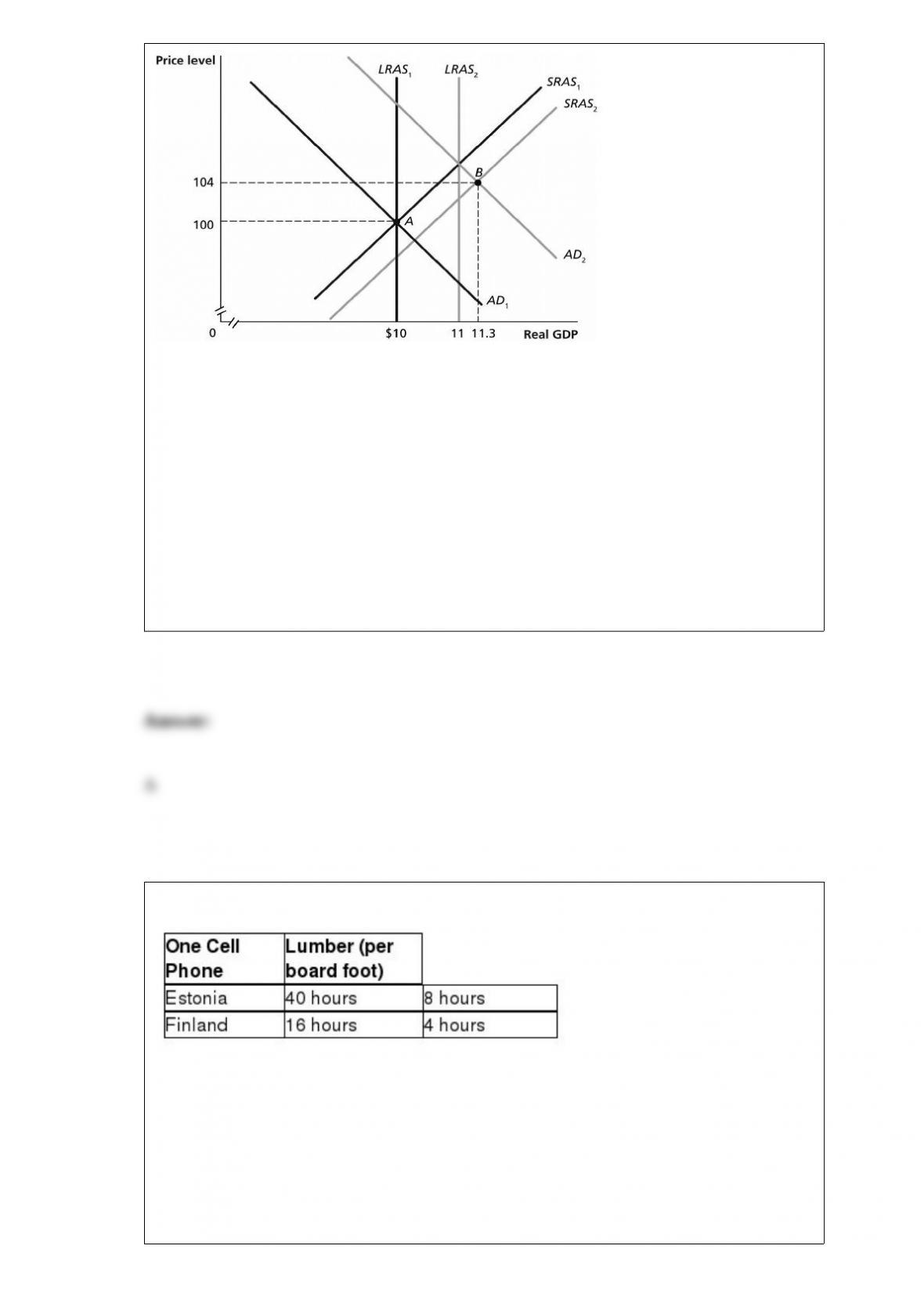
Refer to Figure 15-12. In the dynamic AD–AS model, the economy is at point A in year
1 and is expected to go to point B in year 2, and the Federal Reserve pursues policy.
This will result in
A) unemployment rates higher than what would occur if no policy had been pursued.
B) inflation rates higher than what would occur if no policy had been pursued.
C) potential real GDP levels lower than what would occur if no policy had been
pursued.
D) real GDP levels higher than what would occur if no policy had been pursued.
Table 2-5
Table 2-5 shows the number of labor hours required to produce a cell phone and a board
foot of lumber in Estonia and Finland.
Refer to Table 2-5. What is Estonia’s opportunity cost of producing one board foot of
lumber?
A) 0.2 cell phones

B) 5 cell phones
C) 8 cell phones
D) 32 cell phones
________ is considered a high income country, ________ a developing country, and
________ a newly industrializing country.
A) Japan; Hong Kong; South Korea
B) United States; Somalia; Taiwan
C) Canada; France; Singapore
D) Honduras; New Zealand; South Korea
Which of the following would not be considered an automatic stabilizer?
A) legislation increasing funding for job retraining passed during a recession
B) decreasing unemployment insurance payments due to decreased jobless during an
expansion
C) rising income tax collections due to rising incomes during an expansion
D) declining food stamp payments due to more persons finding jobs during an
expansion

If firms and workers have rational expectations, including knowledge of the policy
being used by the Federal Reserve, the short-run Phillips curve will be
A) negatively sloped.
B) positively sloped.
C) vertical.
D) flatter in the long run than it is in the short run.
Jack just told his boss that he thinks his boss is an idiot. It is likely that Jack will be
experiencing ________ unemployment in the near future.
A) permanent
B) cyclical
C) frictional
D) structural

When the price level falls from 135 to 120, the aggregate level of GDP supplied falls
from $140 billion to $125 billion. This ________ relationship represents the ________
relationship between GDP and the price level.
A) negative; short-run
B) positive; short-run
C) negative; long-run
D) positive; long-run
Bank reserves include
A) vault cash and deposits with the Federal Reserve.
B) loans to bank customers and deposits with the Federal Reserve.
C) vault cash and loans to bank customers.
D) customer checking accounts and vault cash.
E) deposits with the Federal Reserve and holdings of securities.
Table 9-4
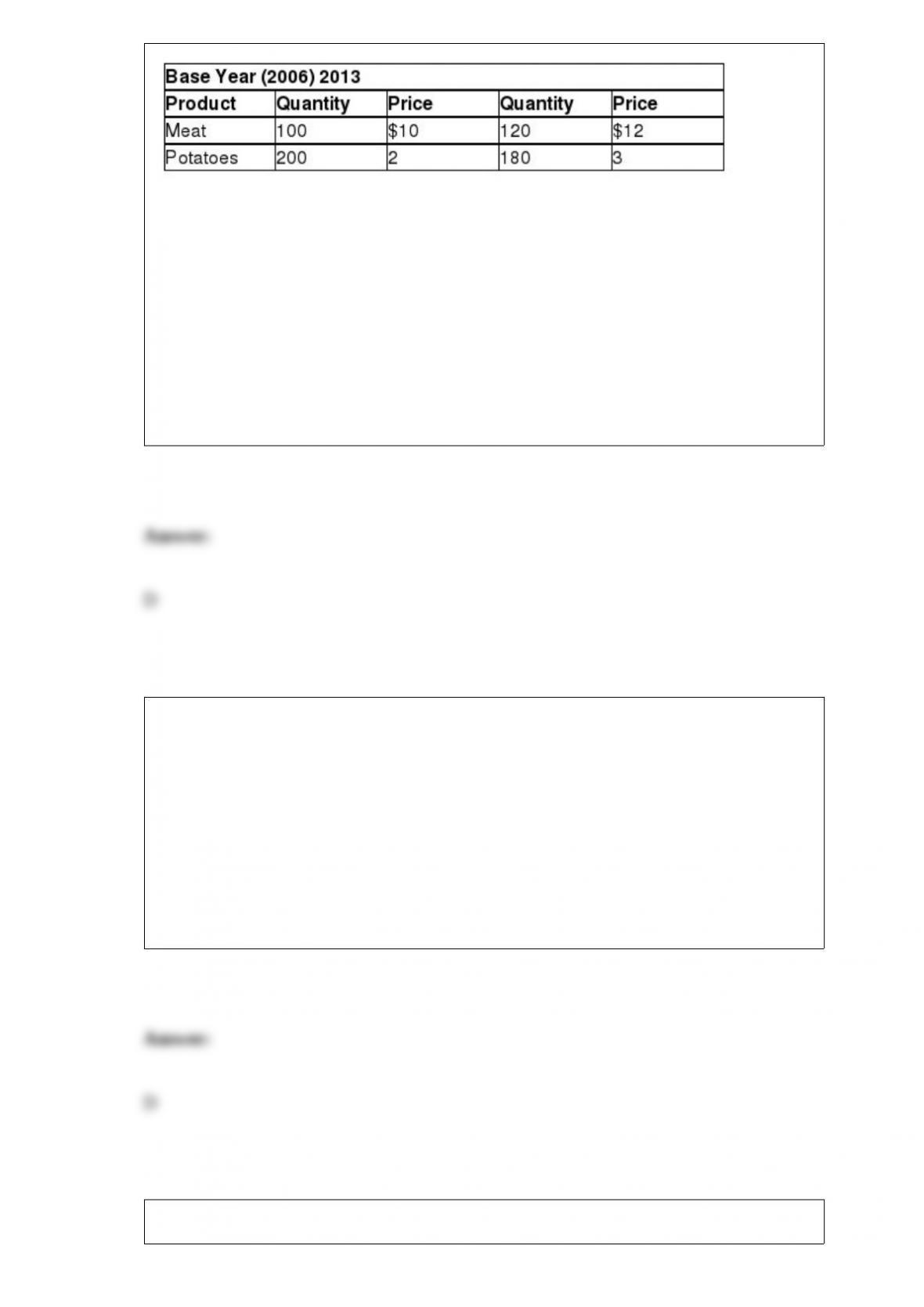
Refer to Table 9-4. Assume the market basket for the consumer price index has two
products € meat and potatoes € with the following values in 2006 and 2013 for price
and quantity: The Consumer Price Index for 2013 equals
A) 125.
B) 129.
C) 135.
D) 141.
According to Joseph Schumpeter, which of the factors of production is central to
economic growth?
A) land
B) labor
C) natural resources
D) the entrepreneur
If, in response to a decrease in the price of coffee, the quantity demanded of coffee

increases, economists would describe this as
A) an increase in demand.
B) an increase in quantity demanded.
C) a change in consumer income.
D) an increase in consumers’ taste for coffee.
Suppose a bank has $100 million in checking account deposits with no excess reserves
and the required reserve ratio is 10 percent. If the Federal Reserve raises the required
reserve ratio to 15 percent, then the bank will now have excess reserves of
A) $0.
B) -$5 million.
C) $5 million.
D) $15 million.
When the market value of the dollar falls relative to other currencies around the world,
we say that
A) the dollar has appreciated.
B) the dollar has depreciated.
C) the demand for dollars has decreased.

D) the supply of dollars has decreased.
If inflation is positive and is perfectly anticipated,
A) those that borrow money lose.
B) those that lend money lose.
C) those that hold paper money lose.
D) no one in the economy loses.
If a corporation retains all its profits and distributes none of the profit to owners, how
can owners benefit?
A) If the retained earnings are expected to create future profits, the market price of the
firm’s stock will increase and create a capital gain for stockholders if the stock is sold.
B) Shares of stock can be converted into bonds so stockholders will be able to earn
coupon payments.
C) Owners will only benefit if some profits are paid out in the form of dividends.
D) Owners will benefit by changing the board of directors.

Upon your graduation from college, you find that the economy is in recession and the
unemployment rate is relatively high. Nonetheless, you continue along your career path
looking for a new job because
A) the cost of additional education is always higher during recession.
B) high unemployment rates do not usually last for very long.
C) looking for work is your only option.
D) the wages of college graduates do not fall during recession.
Which of the following would shift a nation’s production possibilities frontier inward?
A) discovering a cheap way to convert sunshine into electricity
B) producing more capital equipment
C) an increase in the unemployment rate
D) a law requiring workers to retire at age 50