
Which of the following is not true in the long-run?
a. There are no variable costs.
b. There are no fixed costs.
c. Total costs equal variable costs.
d. Identical firms will make zero profits.
The term prisoners’ dilemma
a. refers only to situations where prisoners’ must confess on one another.
b. is in agreement with Adam Smith’s invisible hand idea.
c. represents situations where people do not act in their own self interest.
d. can be applied to show why cartels are difficult to maintain.
In any game, all that is necessary to rule out an outcome is that
a. both players would want to change.
b. one player would want to change.
c. one player is worse off than with some other strategy.

d. both players are worse off than with some other strategy.
Leisure-Consumption indifference curves
a. slope upward and are concave.
b. slope upward and are convex.
c. slope downward and are concave.
d. slope downward and are convex.
A fear that consumption of ice cream may be related to a life threatening disease
spreads rapidly through France. The market result will be:
a. the demand falls, price decreases and therefore French consumers buy more ice
cream.
b. the demand falls, price decreases and the quantity supplied therefore falls.
c. a fall in demand followed by a fall in supply.
d. the equilibrium quantity falls, but the price does not change.

To fully analyze the effects of a tariff on imports of tomatoes, an economist needs
a. only to know the supply and demand curves in the market for tomatoes.
b. only to know about supply and demand in the market for tomatoes and in markets for
other products tomato farmers grow.
c. to use general equilibrium analysis.
d. to use a production possibilities curve.
Which of the following normative criteria rejects a policy whenever there exists an
alternative policy that could unanimously defeat it?
a. Majority rule.
b. The efficiency criterion.
c. The Pareto criterion.
d. The potential Pareto criterion.
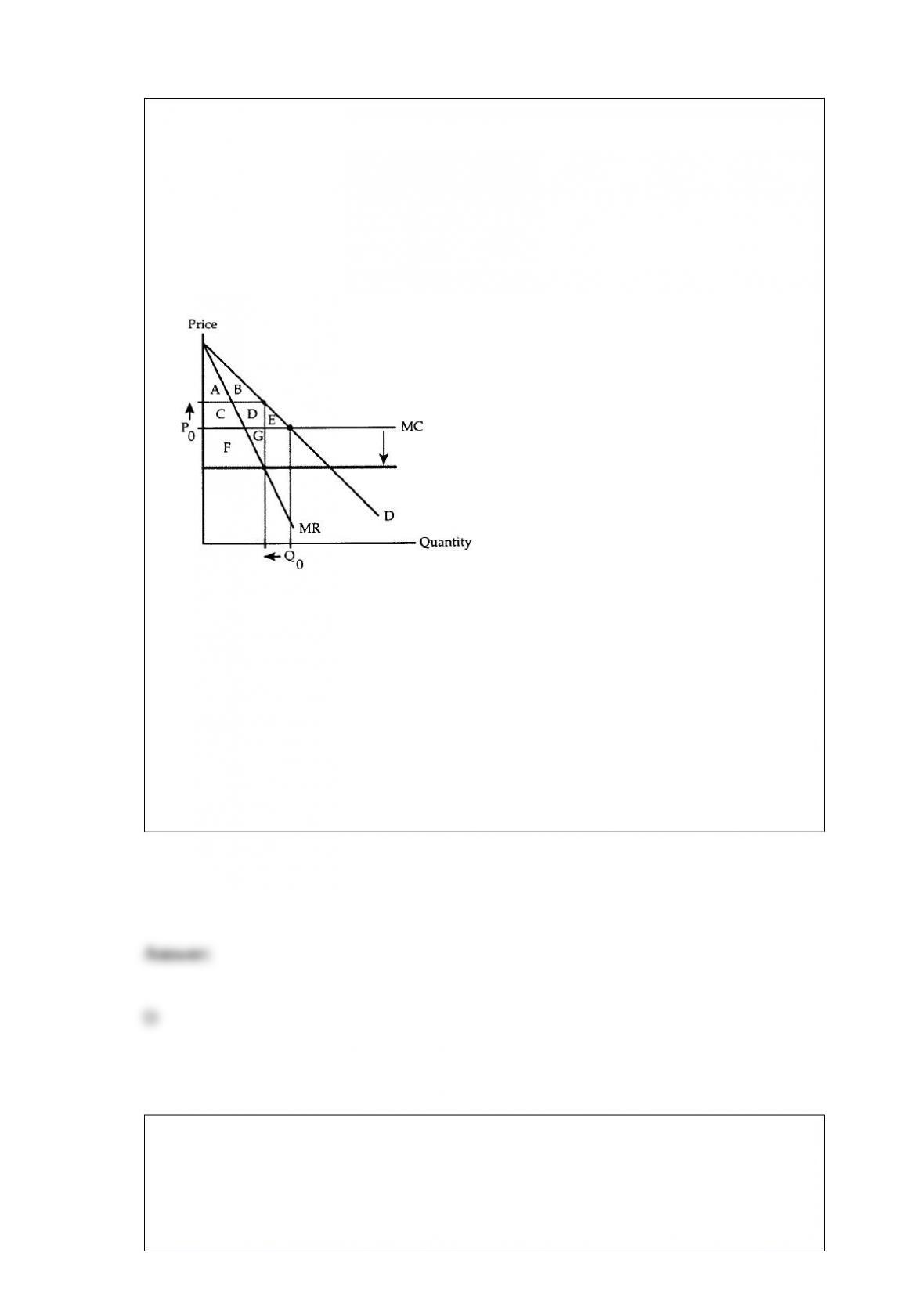
Horizontal Merger
The following questions refer to the accompanying diagram, which shows the effects of
a horizontal merger. Before the merger, the firm behaves competitively producing Q0
and charging P0. The merger lowers the firm’s marginal cost and gives the firm enough
market power to switch to the monopoly equilibrium.
. If area F + G is larger than area E, we can conclude that the horizontal merger
a. will reduce economic efficiency.
b. causes both consumers’ and producer’s surplus to rise.
c. will not increase the firm’s profit and thus will not be undertaken.
d. creates an increase in social gain.
What do economists mean by the phrase ‘sunk costs are sunk”?
a. Sunk costs are irretrievable, but they do lower profits and thus affect the firm’s output
level.

b. Sunk costs are a primary reason why marginal costs tend to increase.
c. Sunk costs cannot be recovered and are irrelevant to future decision making.
d. Sunk costs lower consumer welfare, because producers “pass on” these costs in the
form of higher prices.
What types of goods have compensated demand curves that slope downwards?
a. Normal goods only.
b. Inferior goods only.
c. Giffen goods only.
d. All types of goods.
Suppose that there are only two goods in Japan, sushi and saki. The absolute price of a
100-gram plate of sushi is 200 yen, and the absolute price of a liter of saki is 100 yen.
What is the relative price of saki in terms of sushi?
a. 100 grams per liter.
b. 200 grams per liter.
c. 50 grams per liter.
d. 400 grams per liter.
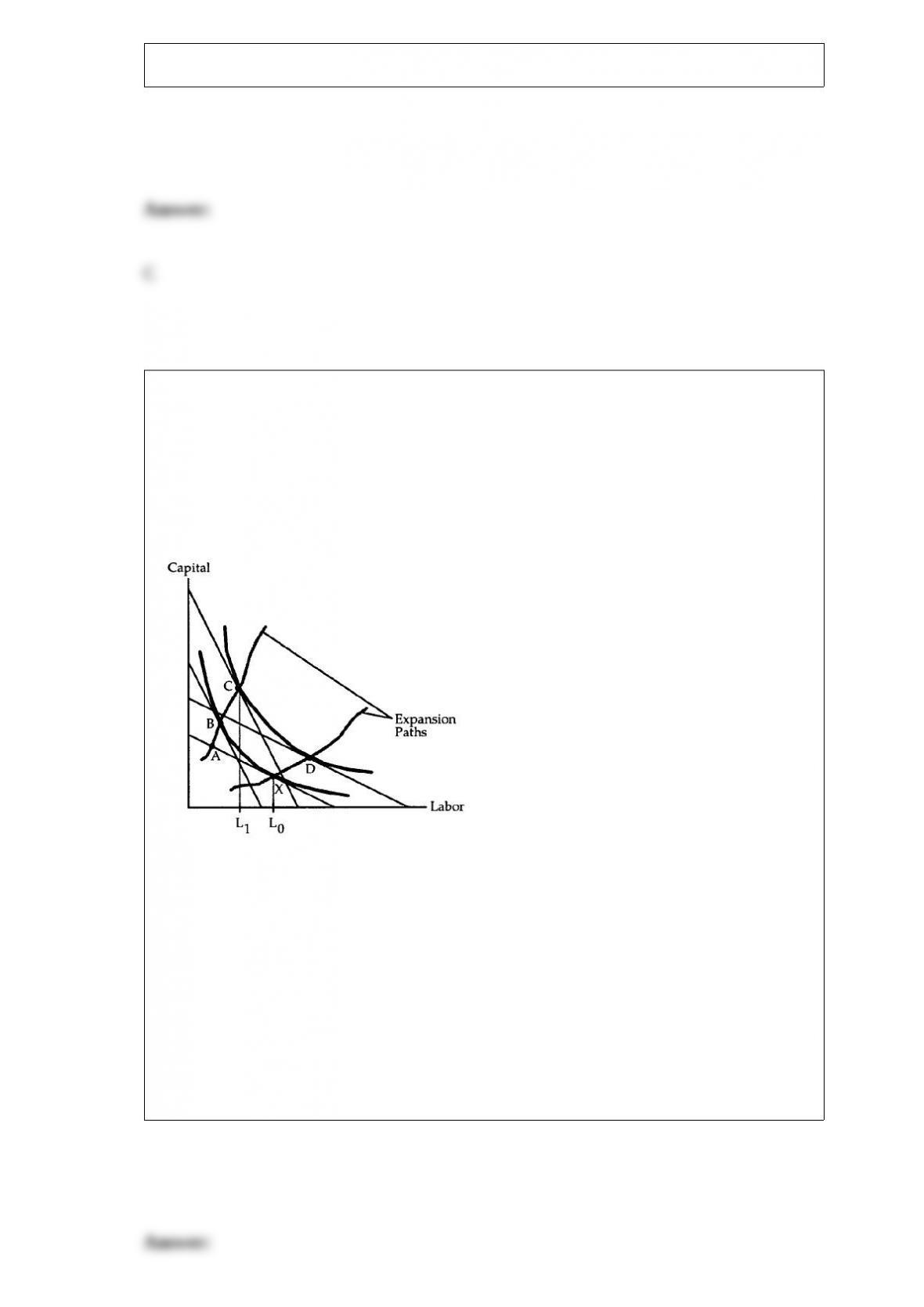
Reducing Long-Run Labor Usage
The following questions refer to the accompanying diagram, which shows a firm
reducing its long-run labor usage from L0 to L1 in response to an increase in the wage
rate.
efer to Reducing Long-Run Labor Usage. The scale effect of the wage change is the
movement from point
a. X to point A.
b. X to point B.
c. B to point C.
d. C to point D.

In the short run, a firm’s marginal cost tends to rise as more is produced because of
a. diminishing marginal returns.
b. the implicit costs of production.
c. diseconomies of scale.
d. rising input costs.
Refer to Cost of Production. In order to produce 50 units of output per week, the firm
must spend at least
a. $60.
b. $120.
c. $180
d. an amount that can not be determined given the available information.

In comparing one market basket, A, to others to the northwest or southeast, we can say
that a typical consumer will
a. prefer A to any other market basket.
b. prefer any other market basket to A.
c. be indifferent between A and any other market basket.
d. find any of the above are possible.
Since Ditto can always be expected to choose the same activity as Dot in the copycat
game
a. any move by Dot to escape from Ditto would not be a Pareto improvement.
b. any move by Dot to escape from Ditto would be a Pareto improvement.
c. Ditto’s choice to follow Dot is a Pareto improvement over going by himself.
d. Ditto’s choice to follow Dot would be a Pareto improvement over playing by himself
so long as Dot does not move.
A risk premium is additional interest, in excess of the market rate, that a bondholder
receives in order to compensate him for

What can, in general, be said about a monopoly’s supply curve?
a. A monopoly’s supply curve, like that for a competitive firm, coincides with its
marginal cost curve.
b. A profit-maximizing monopoly will operate only on the elastic portion of its supply
curve.
c. The monopoly’s supply curve is more inelastic than if the firm were competitive.
d. The concept of a supply curve is meaningless in the context of the monopoly
problem.
A firm will increase its production when
a. its marginal revenue rises.
b. its marginal cost rises.
c. its fixed costs fall.

d. the demand for its product falls.
A utility maximizing person has a utility function such that their marginal rate of
substitution equals the amount of good Y they consume divided by the amount of good
X that they consume (i.e. MRS = Y/X). If the prices of goods X and Y are the same,
then the person will
a. consume more X than Y.
b. consume more Y than X.
c. consume equal amounts of X and Y.
d. we must know the person’s income before coming to a conclusion.
If the average cost curve is downward sloping, then
a. marginal cost is smaller than average cost.
b. the marginal cost curve is also downward sloping.
c. there are increasing marginal returns to labor.
d. wages and other input prices are falling.

When the wage rate rises, a worker is better off and thus chooses to have more leisure
and more consumption. This phenomenon is known as
a. compensating differential.
b. the income effect.
c. the substitution effect.
d. intertemporal substitution.
Suppose there are only two goods: guns and roses. If the relative price of guns falls,
then the relative price of roses
a. must also fall.
b. must rise.
c. is unaffected.
d. could rise, fall, or remain unchanged.
According to Hayek, a social planner has no hope of matching the efficiency of a
competitive pricing system because
a. no social planner can be completely benevolent in his actions.
b. a social planner cannot have access to the specialized knowledge of individuals.
c. the social planner will be unable to fully monitor the activities of his agents.
d. people are selfish and will not be actively altruistic to the social planner.
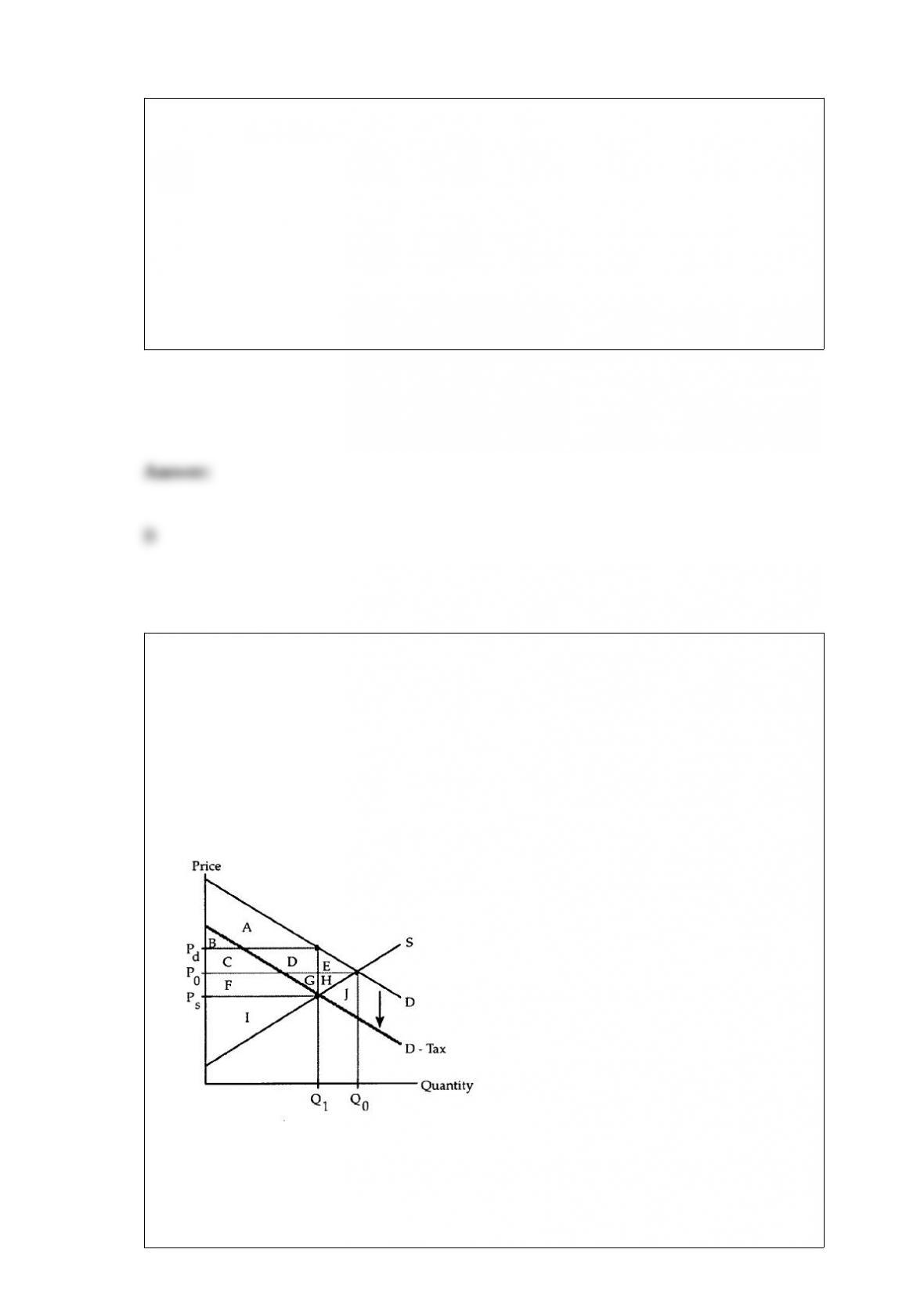
Sales Tax
The following questions refer to the accompanying diagram which shows the effects of
a sales tax imposed on consumers. The initial price and quantity are P0 and Q0,
respectively. After the tax is imposed, the equilibrium quantity is Q1, firms receive the
price Ps, and consumers pay the price Pd.
Prior to the sales tax, which of the following was false?
a. Consumer surplus was A+B+C+D+E.
b. Producer surplus was F+G+H+I+J.
c. Government tax revenue was zero.
d. Dead-weight loss was zero.
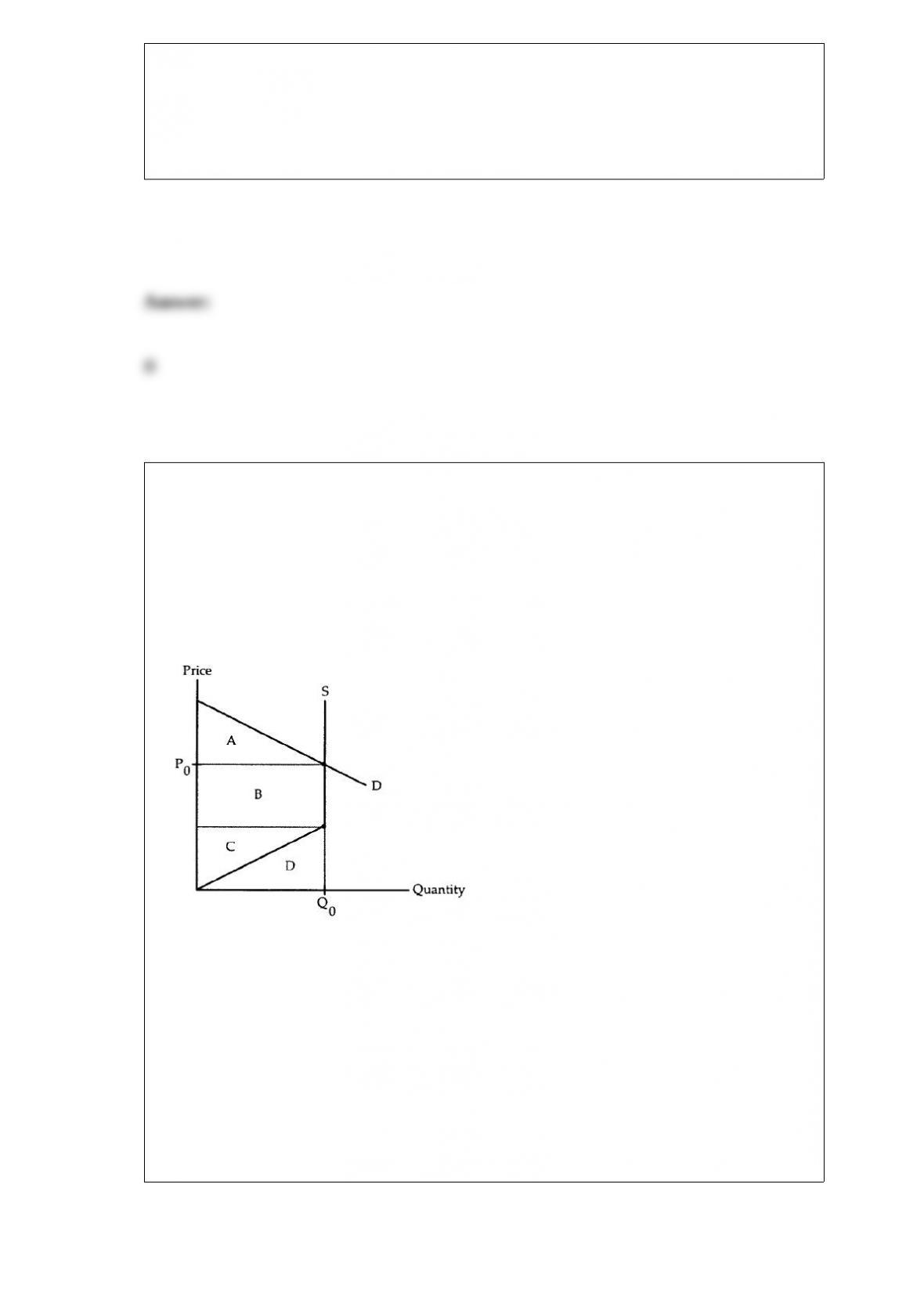
Resource Supply/Demand
The following questions refer to the accompanying graph, which shows the supply and
demand for a resource. The owner of the resource is receiving the price P0 and is
providing the quantity Q0.
The rent earned by the owner of the resource is measured by
a. area A + B + C.
b. area B + C + D.
c. area B + C.
d. area C + D.

Being a member of a cartel is similar to being in a Prisoner’s Dilemma situation because
a. each firm is being held hostage by the decisions of the other firms.
b. of anti-trust laws which make price fixing a criminal offense.
c. to obtain the best possible outcome for all, an enforcement mechanism is needed.
d. of the presence of organized crime in industries with cartels.
In long-run equilibrium, a competitive firm can earn zero profit only if its technology
exhibits
a. increasing returns to scale.
b. decreasing returns to scale.
c. constant returns to scale.
d. regressive returns to scale.

The price of silver increases from $10 per ounce to $15 per ounce while the price of
gold increases from $300 per ounce to $310. In this situation, the price of silver relative
to the price of gold has
a. fallen.
b. risen.
c. remained the same.
d. cannot be determined given the information provided.
Smith’ construction of an 8-foot fence around his property will block his neighbor
Johnson’s scenic view, though if it were only a 6 foot fence it would not. If Johnson
values his view at $1000 and Smith values the extra 2 feet of fence at $500, then a
possible resolution is that
a. Johnson makes a side payment to Smith of $750 not to build the fence so high.
b. Johnson makes a side payment to Smith of less than $500 not to build the fence so
high.
c. Smith makes a side payment of $750 to Johnson to live with the fence.
d. Smith makes a side payment of over $1000 to Johnson to live with the fence.
The association of each quantity of a variable input, like labor, to its total product is the

a. short-run production function.
b. average product of labor.
c. stage of production.
d. expansion path.
Which of the following is the best example of a common property?
a. The car of a student who is frequently willing to give her friends rides around town.
b. The air that you breathe.
c. Bread that you bake and share.
d. Disney World
If there is discrimination, employers engage in it at a cost.

Higher costs are always passed on to a firm’s customers in the form of higher prices.
A firm earns a positive economic profit when the market price exceeds its marginal
cost.
Unlike a consumer, a competitive profit-maximizing firm faces no constraints.
Define the terms marginal revenue and marginal cost. What action should a firm take if
its marginal revenue exceeds its marginal cost? Explain.

If no one in a community desires to watch television, then it would be a waste of
resources for the community to produce television sets.
If a firms fixed costs increase from $2000 to $2500, then its marginal cost is $500.
The principle of general average gives a ship’s captain an incentive to consider the
value of cargo when jettisoning it to prevent a disaster.
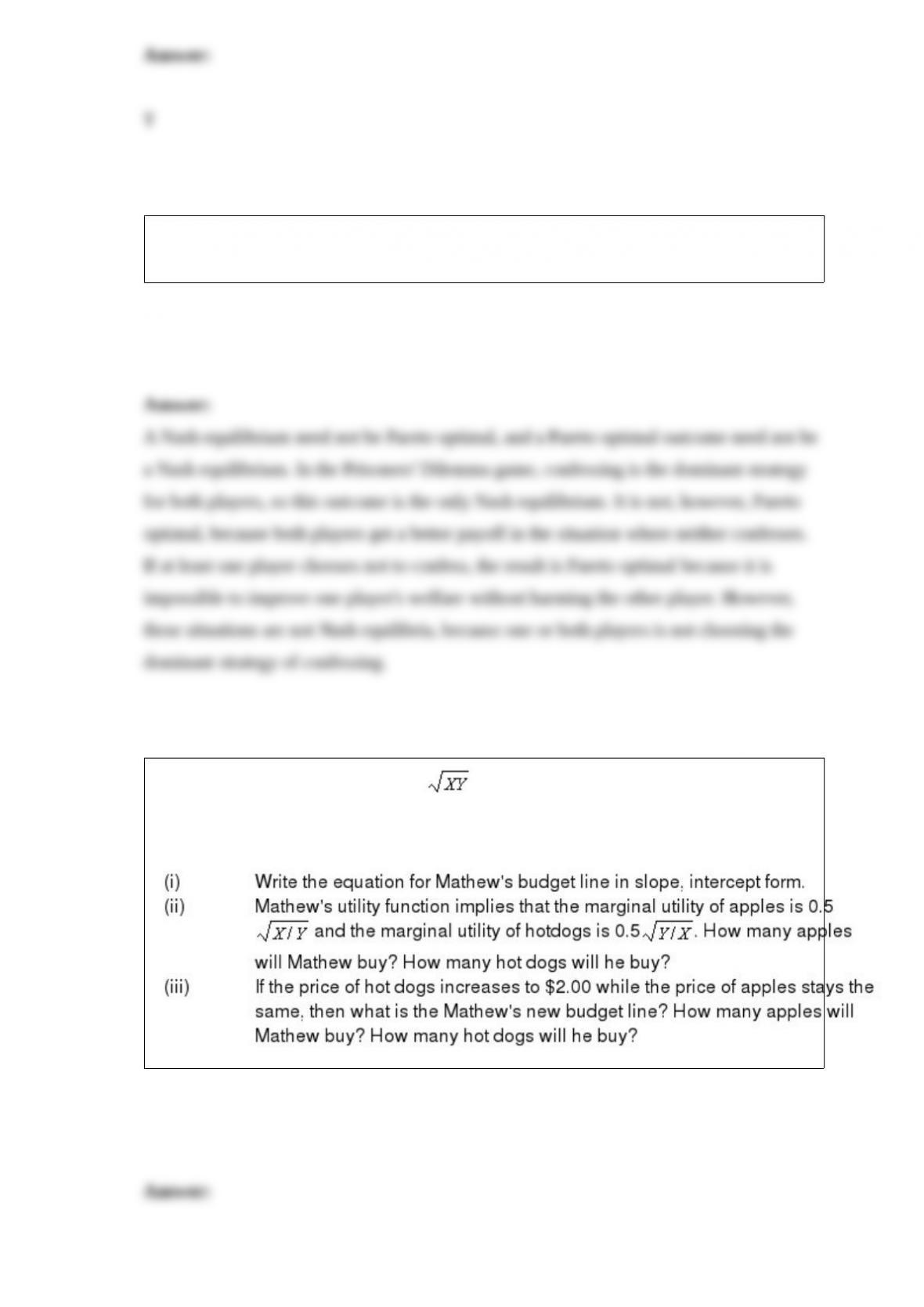
Can a Nash equilibrium fail to be Pareto optimal? Can a Pareto optimal outcome fail to
be a Nash equilibrium? Justify your answers using the Prisoners’ Dilemma game.
Mathew has the utility function U = (where Y represents apples and X represents
hot dogs), income of $20, and is deciding how to allocate that income between apples
and hot dogs. Both hot dogs and apples cost $1.00 each.

In an Edgeworth box, all Pareto-optimal allocations lie within the region of mutual
advantage.
A permanent increase in workers’ marginal productivity causes employment to rise by
more than
if the increase were temporary.
Sunk costs cannot affect a firm’s short-run supply, but they can affect its long-run
decision to exit the industry.

If a bond with face value $100 sells for $75, then we say that the bond is selling for a
discount of 25%.
We know that the producer’s surplus accruing to a simple monopoly firm must be
greater than operating in a competitive market, else firms would not act as monopolists.
A competitive firm’s supply curve is identical to its marginal cost curve.