
1) if there are no statistical discrepancies, ndp is:
a.ni minus net foreign factor income.
b.ni plus corporate income taxes.
c.gdp deflated for increases in the price level.
d.gdp minus taxes on production and imports.
2) answer the next question(s) on the basis of the following information about a
hypothetical economy:
refer to the above information. if the members of the underground economy are
presently counted as part of the unemployed when in fact they are employed, the
official unemployment rate is overstated by:
a.0 percentage points.
b.2 percentage points.
c.4 percentage points.
d.6 percentage points.
3) labor productivity is measured by:
a.the ratio of capital to labor.
b.real output per worker hour.
c.real output per capita.
d.the ratio of worker hours to real gdp.
4) A firm can hire six workers at a wage rate of $8 per hour but must pay $9 per hour to
all of its employees to attract a seventh worker. The marginal wage cost of the seventh
worker is:
A.$9.
B.$10.
C.$15.
D.$21.

5) A unique characteristic of taxes on economic rents is that such taxes:
A.stimulate aggregate production.
B.do not lead to a reallocation of the resource.
C.are paid by consumers.
D.are always regressive.
6) which of the following is a limitation of the simple circular flow model?
a.product markets are ignored.
b.resource markets are ignored.
c.the determination of product and resource prices is not explained.
d.households are included, but not businesses.
7) the production possibilities curve illustrates the basic principle that:
a.the production of more of any one good will in time require smaller and smaller
sacrifices of other goods.
b.an economy will automatically obtain full employment of its resources.
c.if all the resources of an economy are in use, more of one good can be produced only
if less of another good is produced.
d.an economy’s capacity to produce increases in proportion to its population size.
8) which of the following statements is correct?
a.an increase in the price of c will decrease the demand for complementary product d.
b.a decrease in income will decrease the demand for an inferior good.
c.an increase in income will reduce the demand for a normal good.
d.a decline in the price of x will increase the demand for substitute product y.
9) the supply of product x is elastic if the price of x rises by:
a.5 percent and quantity supplied rises by 7 percent.
b.8 percent and quantity supplied rises by 8 percent.
c.10 percent and quantity supplied remains the same.
d.7 percent and quantity supplied rises by 5 percent.
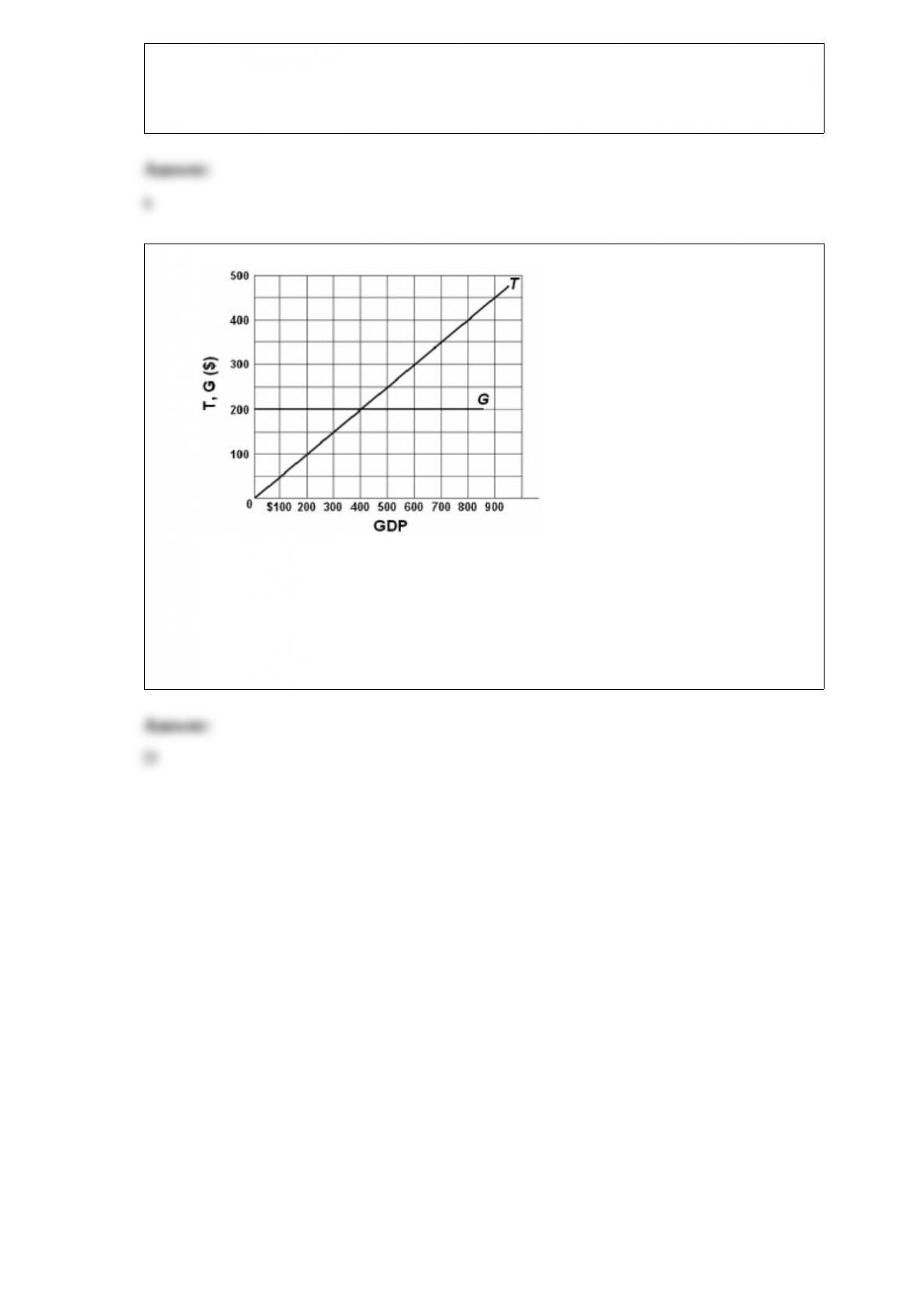
10)
Refer to the above diagram in which T is tax revenues and G is government
expenditures. All figures are in billions. The equilibrium level of GDP in this economy:
A.is $400.
B.is greater than $400.
C.is less than $400.
D.cannot be determined from the information given.